
A home inspection does not pass or fail in the way a driving test does. What people call a failed inspection is a report that lists defects, and the buyer’s reaction to it. As the seller, you generally have five paths: repair the problems, offer a credit, lower the price, hold firm and sell as is, or sell to a buyer who does not care what the report says. Which one makes sense depends on the cost of the fixes, your timeline, and how much leverage the buyer actually has under your contract.
This guide walks through each option, what Rhode Island law adds, and how to decide.
TL;DR
- A seller is not automatically required to make repairs after an inspection. You can negotiate, counter, refuse, or sell as is, but the buyer may be able to cancel if the contract gives them that right.
- In Rhode Island, buyers get a statutory inspection window of 10 days (not counting weekends and holidays) unless they waive it in writing or agree to a different period.
- The common fixes are repairs before closing, a closing credit, a price reduction, or escrowed funds. Put whatever you agree in a written addendum.
- Rhode Island sellers must disclose known defects in writing, so the report does not erase what you already knew.
- If repairs are too costly or too slow, a direct cash sale of the house as is can be the cleaner way out.
Table of Contents
- What a “failed” inspection really means
- Do you have to make repairs?
- Your five options after a bad inspection report
- What Rhode Island law adds
- How to choose: a simple decision test
- Negotiation tips that protect you
- Our perspective: when repairing is the wrong answer
- When a cash sale makes sense
- Mistakes sellers make after a bad report
- FAQ
- Sources
What a “failed” inspection really means
No law says a house must pass a home inspection to be sold. The inspector writes a report. The buyer reads it, usually with their agent, and decides whether to proceed, ask for something, or cancel under the contract’s inspection terms.
That is why the same report can sink one sale and barely register in another. A buyer with a tight budget and a long list of foundation, roof, or electrical findings may walk. A buyer who expected a few small items may not blink.
The items that most often turn a routine report into a negotiation are safety and structural: active leaks, roof condition, electrical hazards, failing heating systems, moisture and mold, pests, and radon. Cosmetic items rarely matter.
Two things decide your leverage:
- What your contract says. Is there an inspection contingency, how long does it run, and what must the buyer do to cancel?
- How the buyer is financing. Lender requirements, and in some cases appraisal findings, can make certain repairs mandatory regardless of what either side wants.
Do you have to make repairs?
No, not by default. The American Society of Home Inspectors states that a seller is not obligated to perform repairs after an inspection. You can negotiate, refuse the request, or tell the buyer to accept the property as is or leave the deal.
The catch is that refusing has a cost. If the buyer still holds a valid contingency, they can usually cancel and you are back on the market, now with a known list of defects that must be disclosed to the next buyer. Sometimes refusing is still right. Sometimes it is the most expensive choice you can make.
Your five options after a bad inspection report
Regulators and industry guides describe the same basic menu. Colorado’s Division of Real Estate, for example, lists five non-termination ways to resolve inspection issues: the seller repairs before closing, the seller pays a concession, the parties change the price, funds are escrowed or a contractor is paid at closing if the lender permits, or the buyer makes repairs after closing without seller help. That is Colorado guidance, but the options themselves travel well. Redfin’s seller guide names a similar set of outcomes: proceed as is, complete repairs, give a closing credit, renegotiate, or cancel under a contingency.
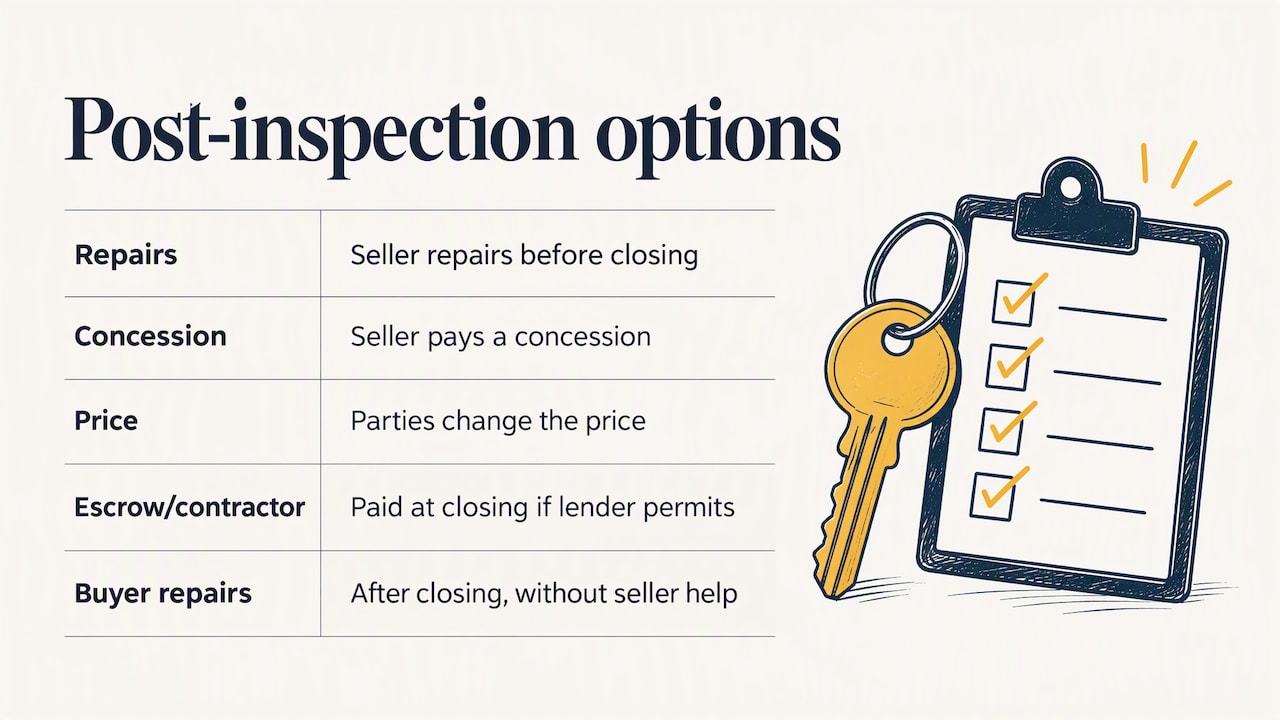
Here is how each plays out in practice.
Option 1: Repair before closing
Fixing the problem yourself keeps the price intact and removes the objection. It works best when the repair is clear, affordable, and quick: a failed handrail, a missing GFCI outlet, a leaking supply line.
It works badly when:
- The repair needs permits or specialists with long wait times.
- The buyer will not trust the workmanship and asks for receipts, re-inspection, or a licensed contractor.
- The scope grows once the work begins. Behind rotted trim is often rotted sheathing.
If you repair, get quotes first, use licensed trades for anything structural, electrical, or plumbing, and keep the paperwork. Redfin recommends putting agreed changes into a written addendum that names who is responsible, the deadlines, and how completion is verified.
Option 2: Offer a credit or concession
A credit hands the buyer money at closing to handle the repair themselves. You avoid contractor delays and arguments about quality. One expert quoted by Redfin describes a credit as a way to manage risk for exactly that reason, but also advises validating the request with an independent contractor estimate. Do the same: ask for the estimate behind the number.
Watch the lender. Colorado’s regulator warns that inspection settlements can affect mortgage financing, delay processing, or trigger further inspections, so the buyer should talk to their lender before agreeing to a repair, credit, or price change. A credit that the lender will not allow is a credit that does not close.
Option 3: Reduce the price
A price cut is a credit with fewer moving parts. The buyer’s loan amount drops, and the repair is entirely theirs. For you, it is simple and final. The downside is that appraisals and lender rules still apply, and a price cut may feel steeper than a one-time credit if the buyer only wanted a modest fix.
Option 4: Hold firm or sell as is
An as-is sale, in the words of the National Association of Realtors, means the seller makes no guarantees about the home’s condition and will not make repairs even if the buyer gets an inspection.
Two misunderstandings cause trouble here:
- As is does not cancel your disclosure duty. Realtor.com explains that an as-is sale does not eliminate disclosure obligations or necessarily remove the buyer’s inspection and contingency rights. A buyer may still inspect, negotiate, or walk away if the contract allows.
- As is usually means a smaller buyer pool and a lower price. Plenty of retail buyers want a house they can move into.
Holding firm is a reasonable play when the report is mostly minor, the market is tight, and you have backup offers. It is a risky one when the findings are serious and you are short on time.
Option 5: Let the buyer cancel and sell to someone else
Sometimes the deal is simply dead. If the buyer terminates inside a valid contingency, you recover your house but not the weeks you lost. Before relisting, decide whether you will fix the issues, price them in, or change your sales route. Otherwise the next inspection will find the same things.
What Rhode Island law adds
We are a Rhode Island company, so here is what matters locally. Two statutes shape this situation, and neither is a substitute for a conversation with a Rhode Island real estate attorney about your own contract.
The 10-day inspection window
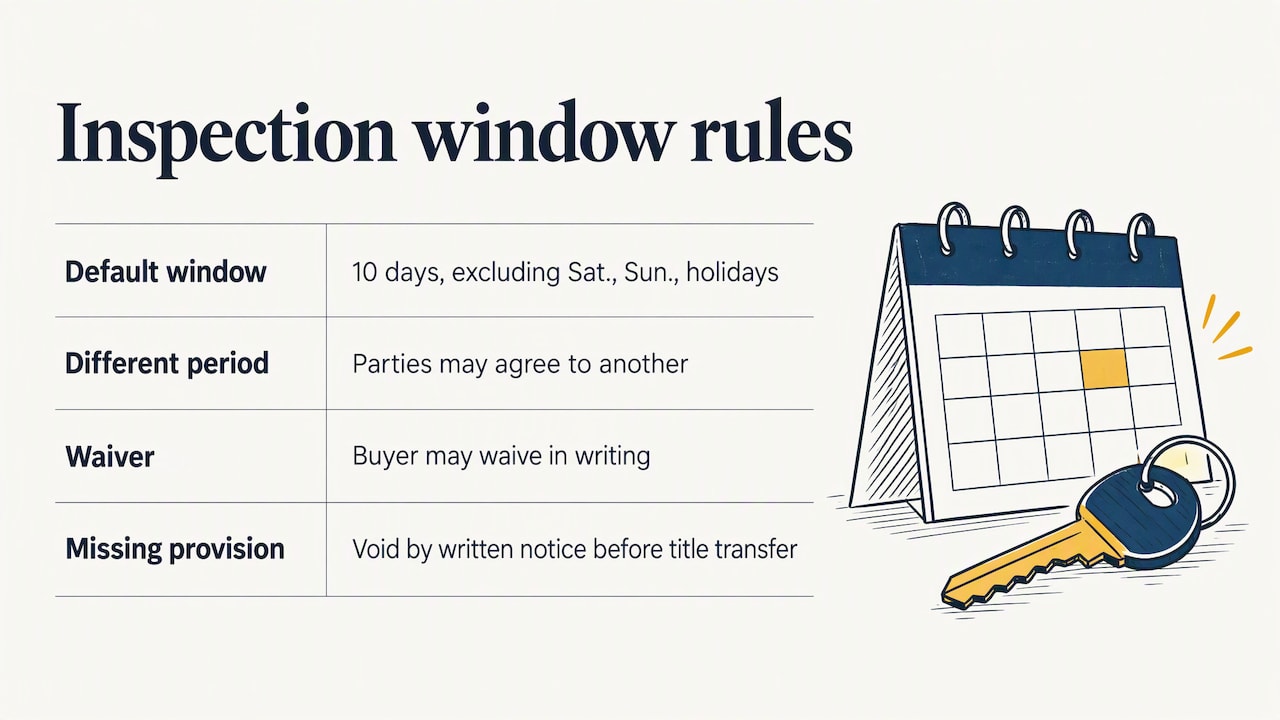
Under R.I. Gen. Laws § 5-20.8-4, every real estate purchase contract must give a potential buyer 10 days, excluding Saturdays, Sundays, and holidays, to inspect before becoming obligated. The parties can agree to a different period, or the buyer can waive the right in writing. If the provision is left out, the buyer may void the purchase and sales agreement by written notice to you before title transfers at closing.
For you, that means a Rhode Island buyer usually has a clear exit during this window, so a negotiation after a rough report happens with the buyer already holding the key to the door. Move quickly. A delayed answer to a repair request can eat the window.
Inspection contingencies are not limited to the general inspection. Specialized tests, radon among them, can have their own thresholds and timelines. If you want to see how a radon result can turn into a cancellation or credit, radon contingency clauses are worth understanding before you sign anything with a testing deadline.
Your disclosure duty
Rhode Island sellers must give the buyer a written disclosure of deficient conditions of which they have actual knowledge, as soon as practicable and before signing the transfer agreement. The statutory form covers areas such as structure, roof, basement, pests, radon, electrical, heating and cooling, plumbing, sewage, water, flood and wetlands, lead, mold, and moisture. The statute treats the disclosure as a required written statement, not a warranty, and does not make you inspect the property.
The practical lesson: an inspection report does not create your disclosure duty, but it does expand what you now know. Once the report names a defect, you cannot pretend you are unaware of it on the next form. If you are unsure what you must list, ask your attorney before you sign.
As for how long a seller can be pursued after closing over undisclosed problems, that depends on the type of claim and the facts, and we are not going to give you a number without a statute behind it. If a buyer ever raises a post-closing claim, call a Rhode Island real estate attorney the same day.
How to choose: a simple decision test
Use these questions in order.
- Is there a safety, structural, or financing-blocking issue? If yes, expect to deal with it one way or another. Lenders can make certain repairs a condition of the loan.
- What do the fixes really cost? Get two written estimates. Buyers often quote the high end of a range. Your own quotes strengthen your counteroffer.
- How long do you have? If you are facing a move, a relocation, a probate deadline, or a foreclosure date, time may be worth more than the dollar difference between options.
- How much repair work can you front? A credit or price cut asks for no cash now. A repair does.
- Would you accept a lower price to be done? If the answer is yes, selling as is to someone who values certainty may beat three rounds of repair negotiations.
Here is a worked illustration with made-up round numbers, not market data. Suppose the report finds a $9,000 roof repair, a $2,500 electrical correction, and $1,500 of minor items. The buyer asks for $13,000 in credits. You get your own estimates and they come to $10,500. You counter with $10,500, or offer to complete the roof and electrical work with receipts and decline the minor items. Either one is a rational move, because each has a number behind it. The wrong move is to refuse everything out of frustration and lose a buyer whose ask was reasonable.
Negotiation tips that protect you
- Respond in writing and on time. Ask for the specific items the buyer wants fixed, not the entire report.
- Separate safety from cosmetic. Agree to the first, push back on the second.
- Ask for estimates, not just a figure. A buyer’s credit request should tie to a quote.
- Record every agreement in an addendum. Who does what, by when, and how it is verified.
- Check with the lender early. Credits and escrow arrangements work only if the lender permits them.
- Do not hide what you learn. Anything you know is something you may have to disclose.
Pre-listing inspections help here too. Finding the issues before the buyer does lets you fix, price, or disclose them on your terms.
Our perspective: when repairing is the wrong answer
We buy houses directly from Rhode Island homeowners, so we see the same pattern often. A seller gets a report, a buyer asks for a long list, the seller spends weeks collecting estimates, and the deal dies anyway. By then the seller is carrying another few months of mortgage, taxes, insurance, and utilities.
Our view is that repairs only pay off when three things are true: the work is modest, the timeline is flexible, and you have the cash on hand. If you are dealing with an inherited house, a property with deferred maintenance, a tenant-damaged home, or a financial squeeze, none of those may hold. In that case, the honest comparison is not repair versus credit. It is net proceeds after repairs, carrying costs, and time, against a clean as-is sale. Our own repair or sell as is comparison walks through how to run those numbers, and our page on selling your house without repairs covers what a no-repair sale looks like.
We make offers based on the After Repaired Value of the home, and we buy as is, so the inspection report is not something you have to negotiate around. We also say plainly: a cash offer will generally not equal a fully repaired, well-marketed retail sale. If your house is in good shape and you have months to spare, listing may net you more. If it is not, and you need certainty, that is where we fit.
— Dave
When a cash sale makes sense
A direct sale to a cash buyer is worth a serious look when:
- The inspection found major structural, roof, mold, or system problems you cannot afford to fix.
- A buyer already walked, and you do not want to repeat the process.
- You are facing a deadline, such as a foreclosure auction or a pending bankruptcy.
- The property has damage you would rather not deal with, including pet damage.
With us, there are no agent commissions, no cleaning, and no repairs, and you pick the closing date that suits you. If you want to know how the process runs, see how cash home sales work, or tell us about your house and we will give you a straightforward offer. There is no obligation to accept, and you can compare it against your repair-and-relist numbers.
For a closer look at timing, our guide on how to sell your house as is lays out the steps.
Mistakes sellers make after a bad report
- Ignoring the contingency clock. Silence can cost you the deal or your leverage.
- Doing cheap, unpermitted fixes. A buyer’s re-inspection will catch them, and they can create new disclosure problems.
- Assuming as is means no obligations. Disclosure duties remain.
- Agreeing verbally. If it is not in the addendum, it did not happen.
- Overlooking the lender. A deal that violates loan rules can stall at the finish line.
FAQ
Can a seller refuse to fix anything after an inspection?
Yes. A seller is generally not required to make repairs unless the contract says so. The risk is that the buyer can cancel if they hold a valid inspection contingency, so refusing is a business decision, not a free choice.
Can you sell a house that will not pass inspection?
Yes. No law requires a house to pass a home inspection before it is sold. You can sell it as is, offer credits, or sell to a buyer who purchases in any condition. You still have to complete the required written disclosure of defects you know about.
How long does a Rhode Island buyer have to inspect?
By statute, 10 days, not counting Saturdays, Sundays, and holidays, unless the parties agree to another period or the buyer waives the right in writing. Your contract is the document to check for the exact terms.
Is a credit better than doing the repairs myself?
Often, when time matters. A credit avoids contractor delays and quality disputes, but the buyer’s lender must allow it, and you should ask for a contractor estimate to support the amount. Repairs make more sense when the work is small and you can finish it quickly.
Can a buyer still walk away from an as-is sale?
Possibly. Realtor.com notes that as is does not necessarily remove inspection and contingency rights, so the buyer may still be able to cancel if the contract permits.
Sources
- Commission Position 25, Resolving Inspection Issues (Colorado Division of Real Estate)
- What Happens After a Home Inspection for Sellers? (Redfin)
- Tips on Negotiating Repairs After a Home Inspection (ASHI Reporter)
- Consumer Guide: Home Inspections (NAR)
- Selling a House As Is: What It Means for Buyers (Realtor.com)
- R.I. Gen. Laws § 5-20.8-4
- R.I. Gen. Laws § 5-20.8-2