
If a foreclosure auction date has been set on your Rhode Island home, you still have options, but each one has a deadline. The main routes are mediation with your lender, a loan workout, a sale of the house before the auction, or a short sale or deed in lieu if you owe more than the home is worth. The earlier you act, the more of these stay open. Below we explain how the Rhode Island process works, what can realistically pause or stop an auction, and where selling the house for cash fits in.
TL;DR
- Rhode Island foreclosures are non-judicial, so there is no court hearing to stop the sale for you. There is also no right to redeem the home after the auction, so the weeks before the sale matter most.
- Call a HUD-approved housing counselor now. RIHousing’s HelpCenter offers free foreclosure counseling, and you should never pay a “rescue” company up front.
- Mediation can pause a foreclosure, and about half of completed mediations end in a workout.
- If keeping the house is not realistic, selling before the auction date can protect your credit and any equity you have. A cash sale is one way to do it.
- If the auction is for unpaid property taxes rather than a mortgage, a different program applies, and you must contact RIHousing at least 20 days before the tax sale.
Table of Contents
- How a Rhode Island foreclosure auction works
- Your first 48 hours
- Mediation: the route most likely to pause a sale
- Ways to keep the house
- If the auction is for unpaid property taxes
- Ways to leave the house without a foreclosure
- Our perspective: speed matters, but so does the decision
- How a cash sale before auction works with us
- What to avoid
- FAQ
- Sources
How a Rhode Island foreclosure auction works
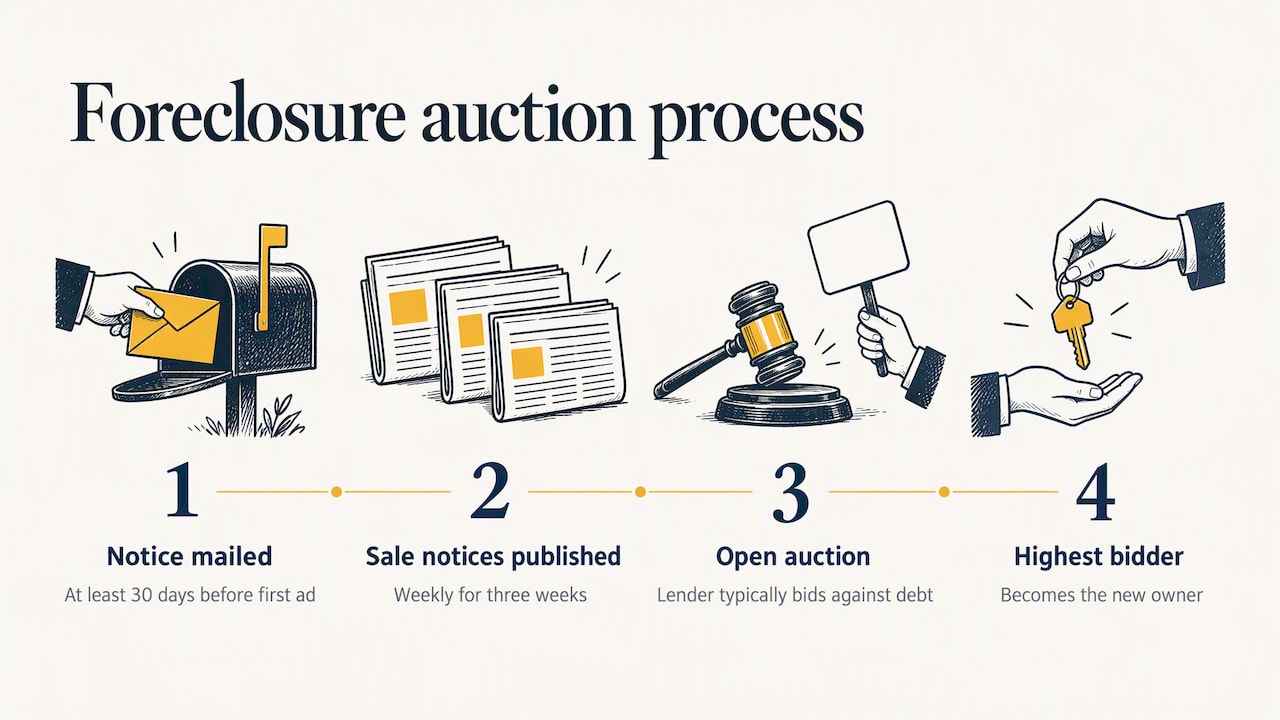
Rhode Island lenders usually foreclose without going to court. The lender mails you a notice at least 30 days before the first newspaper advertisement, then publishes a notice of sale weekly for three weeks. The sale itself is an open auction. The lender typically bids by credit against what you owe, and the highest bidder becomes the new owner.
Two consequences follow from that design.
First, no judge is automatically reviewing your case. If you do nothing, the sale goes ahead on the advertised date. RIHousing is blunt about this: the most damaging mistake is ignoring the problem, and not responding to mail is not a valid defense in foreclosure court.
Second, once the hammer falls, your options shrink sharply. Rhode Island does not give you a statutory right to buy the home back after a non-judicial foreclosure sale, and the same source notes that a deficiency judgment is possible if the lender sues for the gap between the sale price and your debt. Stopping or avoiding the auction is far better than trying to repair things after it.
Your first 48 hours
When you find a notice of sale in your mailbox, do these things in order.
- Find the sale date and the lender’s name. Read every page of the notice. Open any mail from your servicer, even if it is hard to look at.
- Call a HUD-approved housing counselor. The RIHousing HelpCenter is HUD-approved and its foreclosure prevention counseling is free and confidential. HUD also states that foreclosure prevention counseling from approved agencies must be free of charge.
- Gather your paperwork. Mortgage statements, the notice itself, recent pay stubs or benefit letters, a list of monthly expenses, and any hardship documents such as medical bills or a layoff letter.
- Ask whether you are eligible for mediation. Details are in the next section.
- Consider legal help if you suspect the lender skipped a step. Rhode Island Legal Services’ Foreclosure Prevention Project provides counseling and legal representation to homeowners facing foreclosure.
- Start thinking about a fallback. If a workout fails, you want to have already looked at selling, a short sale or a deed in lieu, so you are not starting from zero a week before the auction.
Be wary of anyone who calls offering to “stop” your foreclosure for a large fee. RIHousing warns homeowners about foreclosure rescue scams and says counselors never need to charge for this help.
Mediation: the route most likely to pause a sale
Before 2013 Rhode Island had some of the least restrictive foreclosure procedures in the country. The Foreclosure Mediation Act changed that by bringing lenders and borrowers to the table to explore workouts, and the state reports that about half of the people who complete the process end up with a workout. The program was later made permanent: the 2023 law removed the sunset date and requires good-faith loss mitigation efforts on request.
Here is what matters in practice:
- Who is covered. The requirement applies to a first-lien mortgage on an owner-occupied, one- to four-unit home that is your primary residence. Investment properties and second homes generally fall outside it.
- What the lender must do. Before foreclosing, the lender must send written notice that it cannot foreclose without first taking part in a mediation conference. The conference takes place in person or by phone within 60 days of the notice being mailed.
- Who runs it. Coordinators come from HUD-approved counseling agencies and have no authority to impose a solution. The Division of Banking publishes the approved mediation coordinators and a consumer help page for homeowners.
- If the lender skipped it. A foreclosure can be voidable when the lender fails to follow the mediation law, according to the same legal guide. The lender can often restart, so this buys time rather than a permanent fix. Talk to a lawyer promptly if you think a notice was defective.
Mediation works best when you walk in organized. RIHousing’s experience is that it is not an adversarial fight but a structured negotiation, and a counselor who helps you assemble finances and a clear proposal improves your odds compared with handling the servicer alone.
Ways to keep the house
If you can afford the home with some adjustment, ask your servicer and counselor about:
- A repayment plan, which spreads missed payments over later months.
- A forbearance or modification, which pauses or restructures payments. FHA lists repayment plans and other home retention options for FHA borrowers.
- Reinstatement. Rhode Island law does not give you a right to reinstate, but many mortgage contracts allow it in some circumstances. Check your loan documents and ask the servicer for a written reinstatement figure.
Get every agreement in writing before the sale date. A verbal promise from a call center does not postpone an advertised auction.
If the auction is for unpaid property taxes
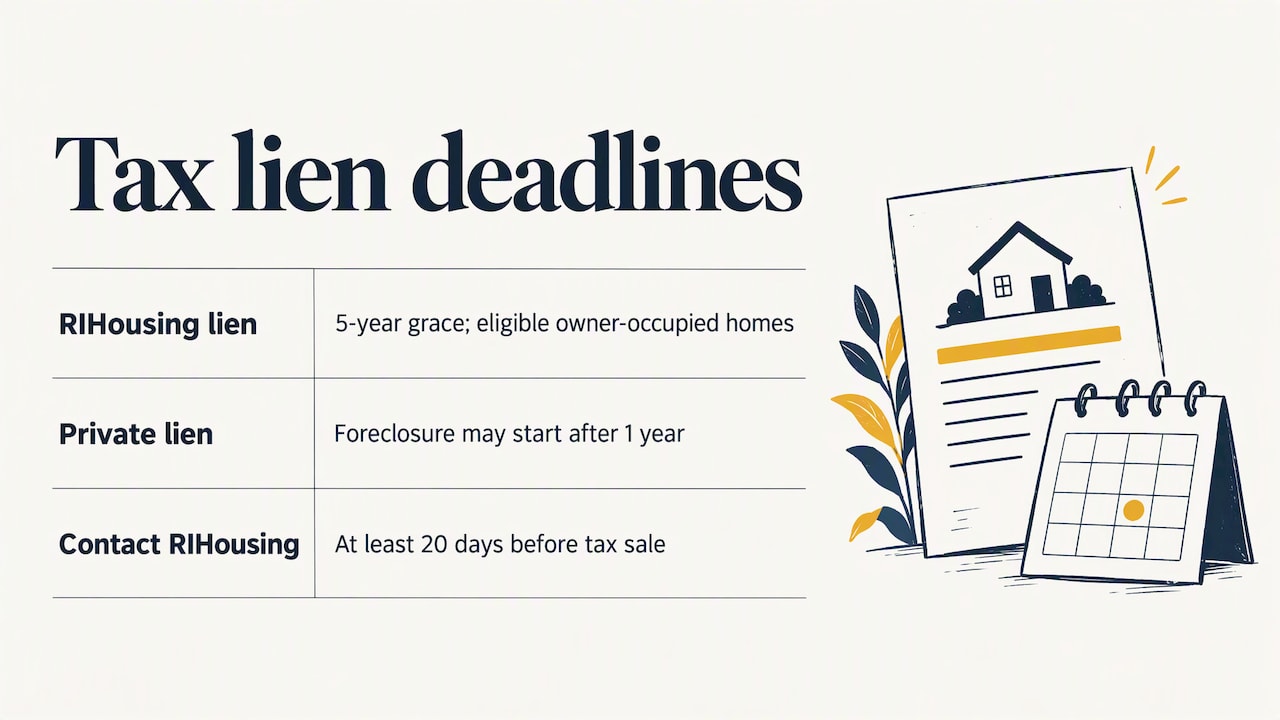
A tax sale is a separate process from a mortgage foreclosure. The Madeline Walker Act lets RIHousing buy delinquent tax liens on owner-occupied homes, which gives you a five-year grace period to repay, where private lien holders can start foreclosure after a year. You must contact RIHousing at least 20 days before the scheduled tax sale. Do not wait for the last week: that deadline is firm.
Ways to leave the house without a foreclosure
Sometimes the numbers do not work. The payment is out of reach, the house needs major repairs, or you inherited a property you cannot carry. Then the goal shifts from stopping the auction to ending it on your terms. The main options differ in what they do to your finances.
| Option | What happens | Best when | Main drawback |
|---|---|---|---|
| Traditional listing with an agent | House is marketed on the open market | Plenty of time and a home in good shape | Agent commissions, repairs, showings, and no guarantee it closes before the sale date |
| Cash sale to a direct buyer | House is bought as-is, usually closing on a schedule you pick | Short timeline, repairs needed, equity to protect | Offer is usually below a fully repaired retail sale |
| Short sale | Lender agrees to accept less than the balance | You owe more than the home is worth | Lender approval takes time and may not erase the debt |
| Deed in lieu | You transfer the title to the lender | Other routes have failed | You give up the home and any equity |
| Do nothing | Auction proceeds | Rarely a good idea | Credit damage, loss of equity, possible deficiency claim |
On the lender-approved routes, lenders typically allow four to six months to find a short sale offer, and FHA loans use a 120-day window. If no offer comes through, a deed in lieu may be possible, though it means leaving the property. A short sale may also not fully satisfy the debt unless the servicer agrees in writing, so ask your counselor to explain this before you sign anything.
When selling before the auction makes sense
A sale before the auction date can work if the price covers your mortgage payoff plus costs, or if your lender will approve a short sale. Proceeds above the payoff are yours. At auction, those same dollars of equity often go to the new owner or are lost.
To check it quickly, collect three numbers: your payoff figure from the servicer (ask for a written payoff statement), what a buyer would reasonably pay for the home as it stands, and the days left before the sale. If the first number is well under the second and there are still a few weeks, a sale is realistic. If the payoff is higher than the price, bring your counselor and the servicer in before any buyer.
Our perspective: speed matters, but so does the decision
We buy houses for cash across Rhode Island, so you might expect us to say a sale is always the answer. It is not. If you can keep the home through mediation or a modification, and you want to, start there. A free HUD-approved counselor costs you nothing, and we would rather you call one before you call us.
What we see is that homeowners often wait too long, partly out of embarrassment. By the time a sale date is close, the choices left are narrow. Selling a house the traditional way means finding an agent, making repairs, cleaning, staging and waiting on a buyer’s financing. None of that fits into a few weeks, and that is where an as-is cash purchase helps: no agent fees, no commissions, no repairs or cleaning, and a closing date set around your situation rather than a buyer’s loan.
Our offers are based on the After Repaired Value of the home, so we are open about the fact that the number reflects what the house needs. Ask for it in writing, compare it with your payoff figure and your counselor’s advice, and only then decide. You should feel no pressure from anyone, us included. If our number does not beat your alternatives, say so, and we will tell you if it does not look like the right fit.
— Dave
How a cash sale before auction works with us
If you decide to sell, the process is deliberately simple. You tell us about the property and the auction date. We review the home and make a cash offer based on its After Repaired Value. If you accept, we coordinate with your lender on the payoff and close on the timeline you need, with no agent fees or commissions and no repairs or cleaning on your part.
Before you commit to any cash buyer, including us, do these checks:
- Ask for proof of funds. Our guide on verifying proof of funds before you sign explains what to look for.
- Compare net proceeds, not headline price. Our pages on cash offers versus financing and whether to accept a cash offer show how.
- Confirm in writing who pays closing costs and when the lender is paid.
- Have your counselor or an attorney look over the contract if time allows.
If foreclosure is one of several pressures, you may also want to read how we approach a sale before bankruptcy, or our overview of how to avoid foreclosure.
When you are ready to talk, request a cash offer for your Rhode Island home. There is no published price, because every offer depends on the property.
What to avoid
- Paying upfront fees to a “foreclosure rescue” service. Free HUD-approved help exists.
- Signing over the deed to anyone who promises to “fix” the loan and let you rent back. Have an attorney review it first.
- Assuming a postponement. Servicers sometimes postpone sales, but confirm the new date in writing and keep working on a plan.
- Skipping the mail. Notices carry deadlines, and the law does not excuse unopened envelopes.
- Waiting for the last week. Tax sale deadlines, mediation timelines and buyer closings all need lead time.
FAQ
Can I stop a foreclosure auction in Rhode Island at the last minute?
Sometimes, but it is rare and depends on the lender. A servicer may postpone a sale if you have a pending workout, a completed payoff, or a sale under contract, and the postponement should be confirmed in writing. Rhode Island has no automatic court stay, so do not count on a last-minute rescue. Start with a HUD-approved counselor as soon as you have the notice.
Does Rhode Island foreclosure mediation stop the auction?
It can delay one. A lender must take part in mediation on request before foreclosing, and a foreclosure can be voidable if the lender skipped this step. The mediator cannot force a deal, but about half of completed mediations result in a workout, according to RIHousing.
Can I still sell my house after the foreclosure notice?
Yes. You own the home until the auction closes, so you can sell it if the buyer closes first and the payoff is covered, or if your lender approves a short sale. Tell your servicer and counselor what you are doing. If time is tight, an as-is cash sale can fit a shorter schedule than a traditional listing.
Can I get my house back after a Rhode Island foreclosure auction?
Generally no. Rhode Island has no redemption right after a non-judicial foreclosure sale. If you believe the lender did not follow the required notice or mediation steps, speak with a lawyer or Rhode Island Legal Services right away, because that is a separate question from redeeming.
Who can help for free?
The RIHousing HelpCenter and other HUD-approved agencies provide foreclosure counseling at no charge. The Division of Banking lists programs and legal help, including Rhode Island Legal Services, for homeowners facing foreclosure.
Sources
- Homeowner Assistance Programs, RIHousing
- Foreclosure Process and Laws in Rhode Island
- Rhode Island law makes mediation upon request a permanent mandate, National Mortgage News
- Foreclosure Mediation Act press release, RI.gov
- Foreclosure Prevention Project, Rhode Island Legal Services
- FHA’s Loss Mitigation Program, HUD
- HUD Housing Counselors Training Module 5.3
- Approved Mediation Coordinators, Rhode Island Division of Banking
- Consumer Information, Rhode Island Department of Business Regulation