
An all-cash offer is usually worth accepting if speed and certainty matter more to you than squeezing out the last dollar of price. The right call depends on three things: what you’ll actually net after costs, how fast you truly need to close, and whether the buyer’s funds and identity check out. Weigh those against contingency guidance from the National Association of Realtors, wire-fraud protocols from the CFPB, and a resource like Rhody Home Buyer if a fast, as-is sale fits your situation.
TL;DR:
- Verifying proof of funds within days is crucial, as some cash buyers may not have the actual liquidity they claim.
- Cash offers usually close within two weeks, but the net proceeds might be less than higher-priced financed deals after fees and costs.
- Reviewing assignment language and escrow details early helps prevent deal disruptions and ensures the buyer is legitimate.
- While cash deals can avoid financing risks, title issues, inspections, or wire fraud still pose significant threats that require thorough due diligence.
- Calculating true net proceeds by subtracting all closing costs and factoring in faster closing benefits is essential before accepting any cash offer.
Table of Contents
- What Is a Cash Offer, and Why Would You Get One?
- Weighing the Trade-Offs: Speed Versus Price
- How to Vet a Cash Buyer Before You Sign Anything
- How to Calculate Your Real Net Proceeds
- From Acceptance to Closing: What Happens Next
- What Can Still Go Wrong (and How to Protect Yourself)
- What About Taxes on a Cash Sale?
- Your Immediate Checklist When a Cash Offer Arrives
- What Rhody Home Buyer Sees in Real Cash Deals
- The Part Most Sellers Get Wrong About Cash Offers
- Get a No-Obligation Cash Offer From Rhody Home Buyer
- Sources
- FAQ
What Is a Cash Offer, and Why Would You Get One?
A cash offer means the buyer isn’t borrowing money from a lender to buy your house. They’re paying with funds already sitting in a bank account, a business account, or an investment fund. Procedurally, that removes the mortgage underwriting step entirely: no appraisal ordered by a bank, no loan approval, no financing contingency that lets a buyer walk away if their loan falls through. That’s the single biggest reason cash offers close faster and with fewer surprises.
But “cash” doesn’t mean the buyer has waived every protection in the contract. Plenty of cash buyers, especially investors, still build in an inspection period and reserve the right to renegotiate or cancel after they see the property up close. The NAR’s guide to contract contingencies makes this distinction clear: contingencies are contractual terms, not financing artifacts, so a cash buyer can still walk if the contract gives them an out. Don’t assume “as-is” unless the language actually says so.
You’ll typically see cash offers from three kinds of buyers: individual investors who renovate and resell or rent, institutional iBuyers that use algorithms to price and flip homes at scale, and owner-occupants who happen to have liquid savings or proceeds from a prior sale. Companies like Opendoor have built entire business models around fast cash purchases, and their own materials note that sellers often trade a modest price discount for speed and convenience, as detailed in Opendoor’s explanation of cash offers.
Cash offers show up most often in three situations: hot markets where buyers compete by removing financing risk, distressed or heavily discounted listings that lenders won’t finance, and any sale where the seller has signaled urgency. If your listing mentions “quick close” or “as-is,” expect cash buyers to find you first.

Weighing the Trade-Offs: Speed Versus Price
Cash offers trade one thing for another. You give up some negotiating leverage on price in exchange for a faster, more predictable transaction. Understanding which side of that trade matters more to you is the whole decision.
The upside is real and fairly consistent across cash deals:
- Faster closings. Without a lender, deals can close significantly faster than the typical timeline for a financed purchase.
- Fewer contingencies. No appraisal contingency and no financing contingency means fewer ways the deal can collapse.
- Sell as-is. Most cash buyers, particularly investors, expect to handle repairs themselves rather than demanding you fix things first.
- Fewer showings and less disruption. Serious cash buyers, especially companies, often make an offer after one visit or a set of photos.
The downside is just as consistent:
- Lower headline price. Cash buyers price in the convenience they’re offering you, so the number is often below what a financed buyer might pay.
- Compressed timeline. A two-week close sounds great until you realize you now have two weeks to find your next place.
- Possible lower net proceeds. A lower price doesn’t always mean lower net proceeds, but it can.
Cash offers tend to make the most sense for sellers facing urgent deadlines or challenging situations, such as job relocations, foreclosure timelines, inherited properties, or homes needing significant repairs.
How to Vet a Cash Buyer Before You Sign Anything
Not every “cash buyer” actually has the cash. Verifying the buyer is the step sellers skip most often, and it’s the one that protects you from wasted weeks and a deal that quietly falls apart.
- Request formal proof of funds. Ask for a bank letter or institutional funds confirmation dated within the last few days, not a screenshot from a month ago. Confirm the funds are liquid, not tied up in an account that requires a lengthy withdrawal process.
- Confirm who you’re actually contracting with. Ask directly whether the purchase agreement allows assignment. If the buyer can assign the contract to another party without your consent, you may end up closing with someone you never vetted. Ambiguous assignment language is a red flag worth an attorney’s attention, according to the NAR’s contingency guide.
- Verify the escrow and title company. Get the name, address, and phone number of the title or escrow company handling the deal, and confirm it independently rather than trusting a number provided only in an email.
- Have a real estate attorney or settlement agent review unfamiliar terms. This is especially important for earnest money handling. Confirm the amount, who holds it, and under what conditions it’s refundable, since disputes over earnest money are one of the most common sources of failed cash deals.
Pro Tip: Ask for proof of funds before you counter on price, not after. If a buyer hesitates or stalls on documentation, that hesitation tells you more than their offer number does.
How to Calculate Your Real Net Proceeds
The offer price is not the number that matters. What lands in your account after closing is the number that matters, and a lower cash offer sometimes beats a higher financed one once you run the math.
Start with the offer price, then subtract:
- Agent commissions, if you’re working with one (cash buyers who purchase direct often eliminate this cost entirely)
- Title and escrow fees
- Transfer taxes, which vary by state and municipality
- Any repairs or concessions you’re agreeing to cover
- Moving costs and prorated expenses like property taxes or HOA dues
Then add back the value of a faster close. Chase’s guidance on evaluating cash offers points out that carrying costs, mortgage payments, insurance, utilities, and property taxes on a home that sits on the market for months, eat into any price advantage a financed offer might have.
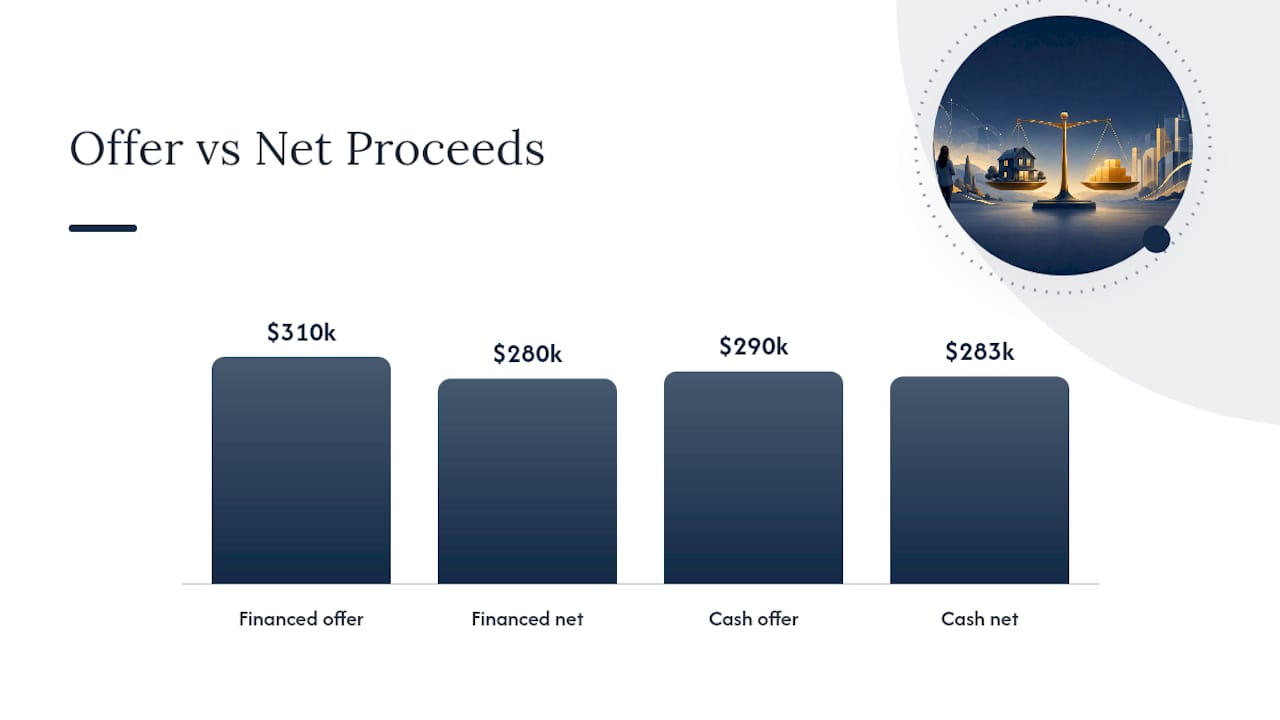
Here’s a simplified example. A financed offer of $310,000 might net you roughly $280,000 after a 6% commission and standard closing costs, and take 60 days to close. A cash offer of $290,000 with no commission and a two-week close could net closer to $283,000, once you subtract two fewer months of mortgage and utility payments. Run these numbers with actual figures from your title or closing agent, not rough guesses, before you compare offers side by side.
From Acceptance to Closing: What Happens Next
Once you decide to move forward, the process runs on a fairly predictable sequence, though timelines shrink considerably without a lender involved.
- Accept or counter. You can accept the offer as written or negotiate specific terms: price, earnest money deposit amount, a rent-back period if you need extra time to move, or the closing date itself.
- Sign the purchase agreement. Once both sides agree on terms, you sign a binding contract that spells out contingencies, deadlines, and remedies if either party fails to close.
- Escrow and title open. A neutral third party (escrow or title company) begins holding funds and documents while a title search runs to confirm clean ownership.
- Inspection period, if any. Even cash buyers frequently reserve inspection rights. This window lets them request repairs, a price adjustment, or in some cases, walk away.
- Settlement statement review. Ask your closing agent for this document as early as possible. The CFPB recommends reviewing closing documents before the closing date, not the morning of, so you catch fee errors or miscalculations while there’s still time to fix them.
- Sign and close. You sign the deed and closing documents, funds are wired or disbursed, and ownership transfers.
Ask for the title report and settlement statement the moment escrow opens. Sellers who wait until days before closing to review these documents lose their leverage to fix mistakes.
What Can Still Go Wrong (and How to Protect Yourself)
Removing the lender from the equation eliminates one category of risk, but several others remain fully in play, and some of them are more dangerous because they involve moving real money.
- Title problems. Unreleased liens, unresolved probate issues, or recording errors can stall or kill a closing even when the buyer is fully funded. Order a title search early regardless of how simple the sale looks.
- Inspection fallout. A buyer with inspection rights can still cancel or demand a price cut after walking through the property, per NAR’s contingency guidance. Read the inspection clause before you sign, not after.
- Wire fraud at disbursement. This is the risk that catches sellers off guard. Scammers intercept email threads near closing and send fraudulent wiring instructions that look legitimate.
Pro Tip: Never rely on wiring instructions that arrive by email alone, even from an address that looks correct. Call the title company using a phone number you saved earlier, not one from a recent email, and confirm instructions verbally before any funds move. The CFPB’s mortgage closing scam guidance walks through exactly how these scams unfold.
What About Taxes on a Cash Sale?
Paying cash doesn’t change how the IRS treats your sale. What matters is ownership and use, not how the buyer funded the purchase. Under IRS Publication 523, you may exclude up to $250,000 of gain if single, or $500,000 if married filing jointly, provided you owned and lived in the home as your primary residence for at least two of the last five years.
If you’re selling an inherited property, a rental, or a home with a large gain relative to your original basis, talk to a tax professional before you close. The exclusion rules get more complicated fast, and a cash sale’s speed can catch sellers off guard if they haven’t planned for the tax bill.
Your Immediate Checklist When a Cash Offer Arrives
Before you sign anything, work through this list:
- Verify proof of funds and confirm the buyer’s identity independently.
- Calculate net proceeds, not just headline price.
- Confirm which title or escrow company will hold funds and handle closing.
- Order a title search early, even if the buyer says it isn’t necessary.
- Verify wiring instructions by phone before any money moves.
- Decide: accept, counter, or reject, and know your negotiation levers.
If the offer feels short, you have options beyond a flat rejection: raise the earnest money deposit to signal seriousness, ask for extra days after closing to move out, or request a short rent-back period so you’re not scrambling to relocate on the buyer’s timeline.
What Rhody Home Buyer Sees in Real Cash Deals
Some cash home buyers purchase homes as-is, based on after-repaired value, potentially without agent fees and with flexible closing dates. The sellers who benefit most are usually facing inherited homes, expensive repairs, or a hard deadline.
It is important to insist on clear assignment language, treat earnest money as a negotiation tool rather than an afterthought, and verify who is disbursing funds before signing anything. Details on how the Rhody Home Buyer process works are worth reviewing before you compare offers.
The Part Most Sellers Get Wrong About Cash Offers
Most advice on cash offers treats them as a binary: take the fast, certain deal or hold out for full price. That framing misses the actual decision, which is a math problem dressed up as an emotional one. The seller who accepts a lower cash offer without running net proceeds is guessing. The seller who rejects a fair cash offer to chase a higher financed price, without accounting for two more months of mortgage payments, insurance, and the real chance that buyer’s financing falls through, is also guessing.
What the evidence actually supports is narrower and less dramatic than either extreme: cash offers are a tool for sellers who value certainty, and that certainty has a calculable price. Sometimes it’s worth paying. Sometimes it isn’t. The mistake isn’t choosing cash or financing. It’s skipping the net proceeds worksheet that tells you which one actually wins for your specific house, your specific timeline, and your specific tolerance for risk.
Prioritize verification over speed of decision. A buyer who balks at providing proof of funds or clear assignment terms is telling you something important, and it’s not about their bank account.
— Dave
Get a No-Obligation Cash Offer From Rhody Home Buyer
If the math above points you toward a fast, as-is sale, some cash home buyers offer a direct path that can skip parts of a traditional sale that eat into net proceeds: no agent commissions, no repair demands, no staging, and no waiting on a buyer’s mortgage approval. Offers may be based on after-repaired value, and closing dates can be flexible.

This approach tends to fit sellers handling inherited properties, homeowners facing repairs they can’t afford to make before listing, or anyone working against a real deadline. If that sounds like your situation, request a no-obligation cash offer and see the number before you decide anything.
Sources
- Should I Accept a Cash Offer for My House? | Chase
- Consumer guide: real estate contract contingencies | NAR
- Review documents before closing | Consumer Financial Protection Bureau (CFPB)
- IRS Publication 523, Selling Your Home
FAQ
Why Would a Seller Only Accept Cash Offers?
Sellers sometimes restrict themselves to cash offers to avoid the risk of a financed buyer’s loan falling through late in the process, which can cost weeks of lost time. It’s also common when a home has condition issues that would fail a lender’s appraisal requirements, making cash buyers the only realistic option.
Is It Better to Accept a Cash Offer on a House?
It depends on your net proceeds and your timeline, not just the price. A cash offer is often better when speed and certainty matter more to you than the last few thousand dollars of price, especially once you factor in carrying costs and closing expenses saved by closing faster.
Do Cash Offers Ever Fall Through?
Yes. Cash removes financing risk but not other risks: title problems, failed inspections, or a buyer exercising a contractual contingency can all still end a deal, according to NAR’s contingency guidance. That’s why verifying proof of funds and reviewing contract terms matters even when a lender isn’t involved.
What Does a Cash Offer Mean?
A cash offer means the buyer is purchasing the home with funds they already have, without a mortgage lender involved in the transaction. It typically speeds up closing since there’s no loan underwriting or appraisal required by a bank, though the buyer may still include an inspection contingency.
How much do cash home buyers pay for houses?
Rhody Home Buyer bases offers on the after-repaired value of the property rather than a fixed formula, so pricing varies by home and location. Current offer details are available by requesting a no-obligation cash offer directly through the site.