
Selling your house to an investor means a buyer who pays cash purchases it directly from you, in its current condition, with no listing, no showings and no agent commission. If you need speed, certainty or relief from repairs, it is often the most direct route. At Rhody Home Buyer, we buy homes in Rhode Island and Eastern Connecticut as-is, with no agent fees, no commissions and no repairs or cleaning on your side. The rest of this guide shows the steps, what to compare in an offer, and how to spot a buyer who is not what they claim.
TL;DR
- An investor sale runs in a short sequence: you share the property details, the investor makes an offer, you sign a purchase contract, a title company or closing attorney clears the title, and you close and get paid.
- Read the contract before you sign. The sale price, closing date, inspection rights, who pays which costs and any cancellation rights should all be written down.
- Your net is what counts. Mortgage payoff, back taxes, unpaid utility bills and liens come out of the proceeds before you receive anything.
- Never pay an investor anything before closing, and be wary of anyone demanding a same-day signature.
- Selling a primary residence often triggers little or no federal tax because of the home-sale exclusion, but your own situation decides.
Table of Contents
- What “selling to an investor” actually means
- The steps from first call to closing
- What a good offer looks like on paper
- Understanding “as is” and inspection rights
- How to check that a buyer is legitimate
- When the sale is driven by foreclosure or hardship
- Will you owe tax on the sale?
- Who a direct investor sale suits best
- Our perspective
- Talk to us about your house
- FAQ
- Sources
What “selling to an investor” actually means
An investor is a person or company that buys houses to resell, rent or renovate. Because they plan to make the property work for them, they can buy houses that a typical retail buyer, who needs a mortgage and a move-in-ready home, would pass over. That is why investors are the natural buyer for homes that need work, homes with tenants, inherited houses nobody wants to maintain, and sales that have to happen on a deadline.
The practical differences from a traditional listing are simple:
- No agent on your side of the deal. You do not pay a listing commission, because there is no listing.
- No prep. You do not repaint, replace the roof or clean out the garage to attract buyers.
- No showings or open houses. Nobody walks through every weekend.
- A cash purchase. The buyer does not depend on a bank appraisal and loan approval, which are the steps where retail sales often fall apart. If a buyer has backed out on you, our guide to what to do when a buyer backs out of a home sale walks through your next move.
This is the path we take with every homeowner who calls us. We buy directly, and our offers are based on the After Repaired Value, which is what the home would be worth once it is repaired.
The steps from first call to closing
The order below is the same for nearly any direct investor purchase. Details differ by buyer and by state, so read each step against your own paperwork.
1. Share the property details
You give the address, the number of bedrooms and bathrooms, the approximate square footage, the condition and your timeline. Be honest about the roof, the foundation, the heating system and any past water or fire damage. Anything you leave out will surface at the walkthrough and can complicate the deal later.
Tell the buyer too if the house is occupied, if you have an unpaid mortgage, or if several heirs share ownership. Each of those changes the paperwork, not the possibility of a sale. If you are weighing whether to fix things first, our page on net proceeds when you repair or sell as is shows how to think it through.
2. Receive and understand the offer
The investor reviews recent sales nearby and estimates what the house needs. Our offers start from the After Repaired Value, the expected worth of the home in good condition, and account for the work involved. Ask any investor to explain how they arrived at their number in plain terms. A buyer with a real offer can do that in a minute.
If you want a sense of how a price is built from the market side, our article on pricing a home to sell fast shows the logic of comparing recent sales.
3. Sign a purchase agreement
The purchase agreement is the contract that binds both sides. It should state the price, what is included (appliances, fixtures), any contingencies, the closing date and each party’s responsibilities. It should also say who pays for title work and closing costs.
Take the time to read every page. If anything is unclear, a Rhode Island or Connecticut real estate attorney can review it before you sign. That is the right professional for contract questions, and it is a step worth taking whenever a deal is complicated by liens, divorce, probate or foreclosure.
4. Title search and escrow
A title company or closing attorney searches the public record for anything attached to the property: mortgages, liens, judgments, unpaid property taxes. Earnest money, a good-faith deposit from the buyer, is usually held by that neutral party, not by the investor. Rhode Island closings are commonly handled through an attorney or title company, so expect one of them to run the paperwork.
The title search is where most delays come from. A forgotten lien or an estate that has not been formally opened can add days or weeks, so the sooner you gather your mortgage statement and any notices, the faster this step goes.
5. Close and get paid
At closing you sign the deed and the settlement statement. Funds move through the closing agent, and the deed transfers to the buyer. On a cash sale there is no lender waiting on an appraisal, so the closing date is the one you and the buyer agree on. We close on the homeowner’s timeline, whether that means moving quickly or waiting until you are ready.
What a good offer looks like on paper
A headline price is not what you take home. Before you accept, line up the numbers.
| Item | What to confirm |
|---|---|
| Purchase price | The exact figure in the contract, not a range |
| Mortgage payoff | Request a payoff statement from your servicer |
| Liens and back taxes | Anything on the title is paid from proceeds |
| Utility bills and fees | Overdue amounts may also be deducted |
| Closing costs | Who pays title, recording and attorney fees |
| Closing date | A specific date, and who can move it |
| Inspection or walkthrough rights | What the buyer may check, and whether the price can change |
The first four rows matter because ProPublica’s investigation of cash home sales explains that mortgage liens, overdue utility bills, delinquent property taxes and other debts can be deducted from the sale proceeds before you receive your net amount. Do this arithmetic before you compare any two offers, whether they come from an investor or from a retail buyer.
For a sale where you owe more than the house is worth, see our guide on selling a house with negative equity in Rhode Island.
A worked example
Suppose a contract says $250,000 and your mortgage payoff is $170,000. Unpaid property taxes add $6,000 and a lien from an old contractor adds $4,000. Before any closing fees, your net is $250,000 minus $180,000, or $70,000. A second offer of $245,000 with the buyer paying all closing costs could leave you with more than the first offer if the first one has you covering fees. The number to compare is always what lands in your account.

Understanding “as is” and inspection rights
“As is” means the buyer takes the house in its current condition and you do not have to complete ordinary repairs. The contract controls everything, though, so read what it says about the buyer’s right to inspect and what happens after. Ask these questions before signing:
- Does the buyer have an inspection period, and for how long?
- Is the offer firm, or can the price be adjusted after a walkthrough?
- What counts as a reason to renegotiate or cancel?
We buy homes as-is, so you do not need to clean out or repair the house first. If you want more background on the contract side of as-is sales, this guide to selling a house as is covers disclosures and your options, and our own page on the four steps of an as-is contract lays out how it works with us. If the house has failed an inspection for another buyer, your options as a seller after a failed inspection are worth reading too.
How to check that a buyer is legitimate
Most investors are straightforward, but a quick sale attracts a few operators who are not. The Better Business Bureau’s advice on selling your home for quick cash is to ask questions, reject vague answers, never pay an investor before closing, and run the transaction through a closing professional. Apply it like this:
- Ask who is buying. You should know the name of the person or company on the contract and whether they are buying for themselves.
- Never pay up front. A legitimate cash buyer does not charge you fees to sell. Costs belong on the settlement statement at closing.
- Use a neutral closing agent. A title company or attorney should handle funds and recording.
- Resist same-day pressure. ProPublica reports that a legal-aid attorney it interviewed called pressure to commit on the spot a major red flag, and advises sellers to learn their home’s value first.
- Read the fine print on assignment and cancellation. ProPublica also advises checking for language that lets the buyer assign the contract to someone else, cancel unilaterally, keep earnest money, or record a memorandum against your title that could cloud it.
If you want to confirm the buyer’s reputation, look at local reviews and ask for references. You are also free to ask how long a company has been buying in your town and which closing attorney or title company it uses.
When the sale is driven by foreclosure or hardship
Many of the people who sell to an investor are under time pressure: missed payments, a job loss, an inherited house with carrying costs, or a notice from the lender. In those cases speed matters, but so do the deadlines that protect you.
Under federal mortgage servicing rules, as summarized in a state regulator’s homeowner guide, a servicer generally may start foreclosure only after more than 120 days of missed payments, and it must evaluate a complete loss-mitigation application received at least 37 days before a scheduled sale. The same guide advises asking in writing whether a short sale, where the lender accepts less than the balance owed, leaves you owing a deficiency.
That means three practical things:
- Call your servicer early and ask what options exist.
- Get any promise about a sale date or a short-sale outcome in writing.
- Sell before the auction date if you want to keep control of the price and your credit.
For homeowners in our service area, we have written about pre-foreclosure options in Rhode Island, how to avoid foreclosure and selling after a job loss. If a foreclosure sale date is already set, speak to a housing counselor or a real estate attorney as well as to a buyer, so every deadline is covered.
Will you owe tax on the sale?
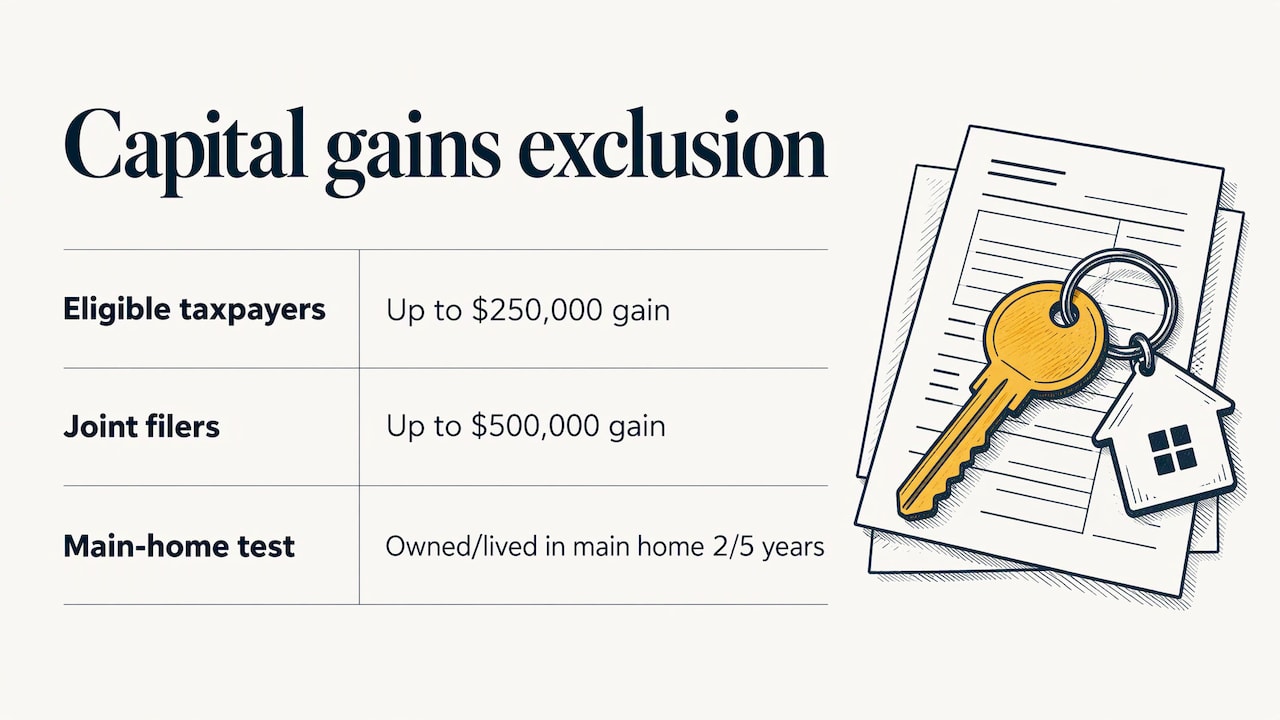
The tax depends on your gain, not on the sale price. The Congressional Research Service explains in its report on the capital gains exclusion for owner-occupied housing that eligible taxpayers can generally exclude up to $250,000 of gain, or $500,000 for qualifying joint filers, when ownership and use tests are met. In general you must have owned and lived in the home as your main residence for at least two of the five years before the sale. Gain is roughly what you receive minus what you paid and spent on improvements and selling costs.
What this means in practice: if you have lived in the home for years and your gain is under the limit, you may owe no federal tax. Inherited property, rentals and second homes follow different rules, so ask a tax professional or CPA about your own numbers before closing. The same cash sale that skips an agent commission also keeps more of your proceeds in your pocket, which is part of why net proceeds are worth comparing.
Who a direct investor sale suits best
An investor sale fits when time, condition or complexity is the problem, not when you have months to wait for a top retail offer on a house in perfect shape. It tends to work well when:
- The house needs repairs you cannot afford or do not want to manage. See what to do when you cannot afford home repairs.
- You inherited a property and want to settle the estate without cleanouts and showings.
- You face a deadline from a lender, a relocation or a life change.
- The home has damage, such as from a fire, that makes financing difficult for a typical buyer. Our page on selling a fire-damaged house goes through the options.
- You want to avoid agent fees, commissions and the uncertainty of a buyer’s financing.
Our perspective
We built Rhody Home Buyer for the homeowner who does not have time for a listing. When someone calls us, they are usually dealing with a repair bill, an estate, a missed payment or a move. They need a plain answer, not a sales pitch.
Our approach is to buy the house as it stands. You do not pay agent fees or commissions, and you do not repair or clean anything. We base our offer on the After Repaired Value, and we explain it so you can see how we got there.
The other thing we care about is the timeline. You choose when to close, so a quick sale does not have to feel like a pressured one. We work with homeowners in Rhode Island and Eastern Connecticut, and we have years of experience guiding people through exactly this kind of sale.
If you take only one thing from this guide, let it be this: compare what you actually net, read the contract, and keep every promise in writing. We are glad to be measured against that standard.
Dave
Talk to us about your house
If your home is in Rhode Island or Eastern Connecticut and you want to sell without agent fees, commissions, repairs or cleaning, we can make you a cash offer based on the After Repaired Value and close on the date that works for you.

Tell us about the property on Rhody Home Buyer, or read how cash home sales work first if you want to see the process before you call.
FAQ
How fast can I sell my house to an investor?
Because a cash buyer does not wait on a lender’s appraisal and approval, the timeline is mostly set by the title search and the closing date you agree on. A missing payoff statement, a lien or an unopened estate can slow things down, so gather your paperwork early. With us, you choose the closing date that suits you.
Do I have to make repairs or clean the house first?
No. We buy houses as-is, so you do not repair, paint or clean out the property before the sale. Whatever stays or goes should be spelled out in the purchase agreement, so decide before signing which items you are leaving.
Do I pay commissions or fees when I sell to an investor?
With us, there are no agent fees or commissions. Closing costs, such as title and recording fees, are set out in the contract and on your settlement statement, so check who is paying each one before you sign.
How do I know the investor is legitimate?
Ask for the buyer’s full name, check local reviews and references, and use a title company or closing attorney to handle the money. The Better Business Bureau advises never paying an investor before closing. A buyer who respects your timeline, answers questions directly and puts everything in writing is a good sign.
Can I sell to an investor if I am behind on my mortgage?
Yes, in many cases. The mortgage is paid from the sale proceeds at closing, so you need a current payoff statement from your servicer. If a foreclosure sale date has been set, act quickly and tell the buyer the date at the first call so the closing can be planned around it.
Sources
- ProPublica: Want to Sell Your Home for Cash? Read This First
- Better Business Bureau: Selling your home for quick cash? Not so fast!
- Congressional Research Service: The Exclusion of Capital Gains for Owner-Occupied Housing
- Oregon Division of Financial Regulation: Keeping your home