
When a buyer backs out, you can usually do three things: hold the deposit if the contract allows it, put the house back on the market, or sell to a buyer who doesn’t depend on a lender. Which one fits depends on your contract, your deadline and how much carrying cost you can take on. This guide covers why deals collapse, what the contract says about it, who gets the earnest money, and how to move forward quickly.
TL;DR
- A buyer can often walk away without penalty if a contingency in the contract (financing, appraisal, inspection) applies. Without one, the seller may be entitled to keep the earnest money.
- Do not assume the deposit is yours. Whether it is refundable depends on state law and on the exact contract wording, and both sides usually have to sign off on its release.
- You can generally relist and accept a new buyer while a dispute over the deposit is still open.
- Talk to a real estate attorney before you sign a release or send any notice.
- If you need certainty and speed, a cash buyer with no financing contingency removes the most common reason deals fall apart.
Table of Contents
- Why buyers back out of home sales
- Was the buyer allowed to back out?
- Who keeps the earnest money?
- What to do in the first few days
- Your options after the buyer is gone
- How to make the next contract harder to lose
- When the failed sale is part of a bigger problem
- Get a cash offer instead of waiting on another buyer
- FAQ
- Sources
Why buyers back out of home sales
It is not just you. Realtor.com data reported in February 2026 shows that 7.1% of homes returned to the market last year after a deal fell apart, for reasons such as financing trouble, appraisal gaps, inspection findings and buyer hesitation. The National Association of Realtors describes a typical fallout rate of about 5%, with causes including financing denial, inspection surprises, low appraisals, clouded title, or a buyer whose own home did not sell.
In softer markets the numbers climb. Deseret News reported in August 2026 that the U.S. cancellation rate was at its highest in years, with far more sellers than buyers and the average 30-year fixed mortgage rate at 6.67%. One agent quoted there described buyers who revisit the numbers with their lender, get anxious about the payment and never even send the deposit.
The most common causes fall into a handful of buckets:
- Financing falls through. The lender denies the loan, the buyer’s job or credit changes, or rates move and the payment no longer fits.
- The appraisal comes in low. The lender will not lend more than the home appraises for, so the price gap has to be closed or the deal ends.
- The inspection turns up problems. The buyer asks for repairs or credits, you disagree, and they cancel.
- Title problems appear. A lien, an old mortgage or an ownership question clouds the sale.
- The buyer cannot sell their own home. Their purchase depended on that sale closing first.
- Cold feet. The buyer gets nervous about the money and the market.
Knowing which bucket your deal fell into matters, because it decides whether the buyer had the right to leave.
Was the buyer allowed to back out?
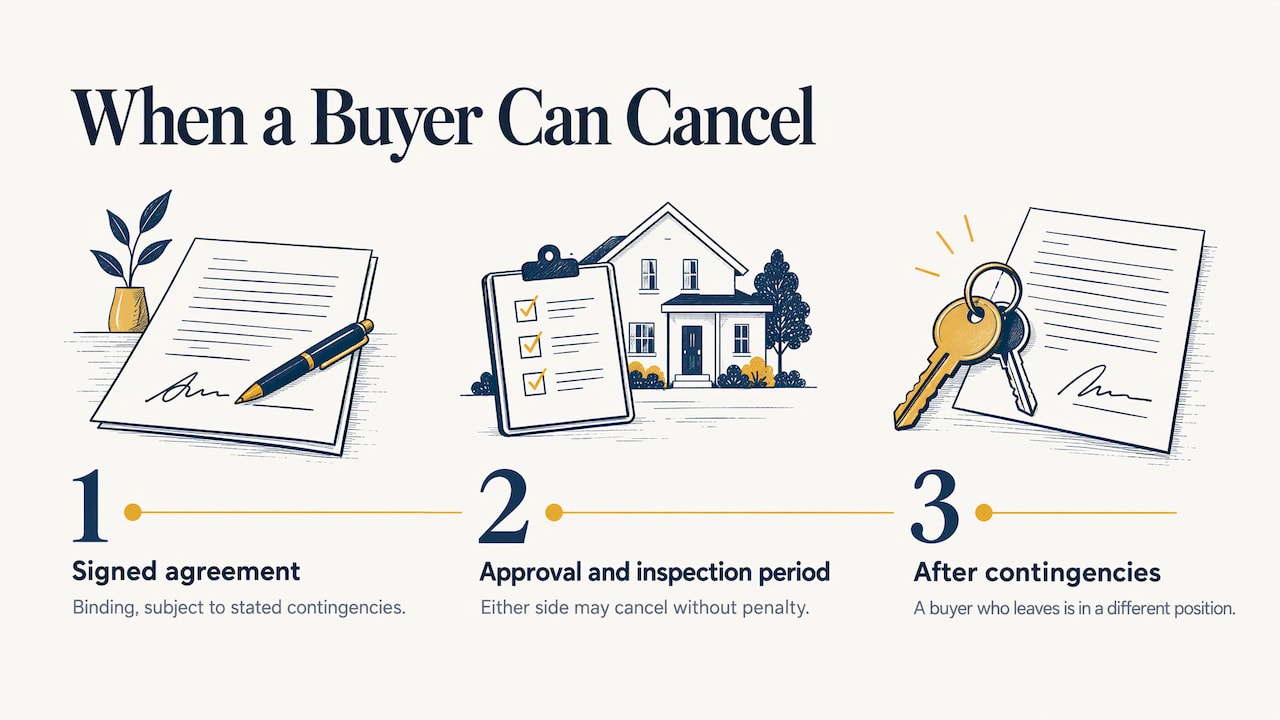
Read the contract before you read anything else. A signed purchase agreement is binding, but it usually contains contingencies, which are conditions that let one side exit. The NAR lists the common ones: financing, appraisal, inspection, sale of the buyer’s current home, title, and homeowners insurance.
Financing is the one that causes the most grief for sellers. The American Bar Association explains that a mortgage contingency lets the buyer void the contract without penalty if they cannot get a loan on the stated terms despite a good-faith effort within the time provided. That window is typically 25 to 30 days, according to Realtor.com’s guidance for sellers.
Timeline matters too. The NAR notes that during an attorney-approval and inspection period, either side can cancel without penalty. After that period, and once contingencies are satisfied or waived, a buyer who leaves is in a very different position.
Three questions to ask about your contract
- Which contingencies were in the contract, and had they expired? A buyer who cancels after a contingency deadline passed may be in breach.
- Did the buyer follow the notice clause? Contracts spell out how and when to give written notice. A text message may not count.
- Did you meet your own obligations? Disclosures, access for the inspection and appraisal, and delivery of documents all count. If you missed one, the buyer may have a defense.
If you want to see how inspection disputes in particular can be handled, our guide on your options after a failed inspection walks through them.
Who keeps the earnest money?
Earnest money is the good-faith deposit the buyer puts down after the contract is signed. The NAR cautions that sellers should not assume they get to keep it when a buyer cancels, even for reasons the contract does not mention. Refundability varies by state law and by contract, and both parties usually have to sign off on its return.
The general rule, as Investopedia explains, is this:
| Reason the buyer backed out | Who usually gets the deposit |
|---|---|
| A contingency in the contract applies (serious inspection defect, low appraisal, loan denied, current home unsold) | Typically returned to the buyer |
| A reason not in the contract (change of heart, chose another property) | The seller is most likely entitled to keep it |
| Dispute over whether a contingency applied | Held until both sides agree or a court decides |
Your contract probably also says what happens in a default. When a buyer breaches, sellers can typically keep the deposit as liquidated damages, sue for actual damages, or seek specific performance. Keeping the deposit under a liquidated damages clause is the most common remedy in residential deals, and by accepting it the seller generally gives up the right to pursue more.
Can you sue the buyer?
Sometimes, but it is rarely the smart first move. If the deposit does not cover your loss, a seller can pursue damages for carrying costs, the price difference on resale, re-listing expenses and related costs. Courts can also order a buyer to complete a purchase through specific performance, but that is more common with unique or high-value properties, and the court looks at whether the contract was valid and whether you did what you promised.
Lawsuits are also expensive, slow and stressful, with no guaranteed outcome. Negotiation, an extension or a mutual release often gets sellers to the same place faster.
What to do in the first few days
The first moves you make can protect your rights and your timeline. Based on what attorneys advise sellers, a sensible order looks like this:
- Do not sign anything yet. A seller should not sign a release prematurely, because it can give up your claim to the deposit.
- Preserve the file. Keep the agreement, addenda, disclosures, inspection reports, appraisal, lender communications, emails, texts and every notice.
- Build a timeline. Write down the dates for the deposit, inspection, financing, appraisal, extensions, notices and closing.
- Follow the notice clause exactly. If you need to declare a breach or respond to a cancellation, do it the way the contract says. Some states and contracts also require a cure period notice first.
- Call a real estate attorney. The single most useful step, according to one attorney’s advice to sellers, is to talk to a real estate attorney before making any moves, since acting on impulse or well-meaning but wrong advice can turn a manageable problem into a dispute.
- Decide how fast you need to sell. This drives everything that follows.
The exact rules for notices, deposits and releases differ from state to state, so an attorney licensed where the property sits should read your contract. That is especially true if escrow or the deposit holder refuses to release the money while you and the buyer disagree.
Your options after the buyer is gone
Option 1: Try to save the deal
Sometimes the deal can be revived. Attorneys often point to reinstating the contract, extending deadlines, or agreeing to partial forfeiture of the deposit in exchange for a release. If the problem is financing, the NAR suggests offering an extension so the buyers can find alternative financing or a cosigner. If it is a low appraisal, a price adjustment or credit may bridge the gap. If it is an inspection, a repair credit may be enough.
This works best when the buyer still wants the house and the issue is a number, not a feeling.
Option 2: Relist and move on
You are generally free to find another buyer. The Pennsylvania Association of Realtors points out that a seller’s refusal to sign the release creates a dispute over the money, not the property, so you can generally move on with a different buyer while the deposit question is unsettled. Check your own state’s rules and contract with your attorney first.
Relisting has costs. Delays, financing gaps and possibly a lower price on relisting are all realistic. The market matters as well: an attorney commentary on California practice notes that a seller in a rising market usually relists, while a seller in a falling market has more reason to hold the buyer to the contract. With sellers outnumbering buyers in many areas in 2026, a second contract with the same kind of buyer can fail for the same reasons.
Option 3: Sell for cash, as is
If the first deal collapsed because of financing, an appraisal or repair demands, a buyer who pays cash and takes the house as is removes all three. There is no loan to deny, no lender appraisal to come in low, and no repair negotiation. We built our business around exactly this situation. You can compare the trade-offs in our guide to cash offers versus financing, and see how closing works when you sell as is.
A cash sale is not right for everyone. If you have time, a strong market and a house in good shape, listing again may net you more. If you have a deadline, such as a job move, an inherited property or a mortgage in trouble, certainty is worth more than chasing the highest price.
How to make the next contract harder to lose
If you relist, tighten the terms that cost you time. The NAR suggests sellers can require the inspection to be done in three days instead of the typical seven to 10, so a cancellation does not leave you two weeks behind. You can also limit the inspection contingency so the buyer can cancel only for major structural issues or repairs above a set dollar amount.
A few more practical habits:
- Look at the buyer’s financing, not only the offer price. A higher offer with a thin down payment and a long financing contingency carries more risk than a slightly lower, stronger one.
- Get a pre-sale inspection and fix or disclose known issues. The NAR recommends presale inspections, repairs before listing and disclosure of material problems to prevent surprises.
- Keep a backup offer. If financing falls through, a backup buyer can step in immediately.
- Choose a closing date that fits your life. A realistic date reduces pressure on both sides. Our guide on choosing your closing date as a Rhode Island seller explains how to think about it.
- Calendar every deadline the day the contract is accepted, and put every notice in writing.
When the failed sale is part of a bigger problem
For some sellers, a collapsed deal is an annoyance. For others it is a crisis: a mortgage in arrears, a foreclosure date, an inherited house you cannot afford to keep carrying, or a job loss. Every month on the market adds mortgage payments, taxes, insurance and utilities. If that is you, speed and certainty matter more than squeezing out the last dollar. Our guides on avoiding foreclosure and selling after a job loss in Rhode Island lay out the options, and your lender or a housing counselor may have more.
Our perspective
We talk to sellers every week whose buyer vanished after the inspection or just before closing. Almost always, the pain is not the lost deal itself. It is the lost weeks: the movers already booked, the next mortgage payment coming due, the nerves of starting over.
Here is how we see it. Most deals fail because something outside the seller’s control, usually a lender, an appraiser or a list of repair demands, stands between the buyer and the keys. When we buy directly for cash, those pieces are gone. We buy homes as is, we base our offers on the After Repaired Value, and there are no agent fees or commissions and no repairs or cleaning. You choose the closing timeline that works for you.
If your buyer backed out, talk to an attorney about your deposit and your rights, then take a clear look at whether another round of listing and waiting is really what you want. For many Rhode Island and Eastern Connecticut homeowners, the straightforward answer is a direct sale to a buyer who does not need a bank’s approval.
Dave
Get a cash offer instead of waiting on another buyer
If your sale fell through and you want a firm path forward, we buy houses in Rhode Island and Eastern Connecticut for cash, in any condition. There are no agent fees or commissions, no repairs and no cleaning, and you decide when to close.

See how our cash buying process works or request an offer on our Rhode Island home selling page. We will tell you what we can offer, and you decide whether it fits.
FAQ
Is there a penalty for a buyer who backs out of a house sale?
It depends on why they backed out. If a contract contingency applies, such as a failed financing, inspection or appraisal, the buyer can usually leave and get the deposit back. If they leave for a reason the contract does not cover, the seller is most likely entitled to keep the earnest money. In some cases a seller can pursue additional damages, but that depends on the contract and state law.
Can I keep the earnest money if the buyer cancels?
Not automatically. The NAR advises that sellers should not assume they keep it, because refundability depends on state law and the contract, and both parties usually must sign off on its release. Have an attorney read the default clause before you respond.
What happens if the buyer’s financing falls through?
A financing contingency lets the buyer cancel and reclaim their deposit if they cannot get a mortgage in the allowed time, typically 25 to 30 days. The seller can then turn to a backup offer, offer a credit, renegotiate the price, or allow the buyer to try another lender.
Can I sell to someone else right away?
Often yes. A dispute over the deposit is generally separate from ownership of the property, so you can usually move on while it is sorted out. Confirm the specifics for your contract with a real estate attorney before you sign a new one.
Should I hire a lawyer if my buyer backs out?
If the deposit is in dispute, escrow is holding funds, or anyone mentions a lawsuit, yes. Attorneys recommend speaking to one before you make any moves, since a lawyer can read your contract language and often resolve the matter through negotiation.
Sources
- Realtor.com: Why More Homebuyers Are Walking Away Before Closing
- NAR: Overcoming Roadblocks to a Sale or Purchase
- Deseret News: More U.S. homebuyers getting cold feet
- NAR: Real Estate Sales Contract Contingencies
- American Bar Association: The Purchase Contract
- Realtor.com: What Sellers Should Do When a Buyer’s Financing Falls Through
- NAR: Help Sellers Regain Confidence After a Buyer Backs Out
- Investopedia: Earnest Money
- LicensePrep: What Happens When a Buyer Breaches?
- Lathouris Law: Legal Options When a Buyer Backs Out
- McSeveney Law: Backing Out of a Real Estate Contract
- Margetas Legal: Buyer’s Earnest-Money Deposit
- Pennsylvania Association of Realtors: The Buyer Terminated the Agreement
- Catalyst Legal: What Happens if a Buyer Backs Out