
Choose the closing date that lines up with the day you can hand over the keys and the day you need your money, not the one that looks best on a calendar. In Rhode Island, the date also has to leave room for a few state requirements, such as the smoke and carbon monoxide alarm certificate. These requirements can quietly push a closing back if you leave them late.
This guide covers who really controls the date, how long closings usually take, whether the day of the month matters to you as a seller, and how to pick a date when you are under pressure to sell fast.
TL;DR
- Once the contract is signed, the date is an agreement with the buyer. You usually cannot move it alone, so decide what you need before you sign.
- For sellers, the day of the month rarely changes your finances. Anchor the date to your move-out day and to the day you need your proceeds.
- Rhode Island adds its own checkpoints: the alarm certificate, tax paperwork for some sellers, and an attorney-led closing. Start them early.
- Ask your closing agent for a status check about a week before closing.
- If speed matters more than anything, a cash sale lets the closing date follow your timeline instead of a lender’s.
Table of Contents
- Who actually controls the closing date
- How long closings take, and what that means for your date
- Does the day of the month matter to a seller?
- Match the date to your move, not to a calendar trick
- Rhode Island rules that can push your date back
- What happens on closing day, and what to do the week before
- When you need to move fast
- Our perspective on closing dates
- If you want the date to follow your timeline
- FAQ
- Sources
Who actually controls the closing date
Before a contract exists, you have the most say. You can tell a buyer which window works and which does not, and you can turn down an offer whose timeline does not fit your life. After signing, the date is a term of the contract, and changing it takes the buyer’s agreement.
That sounds rigid, but in practice the date in the contract is a target. The Consumer Financial Protection Bureau describes closing as the final step in a chain, where the lender sends loan funds to the settlement agent, who then delivers them to the seller. If any link in that chain is late, such as the title search or the lender’s final approval, the date moves. Moves happen often, and they usually go later rather than earlier.
Two practical conclusions follow:
- Say what you need in the first conversation, not after the contract is signed. A buyer who hears “I need to be out by the 28th” in week one can plan around it. A buyer who hears it in week five may not be able to.
- Treat the contract date as the earliest realistic date, then build a small cushion into your own plans, such as your moving truck, your lease start or your next closing.
How long closings take, and what that means for your date
For a sale that involves a mortgage, the buyer’s lender sets much of the pace. One widely cited rule of thumb is that most parties schedule closing 30 to 45 days after the offer is accepted is not what that page says, so treat it only as a general range and confirm the actual timeline with your attorney and the buyer’s lender. The honest answer is that the length depends on the buyer’s financing, the home’s condition and whether the title is clean.
What you can control is the list of things on your side of the table. A realistic seller timeline looks like this:
| Item on your side | When to start | Why it matters for the date |
|---|---|---|
| Smoke and CO alarm inspection | At least two weeks before closing | The certificate is needed at transfer of title and can hold up the deed |
| Payoff request for your mortgage | As soon as the contract is signed | The existing loan must be cleared from your proceeds |
| Tax paperwork (non-resident sellers, higher-value homes) | 10 to 20 or more days ahead, depending on the form | A missing discharge or certificate can stall everything |
| Move-out plan | Before you sign | The buyer expects the home empty on the agreed date unless you negotiate otherwise |
| Status check with the closing agent | One week before | Finds the small problems while there is still time to fix them |
A fast date is only as fast as the slowest item in that table.
Does the day of the month matter to a seller?
Search results on this topic are dominated by advice for buyers: close at the end of the month and you pay less prepaid interest, and your first mortgage payment lands later. That logic is about the buyer’s loan. The Neighborhoods.com guide makes the same point, noting that the ideal date differs for buyer and seller.
For you as the seller, the picture is simpler. A RISMedia piece on the day of the month argues that sellers typically gain little from choosing one particular day for a standard sale, and that the better move is to close as near as possible to the day you actually need to leave. We agree. Chasing a tiny interest or proration difference is the wrong trade if it leaves you paying for two places to live.
There are a few exceptions worth checking with your attorney:
- Your own mortgage payoff. If your closing falls just before or after a payment date, the payoff figure changes. The difference is usually small, but ask for an exact payoff statement for your chosen date.
- Property tax and utility adjustments. These are prorated to the closing date. Again, small, but it is why the settlement statement will differ from your first estimate.
- Your next purchase. If you are buying another home, your two closings need to be sequenced. That is a bigger factor than any day-of-month effect.
Match the date to your move, not to a calendar trick
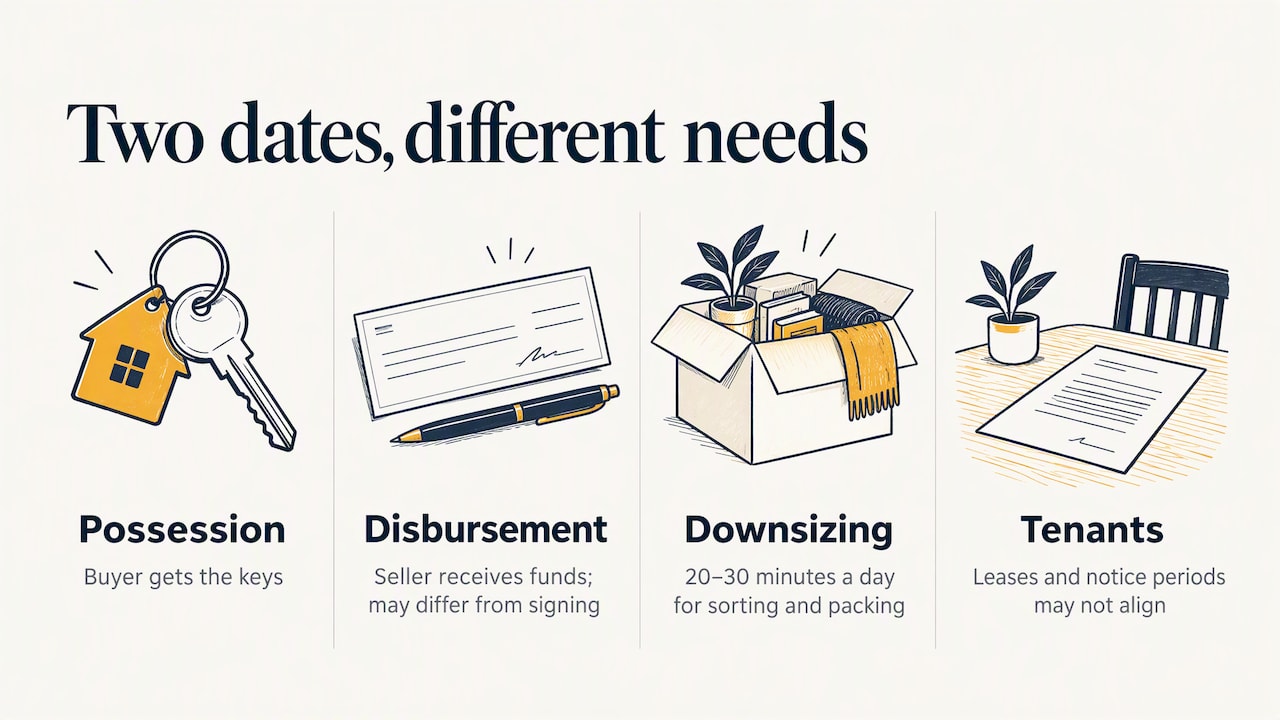
The most useful question is not “which date is best?” but “when will I be fully out, and when do I need cash in hand?” Those are two different dates, and it helps to name them separately.
The possession date is when the buyer gets the keys. For a family with a school calendar, a lease ending on the 31st or a job start in another state, this date is rarely flexible.
The disbursement date is when you actually receive your money. The CFPB explains that the settlement agent collects funds and pays the seller according to the final settlement statement. Signing and receiving funds can fall on different days, so if you need the money for a deposit on your next place, ask your closing agent exactly when funds will be released.
If you are downsizing, the date has to leave you enough runway to sort, sell, donate and pack. A steady routine helps: this guide to downsizing before moving, one room at a time breaks the job into 20 to 30 minutes a day, which makes it easier to count backward from a closing date and see whether it is realistic.
If the house is a rental with tenants in place, the timeline gets another layer, because leases and notice periods may not line up with the buyer’s date. This overview of selling a house with tenants walks through practical options, and it is worth reading before you commit to any date on an occupied property.
Rhode Island rules that can push your date back
Rhode Island has a few specific requirements that catch sellers off guard. None is difficult, but each takes lead time.
The smoke and carbon monoxide alarm certificate
At the transfer of title, the seller must give the buyer a certificate showing that smoke and carbon monoxide alarms were inspected within 120 days before the sale, according to the Rhode Island State Fire Marshal’s alarm guidance. If the inspection is too old by closing day, you need a new one.
Local fire departments handle these inspections. For example, the Town of Narragansett lists a $30.00 inspection fee paid by the seller, a $60.00 fee for a re-inspection after a failed one, and a recommendation to schedule at least two weeks before closing. Fees and scheduling vary by town, so call your own fire department. If alarms fail, you need time to replace them and be re-inspected, which is exactly why this is the first thing to book.
Non-resident seller withholding
If you live outside Rhode Island and sell Rhode Island property, state rules require withholding. The Rhode Island regulation on nonresident withholding says the buyer must deduct and withhold six percent for individuals and pay it to the Division of Taxation within three banking days. A state tax presentation also notes a 7% rate for corporations, and that the requirement creates a lien on the property until it is satisfied. If you want to pay on the actual gain instead of the default amount, the Division of Taxation’s presentation for the bar association says to file at least 20 days before closing. The Division’s own instructions for the election form add that the paperwork cannot be processed if the closing has already happened, and they ask for the expected closing date, so a firm date matters.
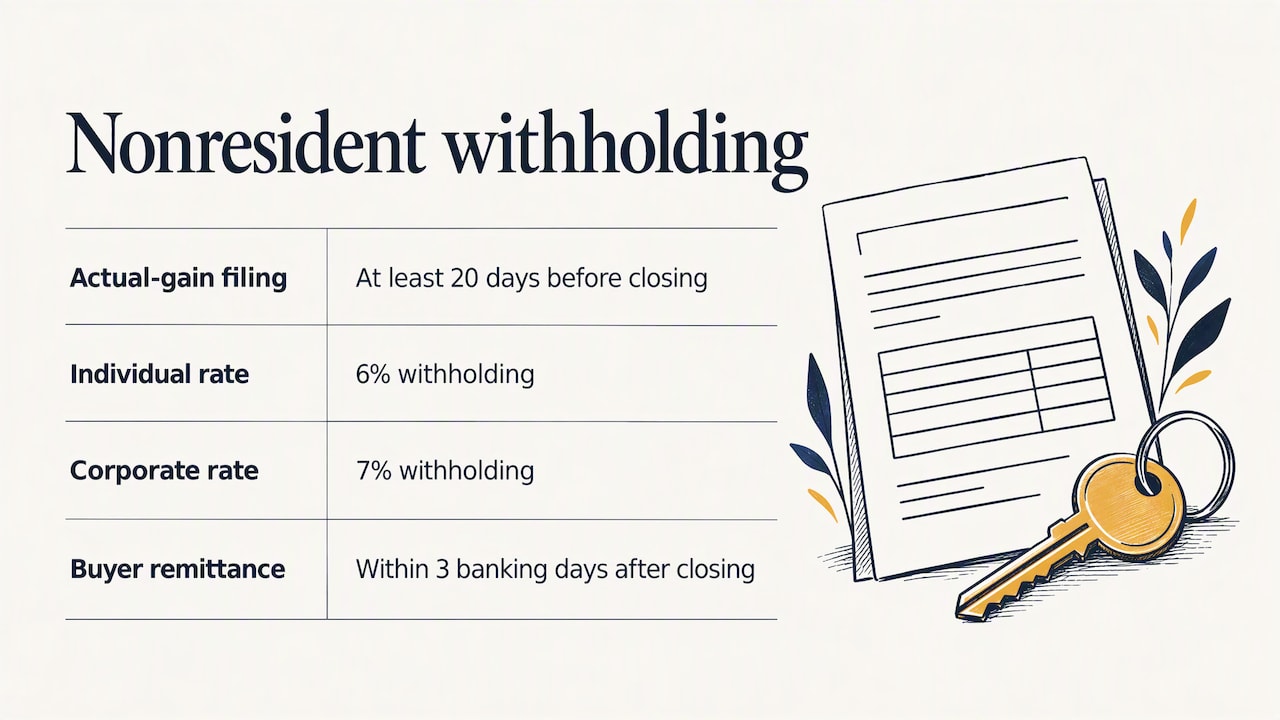
If this applies to you, do not choose a closing date that is less than 20 days out without talking to your attorney first.
Certificate of No Tax Due on higher-value homes
For sales on or after July 1, 2026, the same Division of Taxation presentation states that residential property assessed at over $1 million needs a Certificate of No Tax Due provided to the buyer, to be requested at least 10 business days before closing. If your home is in that bracket, work that into the calendar when you set the date.
An attorney-led closing
Rhode Island closings are more legal-heavy than in many states. The state’s Insurance Bulletin 2020-8 explains that a non-attorney closing agent must give a written disclosure that they cannot give legal advice, and it reflects the position that core tasks like title examination and drafting the deed belong to a licensed attorney. For you, that means your closing date depends on an attorney’s schedule and on a clean title search. Ask early whether any liens, old mortgages or probate matters could slow things down.
What happens on closing day, and what to do the week before
On the day itself, you sign documents, most importantly the deed that transfers ownership, and the settlement agent distributes funds per the final settlement statement. That part is routine. The delays come from small missing items.
The Rhode Island insurance bulletin and our own experience point the same way: closing involves title searches, tax documents and lender funding, so a missing alarm certificate or a late tax discharge can stop the whole process. A short checklist for the week before:
- Call your closing attorney or agent and ask for a status check. Do not wait for closing day.
- Confirm the alarm certificate is in hand and dated within 120 days of the sale.
- Confirm your mortgage payoff figure for the exact date.
- Confirm any tax certificates or discharges are filed and acknowledged.
- Do a final walk-through of the home and confirm everything the contract says stays or goes.
- Ask when and how you will receive your funds.
When you need to move fast
Sometimes the date is not a preference but a deadline: a foreclosure sale date, a bankruptcy filing, an estate that needs settling, a job starting in two weeks. In those cases, the usual 30 to 45 day lender timeline may simply be too long, and a financed buyer’s closing date can slip for reasons you cannot control.
Here is how to pick a date when time is tight:
- Work backward from the hard deadline. Subtract the days needed for the alarm inspection, any tax paperwork and the attorney’s schedule. What is left is your realistic window.
- Ask about buyer financing. A buyer who does not depend on a lender’s approval removes the biggest source of date slippage.
- Say “disbursement date” out loud. If you need cash on a specific day, put that in writing early.
- Be honest about repairs. If the house needs work, a buyer that purchases as-is saves you the time of fixing things before closing. Our guide on selling without repairs covers what that looks like.
If foreclosure is behind the urgency, read our page on how to avoid foreclosure before choosing any date. If an estate is involved, our article on tax consequences when selling an inherited house explains what to sort out first.
Our perspective on closing dates
We buy houses directly from Rhode Island homeowners, and most of the people who call us are not asking for the perfect date. They are asking for a date that works. Often it is because of a repair bill they cannot afford, an inherited house they cannot keep up, or a financial squeeze that has a clock on it.
Here is what we have come to believe. The date should serve the seller, not the process. A traditional sale ties your closing to a buyer’s loan approval, an appraisal and a long chain of steps that you do not control. That is fine when you have time. It is stressful when you do not.
Because we buy as-is, with no agent commissions and no repair requests, the closing can be built around your situation. If you need a few weeks to move out, we can plan for that. If you need to close quickly, we can talk about how fast it can go. What we will not do is pressure you toward a date that does not fit your life.
Our advice to any seller, whether or not you work with us: write down your possession date and your disbursement date before you talk to a buyer, book the alarm inspection early, and ask your attorney what could go wrong with the title. Boring preparation makes the date hold.
— Dave
If you want the date to follow your timeline
If you are weighing a standard listing against a direct cash sale, the main difference for your closing date is who decides the pace. With a cash purchase of your home as-is, there is no lender timeline to wait on and no repair negotiation, so the date can be set around you. You can see how the process works on our page about how cash home sales work, or tell us about your house and the timeline you need. Our page on selling as-is and closing in 7 to 21 days shows what a faster closing can look like.
FAQ
Is it better to close at the end of the month or the beginning?
For buyers, the end of the month usually lowers prepaid interest and pushes back the first payment. For sellers, the day of the month rarely makes a meaningful financial difference. Pick the date that matches your move-out and your need for cash.
Can I change the closing date after signing the contract?
Not on your own. After signing, the date is part of an agreement, so changing it requires the buyer’s consent, and usually a written amendment. Ask your attorney before you promise anything to your landlord, movers or next seller.
Is it normal for closing dates to change?
Yes. The date in the contract is a target, and it often shifts when the title search, lender approval or required certificates run late. Checking in with your closing agent about a week ahead helps you catch problems early.
Is the closing date the day I get my money?
Not always. Signing and disbursement can happen on different days, depending on how the settlement agent releases funds. If you need cash by a certain day, ask your closing agent about the disbursement date as soon as the contract is signed.
Sources
- Consumer Financial Protection Bureau: what to expect in the mortgage closing process
- Neighborhoods.com: What’s the best day to close on a house?
- RISMedia: Does it matter which day of the month your mortgage closes?
- Rhode Island State Fire Marshal: Smoke and Carbon Monoxide Alarms
- Town of Narragansett: Smoke Detector Requirements
- Rhode Island Department of State: Withholding Tax on the Sale of Real Property by Nonresidents
- RI Division of Taxation: Bar Association presentation, June 2026
- RI Division of Taxation: Nonresident withholding election instructions
- RI Department of Business Regulation: Insurance Bulletin 2020-8