
If you own a house in Rhode Island and need to sell it fast, as-is, without paying an agent, a direct cash buyer is the shortest route from “I need out” to money in hand. We buy homes in Rhode Island ourselves, in any condition, with no agent fees, no commissions and no repairs or cleaning on your side. This guide walks through exactly how that sale works here, what it costs, how long it takes and what to know if the reason you are selling is a foreclosure, an inheritance or a house that needs work.
TL;DR
- A direct cash buyer purchases your house as-is, so there are no listings, showings, repairs or agent commissions.
- Rhode Island is an attorney-closing state: a licensed attorney handles the closing, title check and deed recording on every sale.
- Cash deals skip lender steps such as the appraisal, which is why they can close in weeks instead of months.
- Rhode Island law still requires you to disclose known problems with a one- to four-unit home, even when you sell as-is.
- If you are behind on your mortgage, the clock matters: nonjudicial foreclosure here normally takes 60 to 90 days.
Table of Contents
- What “we buy houses” means in Rhode Island
- How a cash sale works, step by step
- What a cash sale costs you in Rhode Island
- Selling as-is still means telling the truth about the house
- Know who you are selling to
- If you are facing foreclosure or preforeclosure
- If you inherited the house
- A note from us
- Get a cash offer for your Rhode Island house
- FAQ
- Sources
What “we buy houses” means in Rhode Island
A cash home buyer is a company or investor that purchases your property directly, with its own funds, instead of helping you list it for a buyer who needs a mortgage. We profit from reselling or renting the homes we acquire, which is why we can skip the agent and the commission and make an offer based on the home’s After Repaired Value, the value the house would have once it is repaired.
That is a different deal from a traditional listing. With an agent you prepare the house, list it, host showings, wait for an offer, then wait again while the buyer’s lender appraises the home and underwrites the loan. A direct purchase removes most of those steps. You keep the decision about when to close.
The sellers who usually get the most from this are:
- Homeowners who need to move quickly because of a job, a divorce or money pressure.
- Owners of houses that need repairs they cannot afford or do not want to manage.
- Heirs who inherited a property they do not want to carry.
- Landlords tired of a rental (selling a rental property fast has its own timeline considerations).
- Homeowners behind on payments who want to sell before foreclosure.
How a cash sale works, step by step
1. Share the basics about the property
You tell us the address, the condition and your situation. You do not need to clean, repair or stage anything. Our step-by-step overview shows the process from first contact to closing.
What goes wrong here when you go it alone: owners spend weeks and thousands of dollars on paint, carpet and small fixes that a buyer then prices around anyway. We buy as-is, so that money stays in your pocket.
2. Receive a cash offer
Our offers are based on the After Repaired Value, and you receive a fair cash offer with no agent commission taken out of it. You decide whether it works for you. There is no pressure to accept and no obligation.
A useful habit with any offer: ask what your net proceeds would be, meaning what you actually walk away with after the mortgage payoff, taxes and closing costs. A listing price that looks higher can net less once a commission, repairs and carrying costs are subtracted. Our page on net proceeds when deciding whether to repair or sell as-is lays out that comparison.
3. Choose your closing date
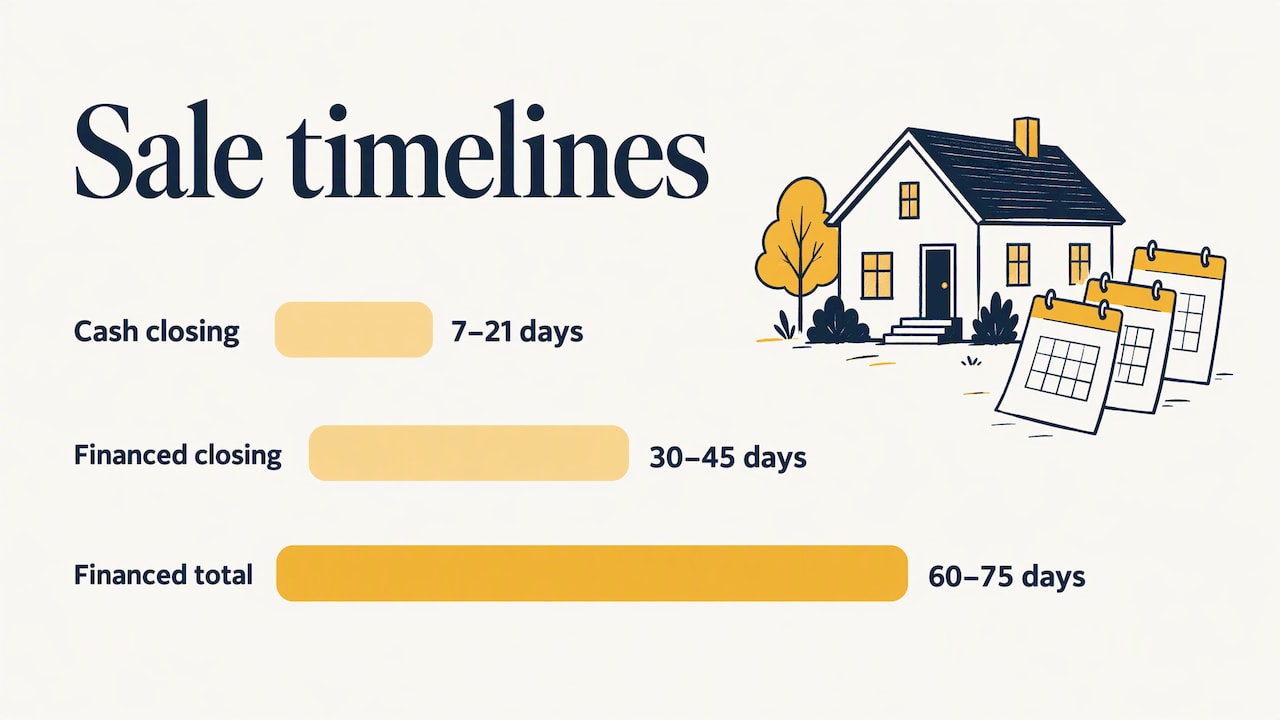
Because there is no mortgage lender in the middle, the closing date is mostly about your schedule. One Rhode Island practitioner describes cash deals closing in two to three weeks, because they skip the appraisal and underwriting that a financed sale needs. A financed sale, by comparison, typically takes 30 to 45 days to close after the offer is accepted, and roughly 60 to 75 days in total once you count the time to find a buyer. Our as-is pages describe closing in 7 to 21 days when you want speed, and you can pick a later date if you need time to move.
4. Close with an attorney
Rhode Island is an attorney-closing state. A licensed attorney conducts the closing, prepares and reviews the legal documents, confirms the title is clear, coordinates the disbursement of funds and records the deed. The same source says the closing meeting itself typically runs 45 minutes to an hour, with the deed recorded in the city or town land evidence office the same day or within one to two business days.
This is a legal step that belongs to the attorney, not to the buyer or seller. It is part of every Rhode Island sale, and we handle it as a normal part of closing, so you do not have to coordinate it alone.
What a cash sale costs you in Rhode Island
The headline benefit is no commission and no agent fee. That does not mean every cost in a sale disappears. Here is what still applies to most Rhode Island sellers.
| Item | What it is | Source |
|---|---|---|
| Conveyance tax | $2.30 per $500 of the sale price, so $1,840 on a $400,000 sale | Quill closing guide, 2026 |
| Mortgage payoff | The balance of any loan, paid from your proceeds at closing | Same guide |
| Final water and sewer bill | Settled up to the closing date | Same guide |
| Municipal lien certificate | Itemizes taxes and assessments that are liens; fee capped at $25, plus $8 to record | R.I. Gen. Laws §44-7-11 |
| Seller’s own attorney | Only if you choose to retain separate counsel | Quill closing guide |
The lien certificate is worth understanding. The tax collector must provide it within five days of a written application, not counting weekends and holidays. It tells everyone at the table whether unpaid property taxes, water charges or other assessments are attached to the house.
If you live out of state, one more item applies. Rhode Island requires the buyer to withhold 6% of net proceeds paid to nonresident individuals, estates, partnerships or trusts, and 7% for nonresident corporations, and send it to the state within three banking days of closing. Closing attorneys are not subject to that requirement. Withholding is not the same as a final tax bill; it is a prepayment you reconcile later. If you are also a foreign seller, FIRPTA withholding rules for sellers add a federal layer, so it is worth planning for before the closing date.
Selling as-is still means telling the truth about the house
Selling as-is means you do not repair anything. It does not mean you can stay silent about known problems. Under Rhode Island’s seller disclosure law, as amended in 2024, the seller of a one- to four-unit home must give the buyer a written disclosure of all known deficient conditions before the purchase agreement is signed. The form is not a warranty. It tells the buyer to estimate repair costs and do their own inspections. Buyers also get a 10-day period to inspect the sewage system for cesspools.
In practice, this is simple: write down what you know, such as the leaking roof, the old oil tank or the basement water. With a buyer who is already planning for repairs, those items are already priced into the offer. If you want to see how condition affects value, our guide on selling a house with no repairs walks through the range, and the page on a failed inspection covers what to do if a previous buyer walked away over one.
Know who you are selling to
Rhode Island changed its rules in 2026 to give home sellers more protection when they deal with buyers who buy and resell homes quickly. According to the state’s 2026 public laws list, a law signed on June 23, 2026 updated real estate licensing to cover repeat wholesalers, and it requires a license, a written disclosure of any assignment of the contract and a three-business-day cancellation right.
In plain terms, “assignment” means a company signs a contract with you and then passes it to a different buyer. For you as a seller, the practical points are:
- Read the contract for any language that lets the buyer assign it to someone else.
- Make sure you know who is actually purchasing your house and whose money is paying for it.
- Keep the full contract and have it reviewed by your closing attorney before you sign.
We buy homes directly and keep them to resell or rent, which is how we earn. The offer you receive from us is for us to acquire the home, not to shop your contract around to someone else.
If you are facing foreclosure or preforeclosure
Time is the main issue. Rhode Island mostly uses nonjudicial foreclosure under a power-of-sale clause in the mortgage, so a lender generally does not need a court order. According to a Rhode Island law firm’s 2025 finance guide, the notice of sale goes out by certified mail at least 20 days before the first newspaper publication, runs weekly for three weeks, and the whole process normally takes 60 to 90 days. There is no right to redeem the property after a nonjudicial foreclosure.
The same year as the law on wholesalers, the legislature also passed a law requiring mortgage foreclosure notice by first class and overnight mail, signed June 24, 2026.
What to do, in order:
- Call your servicer now. Ask about loan restructuring programs. Rhode Island Legal Services also advises homeowners to use free HUD-certified housing counselors and to get legal help, and notes that a straight sale is better than a foreclosure and that a short sale can have tax consequences if debt is forgiven, so talk to an accountant.
- Talk to a Rhode Island attorney about your notice and your rights. Notice requirements under a mortgage are strictly construed here, and an attorney can tell you whether yours were followed.
- Get a cash offer early. A sale before the auction date can pay off the mortgage and may leave you with equity that a foreclosure sale would not.
Our pages on pre-foreclosure options in Rhode Island, how to avoid foreclosure and stopping a foreclosure auction go deeper. If bankruptcy is on the table, see selling before bankruptcy, and speak with a bankruptcy attorney before you decide.
If you inherited the house
An inherited house comes with costs from day one: taxes, insurance, utilities and upkeep, often while the family is still grieving and the contents are untouched. A cash sale lets you sell the property as it stands, furnished or not, without clearing it out or fixing it. The probate court and your attorney decide when you have authority to sell, so confirm that first. Once you do, the sale itself follows the same steps above.
A note from us
Most of the people who call us are not shopping for a real estate transaction. They are trying to get out from under something: a missed payment, a house they can no longer afford to fix, an estate they never asked to manage.
That is why we keep the process plain. We buy houses in Rhode Island and Eastern Connecticut as they are, with no agent fees, no commissions and no repairs or cleaning. You get a fair cash offer based on the After Repaired Value, and you choose the closing date that fits your life, without delays or pressure.
If you want to compare, work out your net proceeds from a listing and from a direct sale side by side. We think the numbers, and the weeks you get back, speak for themselves.
Dave
Get a cash offer for your Rhode Island house
If you want to sell your house as-is, skip the commission and choose your own closing date, we can make you a cash offer on a Rhode Island home in any condition. Start on our Rhode Island cash home buyer page and tell us about the property.

If you would like to see the full process before you reach out, read how cash home sales work or learn about an off-market sale in Rhode Island.
FAQ
How fast can I sell my house for cash in Rhode Island?
Cash sales skip the lender appraisal and underwriting, so they can close in two to three weeks, against 30 to 45 days after offer for a financed sale. Our as-is closings are described at 7 to 21 days, and you can choose a later date if you need it. The attorney-run closing meeting itself usually takes under an hour.
Do I pay agent fees or commissions when I sell to you?
No. We buy directly, so there is no agent and no commission. You may still have normal closing items, such as the conveyance tax, your mortgage payoff and final utility bills, which are paid from the proceeds at the closing table.
Do I need to repair or clean the house first?
No. We buy homes in any condition. You still need to disclose known problems in writing if the home has one to four units, as Rhode Island law requires, but you do not have to fix them.
Can I sell if I am behind on my mortgage?
Yes, as long as the sale closes before the foreclosure sale. Rhode Island foreclosures normally take 60 to 90 days from the start, so the earlier you call, the more options you keep. Also contact your servicer and a Rhode Island attorney about your notices and rights.
Do I need a lawyer to close?
Yes. Rhode Island requires a licensed attorney to run the closing, check the title and record the deed. That step is part of every sale in the state.
Sources
- Real Estate Closing Attorney RI, McCormick Law
- How long does it take to sell a house in Rhode Island?
- How long after an offer is accepted until closing in Rhode Island
- Rhode Island Real Estate Closing Guide, Quill
- R.I. Gen. Laws §44-7-11, municipal lien certificates
- R.I. Gen. Laws §44-30-71.3, nonresident withholding
- Rhode Island Public Law 2024-136, seller disclosure
- Rhode Island 2026 public laws list
- Real Estate Finance: Rhode Island, Pashman & St. Hilaire
- Foreclosure facts brochure, Rhode Island Legal Services
- FIRPTA for Sellers: Withholding Rules and How to Plan