
An off-market sale in Rhode Island means your house is sold without being publicly listed on the MLS or portals like Trulia and Zillow. You sell privately, usually to a direct buyer, an investor or someone who already knows the property. You skip showings, open houses and listing prep. You still owe the same disclosures, the same conveyance tax and the same closing paperwork as any other seller. This guide covers how the process runs, what it costs, where it can go wrong and how to compare a private offer with a listing.
TL;DR
- An off-market sale is a private sale with no public listing. In Rhode Island, the MLS rules say Non-MLS listings may not be publicly marketed.
- Disclosure rules, conveyance tax and title work apply in full. Skipping the MLS does not skip the law.
- A cash offer can be faster and more certain, but it may be lower. Compare estimated net proceeds, not headline prices.
- Homes that need repairs can sell as-is, but you still disclose what you know about the condition.
- Ask for proof of funds and a written offer before you sign anything.
Table of Contents
- What “off market” means in Rhode Island
- Who an off-market sale fits
- How an off-market cash sale works, step by step
- Costs and paperwork in a Rhode Island private sale
- Can a house that needs repairs sell off market as-is?
- Off-market offer vs. listing: compare net proceeds
- Risks to weigh before you accept
- Perspective: what we see from the seller’s side
- Selling to Rhody Home Buyer
- FAQ
- Sources
What “off market” means in Rhode Island
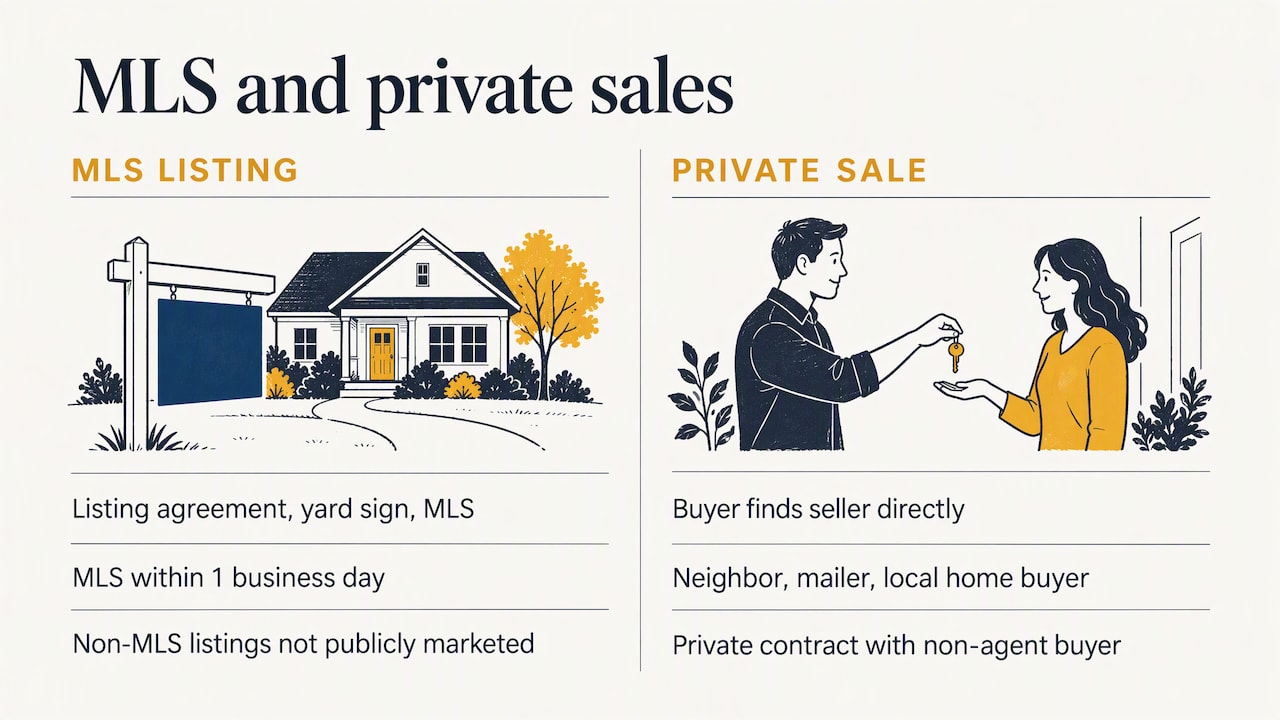
A typical sale starts with a listing agreement, a sign in the yard and a listing in the MLS. An off-market sale skips that step. The buyer finds you directly, through a neighbor, a mailer, a call to a local home buyer or an agent’s private network.
The Rhode Island MLS has its own rules about this. Its rules and regulations say that Non-MLS listings may not be publicly marketed. They also say Coming Soon listings need a signed listing agreement and may not be shown until their expected active date. A listing broker must submit a property to the MLS within one business day of publicly marketing it.
That last rule is why a house that is quietly being sold “off market” by an agent is not advertised on the open web. If someone publicly pushes a property, it belongs in the MLS. If you work with an investor or direct buyer who is not an agent, you are not using the MLS at all. You are making a private contract between two parties.
You may see Facebook groups and wholesaler posts that share “off-market deals” across New England. Those posts are marketing by investors looking for inventory. Treat them as a way for buyers to find sellers, not as a guarantee of a better price for you.
Who an off-market sale fits
A private sale makes the most sense when speed, privacy or condition matters more than squeezing out the last dollar. Common situations in Rhode Island include:
- A home that needs repairs you cannot afford or do not want to manage.
- An inherited house that is far away, empty or costing you carrying costs every month. Our guide to tax consequences when selling an inherited house covers the money side.
- A tight deadline, such as a job move, a divorce or a looming foreclosure or bankruptcy. See our steps for selling before bankruptcy.
- A seller who simply does not want strangers walking through the house.
- Work done without permits, which can complicate a listed sale. We lay out three options for unpermitted work.
If your house is in good shape, you have time and your goal is the highest possible price, a traditional listing exposes the home to more buyers. We say that plainly because the right choice depends on your situation, not on ours.
How an off-market cash sale works, step by step
The sequence is similar everywhere. Redfin’s overview of cash offers describes it as reviewing the offer, signing the purchase agreement, completing inspections and title work, then signing closing documents, transferring funds and recording the deed. In Rhode Island it looks like this.
- Contact and basic details. You share the address, the condition and your timeline. A direct buyer reviews the property and the neighborhood.
- Written offer. Buyers can make cash offers through an agent or directly to the seller. The process includes proof of funds, a written offer, acceptance and contract signing, according to the same Redfin guide.
- Proof of funds. Before accepting, ask to see a bank or investment-account statement showing the buyer can complete the purchase.
- Purchase and sale agreement. This sets the price, the closing date, who pays which costs and what happens if either side backs out.
- Title search and closing prep. Cash sales skip mortgage paperwork, but Zillow notes they still involve title and escrow work and a deed transfer.
- Closing. You sign the deed and closing documents, funds are transferred and the deed is recorded.
We walk through our own version of this on the page about how our cash purchase process works.
How fast can it close, and what slows it down?
The honest answer is that it depends on the buyer and the file, not on the absence of a listing. With no lender, there is no appraisal and no loan underwriting to wait for. That removes the most common source of delay on a financed sale. What remains is the work every Rhode Island closing needs:
- Title problems. Unpaid liens, old mortgages that were never discharged or unclear ownership after a death can take time to clear.
- Payoff letters. If you have a mortgage, your lender must provide a payoff figure before closing.
- Estate paperwork. An inherited house usually cannot close until the person signing has legal authority to sell.
- Tax paperwork. For residential sales assessed over $1 million, a Certificate of No Tax Due is required as of July 1, 2026, and the seller requests it at least 10 business days before closing, according to the Division of Taxation.
- Your own move. Many sellers need time to pack. A flexible closing date is a real advantage of a private deal. Read how to choose your closing date as a Rhode Island seller.
Because timing depends on title and your documents, ask any buyer for a target closing window in writing and what it assumes.
Costs and paperwork in a Rhode Island private sale
Skipping the listing removes agent commissions and marketing costs. It does not remove the state’s requirements.
Conveyance tax
The Rhode Island Division of Taxation says the seller pays the Real Estate Conveyance Tax unless the parties agree otherwise. The rate is $3.75 per $500 of consideration, with an additional $3.75 per $500 on residential consideration above the statutory threshold. The tax is traditionally paid by closing attorneys, who hold the funds in escrow and send them to the city or town when the deed is recorded.
A quick example at the base rate only: a $400,000 sale is 800 units of $500, and 800 times $3.75 is $3,000. If your price crosses the threshold, the additional charge applies to the part above it, so check the Division’s page or ask your closing attorney for the exact figure. For more on how closing costs and concessions get negotiated, this breakdown of seller concessions and closing costs is a helpful companion.
Disclosures
Sellers must disclose known deficient conditions in writing before signing a purchase and sale agreement, according to a Rhode Island seller guide. For homes built before January 1, 1978, state and federal law also require sellers to disclose known lead hazards, share inspection results and provide a lead booklet, as the same guide explains. Selling to an investor does not erase these duties. If you are unsure what counts as a known condition, ask your closing attorney before you sign.
Who runs the closing
A title insurance agent who is not a licensed attorney must give a disclosure notice at a residential closing, stating that they are not an attorney and do not represent either party. That comes from Insurance Bulletin 2020-8 from the Department of Business Regulation. The bulletin also discusses the Rhode Island Supreme Court’s decision in In re Paplauskas, which separates closing tasks title agents may perform from those reserved for attorneys. If you want someone representing your interests, you can hire your own attorney.
The Consumer Financial Protection Bureau describes the settlement agent’s role in mortgage closings as coordinating obligations, collecting and disbursing funds, preparing transfer documents and submitting them for recording. Cash closings follow the same logic, without the loan documents.
Can a house that needs repairs sell off market as-is?
Yes. Selling as-is means you do not fix, clean or upgrade the home for the buyer. It does not mean you can hide problems. You still disclose what you know in writing. The buyer then prices the condition into the offer.
Direct buyers who plan to repair and resell, or rent the property, are built for this. Our offers are based on the After Repaired Value, the estimated value once the home is fixed, with repair needs reflected in what we offer. You do not pay for a cleanout, staging, contractors or an agent.
If you are weighing repairs against a sale, these two pages help you run the numbers: net proceeds first, repair or sell as-is and expect 5% to 30% less, sell as-is or take a cash offer. For a broader look, see selling your house without repairs.
Off-market offer vs. listing: compare net proceeds
The biggest mistake sellers make is comparing two numbers that mean different things. A listing price is a hope. A written cash offer is a commitment. Uber Realty suggests putting the written direct offer next to a supported open-market estimate and comparing estimated seller proceeds after costs, since a higher price alone does not show which choice leaves you with more.
Build your own comparison with these lines:
| Line item | Off-market cash offer | Traditional listing |
|---|---|---|
| Sale price | Written offer amount | Realistic estimate from recent comparable sales |
| Agent commissions | Usually none with a direct buyer | Negotiated in the listing agreement |
| Repairs and cleaning | None if sold as-is | Whatever it takes to list well |
| Carrying costs while waiting | Short window | Taxes, insurance, utilities and any mortgage for each month on the market |
| Conveyance tax | Paid by seller unless agreed otherwise | Same |
| Certainty of closing | Depends on proof of funds and title | Depends on the buyer’s financing and inspections |
The Realtor.com guidance for sellers points the same way: cash can give greater certainty and speed but may come in lower. Buyers may waive or limit contingencies, though inspection issues can still cause a deal to fall through. The same article warns against overlooking contingencies, or choosing an offer without considering proof of funds and timing.
If you have a reverse mortgage, the payoff happens at closing and affects what you net. Selling a home with a reverse mortgage explains the payoff mechanics in general terms. Ask your servicer for the exact figure before you compare offers.
Risks to weigh before you accept
- A lower price. You are paying for speed, convenience and certainty. Know the figure, in dollars, you give up.
- A vague offer. Get the price, closing date, who pays closing costs and any contingencies in writing.
- No proof of funds. Ask for a statement showing the buyer can close in cash.
- A buyer who assigns the contract. Some wholesalers sign with you, then sell the contract to someone else. Ask whether the buyer will close in its own name.
- Pressure. A real offer survives a weekend of thought and a call to an attorney.
Get a second opinion from a Rhode Island real estate attorney before you sign, particularly if there is a mortgage, a lien, an estate or a pending foreclosure involved.
Perspective: what we see from the seller’s side
We buy houses in Rhode Island directly, so we hear the same story often. Someone is tired of a house that has become a burden. Repairs are overdue, bills are stacking up or an inherited property sits empty. They do not need a marketing plan. They need a clean way out.
Our view is that a private cash sale is a tool, not a trick. It works best when the seller can see the full picture: our offer, what a listing might bring after costs and the time each path takes. We base our offers on the After Repaired Value, and we buy as-is, so there are no agent fees or commissions on your side and no repairs or cleaning to arrange. If the numbers show a listing would leave you better off, we would rather you know that than regret the sale later.
What we ask of ourselves is transparency, clarity on the closing date and no pressure. You decide when the deal closes.
— Dave
Selling to Rhody Home Buyer
If an off-market sale sounds like the right fit, we buy Rhode Island homes for cash in any condition, with no agent fees, no repairs and no cleaning. You choose a closing timeline that works for you.

Tell us about your property on our Rhode Island cash home buyer page and we will respond with a straightforward offer. If you want to see the whole process first, read how cash home sales work.
FAQ
Is an off-market sale the same as a For Sale By Owner sale?
No. A FSBO sale is usually still publicly marketed by the owner. An off-market sale is private, with no public listing. You can sell off market with or without an agent.
Do I have to disclose problems if I sell off market?
Yes. Rhode Island sellers must disclose known deficient conditions in writing before signing a purchase and sale agreement. Homes built before 1978 also require lead disclosures. A private buyer does not change those duties.
Who pays the conveyance tax in a private sale?
The seller pays unless the parties agree otherwise, according to the Rhode Island Division of Taxation. The rate is $3.75 per $500 of consideration, with an additional amount on residential consideration above the statutory threshold. The tax is usually collected at closing and sent to the city or town when the deed is recorded.
Will I get less money selling off market?
Often the headline price is lower, but you may avoid commissions, repair costs and months of carrying costs. The way to know is to compare estimated net proceeds from the written offer against a supported listing estimate.
Can I sell a house that needs major repairs off market?
Yes. Direct buyers purchase homes as-is and price the repairs into the offer. You still disclose known conditions, and you should confirm the buyer’s proof of funds before signing.
Sources
- Rhode Island MLS rules and regulations
- Redfin: What is a cash offer on a house
- Zillow: How to sell my house for cash
- RI Division of Taxation: Real Estate Conveyance Tax
- RI Division of Taxation: Certificate of No Tax Due presentation
- Insurance Bulletin 2020-8
- CFPB: Mortgage closing process
- Rhode Island seller guide: what to know to sell your house
- Uber Realty: Cash offer vs. listing your home
- Realtor.com: What sellers should look for in an offer
- Seller concessions and closing costs
- Selling a home with a reverse mortgage