
Yes, you can sell a house with septic problems, including a failing system. You are not required to fix it first in most cases, but you do have to be honest about what you know. The real choice is how you sell: spend months and thousands of dollars on repairs for a financed buyer, or sell as-is to a cash buyer who prices the problem in. At Rhody Home Buyer, we buy Rhode Island homes in any condition, with no agent fees, no repairs and no cleaning, and our offers are based on the After Repaired Value (what the home would be worth once fixed).
TL;DR
- A failing septic system does not make a house unsellable. Sellers repair, give a credit, hold money in escrow, or sell as-is, and known problems must be disclosed in writing in most places.
- In Rhode Island, a cesspool on a property that is sold must be removed from service within one year of the closing date. That deadline is a big reason many buyers ask for a lower price or walk away.
- A system that is old but not failing generally does not have to be replaced just because you are selling, according to Rhode Island DEM.
- Replacement often runs into five figures, so many owners compare a repair-and-list plan against an as-is cash sale by net proceeds.
- Selling as-is never cancels the duty to disclose a defect you know about.
Table of Contents
- Why septic problems scare buyers
- Failing, failed, nonconforming, cesspool: what the words mean
- The Rhode Island cesspool rule at sale
- What you have to disclose
- Your four options
- What repair costs look like
- What a septic inspection involves
- Selling a septic-problem house, step by step
- When septic trouble comes with other problems
- Perspective
- Selling to us
- FAQ
- Sources
Why septic problems scare buyers
A septic system is a buried tank and a drainfield that treat your household wastewater on your own land. Nobody can see most of it. A buyer’s lender and inspector can’t see it either, so a bad report feels like an open-ended bill.
That uncertainty hurts the sale in three ways:
- Financing. Lenders often want a passing inspection, and the EPA notes that inspections may be required by local or state government or by the mortgage lender. A failed report can stall the loan.
- Price. Buyers subtract the full cost of replacement, plus a cushion for the trouble.
- Timing. Permits, soil testing and weather can stretch a repair over many weeks, and a contract can fall apart in the meantime.
If a buyer has already backed out over a septic report, our page on what to do when a buyer backs out of your home sale covers the next move.
Failing, failed, nonconforming, cesspool: what the words mean
The vocabulary decides what you owe, so it is worth getting straight.
- Failing or failed system. Sewage is backing up, surfacing in the yard, or not being treated. Rhode Island DEM says a failing system must be replaced as soon as possible.
- Nonconforming system. It was built to an older standard and doesn’t meet today’s code, but it still works. DEM says that if you are selling and the existing nonconforming system is not failing, replacing it is not necessary.
- Cesspool. A buried chamber that sends sewage straight into the ground. Under the Rhode Island Cesspool Act, all cesspools in the state will eventually have to go, and a sale triggers the clock.
A home inspector’s “unsatisfactory” note is not the same as a legal violation either. A health department in New Jersey makes the point plainly in a 2025 presentation on septic myths: it is false that you cannot sell a house with a malfunctioning system, and false that a system of a certain age must be replaced. Enforcement starts when a verified malfunction is recorded. Rules differ by state and town, so read the Rhode Island ones below as yours.
The Rhode Island cesspool rule at sale
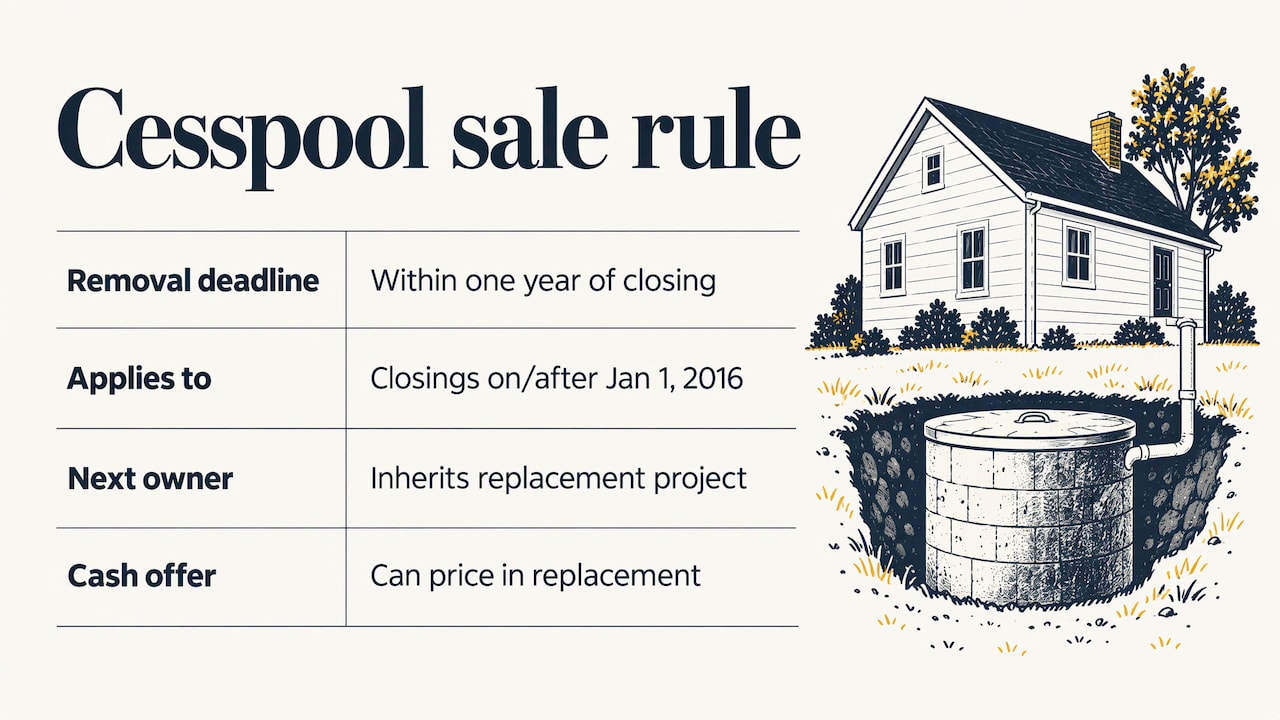
If your home has a cesspool, this is the rule that matters most. DEM states that for a property sold or transferred, the cesspool must be removed from service within one year of the closing date. The Cesspool Act applies to closings on or after January 1, 2016.
In practice, that means the next owner inherits a replacement project. A financed buyer has to budget for it and a lender may object. A cash buyer who plans for the replacement can simply price it into the offer. Check with your town and DEM about your parcel, because the rules also have special zones near drinking water supplies and coastal waters.
What you have to disclose
Disclosure is the part of this process you cannot skip. The Maryland Department of the Environment, in a guide for sellers, advises telling buyers what you know about the system: its age, pumping record, inspection history, the location of the tank and drainfield, and any operational problems. It also notes that all states have disclosure laws.
Two practical points:
- Selling as-is does not erase known defects. The duty to disclose stays. What changes is that you aren’t fixing anything, so the price reflects the condition.
- Rules keep tightening. New York, for example, added a septic question to its seller disclosure form in July 2025, and a seller who skips the form may face liability for actual damages. Rhode Island has its own seller disclosure form, so fill it out fully and honestly.
If you are unsure what a defect means legally, talk to a Rhode Island real estate attorney before you sign anything. Working with a cash buyer does not replace that advice, and a clear written description of the condition protects you.
Your four options
The Septic Guide lays out the standard paths: repair or replace before listing, offer a credit, use an escrow holdback, or sell as-is. Here is how each plays out for a seller who needs certainty.
| Option | What it means | What it asks of you |
|---|---|---|
| Repair or replace first | Fix it, then list with a passing report | Cash up front, permits, weeks or months, and still a full sale process |
| Price reduction or closing credit | Buyer takes the problem, you lower the price | A clear quote, a lender that allows it, and a buyer who stays |
| Escrow holdback | Money is set aside at closing to cover work done later | Written terms, an agreed amount and a deadline |
| Sell as-is for cash | The buyer takes the system as it is | Disclosure, and an offer that reflects the condition |
For an owner dealing with foreclosure, an inherited house, a divorce or a tight budget, the first three options all depend on someone else’s loan or on money you may not have. Our as-is purchase removes that dependency: we buy the home in its current condition, so there is nothing to fix, no inspection contingency to survive and no agent commission to pay.
What repair costs look like
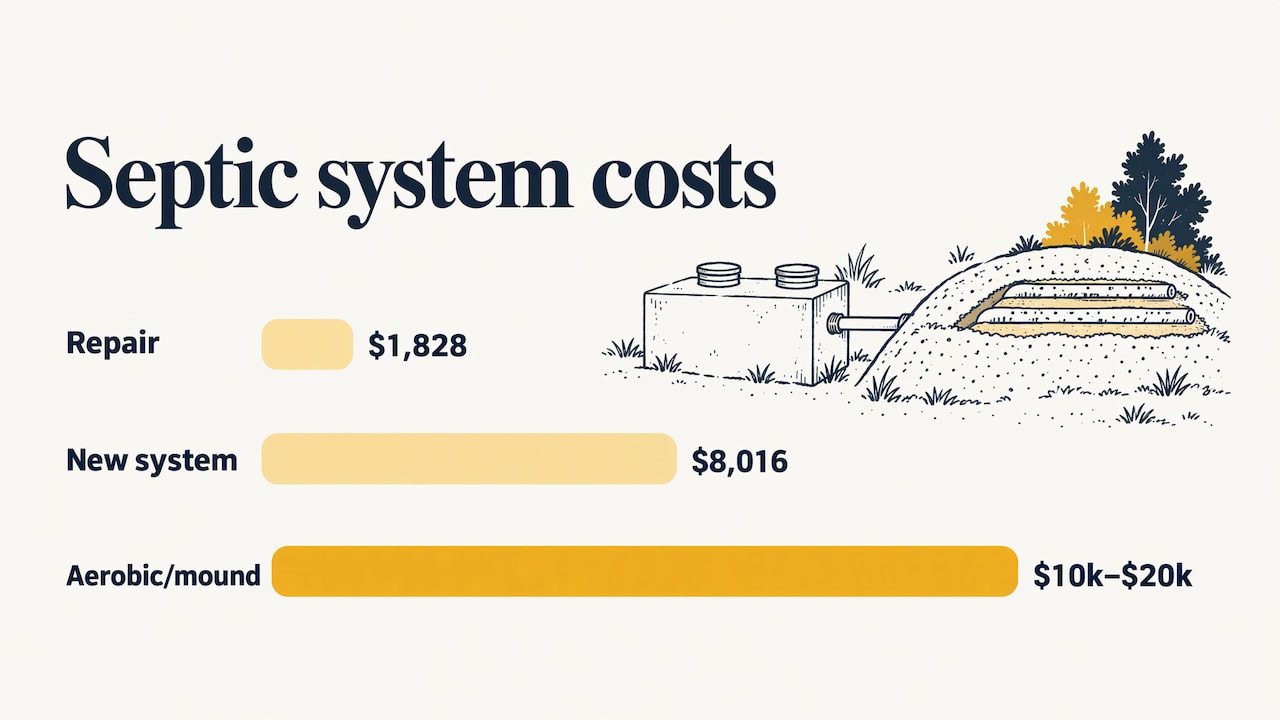
Costs vary a lot by lot, soil and system type, so treat any national figure as a starting point. The Septic Guide cites Angi’s 2026 figures of an average of $8,016 for a new septic system and $1,828 for a repair, with aerobic and mound systems at $10,000 to $20,000. Coastal Rhode Island lots with high water tables or small parcels can need advanced treatment systems, which sit at the top of that range or above it.
A worked example shows why this matters. Suppose a house would sell for $400,000 once fixed, and a replacement quote is $20,000. Repairing first means you spend $20,000, wait for permits and installation, then pay an agent commission on the sale, and the buyer’s lender can still raise other issues. Selling to a cash buyer means the repair cost is absorbed in the offer and you skip commission and carrying costs. Which one nets more depends on your numbers, which is why we suggest comparing offers by what you actually keep. Our guide on deciding by net proceeds walks through that comparison, and cash offers versus financing shows where the costs hide on each side.
If you are weighing small fixes against bigger ones, a guide on what to fix before selling can help you decide where repair money earns its keep and where it doesn’t.
What a septic inspection involves
Whether you sell as-is or repair first, you will want to know what is actually wrong. The EPA says a typical inspection includes reviewing permits and pumping records, opening and checking all tanks, evaluating sludge and scum levels, looking for leaks and backups, and assessing the drainfield. The inspector may also run a camera through the pipes.
The EPA recommends inspections every 1 to 3 years for as long as you own the home. If you have not had one in a while, gather these before talking to any buyer:
- Pumping and maintenance receipts
- The original permit, design or as-built drawing, if you have it
- Any past inspection report
- A description of symptoms you have noticed: slow drains, odors, wet spots, backups
DEM advises working with a registered septic system inspector in Rhode Island to locate and identify your system, so pick one with that credential.
Selling a septic-problem house, step by step
- Find out what you have. Pull records from your town’s building or health office and DEM. Know whether you have a septic system or a cesspool, and when it was last pumped. We can look at your house without a finished inspection, but any records you have speed things up.
- Get the problem described in writing. An inspector’s report or a contractor’s quote gives you a number to work from. It also documents what you disclosed, which protects you after closing.
- Decide whether repair makes sense for you. Repairing helps if you have time, cash and a plan to list with an agent. If you are facing a deadline, a foreclosure timeline or a house you inherited and can’t maintain, repair-first often doesn’t fit.
- Compare real offers. Ask each buyer what the net amount in your hand will be after commissions, repairs, credits and closing costs. A higher listing price can net less.
- Disclose and sign. Complete the seller disclosure with everything you know. Have an attorney review the contract if anything is unclear.
- Close. With a cash purchase there is no lender appraisal to wait on. See how the cash offer process works from first call to closing table.
At step 3 and step 4, this is where we take the work off your hands. We buy as-is, so you don’t hire a septic contractor, you don’t clean out the house, and you don’t pay agent fees or commissions. Our offer is based on the After Repaired Value, and you choose the closing timeline that fits your situation.
When septic trouble comes with other problems
Septic issues rarely show up alone. They often arrive with deferred maintenance, a failed home inspection, unpermitted work or a mortgage that is behind. A few of our pages cover those overlaps:
- Failed inspection: your options as a seller
- Can’t afford home repairs in Rhode Island
- Selling a house with open permits
- Options if you are behind on your mortgage
If the house came to you through an estate, you may not know the system’s history at all. That is fine. Tell the buyer what you know, say what you don’t, and let the price reflect it.
Perspective
Most owners call us after a septic problem has already eaten weeks of their time. A report comes back, a buyer wavers, and the repair quote lands on top of a mortgage payment, a tax bill or an estate nobody wants to manage.
Our view is that a septic problem is a pricing question, not a verdict on the house. We buy homes as-is in Rhode Island and Eastern Connecticut, we base our offers on the After Repaired Value, and we don’t ask you to fix, clean or stage anything. There are no agent fees or commissions taken out of what you receive.
That is why we think the cash route is the right first call for an owner who is short on time or money: you decide the closing date, and you aren’t gambling on whether a buyer’s lender likes your drainfield.
Dave
Selling to us
If you own a home in Rhode Island or Eastern Connecticut with a failing septic system or a cesspool, we will make you a cash offer for it as it stands. We don’t charge agent fees or commissions, and you don’t repair or clean anything. You pick the closing timeline, and you can read how it works on our cash home buying page or start directly on Rhody Home Buyer.

If you want the full picture of what to expect, our page on how a cash sale works when we buy houses in Rhode Island lays out each stage.
FAQ
Can I sell a house with a failed septic system?
Yes. Failed systems are sold regularly, and in most states the law requires disclosure rather than a repair. In Rhode Island a failing system should be replaced as soon as possible, and a cesspool must be taken out of service within a year of closing. A buyer can take on that work, which is how as-is sales happen.
Do I have to replace a cesspool before I sell?
Not before the sale, according to DEM’s rule: the requirement is that the cesspool be removed from service within one year of the closing date. Check with your town and DEM about your parcel, since special protection zones can add conditions.
Do I still have to disclose septic problems if I sell as-is?
Yes. As-is describes the condition and the price, not your duty to share what you know. Describe the problems you are aware of, in writing, on the seller disclosure form.
Is an old septic system a reason to replace it before selling?
Not by itself. DEM says that when you sell and your nonconforming system is not failing, replacement isn’t necessary. A system that is working but older than current code is treated differently from one that is failing.
Sources
- Can You Sell a House With a Failing Septic System? (The Septic Guide)
- OWTS Cesspool Phaseout (Rhode Island DEM)
- Onsite Wastewater Treatment Systems (Rhode Island DEM)
- Septic Systems in Hunterdon County (health department presentation)
- Homebuyer’s Guide to Septic Systems (US EPA)
- Frequent Questions on Septic Systems (US EPA)
- Buying or Selling a Home with an Onsite Wastewater System (Maryland Department of the Environment)
- New York Property Condition Disclosure Act: 2025 Updates