
If your move date is fixed, the sale has to fit around it, not the other way around. The cleanest way to do that is to choose the sale route first: a traditional listing when you have months, or a direct cash sale when you don’t. With a cash sale you set the closing date, skip showings and repairs, and you don’t pay agent commissions. If you own in Rhode Island or Eastern Connecticut, Rhody Home Buyer buys homes as-is for cash, which is built for exactly this situation.
This guide walks through the timeline math, the three ways to sell, what to do when you have already moved, how to close from another state, and the special cases that trip people up: inherited homes and mortgages that have fallen behind.
TL;DR
- Start from your possession date, the day you must be out or need keys elsewhere, and work backward. Listing is the last step in the plan, not the first.
- A traditional sale is quick when the market is hot, but contracts can still slip: NAR’s April 2025 survey found 7% terminated and 10% delayed in the prior three months.
- Compare offers on what you keep after repairs, fees and every month of carrying costs, not on the headline price.
- You can close from out of state. Rhode Island closings are usually run by an attorney, so line that person up early.
- If you are behind on the mortgage or inherited the house, sort out who can sign and what you owe before you pick a buyer.
Table of Contents
- Start with the date you must be gone
- Three ways to sell, and what each asks of you
- Compare offers on net proceeds, not price
- Does the house need repairs? You may not have to fix them
- If you have already moved
- Closing from another state
- Special situations that change the plan
- Selling to Rhody Home Buyer
- Our view on relocation sales
- FAQ
- Sources
Start with the date you must be gone
Most relocations have two dates. The first is the day you want to move. The second is the latest day you can move without real cost: a job start date, a lease beginning elsewhere, or a second mortgage payment you can’t carry. Write both down. The second one is the deadline your sale has to beat.
Then count backward. A rough formula looks like this:
- Take your latest safe move date.
- Subtract a buffer of two to three weeks for appraisal questions, lender requests, inspection negotiations and moving logistics.
- Subtract the time from signed contract to closing.
- Subtract the time a listing typically sits before it gets an offer.
The market numbers give you something to plug in. In its April 2025 survey, the National Association of Realtors reported a median of 29 days on market, with contracts typically closing in 30 days. That is a snapshot of one month nationally. It will not match a slow stretch in a specific Rhode Island town, and it moves with the season and with interest rates, so treat it as a reference for the arithmetic, not a promise.
Here is a worked example. Your new job starts on 1 March and you need to be in your new place by 15 February. Allow 3 weeks of buffer, 30 days to close and, say, 30 days on market. Your listing would have to go live roughly 3 months before the 15th, in mid-November, with the house photo-ready. If it is already mid-November and nothing is prepped, the listing route has no slack left, and a sale where you choose the closing date becomes the more realistic plan.
The same survey is a reminder that contracts do not always hold: 7% of contracts were terminated and 10% had delayed settlements over the prior three months. A deal falling through two weeks before you leave costs you a restart, and each restart costs weeks.
Three ways to sell, and what each asks of you
There are three basic routes. They differ in speed, effort and what ends up in your pocket.
| Listing with an agent | Selling it yourself | Direct cash sale | |
|---|---|---|---|
| Your timeline | Set by the market and the buyer’s lender | Same, plus your own marketing time | You choose the closing date |
| Showings and prep | Cleaning, staging, repairs, open times | All of it, plus coordinating visits | None: the home is bought as-is |
| Commissions | Paid from your proceeds | You skip your own agent but still deal with buyers’ agents | None |
| Financing risk | Buyer’s loan and appraisal can fall through | Same | Cash purchase |
| Best when | You have many months and a move-in-ready home | You live nearby and have time | Your date is tight, or the home needs work |
The distance matters more than people expect. Showings, a lockbox, contractor visits and last-minute fixes all assume someone is local. Once you have moved, that someone is you on a plane, or a friend you are asking for favors.
If you want to see how a market sale works in detail, this overview of selling a house as is covers disclosures and pricing. For a relocation with a hard deadline, the question to ask of any route is simple: what happens if it takes six weeks longer than planned?
What a cash sale takes off your plate
With Rhody Home Buyer you sell your house as-is. There are no agent fees or commissions, and no repairs or cleaning before the sale. Our offers are based on the After Repaired Value, meaning the value of the home once it has been fixed up, and we close on the timeline that suits you. When you are juggling a job, a lease and a moving truck, that is four fewer things to coordinate. You can read how it works on our page about how a cash sale works in Rhode Island.
Compare offers on net proceeds, not price
A higher list price does not always mean more money. What counts is what is left after everything that comes out of the sale. Add up:
- Agent commissions, if you list with one.
- Repairs a buyer will ask for or an inspection will turn up.
- Closing costs. In Rhode Island that includes the state real estate conveyance tax, which is $3.75 for each $500 of the price at the base tier, with an additional tier for higher-priced residential property.
- Carrying costs for every month the house stays unsold: mortgage, utilities, insurance, lawn and snow care.
That last item is the one relocators forget. If you are paying a mortgage on the old home and rent or a mortgage on the new one, each extra month on the market is a real cost, and a vacant house needs someone to watch it. A quick way to see the effect: take your monthly carrying cost and multiply it by the extra months a listing might take compared to a fixed closing date. Subtract the commission and repair estimate too, and compare that total to a cash offer.
We built a walkthrough of this arithmetic in how to calculate net proceeds from a home sale. Run it with your own mortgage balance and monthly costs, and see which route leaves you ahead by your move date.
Does the house need repairs? You may not have to fix them
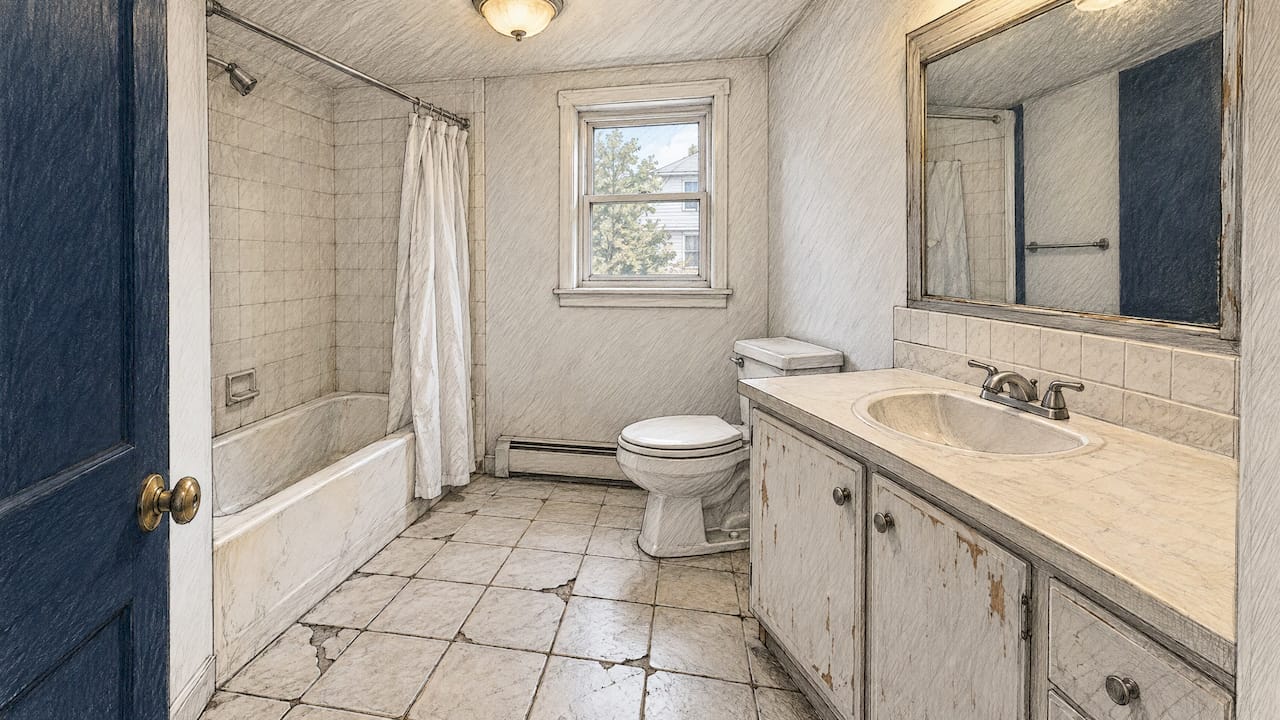
Relocators often face a choice: spend weeks on a roof, a kitchen or a bathroom to get top dollar, or sell without touching it. If you are already two states away, managing contractors is hard, and every delay pushes your closing back. Selling as-is means a buyer takes the house in its current condition, so there is nothing to schedule and nothing to inspect for repairs. Rhody Home Buyer buys homes in any condition and makes its offer based on the After Repaired Value, so you don’t need to clean out or fix a thing first.
If you have already moved
Plenty of people leave first and sell second: the job started sooner than the house could sell. That is workable, but it needs a short list of arrangements before you do anything else.
- Name a local contact. A relative, friend or neighbor who can let people in, meet a locksmith and check the house after a storm.
- Call your insurer. A vacant house is often treated differently from an occupied one, so ask how long you are covered and what is required.
- Get your payoff figure. Ask your lender for the amount needed to pay off the mortgage, so you know the minimum the sale has to bring in.
- Decide who pays the bills. Utilities should stay on, and the heat must keep running through a Rhode Island winter to protect the pipes.
- Keep digital copies of your deed, mortgage statement and any disclosures you filled out.
Because a vacant home costs money every month and gets harder to manage from a distance, a defined closing date helps. You can pick the date, hand over the keys and be done. Our page on choosing your closing date as a Rhode Island seller explains how that choice works.
Closing from another state
You do not have to travel back to sign. A title company can run a virtual closing using remote online notarization, electronic signatures and a secure video call. Great East Title describes the process: the title company asks for your authorization to collect payoff information from your lender, and its attorney prepares the deed that transfers ownership.
In Rhode Island, much of this is legal work. A Rhode Island law firm explains that closings are usually run by a licensed attorney, who can coordinate electronic review and courier delivery of any original documents. Practical steps:
- Tell the closing attorney early where you will be on signing day.
- Ask which documents can be signed electronically and which need a notary or witnesses.
- Make sure the name on your ID matches the name on the deed.
- Verify any wire instructions by calling a phone number you have confirmed independently. Wire fraud targets closings.
If an attorney has questions about your particular situation, such as a deed with multiple owners or a trust, that is an attorney’s call. Ask them before you accept a closing date from any buyer.
Special situations that change the plan
You inherited the house and live elsewhere
Inheriting a property and moving at the same time is common, and the paperwork is the real obstacle. Being a beneficiary does not by itself give you the power to sign a deed. Whether the house is still in an estate, held in a trust, or already distributed to heirs changes who must sign, and a power of attorney generally ends when the person who granted it dies. Rules differ by state, so in Rhode Island the probate court and an estate attorney confirm who has authority. If several heirs share the house, all of them are sellers, or one must hold written authority for the rest.
Settle that before you agree to any closing date. Once signing authority is clear, an as-is cash sale is a simple fit for an inherited home that nobody wants to clean out from afar.
Your mortgage is behind
If a relocation has come with a job loss, a pay cut or a second set of housing bills, your first priority is to stop the clock. Nolo’s attorney-written guide says the time before foreclosure begins is typically the best time to sell, and that in most cases a servicer cannot officially start foreclosure until the borrower is more than 120 days delinquent. Waiting until late in the process can leave you too little time to prepare the house and may force a low asking price.
The first step is a payoff quote from your servicer, so you know whether a sale covers the loan. If it doesn’t, talk with a housing counselor or attorney about a short sale or other options. Our pages cover pre-foreclosure options in Rhode Island, how to avoid foreclosure and what to do if you are behind on your mortgage. If you are also dealing with a job loss, see selling after a job loss in Rhode Island.
Selling to Rhody Home Buyer
We buy houses for cash across Rhode Island and Eastern Connecticut. You don’t pay agent fees or commissions, you don’t repair or clean anything, and you decide when you close. Our offers are based on the After Repaired Value. If your move date is set and you would rather not depend on showings and a buyer’s loan, tell us about your house and we will tell you what we can offer.

If you want to read first, how cash home sales work explains each step from first call to closing.
Our view on relocation sales
Most people who call us about a relocation are not short on options. They are short on days. The house has to be sold, the new place has a start date, and every week of showings, repair quotes and waiting for a buyer’s loan is a week they don’t control.
That is why we think the closing date should belong to the seller. When we buy a home as-is, there is no staging, no repair list and no commission to subtract. We make our offer based on the After Repaired Value, and the homeowner decides when to close.
Our advice: before you list anything, decide your latest safe move date, work out what a month of carrying costs really is, and get a cash offer next to your list-price estimate. When the numbers sit side by side, the right choice is usually clear. We work with homeowners in Rhode Island and Eastern Connecticut, and we would like to be that second number for you.
Dave
FAQ
How long does it take to sell a house when relocating?
A traditional sale means time on the market plus time to close. NAR’s April 2025 survey put the median at 29 days on market and contracts typically closing in about 30 days, so plan for two to three months with a buffer. A cash sale lets you set the closing date, which is why it suits a fixed deadline.
Can I sell my house if I have already moved out of state?
Yes. You need a local contact for access, an insurer who knows the house is vacant, and a closing attorney who can handle remote signing. Rhode Island allows remote online notarization through approved providers, and originals can be couriered.
Do I have to make repairs before selling?
Not if you sell as-is. With a cash buyer such as Rhody Home Buyer, you don’t repair or clean, and the offer is based on the After Repaired Value. If you list on the open market, expect buyers to ask for repairs after their inspection.
What if I’m behind on my mortgage and need to relocate?
Get a payoff quote from your servicer first, so you know what a sale must cover. Selling before foreclosure starts gives you the most options, and in most cases foreclosure can’t start until you are more than 120 days delinquent. Speak with a housing counselor or attorney about your specific loan.
Sources
- NAR Realtors Confidence Index, April 2025
- Rhode Island Division of Taxation: Real Estate Conveyance Tax
- Great East Title: Sellers Title Services
- Senerchia & Senerchia: Out-of-State Home Closings in Rhode Island
- Nolo: How to Sell Your House Before Foreclosure
- Real Simple Housing: How to Sell a House As Is