
If you own a house in Rhode Island but live somewhere else, you can sell it without moving back. You need to settle who signs, what you disclose, what you owe at closing and who watches the property until the deed transfers. A cash sale to a direct buyer shortens most of that list, because there are no showings, no repair negotiations and no staging to supervise from far away.
This guide covers what “absentee owner” means when you sell, the Rhode Island rules that matter, the costs that reduce your proceeds, how cash and agent-listed sales compare, and how to keep a vacant house safe while the sale is pending.
TL;DR
- An absentee owner is anyone who owns a property but does not live in it. You can sell from anywhere, as long as the signing and notary steps are arranged correctly.
- Rhode Island requires sellers of one-to-four-unit homes to disclose known deficient conditions in writing. You do not have to inspect the house, but you must not hide what you know.
- Notaries in Rhode Island can only act while physically in the state, so out-of-state sellers usually plan around a power of attorney or a closing arranged near where they live.
- Conveyance tax, mortgage payoff, liens and unpaid taxes come out of your proceeds. Ask for a payoff figure and a title search early.
- A cash, as-is sale removes repairs, cleaning and showings, which is where most remote sellers lose time.
Table of Contents
- What selling as an absentee owner actually means
- Rhode Island disclosure rules when you do not live there
- Paperwork and signing when you cannot attend the closing
- What comes out of your proceeds
- Cash sale or agent-listed sale: how they compare
- How to sell an unoccupied house for cash, step by step
- Protecting a vacant house while the sale is pending
- Our perspective
- Ready to sell without the trip?
- FAQ
- Sources
What selling as an absentee owner actually means
An absentee owner holds title to a property but lives elsewhere. In Rhode Island that is a very common situation. Typical examples:
- A landlord whose tenant moved out and who now lives in another state.
- Heirs who inherited a family house and live far away.
- Someone who relocated for work and kept the house, then found the carrying costs too high.
- An owner of a vacant, run-down property who cannot make repeated trips to deal with it.
The legal path to a sale is the same as for any owner. The difference is logistics. Nobody is there to let in a buyer, meet an inspector, hand over keys or notice a burst pipe. Everything you would normally do in person has to be done through documents, local helpers or a buyer who does not need any of it.
Before you decide how to sell, settle five things:
- Who holds title. Check the deed. If two siblings or a former spouse are on it, every owner must agree and sign.
- What you owe. Request a mortgage payoff statement and look for home equity loans, tax liens and unpaid municipal bills.
- Who can sign for you. If you cannot travel, decide whether you will sign remotely at a closing arranged near you or appoint an attorney-in-fact.
- What condition the house is in. Ask someone you trust to walk it and take dated photos and video.
- Who has the keys. Know exactly who can enter, and change locks if the history is unclear.
If the property came to you through a death, the tax picture has its own wrinkles. Our page on tax consequences when selling an inherited house walks through them.
Rhode Island disclosure rules when you do not live there
Rhode Island law requires a seller of a one-to-four-unit residential property to give the buyer a written disclosure of all deficient conditions the seller has actual knowledge of. The same statute says the seller has no affirmative duty to inspect the property, according to Rhode Island’s real estate disclosure statute.
For an absentee owner this has a practical consequence. The duty turns on what you actually know. If you have not been inside the house in three years, you cannot truthfully describe its current condition, and you should not guess. State what you know, say when you last saw the property, and say what you do not know. If a neighbor or caretaker told you about a leak or a bad roof, that is knowledge, and it belongs on the form.
A few habits protect you:
- Keep a written record of every repair, insurance claim and problem you have been told about.
- Do not fill in “none” on a line you have not checked.
- If a prior tenant, contractor or neighbor reported something, disclose it rather than hoping it goes unmentioned.
- Ask your closing attorney to review the form before it goes to the buyer.
Can you sell as-is when the house needs repairs?
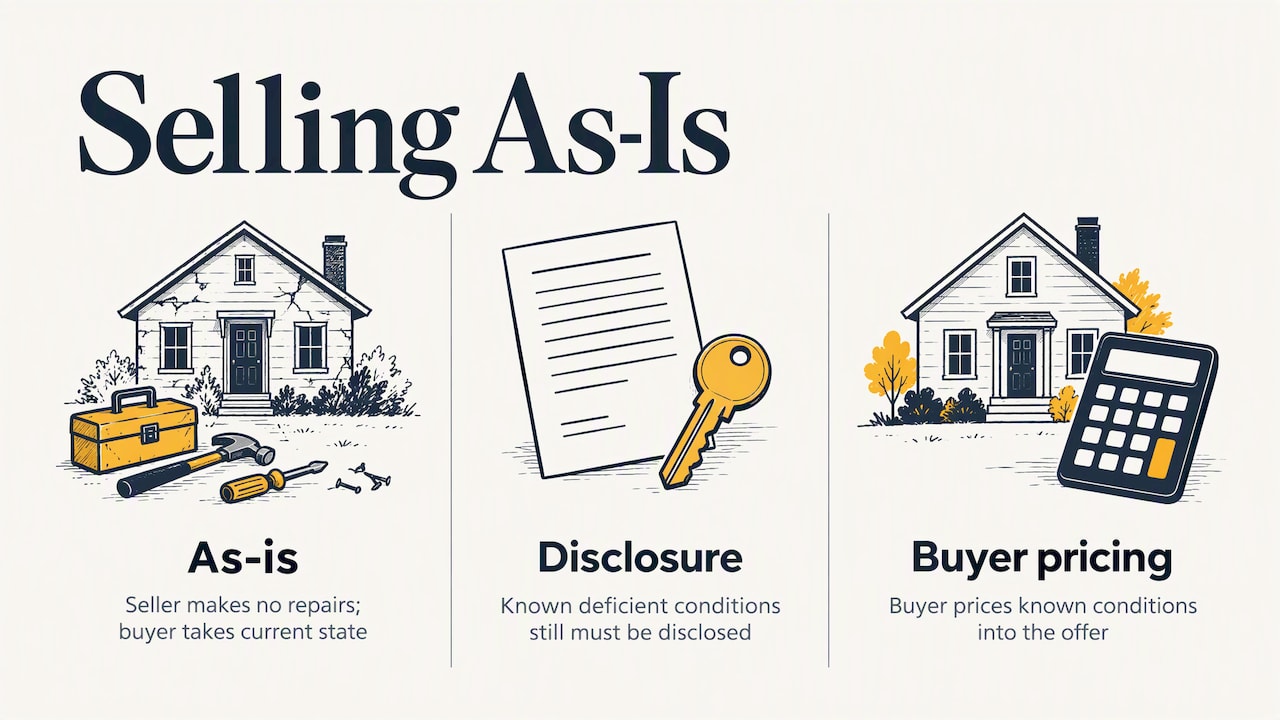
Yes. Selling as-is means you agree to make no repairs and the buyer takes the house in its current state. It does not cancel the disclosure duty. You still tell the buyer about the deficient conditions you know of, and the buyer prices them in. Because a cash buyer expects problems, the disclosure rarely becomes a negotiation. If you are weighing how much repair work is worth doing before a sale, read our breakdown of what an as-is sale costs you compared with fixing up first.
Specific problems have their own pages: smoke odor, pet damage and a house you cannot clean out are all common in absentee-owned homes, and none of them has to stop a sale.
Paperwork and signing when you cannot attend the closing
This is where remote sellers get stuck, so plan it first.
Who runs a Rhode Island closing
Rhode Island closings are attorney-centered. The state’s Supreme Court has set out which tasks a licensed title insurance agent may perform in a residential closing and which must be done by a licensed attorney, and the Department of Business Regulation requires a disclosure notice when a non-attorney title agent conducts the closing, per DBR Insurance Bulletin 2020-8. Practically, hire a Rhode Island closing attorney early and tell them at the start that you will not be present.
Notary limits
A Rhode Island notary can perform notarial acts only while physically within the state’s borders, according to the Rhode Island Notary Public manual. That means a Rhode Island notary cannot notarize your signature while sitting in the state and you sit in another one over video. Your usual options:
- Sign near home. Your closing attorney sends the documents to you, and you sign before a notary where you live. Ask the attorney which form of notarial certificate they need so the paperwork is accepted for recording.
- Use a power of attorney. You appoint someone you trust to sign for you in Rhode Island. The same manual notes that a power of attorney for a real estate transaction must clearly state the agent’s capacity, for example “John Doe as attorney-in-fact for Betty Smith.”
- Travel once. Sometimes a single short trip is simplest, particularly when title is held by several people.
If you use a power of attorney, have the closing attorney review it before you sign. Title companies and lenders can be strict about the wording, and a document that looks fine to you can be rejected at the table. Also expect the buyer’s side to want the original or a certified copy, so allow mailing time.
Documents to gather
- Photo ID and the deed or the probate paperwork showing your authority
- Mortgage payoff statement and account details
- Recent tax bills and any water, sewer or other municipal balances
- Keys, garage openers, alarm codes and utility account information
- Death certificate and letters of authority, if you are selling as an executor or administrator
Our page on shaving a week off a cash closing covers the title, notary and checklist steps that tend to cause delays.
What comes out of your proceeds
A sale price is not what you receive. For an absentee owner, three categories matter most.
Rhode Island conveyance tax
The state’s conveyance tax is $3.75 for each $500 of consideration, or fraction of it. Residential property pays an additional $3.75 per $500 above a statutory threshold, per the Rhode Island Division of Taxation. Check the Division’s page for the current threshold and for who customarily pays in your transaction, then have your attorney confirm the exact number on your closing statement.
Higher-value homes: Certificate of No Tax Due
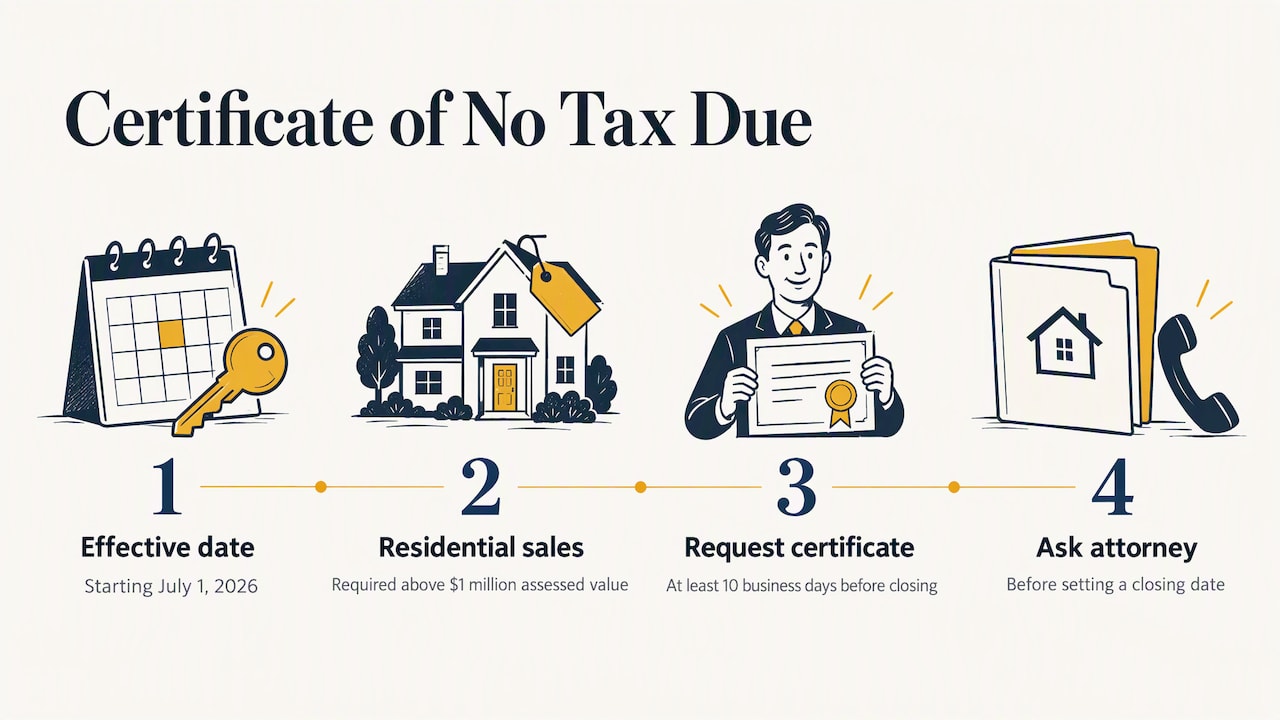
Starting July 1, 2026, sales of residential property assessed at more than $1 million require a Certificate of No Tax Due. The seller must request it from the Division of Taxation at least 10 business days before closing, according to a Division of Taxation presentation on non-owner-occupied property. If your house is near or above that assessment, ask your attorney about it before you set a closing date, because the 10-business-day lead time can push the schedule.
Mortgage, liens and back taxes
These are paid from your proceeds at closing. A title search turns up the ones you forgot: a contractor’s lien, an unpaid municipal charge, a second mortgage. Ask for a title search at the start, not the week of closing. If you are behind on payments, see our page on options when you are behind on the mortgage. For a view of who pays what on each side of the table, our seller versus buyer closing costs page is a good reference.
Cash sale or agent-listed sale: how they compare
The right choice depends on how much time you have, how much repair work the house needs and how much you can manage from a distance.
| Factor | Agent-listed sale | Direct cash sale |
|---|---|---|
| Showings and open houses | Required; someone must provide access | None needed |
| Repairs and cleaning | Often done before listing to get a good price | Not needed; the house is bought as-is |
| Agent commission | Paid by the seller at closing | None with a direct buyer |
| Timeline | Listing, offers, inspection, appraisal and buyer financing all take time | Set by you and the buyer; we aim for 7 to 21 days |
| Chance of falling through | Buyer financing or inspection issues can end the deal | Fewer moving parts |
| Price | Can be higher on a house in good shape | Based on the After Repaired Value, adjusted for the work needed |
An agent-listed sale can bring a higher price when the house is in good condition and you have months and a local person to manage it. A cash sale tends to fit when the property is vacant, dated, damaged or inherited, when carrying costs are rising, or when you cannot be present for the process. Weigh the commission and repair costs you avoid against the price difference, rather than comparing headline numbers alone.
Remember that a cash offer is not magic: you should still get a written offer, confirm the closing attorney, and understand the title steps. Our four-step as-is contract overview explains what to check in the agreement.
How to sell an unoccupied house for cash, step by step
- Gather basics. Address, deed holders, payoff figure, rough condition and photos from a local helper.
- Request an offer. A direct buyer looks at the property, often with photos and a short walkthrough, and prices it based on its After Repaired Value minus the work needed.
- Review the written offer. Compare the net you would receive, after payoff and closing costs, with what a listing would likely leave you.
- Choose your closing date. You pick the timeline, whether that is as fast as possible or later to fit your plans. See how to choose your closing date.
- Open title and assign the closing attorney. Title work finds liens and confirms who must sign.
- Arrange signing. Sign near home before a notary, or through an attorney-in-fact.
- Close and get paid. Funds are disbursed after payoffs and costs. Hand over keys by mail or through your local helper, or let the buyer change the locks.
The full process is laid out on our page about closing a cash offer in 14 days.
Protecting a vacant house while the sale is pending
A vacant house is the one that suffers. Time delays are common: a payoff figure arrives late, a signer is hard to reach, a title issue appears. Until the deed transfers, the property and the liability are yours.
- Call your insurer. Standard homeowners policies often restrict coverage when a home is unoccupied for an extended period. Ask your agent what applies to your policy and whether you need a vacancy endorsement or a different policy.
- Keep utilities on or winterize. Heat, or a proper drain-down, prevents frozen pipes in a Rhode Island winter. Have a plumber do the winterization if you are not sure how.
- Arrange regular checks. A neighbor, property manager or relative can look in weekly, collect mail and keep a log.
- Make it look lived in. Timers on lights, a cut lawn and cleared snow discourage break-ins and keep the town off your back.
- Secure the keys. Know every key holder. Change locks if a former tenant or contractor kept a set.
- Check for occupants. If someone has moved in without permission, do not ignore it. Our guide to selling a house with squatters explains your options.
What most often delays a fast sale
- A co-owner who cannot be reached or does not agree
- A power of attorney that the title company will not accept
- An unknown lien or an unpaid municipal balance
- Probate not yet complete on an inherited house
- A mortgage payoff statement that is out of date
- A closing planned around a notary who cannot legally act across state lines
Most of these are solved by starting the title search and the signing plan on day one.
Our perspective
We buy houses from owners who are not there, and what we see is that distance, not price, is the real problem. People are not worried about getting a few thousand dollars more; they are worried about a house they cannot check on, a bill that keeps arriving and a family member who needs to sign from three states away.
That is why we buy as-is. No agent fees, no commission, no repairs, no cleaning, and a closing date that fits your life. We base our offer on the After Repaired Value and we explain how we got there, so you can compare it with a listing instead of taking our word for it.
Our advice to any absentee owner: get the payoff figure, call a closing attorney and settle the signing method before you do anything else. Then choose the route that costs you the least time and worry. For many vacant or run-down Rhode Island houses, that is a direct sale.
Dave
Ready to sell without the trip?
If your Rhode Island house is empty, in need of work or simply too far away to manage, we can make you a cash offer based on its After Repaired Value, with no agent fees, no commission and no repairs or cleaning on your side. You choose the closing date.

Tell us about the property on our page to sell your house fast for cash in Rhode Island, or read how to sell as-is and close in 7 to 21 days first.
FAQ
Can I sell my Rhode Island house if I live out of state?
Yes. Nothing in Rhode Island law requires you to live in the state to sell. You hire a Rhode Island closing attorney and sign near home before a notary, or appoint an attorney-in-fact. Agree the signing method before you accept an offer.
Do I have to disclose problems I have never seen?
The statute covers conditions you have actual knowledge of, and it does not require you to inspect. If you have heard about a problem from a tenant, neighbor or contractor, treat it as known and disclose it. Where you simply do not know, say so plainly rather than guessing.
Can a Rhode Island notary sign for me over video if I am in another state?
A Rhode Island notary may only perform notarial acts while physically in the state, so the notary’s location is the issue. Most out-of-state sellers sign before a notary where they live, or use a power of attorney. Ask your closing attorney which route they will accept.
Is a cash sale faster than listing with an agent?
Usually, because there are no showings, buyer financing or repair negotiations. We aim to close in 7 to 21 days on our timeline, and you can choose a later date if you prefer. Your closing speed still depends on title work and signatures, so start both early.
What will I pay when I sell?
Expect your mortgage payoff, any liens or unpaid taxes, and the Rhode Island conveyance tax, plus attorney and title charges. With a direct buyer there is no agent commission. Your closing statement shows the exact figures before you sign.
Sources
- Rhode Island General Laws, Title 5, Chapter 20.8: real estate sales disclosure
- DBR Insurance Bulletin 2020-8: title agents and attorneys in residential closings
- Rhode Island Secretary of State: Notary Public manual
- Rhode Island Division of Taxation: Real Estate Conveyance Tax
- Rhode Island Division of Taxation: non-owner-occupied property presentation, June 2026