
If you need to sell a house in Woonsocket quickly, the fastest route is a direct cash sale to a local buyer who purchases the home as-is. There are no showings, no agent commissions and no repair list. At Rhody Home Buyer we buy homes in Rhode Island and Eastern Connecticut for cash, base our offers on the After Repaired Value, and let you close on your timeline. The rest of this page explains how that compares with listing, what a sale costs you either way, and what to check before you sign anything, whether you are facing foreclosure, inherited a house or are dealing with fire damage.
TL;DR
- A traditional sale usually means weeks of showings, then a closing about a month after the contract. A direct cash sale skips the listing, the buyer’s mortgage approval and the repair negotiations.
- You pay a seller’s share of Rhode Island’s conveyance tax and an attorney in either route. A cash sale removes the agent commission and the repair bills.
- Fire damage, inheritance and preforeclosure are all workable situations. Rhode Island’s disclosure rules still apply, and you have time-limited rights if you are behind on your mortgage.
- Before accepting any offer, ask who is actually buying the house and read the contract. New 2026 Rhode Island rules now protect sellers from wholesaler games.
Table of Contents
- How a fast cash sale works in Woonsocket
- Cash sale versus listing: what you actually keep
- Selling a fire-damaged house in Rhode Island
- If you are behind on the mortgage
- Inherited homes and other urgent sales
- How to judge a cash offer and avoid the bad ones
- How long a sale takes in Woonsocket and nearby
- Our perspective
- Get a cash offer for your Woonsocket house
- FAQ
- Sources
How a fast cash sale works in Woonsocket
A cash sale removes the steps that make a normal sale slow. In a conventional listing you prepare the house, photograph it, host showings, wait for an offer, then wait for the buyer’s lender to approve a loan and appraise the property. The National Association of Realtors’ July 2026 survey reports that contracts typically closed in 30 days, and 12% of contracts were delayed, 6% because of appraisal problems. That is before you count the weeks spent getting under contract.
With a direct buyer the sequence is shorter:
- You tell us about the house. Address, condition, your timeline and your situation. You do not clean or fix anything first.
- We make an offer. Our offers are based on the After Repaired Value, which is what the home would be worth once repaired, so the offer reflects the property rather than a lowball guess at its condition.
- You choose the closing date. Some sellers want out in a couple of weeks. Others need a few months to move. Our guide to choosing your closing date walks through how to decide.
- An attorney closes the sale. Rhode Island is an attorney-state for residential closings. A 2020 Rhode Island Supreme Court ruling requires an attorney to examine and certify title, draft or review the deed and supervise the closing, so title companies cannot run a residential closing on their own.
That last step is law, not a delay. The attorney searches the land evidence records at the city’s registry of deeds, checks the chain of title and certifies that it is marketable. If an old lien or an unrecorded heir turns up, it is better found at the start than at the closing table.
For a step-by-step view of our process, see how our fast cash purchase works.
Cash sale versus listing: what you actually keep
The headline offer is never the whole comparison. What matters is what lands in your account after everything is paid. Here is where the two routes differ.
| Cost or step | Traditional listing | Direct cash sale to Rhody Home Buyer |
|---|---|---|
| Agent commission | Paid from your proceeds | None |
| Repairs and cleaning before listing | You pay and manage them | None, we buy as-is |
| Showings and open houses | Weeks of them | None |
| Buyer’s financing and appraisal risk | Can delay or end the deal | Not part of the process |
| Conveyance tax | Customarily paid by seller | Customarily paid by seller |
| Closing attorney | Required | Required |
| Closing date | Set by contract and the buyer’s lender | You choose the timeline |
The costs both routes share
Rhode Island’s realty conveyance tax rose on October 1, 2025, to $3.75 per $500 of the purchase price, a 63% increase over the earlier $2.30 per $500. That works out to $7.50 per $1,000, and it is customarily paid by the seller. On a $350,000 sale that is $2,625. For residential sales above $824,000 in 2026, an additional tier applies to the portion above that threshold, which is unlikely to matter for most Woonsocket homes.
Seller-side attorney fees for a Rhode Island closing generally run $500 to $1,500. Recording fees are small by comparison: $80 for a deed and $45 to discharge a mortgage, plus a few dollars in per-page and per-instrument charges.
The costs only the listing route carries
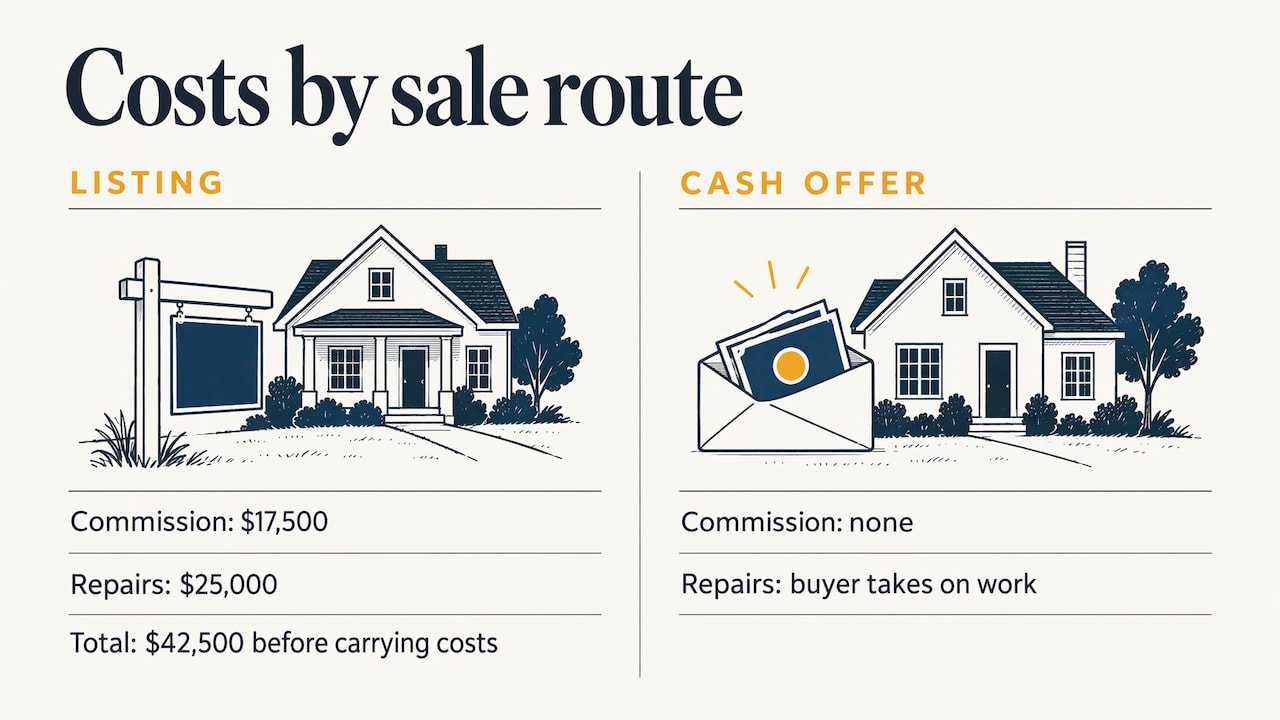
Here is a worked example with round numbers. Suppose a Woonsocket house would sell for $350,000 once repaired. Listing it with a 5% commission would take $17,500 off the top before any repair, staging or carrying cost. If it also needs $25,000 in work to pass a buyer’s inspection and win a lender’s appraisal, you have spent $42,500 and added weeks of mortgage, taxes and utilities. A direct cash offer is priced from the repaired value and takes the repair work on itself, with no commission.
We will not pretend every cash offer beats every listing for every house. Run the numbers on net proceeds, not on the headline price: what you keep, minus what you still owe, by the date you need to be done. Our pages on comparing cash offers with financed offers and deciding by net proceeds show the same arithmetic in more detail.
If you are weighing a listing and wondering about presentation, a planned three-week staging routine is what a conventional sale asks of you. Selling directly to us takes all of that off your calendar.
Selling a fire-damaged house in Rhode Island
Fire damage is one of the situations where listing is hardest. Buyers who need a mortgage often cannot get one on a house with structural, smoke or water damage, and the repair estimates keep changing as contractors open walls. A buyer who purchases as-is does not depend on a lender’s condition rules.
Whatever route you take, Rhode Island law requires you to be open about the damage. A seller of a one-to-four unit home must give the buyer a written disclosure of every deficient condition the seller actually knows about before signing an agreement to transfer the property, and the disclosure form has specific lines for fire, mold, and moisture penetration and damage. Practical steps:
- Gather what you have. Fire department report, insurance claim number, photos taken before cleanup, contractor estimates, and any permits.
- Settle the insurance picture. Know what has been paid, what is pending and whether your mortgage lender is named on the payout. Your insurer and your closing attorney can tell you how a claim interacts with a sale.
- Disclose everything you know. Fill out the form fully. The rule is a legal duty, and a complete form also protects you after closing.
- Do not start repairs just to sell. Net proceeds matter. Our page on selling a fire-damaged house and our guide to repairing versus selling as-is help you compare.
We buy homes in any condition, so fire, smoke and water damage do not stop us from making an offer.
If you are behind on the mortgage
Facing foreclosure feels like a countdown, but the process has steps, and each gives you room to act. Under federal rules, a servicer usually cannot begin a foreclosure until you are more than 120 days past due. Rhode Island also requires the lender to send a mediation notice before that point, and the mediation conference must take place within 60 days of the notice’s mailing and costs the homeowner nothing.
RIHousing provides that mediation and has mortgage counselors who work with you and your lender on loan modifications, work-out agreements and repayment plans. If you can keep the house, call them first. If keeping it is no longer realistic, selling before the auction lets you pay off the loan and keep whatever equity is left, rather than losing it at a foreclosure sale. Our pages on pre-foreclosure options in Rhode Island, how to avoid foreclosure and stopping a foreclosure auction lay out the timeline in detail.
Some owners also look at bridge financing to catch up on payments, and an overview of ways to stop foreclosure fast explains how those short-term options are structured. If you are also considering bankruptcy, read our guides on selling a house during bankruptcy and selling before bankruptcy, and speak with a bankruptcy attorney before you sign a sale contract.
Inherited homes and other urgent sales
Inherited houses are common in Woonsocket’s older neighborhoods, and they usually carry three problems: the house is full of belongings, it needs work, and several heirs have to agree. A direct as-is purchase means no one has to clean it out or fund repairs before the sale. What you do need is clear authority to sell. Usually that means the probate court has appointed an executor or administrator, and the closing attorney will confirm who must sign. Talk to a Rhode Island probate attorney if there is a dispute among heirs or no will.

Taxes and utilities matter too. Before closing, the town tax collector must provide a municipal lien certificate within five business days of a written request, for a fee of no more than $25, showing the taxes, assessments and water and sewer charges that are liens on the property. Ask for it early so no unpaid balance surprises you at the closing.
How to judge a cash offer and avoid the bad ones
Most cash buyers are honest, but this market has real predators, and the state has acted. In 2024 the Rhode Island Attorney General filed a case under the Deceptive Trade Practices Act alleging that defendants misled elderly homeowners into selling a $450,000 house for $100,000 in a foreclosure-rescue scheme. The allegations describe the pattern to avoid: pressure, vague promises and a price far below value.
In June 2026 a new law took effect, written with AARP Rhode Island and the Rhode Island Association of Realtors. According to AARP, it requires wholesalers to hold a real estate license, to state clearly that they may sell the contract before closing, and to give sellers three days to cancel a signed contract without penalty. A wholesaler is someone who contracts to buy your house and then sells that contract to another buyer for a fee.
Use these questions with any buyer:
- Who is buying the house? You want the buyer on the contract to be the buyer who closes. We buy directly, and we profit from reselling or renting the homes we acquire, not from passing your contract on.
- How is the offer built? A fair offer should be explainable from the property’s repaired value and its condition.
- What does the contract say about timing and fees? Read the closing date, who pays what and any cancellation terms before signing.
- Is there pressure? A good buyer lets you read, think and talk to your own attorney.
- Who is the closing attorney? A Rhode Island attorney must handle the closing, and you can bring your own.
One local point to raise early: according to a Woonsocket broker’s blog, the Woonsocket Fire Department asks for a passing smoke and carbon monoxide inspection certificate on traditional sales. Confirm with the department and your closing attorney how it applies to an as-is sale, and settle who handles it in the contract.
How long a sale takes in Woonsocket and nearby
The same logic applies in Pawtucket and across the Blackstone Valley. Time on market, financing and inspections vary from house to house, which is why the listing route cannot promise a date. A direct purchase puts you in control of the date instead: closing is limited mainly by the title work and the attorney’s schedule, and by when you want to move. If your closing needs to be quick, tell us at the start so the title search can begin immediately. If you need breathing room to find a new place, say so too.
Our perspective
We built Rhody Home Buyer for the homeowner who does not have the time, money or energy for a traditional sale. That is the person with a house full of a parent’s belongings, the owner who got a repair estimate they cannot afford, and the family who got a foreclosure letter.
What we care about most is that you can see the whole picture. We buy directly, we buy as-is, and our offers are based on the After Repaired Value. There are no agent fees or commissions, and no one asks you to clean or fix anything. You pick the closing date, and the choice stays yours.
The strongest sellers are the ones who ask questions. Ask us what the offer is based on. Ask us what you will net. Ask your own attorney to read the contract. We would rather earn your trust with clear answers than with pressure.
Dave
Get a cash offer for your Woonsocket house
If you want to sell your house in Woonsocket, Pawtucket or anywhere in Rhode Island or Eastern Connecticut without agent fees, repairs or cleaning, tell us about the property and we will tell you what we can offer. You decide the timeline, and there is no pressure to accept.

Start with our page on selling your house fast for cash in Rhode Island, or see how selling as-is works first.
FAQ
Can I sell a fire-damaged house in Rhode Island?
Yes. Rhode Island law requires you to disclose known deficient conditions, including fire damage, in writing before you sign an agreement to sell. We buy houses as-is, so fire, smoke and water damage do not stop us from making an offer. Have your insurance and repair paperwork ready for your closing attorney.
How fast can a house sale close in Woonsocket?
A financed sale typically closes about 30 days after the contract is signed, according to the National Association of Realtors, and that comes after the time spent listing. With a direct cash purchase, the timeline is set mostly by the title search and your own schedule, so you can close quickly or later.
Do I pay agent fees when I sell to Rhody Home Buyer?
No. We buy directly, so there is no agent commission and no repair or cleaning cost. You will still have the seller’s usual closing items, such as the conveyance tax and your attorney’s fee, which are the same in any Rhode Island sale.
Do I need an attorney to close a cash sale in Rhode Island?
Yes. Rhode Island requires an attorney to examine title, prepare or review the deed and supervise a residential closing. That protects you as the seller, and it applies whether the buyer pays cash or uses a mortgage.
What if I am behind on my mortgage?
Act early. You can use RIHousing’s free mediation and counseling to look at modification or repayment options. If selling is the better path, selling before foreclosure can let you keep any remaining equity. Our team can explain how a cash sale fits your timeline.
Sources
- NAR Realtors Confidence Index, July 2026
- Rhode Island Real Estate Closing Guide, Quill
- Rhode Island Real Estate Transfer Tax Increase 2025
- Rhode Island Transfer Tax 2026
- Closing Costs in Rhode Island 2026: Buyer & Seller Guide
- R.I. Gen. Laws § 5-20.8-2, seller disclosure
- Rhode Island Foreclosure Process and Laws, Nolo
- Homeowner Assistance Programs, RIHousing
- Stop Foreclosure Fast
- R.I. Gen. Laws § 44-7-11, municipal lien certificate
- Rhode Island Attorney General Superior Court complaint, October 2024
- AARP: Fighting predatory “We Buy Homes for Cash” offers
- Open House Staging: 3 Moves and a 3-Week Plan