
Yes, you can sell a Rhode Island house with open permits. An open permit is not a title defect and does not legally stop a sale. But it can slow a traditional one, because buyers, lenders and insurers tend to ask questions about it. You have three realistic paths: close the permit before you sell, sell with the permit open and disclose it, or sell as-is to a cash buyer who takes the permit on.
TL;DR
- An open permit means work was approved by your city or town, but an inspector never signed it off. It stays with the property, not with you.
- Rhode Island law requires you to disclose deficient conditions you actually know about, and the state disclosure form asks whether required permits were obtained and final approval received.
- Open permits can delay closing, complicate financing and insurance, or lead a buyer to ask for credits. They do not automatically kill a sale.
- Start by pulling your permit history from your local building office. Many problems turn out to be paperwork, not unfinished work.
- If you can’t or don’t want to finish the work, selling as-is to a cash buyer is a legitimate way to avoid the delay.
Table of Contents
- What an open permit means when you sell
- Expired permits are a related problem
- What you must disclose in Rhode Island
- How an open permit affects a traditional sale
- Step one: find out which permits are open
- Step two: choose how to handle it
- Common situations
- Our perspective
- Selling to us with open permits
- A short checklist before you decide
- FAQ
- Sources
What an open permit means when you sell
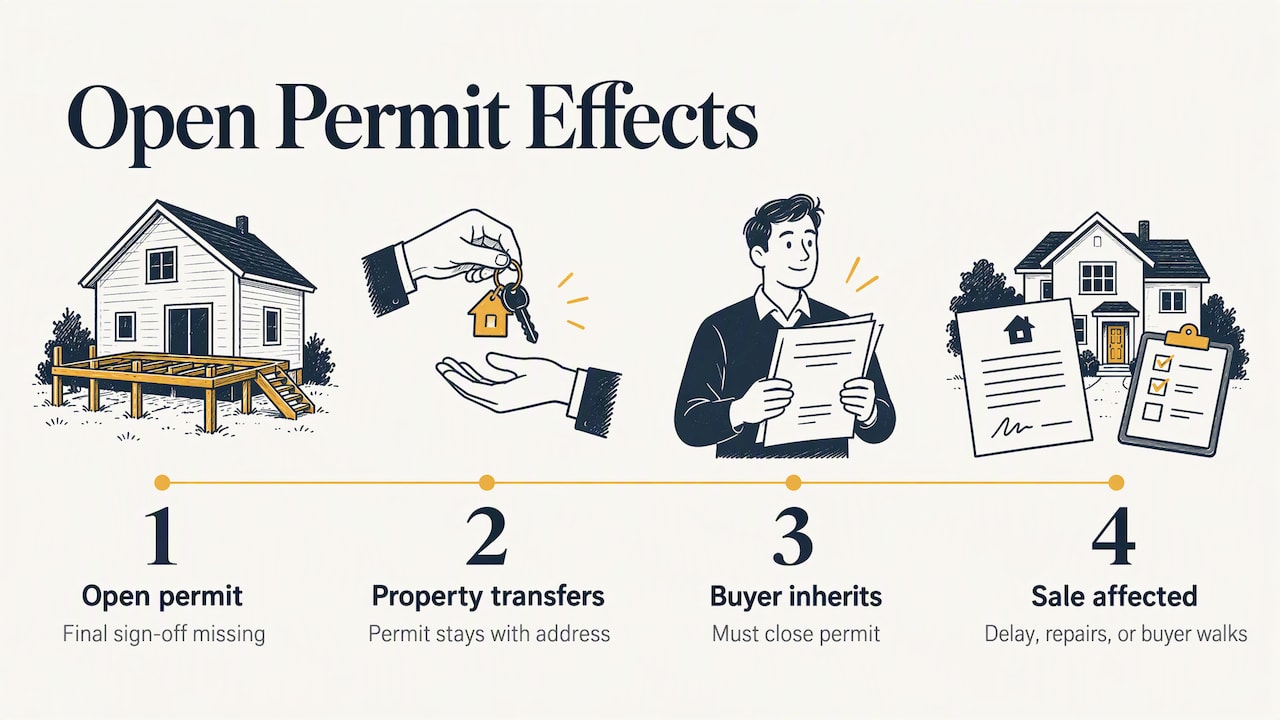
A building permit is the town’s approval for a specific job: a deck, a finished basement, a new furnace, rewiring, a roof. The permit is “closed” when the work is finished and the inspector signs off. It is “open” when that final step never happened.
That can happen for many ordinary reasons. A contractor pulled the permit and never scheduled the final inspection. The previous owner started a project and stopped. The work was finished years ago and nobody followed up. Sometimes the work was done well and only the sign-off is missing.
The permit belongs to the address. When the house changes hands, the open permit goes with it. That is why it matters to buyers: they would inherit the job of closing it out, and possibly the cost of fixing whatever an inspector finds. Attorneys who handle these transactions note that purchasers and lenders may require open permits to be closed before acquisition or financing. If the permit surfaces late, it can delay closing or cause a buyer to walk away. A buyer who accepts the property anyway may end up paying to close it.
It is also worth knowing what an open permit is not. It doesn’t show up in a title search the way a mortgage or lien does. It tends to appear in the municipal records search a closing attorney orders, or when a buyer’s inspector asks about visible work.
Expired permits are a related problem
Permits don’t stay valid forever. Under Rhode Island’s building code statute, a permit becomes invalid if work doesn’t begin within six months, or if work is suspended or abandoned for six months. The law allows written extensions of up to 90 days and recognizes court-ordered suspensions as exceptions.
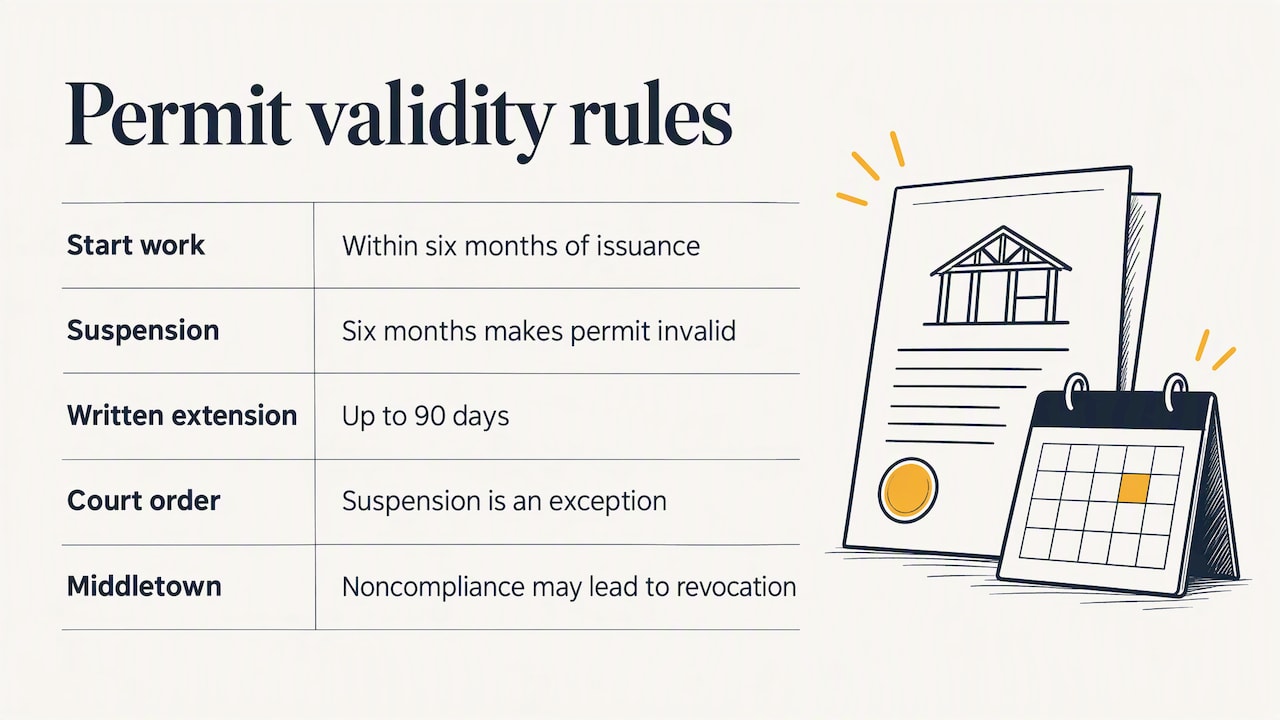
Towns apply this in their own way. Middletown, for example, says work must begin within six months of issuance and must not lapse for more than six months afterward, and that noncompliance can lead to revocation. Activity and inspection requests go through its online permit portal.
For a seller, the practical meaning is this: a permit that was issued years ago and never finished is probably expired, not merely open. You may need to ask the building office whether it can be renewed, reissued or closed with a final inspection, and what it will want to see. Rules and fees differ by town, so the answer for Providence won’t necessarily match the answer for Westerly.
What you must disclose in Rhode Island
Disclosure is where sellers get nervous, so here is what the law says.
Rhode Island requires a seller, as soon as practicable and before signing an agreement to transfer real estate, to give the buyer a written disclosure of deficient conditions the seller has actual knowledge of. The statute does not require you to commission inspections. Its focus is on accurate disclosure of what you know.
The standard form puts permits in front of you directly. The state’s seller disclosure form, used under R.I.G.L. § 5-20.8-2, asks whether the required building permits were obtained and final approval received. If you know a permit was never finalized, “yes” is not an honest answer.
Two practical points follow:
- Disclose what you know, in writing. If you know about an open permit, an unpermitted renovation or an unfinished project, say so. Hiding a known problem is the most expensive mistake a seller can make.
- Disclosure doesn’t make you the only safeguard. Rhode Island follows the principle of caveat emptor, and the burden of due diligence falls mainly on the buyer even though the seller must disclose. The legislature’s own framework warns buyers to investigate and estimate repair costs themselves.
If you aren’t sure how a particular situation should be answered on the form, a Rhode Island real estate attorney can review it before you sign anything.
How an open permit affects a traditional sale
Open permits are a source of uncertainty more than a guaranteed deal-breaker. Real estate legal practitioners describe them as something that may involve lenders and affect closing timelines, but that does not automatically derail a transaction. Here is where the friction usually appears.
Buyer negotiations
An open permit raises the question of whether work was done properly and whether municipal requirements were met. Buyers may ask for documentation, a price credit or a repair. Lenders may require further review, especially when the work involved structural, electrical, plumbing or safety systems.
Financing and appraisal
A buyer using a mortgage has a lender with its own standards. Unpermitted or unfinished work can limit buyer interest and financing and affect appraisal value. That shrinks your pool of buyers to those who can pay cash or tolerate the risk.
Insurance
The same source notes that insurers may refuse coverage for unpermitted spaces or deny related claims. A buyer who can’t insure the house can’t close on it with a mortgage.
Timing
The worst moment to find an open permit is after you are under contract. Late discovery makes closing timing harder, because you now have a clock running while you try to get inspections scheduled by a municipal office that has its own backlog.
Step one: find out which permits are open
Before you decide anything, learn what is actually on record. You may have a surprise, or you may have nothing.
- Search your town’s permit records. Many Rhode Island municipalities run online portals. In Tiverton, for instance, you can search permit records by address, plat and lot, or record number and see the permit status and the files attached. Middletown uses an e-permitting portal as well. Other towns may require a phone call or a visit to the building official.
- Ask the building office directly. The Rhode Island Secretary of State explains that municipal governments maintain licensing applications, permit registrations and inspection reports, and that you should contact the relevant city or town. If records are not readily available, an APRA (Access to Public Records Act) request is the formal route.
- Gather your own paperwork. Look for contractor invoices, old permit cards, inspection stickers or emails about past projects. A contractor’s records can sometimes show the work was finished and only the sign-off was missed.
- List the work that was done without a permit. A finished attic, a basement bedroom or a relocated bathroom that never had a permit is a different issue than an open one, but buyers and inspectors will ask about both.
Do this before you list or accept an offer. Knowing early gives you control over how the issue is presented.
Step two: choose how to handle it
Once you know what’s open, you have options. The right one depends on your timeline, your budget and the condition of the work.
| Option | Best when | Main tradeoff |
|---|---|---|
| Close the permit before listing | The work is finished and sound, and you have time | Inspection scheduling and possible corrections add time and cost |
| List and disclose, negotiate with the buyer | You have time and the issue is minor | Buyers may ask for credits or walk away; financing can stall |
| Escrow or credit at closing | A buyer is willing to take on closure | Needs a cooperative buyer and attorney, and a clear cost estimate |
| Sell as-is to a cash buyer | You need speed, can’t afford repairs, or the work is unfinished | You trade a retail price for certainty and speed |
Closing the permit yourself
In many towns the fix is simple. In Middletown, the permit holder sends activity or inspection requests through the e-permitting portal and closes the permit with a final inspection. If the work was done correctly, that may be all it takes. If the inspector finds problems, you will have to correct them first, and that is the unpredictable part. Ask the building office what it will require for an expired permit before you hire anyone.
If a contractor pulled the permit, ask them to close it. It is their job, and they may still be on record as responsible.
Selling with the permit open
This is legal as long as you disclose what you know. It works best when the buyer is paying cash, or when the permit covers something small. Expect your attorney and the buyer’s attorney to discuss who takes responsibility after closing. Negotiated credits or a holdback are common ways to deal with it.
Selling as-is for cash
If the work is unfinished, you can’t afford to fix it, or you simply don’t want months of delays, an as-is sale avoids the permit chase altogether. A direct buyer is not relying on a lender’s checklist, so the questions that stall a financed purchase don’t have the same hold. That is the situation we see often, and we cover related situations in our guides to selling a house without repairs and what to do after a failed inspection.
Common situations
You inherited the house. The permits are now yours to deal with, though you may not know the history. Pull the town records, disclose what you learn, and don’t assume the previous owner’s projects were closed.
A contractor disappeared. The permit stays open. Contact the building office, explain the situation and ask what it takes to transfer or close it. A new licensed contractor may need to pick up the job.
You bought the house with the permit already open. The obligation came with the purchase. It is still yours to disclose and resolve, so check your closing file from that purchase for anything the buyer’s attorney flagged.
You are facing a deadline. Foreclosure, a job relocation, a probate timeline or a divorce don’t wait for inspectors. In that case, ask yourself honestly whether closing the permit fits inside your timeline. If not, an as-is sale may be the sensible route. We explain how the process works in our overview of fast cash buying in Rhode Island, and how to pick the closing date that suits you.
Our perspective
We talk with Rhode Island homeowners every week who found out about an open permit at the worst possible time: after a buyer’s attorney ran the town search. Most of them had done nothing wrong. A contractor skipped a final inspection, or a parent started a project years ago.
Here is how we see it. An open permit is a paperwork and risk question, and a conventional sale asks you to solve it on someone else’s schedule. You have to find the records, hire people, wait on inspections, and hope the buyer’s lender stays comfortable. That is a lot to carry if you are already under pressure.
We buy houses as-is, so repairs, cleaning and unfinished projects are not what stands between you and a sale. Our offers are based on the After Repaired Value, and there are no agent fees or commissions. You choose the closing date that works for you. We would rather you know your options, including closing the permit yourself if you have the time and money, than feel cornered.
If you are unsure where to start, call your town’s building office, find out what is open, and then talk to us. A straight conversation costs nothing.
Dave
Selling to us with open permits
If an open permit, an unfinished project or a costly repair list is keeping you from selling, we can make you a cash offer on the house as it stands. We handle the purchase directly: no agent fees, no commissions, no repairs or cleaning required, and a closing date that fits your situation.

Tell us about the property and we will explain what we can do. Start on our Rhode Island cash home buyer page to request your offer.
A short checklist before you decide
- Pull permit records for your address from your town.
- Note which permits are open, expired or missing, and what work each covers.
- Collect contractor names, invoices and photos.
- Read the seller disclosure form and answer the permit question honestly.
- Ask the building office what is needed to close or reissue each permit, and what it costs.
- Compare the time and cost of resolving them against your deadline.
- Speak with a Rhode Island real estate attorney if the situation involves a dispute, a lien or a missing contractor.
FAQ
Can you sell a house in Rhode Island with an open permit?
Yes. An open permit is not a title issue and doesn’t legally prevent a sale. You do have to disclose deficient conditions you know about, and a financed buyer may ask you to close the permit first. A cash buyer can often take the property with the permit open.
Can you close on a house with an expired permit?
Often yes, but it depends on the buyer and, if there is one, the lender. Under state law a permit generally becomes invalid when work doesn’t start or is abandoned for six months, so the town may need to reissue or close it. Ask your local building office what it requires.
Who is responsible for closing an open permit after the sale?
The permit stays with the property, so unless the contract says otherwise, the new owner inherits the task. Many sellers and buyers negotiate it through a credit, a holdback or a closing condition. Your attorney can write that into the agreement.
How do I find out if my house has open permits?
Contact the building department in your city or town, or search its online permit portal if it has one. You can search by address, plat and lot, or permit number in some towns. If records aren’t readily available, the state’s public records law allows you to file a request.
Do I have to fix the work before selling?
Not by law. Rhode Island requires disclosure of known problems, not repairs. Whether to fix them depends on your buyer, your timeline and your budget. If you don’t want to repair or finish the work, selling as-is is a valid option.
Sources
- Open Permits Can Open Up Issues for Property Owners
- Rhode Island General Laws: Expiration of Permit
- Title 5, Chapter 5-20.8, Section 5-20.8-2 | Rhode Island Legislature
- Rhode Island Single Family or Condominium or Land Real Estate Sales Disclosure
- Shoreline Property Disclosures in Rhode Island
- What Happens If There Are Open Permits On A Property?
- Discovering Unpermitted Construction When Selling Your Home
- Building / Code / Zoning | Tiverton, RI
- Accessing Public Records | Rhode Island Secretary of State