
A home sale contingency is a clause in a purchase contract that says the buyer’s purchase of your house only goes through if the buyer first sells their own house. If you accept one, your sale depends on a stranger’s sale, and you carry the waiting. If you need certainty or speed, a cash purchase has no buyer mortgage and no second house to sell, and we explain below why that matters when time is short.
TL;DR
- A home sale contingency lets the buyer back out, usually without penalty, if their current home does not sell within the time the contract sets.
- Typical periods run from 30 to 90 days, so your house can sit under contract for weeks without a guaranteed closing.
- You can accept, reject or counter a contingent offer, and a kick-out clause lets you keep marketing the house.
- If foreclosure, an inherited property or a move date is pressing, the wait is the real cost of this clause.
- A cash buyer that purchases as-is removes both the sale contingency and the buyer’s mortgage approval from your timeline.
Table of Contents
- What a home sale contingency is
- How a contingent offer works, step by step
- How long a house stays contingent
- What the clause costs you as a seller
- Protections you can ask for: the kick-out clause
- The financing contingency is a different clause
- Contingent or pending: can someone still offer?
- If you are also buying: ways to avoid a contingency
- When a contingency does not fit your situation
- What a cash sale takes out of the equation
- Selling to Rhody Home Buyer
- Our perspective
- FAQ
- Sources
What a home sale contingency is
A contingency is a condition that has to be met before a purchase is completed. The National Association of Realtors explains that contingencies are legally binding once buyers and sellers agree to and sign them. A home sale contingency, specifically, gives the buyer time to sell their current home before closing on yours.
Why do buyers ask for it? Many people cannot afford two mortgages at once, or need the money from their old house for the down payment on yours. The clause protects them. For you, it works the other way: you have agreed to a price, but the deal rests on someone else’s closing.
You may also see it called a contingent offer. The word “contingent” covers any condition: a home inspection, an appraisal, a mortgage approval or the sale of the buyer’s house. This article is about the sale of the buyer’s house, because that is the one that hands your timeline to a third party.
How a contingent offer works, step by step
The sequence is fairly standard across the country, and it helps to know where each step can go wrong.
- The buyer makes an offer with the clause. The offer states the price and also the period the buyer gets to sell their home. Read that period closely. A vague deadline is the most common source of disputes later.
- You respond. A seller may accept, reject or counter a contingent offer. Countering is where you can shorten the period, ask for a larger deposit or add protections.
- The clock starts. The buyer lists, shows and negotiates their own house. You do not control any of it. Whether their price is realistic, whether their buyer’s loan is approved and whether their inspection goes smoothly all affect you.
- The condition is met or it is not. If their house sells, the deal moves on toward your closing. If it does not sell in the stated time, the parties acting in good faith can generally cancel without penalty and the deposit goes back to the buyer. The buyer can also ask for more time, and you decide whether to grant it.
Notice what you get at the end of a failed contingency: your house back on the market, weeks later, and a listing history that now shows a deal that fell apart. If that has already happened to you, our page on what to do when a buyer backed out of your home sale walks through the next steps.
How long a house stays contingent
The contract sets the period, and there is no single rule. NerdWallet gives 30 or 60 days as examples of a home sale contingency period, after which the buyer is free to walk away and the seller can consider other offers. Chase reports a typical range of 30 to 90 days for this type of contingency, and says overall contingent status often lasts 30 to 60 days depending on the contract.
How often do these deals collapse? The same Chase guide reports that roughly 4% to 7% of contingent offers fall through, a figure it attributes to NAR. That means most close. It does not tell you whether yours will, and a home sale contingency depends on two sales rather than one, so a hiccup in either one stalls both.
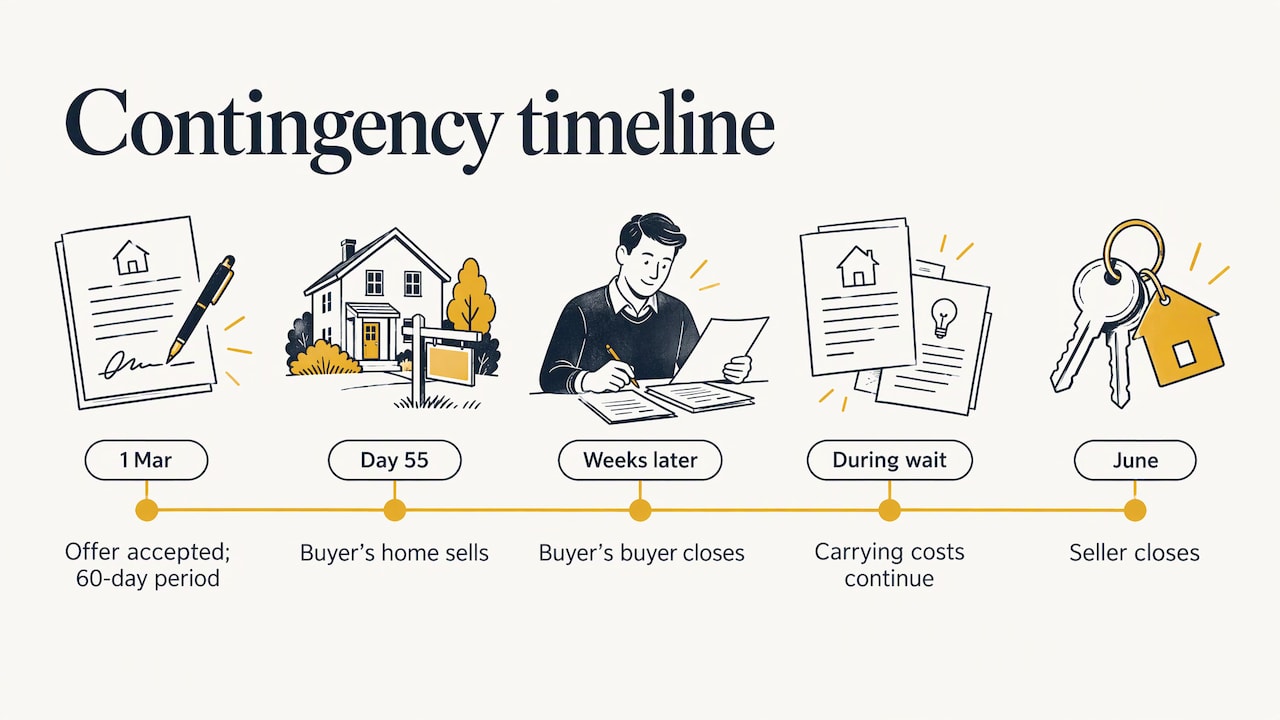
A worked example makes the cost concrete. Say you accept an offer on 1 March with a 60-day period. If the buyer’s house sells on day 55 and their buyer then needs a few weeks to close, your closing lands in June. During those three months you may still be paying your mortgage, taxes, insurance and utilities. If the sale then fails, you start over from the listing stage with the carrying costs already spent.
What the clause costs you as a seller
The risk is mostly time and uncertainty. Chase describes a home sale contingency as risky for the seller because your transaction depends on another home selling. In practice that shows up in four ways:
- You cannot plan your move. You do not know your closing date, so you cannot commit to a new home, a job relocation or a rental.
- Other buyers drift away. While your house shows as contingent, serious buyers may move on to other listings.
- The buyer’s price can be renegotiated. If their house sells for less than expected, they may come back to you for a lower price.
- Debt keeps running. Every month of waiting is another mortgage payment, which matters if you are already behind or facing a deadline.
If your house needs repairs, add one more layer: a buyer who is waiting on their own sale is also likely to ask for inspection concessions, and each request is another round of negotiation before you reach the closing table.
Protections you can ask for: the kick-out clause
If you accept a contingent offer, ask for these in writing. NAR advises sellers to state contingencies and deadlines clearly, to keep showing the property and to consider a kick-out clause.
A kick-out clause lets you keep marketing the house. If another acceptable offer arrives, the contingent buyer gets a specified window to proceed, typically by removing the sale contingency. If they cannot, you can go with the other buyer. NAR notes that the first buyers typically have a first right of refusal in this situation.
Two practical points:
- Keep the window short and written in hours or days, not vaguely “promptly”.
- Agree on how the buyer must prove they have removed the contingency, so there is no argument about whether they did.
The terms of a purchase contract are legal terms, and in Rhode Island contracts are commonly handled with an attorney. Have the one who represents you review any contingency language before you sign.
The financing contingency is a different clause
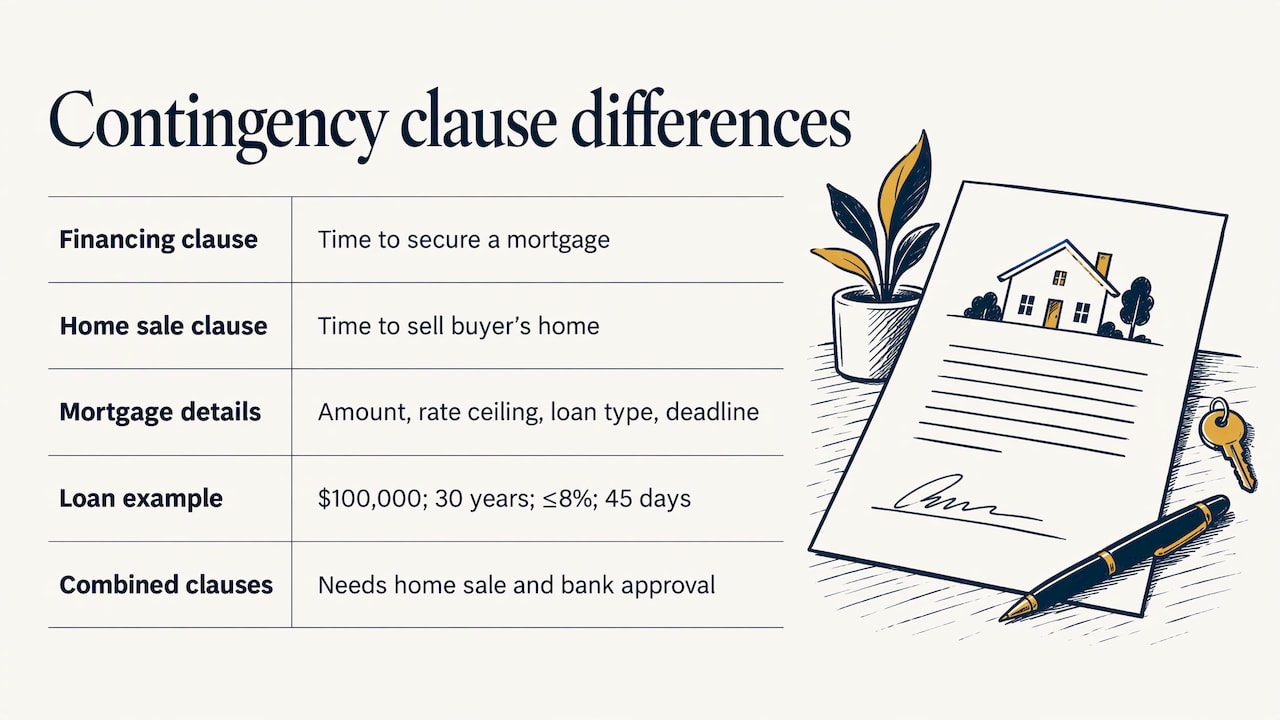
Search results often mix up the two, but they carry different risks for you. A financing contingency gives the buyer a set time to secure a mortgage, while a home sale contingency gives them time to sell their home. The American Bar Association explains that a mortgage contingency commonly specifies the loan amount, an interest-rate ceiling, the loan type and a deadline. Its example is a 30-year, $100,000 mortgage at no more than 8% within 45 days. A buyer who makes a reasonable, good-faith effort but cannot get that loan can void the contract without penalty.
A home sale contingency and a financing contingency can sit in the same contract. Then your deal needs the buyer’s house to sell, and also needs the buyer’s bank to approve the loan. Each condition is a separate way for the sale to fail. This is one reason sellers who need certainty compare cash offers against financed offers by net proceeds before choosing.
Contingent or pending: can someone still offer?
On listing sites, “contingent” means an offer is accepted but conditions remain open. “Pending” usually means the conditions have been met or removed and the sale is moving toward closing, though labels vary by local listing service. A buyer can still make a backup offer on a contingent house. For you as a seller, a backup offer is a useful safety net, but it is only as good as the terms you negotiate with it.
If you are also buying: ways to avoid a contingency
Some readers are on both sides: selling one home and buying another. A home sale contingency is one way to coordinate the two. NAR lists others: an offer with a home-close contingency, an early move-in before closing, or a rent-back after closing, where the seller stays on in the house for a set time after the sale.
Buyers can also tap equity without selling first, and each route has a cost:
- HELOC or home equity loan. The Consumer Financial Protection Bureau warns that your home secures the debt, so missed payments can lead to foreclosure, and HELOC rates may adjust with the market. Lenders typically require you to keep 10% to 20% of the home’s value as equity. For the basics, see this explanation of how a HELOC works.
- Bridge loan. Fannie Mae’s glossary describes it as a short-term loan secured by the current home that can fund a new purchase before the old home sells. Under its conventional lending policy, the lender must document that you can carry payments on the new home, the current home, the bridge loan and your other obligations.
Both routes add debt at the moment you are least certain about cash. Preparation and clear communication between the two transactions make a difference either way, as this guide to selling a house while buying another shows.
When a contingency does not fit your situation
A contingent offer works best for a seller who has time. It fits poorly when:
- You are behind on your mortgage and the lender has started foreclosure. A 60-day wait can pass the point where you can still act. Read how to stop a foreclosure auction in Rhode Island before you accept an open-ended offer.
- You inherited a house and are paying taxes, insurance and upkeep on a property you do not live in.
- The house needs repairs a financed buyer’s lender or inspector may object to.
- You need to choose your own closing date, for a move, a job or a court deadline. Our guide on choosing your closing date as a Rhode Island seller covers what to weigh.
In each case the goal is the same: a buyer whose purchase does not depend on anything else happening first.
What a cash sale takes out of the equation
A contingent sale has three moving parts: your buyer’s house, your buyer’s mortgage and your own timeline. A cash purchase of your house as-is removes the buyer’s mortgage and the buyer’s other house from the picture. There is no loan to approve, and you do not need to make repairs or clean before closing.
The trade-off is a price based on what the home is worth after repairs, rather than a retail listing price. To judge it fairly, compare what you would walk away with in each case: price, minus agent commissions, repairs, carrying costs through a long wait and the risk of a deal falling through. Our cash offer net proceeds comparison shows how to run that math with your own numbers.
Selling to Rhody Home Buyer
We buy houses for cash from Rhode Island homeowners, in any condition, as-is. There are no agent fees or commissions, no repairs and no cleaning. Our offers are based on the After Repaired Value of the home, and you close on the timeline that suits you, without pressure. We focus on homeowners in Rhode Island and Eastern Connecticut.
If an open-ended contingency would leave you waiting, you can ask us for a cash offer on your house.

We also explain how the process works in How Cash Home Sales Work, so you can read it before you speak to anyone.
Our perspective
A contingency is a fair tool for a buyer with time and a stable job. It is a hard one for a seller who has a deadline.
The homeowners who call us are often in the middle of something: a foreclosure notice, an inherited house they cannot keep, a property that needs more work than they can pay for. For them, the question is not whether a contingent offer can close. It is whether they can afford to find out in 60 or 90 days.
That is why we buy directly, for cash, as-is. We do not charge agent fees or commissions, we do not ask you to repair or clean, and we let you choose the closing timeline. Our offer is based on the After Repaired Value, and we explain how we got to it so you can compare it with any other route.
If you are weighing a contingent offer against a cash sale, put both on paper with the net amount and the dates. The answer is usually clear once the waiting time has a price.
Dave
FAQ
Can a seller reject a contingent offer?
Yes. You can accept it, reject it or counter it. Many sellers counter with a shorter contingency period, a larger deposit or a kick-out clause so they can keep showing the house.
How long is a house usually contingent?
The contract decides. Home sale contingencies commonly run 30 to 90 days, and the overall contingent status often lasts 30 to 60 days, according to Chase’s guidance cited above. If the buyer’s home does not sell in time, the deal can usually be cancelled without penalty.
Can I still make an offer on a contingent house?
Yes, often as a backup offer. The seller generally does not move forward with another buyer until the first buyer’s conditions are resolved, unless the contract includes a kick-out clause.
What happens if the buyer’s financing falls through?
If a financing contingency is in the contract and the buyer made a good-faith effort to get the loan on the stated terms, they can usually cancel without penalty and recover the deposit. You then relist or try another buyer. A cash sale has no loan to approve, so this risk does not arise.
Sources
- Consumer Guide: Real Estate Sales Contract Contingencies, National Association of Realtors
- Contingent offer: how it works when buying a house, Chase
- How Often Do Contingent Offers Fall Through? Chase
- How to Make a Contingent Offer to Buy a Home, NerdWallet
- Buying or Selling a Home: mortgage rider, American Bar Association
- Older Americans Housing Guide: using home equity, Consumer Financial Protection Bureau
- Acronyms and Glossary of Defined Terms: B, Fannie Mae
- Bridge/Swing Loans, Fannie Mae
- What Is a HELOC? Guide to Home Equity Line of Credit
- How to Sell Your House While Buying Another