
If you lost your job and the mortgage now feels out of reach, you can sell the house, but the order of your moves matters. Call your mortgage servicer first, get free help from a HUD-approved counselor, work out what the house would net you after costs, and only then choose between listing with an agent and taking a cash offer. You usually have more time than the panic suggests, and a sale is one option among several, not a last resort you must rush into.
This guide walks through each step for Rhode Island homeowners, with the numbers and the traps to watch for.
TL;DR
- Call your mortgage servicer the week the layoff happens. Servicers can offer forbearance, a loan modification or other relief, and formal foreclosure generally cannot start until you are more than 120 days behind.
- Free HUD-approved counseling is available in Rhode Island. Use it before you decide anything.
- Selling costs money: Rhode Island sellers often pay between 2.79% and 8% of the sale price in closing costs, and the conveyance tax rose on October 1, 2025.
- A cash sale trades price for speed and certainty. Ask for proof of funds, read the contract for assignment clauses, and compare the offer with your net from a listing.
- A loss on the sale of your home is generally not tax-deductible, so plan your numbers around that.
Table of Contents
- Start with the lender, not the listing
- Get free counseling before you decide
- Cover the gap: income you may be missing
- Decide if selling is the right call
- Know what a sale will cost you
- Your three ways to sell
- How to vet any cash offer
- Our perspective
- When a cash sale fits after a job loss
- Work with us if speed matters
- A simple 7-day plan
- FAQ
- Sources
Start with the lender, not the listing
The most common mistake after a layoff is going quiet. The Consumer Financial Protection Bureau’s unexpected job loss checklist says the first step is to contact your mortgage servicer and explain the hardship. Servicers may offer forbearance (a temporary pause or reduction in payments), a loan modification (new terms that lower the monthly payment) or a refinance.
Two details matter here:
- Forbearance does not erase what you owe. Missed payments still have to be repaid through a plan, a refinance or a sale of the home.
- Foreclosure has a runway. Under federal rules, a servicer usually cannot formally begin foreclosure until you are more than 120 days past due, with a couple of exceptions.
HUD’s own homeowner guidance adds that most default notices do not end in foreclosure. That is not a reason to ignore letters. It is a reason to open them, answer them and use the time they give you.
If you are still current on payments, even better. You are choosing a sale from a position of control, and that usually produces a better price and a calmer timeline.
Get free counseling before you decide
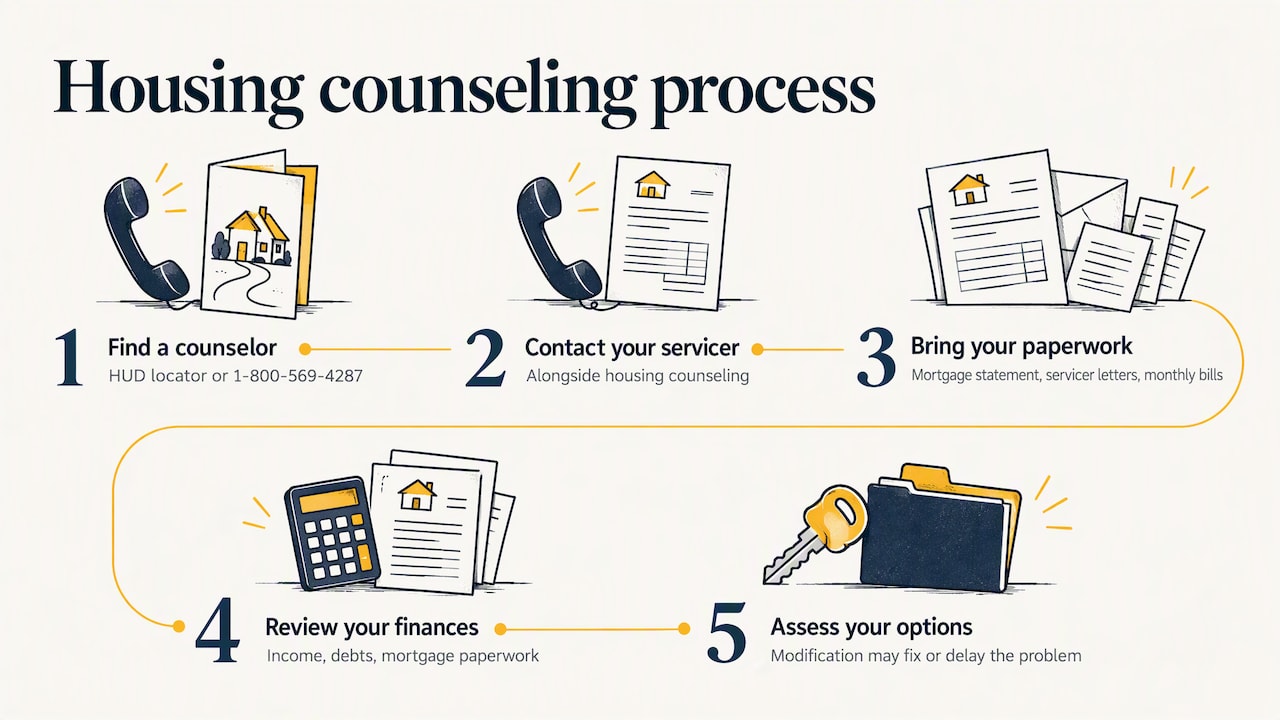
Before you sign a listing agreement or a purchase contract, talk to someone who earns nothing from your decision. The CFPB recommends contacting a HUD-approved housing counseling agency alongside your servicer, and you can find one through HUD’s counselor locator or by calling 1-800-569-4287.
In Rhode Island, RIHousing’s HelpCenter is one of these agencies. Its annual report describes foreclosure mitigation and counseling work. A counselor will review your income, debts and mortgage paperwork, and help you talk to your lender. Bring your last mortgage statement, any letters from the servicer, and a rough list of monthly bills.
Counseling also tests whether selling is really the right move. Sometimes a modification fixes the problem. Sometimes it only delays it, and you are better off selling while you still have equity.
Cover the gap: income you may be missing
File for unemployment right away. Rhode Island’s Department of Labor and Training announced that for new claims effective July 1, 2026 or later, the maximum weekly unemployment benefit is $777, or $971 with up to five dependents. Your own amount depends on your earnings, and it may be well below the maximum, so check your claim rather than assuming.
Those checks may not cover a full mortgage payment plus everything else. That is the honest math many families face, and it is the point where selling enters the conversation.
Decide if selling is the right call
Selling makes sense when at least one of these is true:
- Your new income, even if you find work soon, will not support the payment.
- You have equity you would lose if the loan went into foreclosure.
- You need to relocate for work.
- The house needs repairs you cannot fund.
- Staying means draining savings with no end date.
It makes less sense if a modification would make the payment manageable and your job search looks short. Be honest about which describes you. A counselor can help with that, and so can writing down your monthly budget for the next six months.
Know what a sale will cost you
Before comparing routes, figure out your net. Start with your payoff balance from your servicer, then subtract selling costs.
Rhode Island seller closing costs commonly run from 2.79% to 8% of the sale price, including agent commissions (often 5% to 6%) and the realty conveyance tax. That source reports the conveyance tax rose to $3.75 per $500 of the price effective October 1, 2025, from $2.30. On a $492,000 home, the estimated transfer tax is $3,690.
A quick worked example, with made-up round numbers:
| Item | Traditional listing | Direct sale, no agent |
|---|---|---|
| Sale price | $400,000 | Varies by offer |
| Agent commissions at 5% to 6% | $20,000 to $24,000 | None |
| Repairs and prep before listing | Your cost | None when sold as-is |
| Mortgage payments while waiting | Every month it sits | Fewer months |
The point is not that one column always wins. A higher list price can beat a lower cash offer by a lot. The point is to put every cost on the page so you compare nets, not headlines.
Taxes on the sale
If you sell for less than you paid, the IRS says that a loss on a personal residence is not deductible, and it does not qualify for the $3,000 annual capital loss deduction. If you sell at a gain, you may exclude up to $250,000 ($500,000 for married couples filing jointly) when you meet the ownership and use tests. If part of your mortgage debt is forgiven, ask a tax professional how it is treated for your year, because the rules for canceled debt on a main home have changed over time. A CPA or enrolled agent is the right person for that question.
Your three ways to sell
1. List with an agent
This usually brings the highest price when the house is in good shape and you can wait. Traditional sales commonly take a couple of months from listing to closing, and a buyer using a mortgage can fall through on appraisal or financing. If you can keep making payments for that stretch, it is a strong option. If you cannot, the months of waiting are part of the cost.
2. Sell it yourself
You save commission but take on pricing, showings, paperwork and negotiation. It rarely suits someone already stretched thin, and you will likely still need a real estate attorney for the closing. In Rhode Island, attorneys handle closings.
3. Sell directly to a cash buyer
A direct buyer purchases the house as-is, without agent commissions, without repairs, and on a timeline you pick. Speed and certainty are the benefits. The trade-off is price. The guide to selling to a cash buyer puts it plainly: a cash sale buys speed and certainty and costs you some price, which can be a fair trade for an inherited or distressed property or a tight timeline. NAR data shows all-cash deals are roughly 30% of transactions, so this is a normal part of the market, not a fringe one.
If you need to see how the process runs, our page on how cash home sales work lays out the steps, and our guide to selling your house without repairs covers the as-is side.
How to vet any cash offer
Homeowners in a crisis attract bad actors. Use this checklist with every buyer, including us.
- Ask for proof of funds. A bank statement or a letter from a financial institution should be easy to produce. If a buyer refuses, they may not have the capital to close.
- Read for an assignment clause. Some contracts let the investor market your contract to other buyers. That can delay your sale or kill it if they cannot flip it. Ask for language that forbids assignment without your written permission.
- Refuse the clock. You should be allowed to review the contract, and an attorney should look at it. Pressure to sign today is a warning sign.
- Be wary of sight-unseen offers. An offer with loose contingencies can be a setup to cut the price later.
- Compare against the market. Get a rough value from an agent’s free opinion or recent nearby sales, then see how far the offer sits below it and why.
- Protect the wire. Never trust wiring instructions sent by email. Call a phone number you found independently for the title company or attorney and confirm verbally.
The sources behind items 1 to 4 are in the cash buyer guide. Good buyers will welcome these questions.
Our perspective
We buy houses directly from Rhode Island homeowners, so we are not neutral on whether a cash sale can help. But we have also learned that a layoff is rarely a clean yes or no decision. Most people who call us have not yet decided to sell. They want to know what the numbers look like and how much time they have.
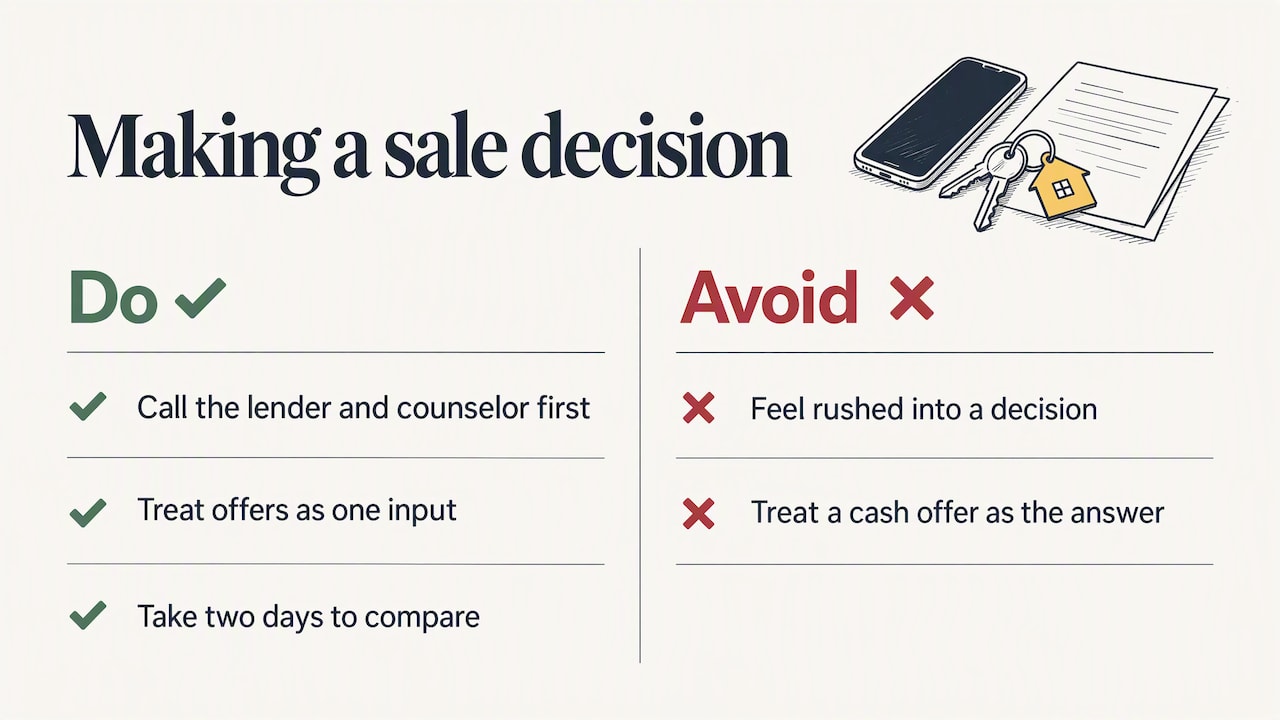
Our advice is to do the lender call and the counseling first, and to treat any offer, ours included, as one input. We buy as-is and base offers on the After Repaired Value, which means you do not have to fix, clean out or stage anything, and there are no agent fees or commissions on your side. The trade is simple: you give up the top-of-market price a repaired, listed house might reach, and you get speed, certainty and control over your closing date.
If the mortgage is already behind, timing matters more. Our pages on how to avoid foreclosure and stopping a foreclosure auction in Rhode Island explain what the stages look like and where a sale fits.
We would rather you take two days to compare than feel rushed into anything. If our offer is not the best one for your situation, we will tell you.
— Dave
When a cash sale fits after a job loss
These are the situations where a direct sale tends to make the most sense:
- You are behind on the mortgage and want to sell before the account goes further into default.
- The house needs work you cannot afford, and a financed buyer’s appraisal might not pass.
- You need to move for a new job and cannot carry two housing costs.
- You inherited or co-own the property and the carrying costs are piling up.
- Bankruptcy is on the table. Our page on selling before bankruptcy walks through that scenario, and you should talk to a bankruptcy attorney before acting.
And where it fits less well: you have a lot of equity, a house in excellent condition, and the ability to carry payments for a few months. In that case, listing probably nets more.
Work with us if speed matters
If you want a no-obligation read on what your Rhode Island house could sell for, contact Rhody Home Buyer. We buy homes as-is for cash, with no agent fees, no commissions and no repairs or cleaning. Our pages describe closings in as little as 7 to 21 days, and you can choose a later date if you need time to move. We do not publish a price list, because every offer depends on the property and the After Repaired Value, so the way to find out is to ask. Condo owner? See how we handle condo sales.
A simple 7-day plan
- Day 1: Call your servicer. Ask about forbearance, modification and any foreclosure timeline. Write down the name, date and what you were told.
- Day 1 or 2: File for unemployment with the Rhode Island Department of Labor and Training.
- Day 2 or 3: Book a HUD-approved counseling session and gather statements.
- Day 3 or 4: Get your payoff figure and a rough market value.
- Day 5: Build the net-proceeds comparison for a listing and a direct sale.
- Day 6: Request proof of funds and a sample contract from any buyer you are considering. Have an attorney review it.
- Day 7: Decide, or decide what you still need to know.
FAQ
Should I sell my house right after losing my job?
Not necessarily. Call your servicer first and ask about forbearance or a modification, then talk to a HUD-approved counselor. If your future income will not support the mortgage, or you want to protect your equity, selling can be the right move, and it is better done before the loan is seriously delinquent.
Can I sell if I am behind on my mortgage?
Yes. You can sell while behind as long as the sale proceeds cover the payoff, and a sale can stop the foreclosure process before it finishes. Contact your servicer and an attorney or counselor so you know the exact payoff and the stage you are in.
How fast can a cash buyer close in Rhode Island?
Speed depends on title work and the buyer. Our pages describe closings from 7 to 21 days, and you can pick a later date. Traditional sales commonly take longer, mostly because of buyer financing and inspections.
Will I owe taxes if I sell at a loss?
You will not owe tax on a loss, but you generally cannot deduct it either, according to the IRS. If you sell at a gain, you may be able to exclude a large part of it. A tax professional can confirm how your situation works.
Sources
- CFPB: Unexpected job loss
- Nolo: Rhode Island foreclosure process and laws
- CFPB: If I can’t pay my mortgage, what are my options?
- HUD: Talk to a housing counselor
- RIHousing annual report 2024
- Rhode Island DLT: Maximum weekly benefit amounts
- Rhode Island seller closing costs and transfer tax
- IRS: What if I sell my home for a loss?
- IRS: Losses on homes, stocks and other property
- Selling to a cash buyer: what you gain and give up
- NAR Realtors Confidence Index, September 2025