
You can sell a house that is held in a trust, but only the trustee can sign for it. The trust document and your state’s trust law decide how much freedom the trustee has. In Rhode Island, a trustee has broad power to sell unless the trust says otherwise, so the sale often goes faster than a probate sale. If the trustee wants a quick, as-is sale with no repairs, no agent commission and no showings, we buy houses for cash in Rhode Island and Eastern Connecticut, and the trustee picks the closing timeline.
TL;DR
- The trustee holds legal title and signs the contract and deed. Beneficiaries do not have the authority to sell just because they are beneficiaries.
- Rhode Island law gives a trustee a power of sale unless the trust document says otherwise, so most trust sales need no court approval.
- Expect to hand over proof of authority: the deed into the trust, a certification or relevant trust pages, the trustee’s ID and, after a death, a death certificate.
- Sale proceeds belong to the trust until the trustee distributes them as the document directs. Inherited property usually gets a date-of-death tax basis.
- A sale after a death often takes a few months. A cash sale of the house as-is removes repairs, listing prep and buyer financing from that timeline.
Table of Contents
- Who owns a house held in a trust
- What Rhode Island law lets a trustee do
- The documents a buyer and title company will ask for
- When the owner has died
- What the trustee owes the beneficiaries
- Where the sale money goes
- Taxes on a trust sale
- What slows a trust sale down
- Selling a trust house for cash in Rhode Island
- Our view on trust sales
- FAQ
- Sources
Who owns a house held in a trust
When a house is in a trust, the trustee holds legal title and the beneficiaries hold the benefit of the property. Doane & Doane explains that the trustee holds title in a fiduciary capacity, which means acting for the beneficiaries and not treating the house as personal property.
That split decides who can sell. The acting trustee is the person with legal authority to sign the listing agreement, the contract and the deed. Federal Title & Escrow states that beneficiaries have no authority to sell simply because they are beneficiaries.
The trustee changes depending on the situation:
- The person who created a revocable trust is alive. That person is usually the trustee and can sell as freely as they could before the house went into the trust.
- The creator has died or is incapacitated. The successor trustee named in the document steps in. A named successor generally has to actually become trustee before acting, so the paperwork showing that change matters.
- The trust is irrevocable. The trustee must follow the document closely, and the proceeds may be locked in as principal. Read the terms before you list or accept any offer.
Check that the house is actually in the trust
Signing a trust document does not by itself move a house into it. A deed has to transfer the property to the trustee, and it has to be recorded. A North Carolina estate attorney makes this point for that state, and it applies in general: the trust only controls the home if the deed was signed and recorded.
So your first step is to pull the recorded deed from the city or town land evidence records. If the deed names the trustee, the trust controls the sale. If it still names the person who died, the house sits outside the trust and is likely a probate matter.
What Rhode Island law lets a trustee do
Rhode Island does not follow the Uniform Trust Code that many states adopted. A Rhode Island trust administration guide notes that Title 18 of the General Laws governs instead. Under R.I. Gen. Laws § 18-4-2, a trust with no provision to the contrary gives the trustee a discretionary power to sell, lease or exchange trust property, real or personal, at public or private sale.
In plain terms: unless the trust document takes the power away or limits it, a Rhode Island trustee does not need a judge, or a vote of the beneficiaries, to sell the house. Always read the document anyway. It may require:
- Two or more co-trustees to sign together
- Written consent from a beneficiary or a trust protector for a sale
- A particular process or timing for selling the home
- A sale price floor, or a preference that a family member be allowed to buy
If you manage a trust that is not in Rhode Island, or the house is in another state, that state’s law governs the sale. For anything unclear, such as a conflict between the document and the statute, speak to a Rhode Island trust and estate attorney before you sign a contract.
The documents a buyer and title company will ask for
A title company has to be sure the person signing really can bind the trust. Closing requirements vary by state and by title company, but a trust-sale checklist lists the usual items: the recorded deed, the trust terms or the relevant portions, any amendments, documents showing a change of trustee, and the trustee’s identification.
In practice, have these ready:
- The recorded deed showing the trust or trustee as owner.
- A certification of trust, or the relevant trust pages. A certification is a short document that confirms the trust exists, who the trustees are, what powers they have and whether the trust is revocable. It lets you prove authority without showing who gets what. California’s statute, Probate Code § 18100.5, is one example of how a state defines it. Some title companies ask for trust excerpts instead, and practice differs by state.
- Trust amendments and any document appointing a new trustee.
- A death certificate and the successor trustee’s acceptance, if the person who created the trust has died.
- Government ID for each trustee who signs.
One trap: a trustee cannot hand signing authority to someone else under a power of attorney unless the trust agreement expressly allows delegation, according to Federal Title & Escrow. A power of attorney signed only by the trustee is not enough. If the trustee lives out of state or cannot be at the closing, ask the title company early how they handle it. Our guide for absentee owners selling in Rhode Island covers the remote-closing side.
When the owner has died
When the home was in a revocable trust, the successor trustee can generally sell it under the trust after the death, without a probate sale proceeding. If the house stayed in the owner’s own name, the estate’s personal representative may need court authority first. For how that route works, see this explanation of what a probate sale involves, and our own page on probate laws in Rhode Island.
A trustee’s guide to selling after a death reports that trust sales often take 2 to 4 months, against 6 to 18 months for probate. It lists title problems, disputes between beneficiaries and tax questions as the things that stretch that timeline. Treat those figures as typical ranges, not promises.
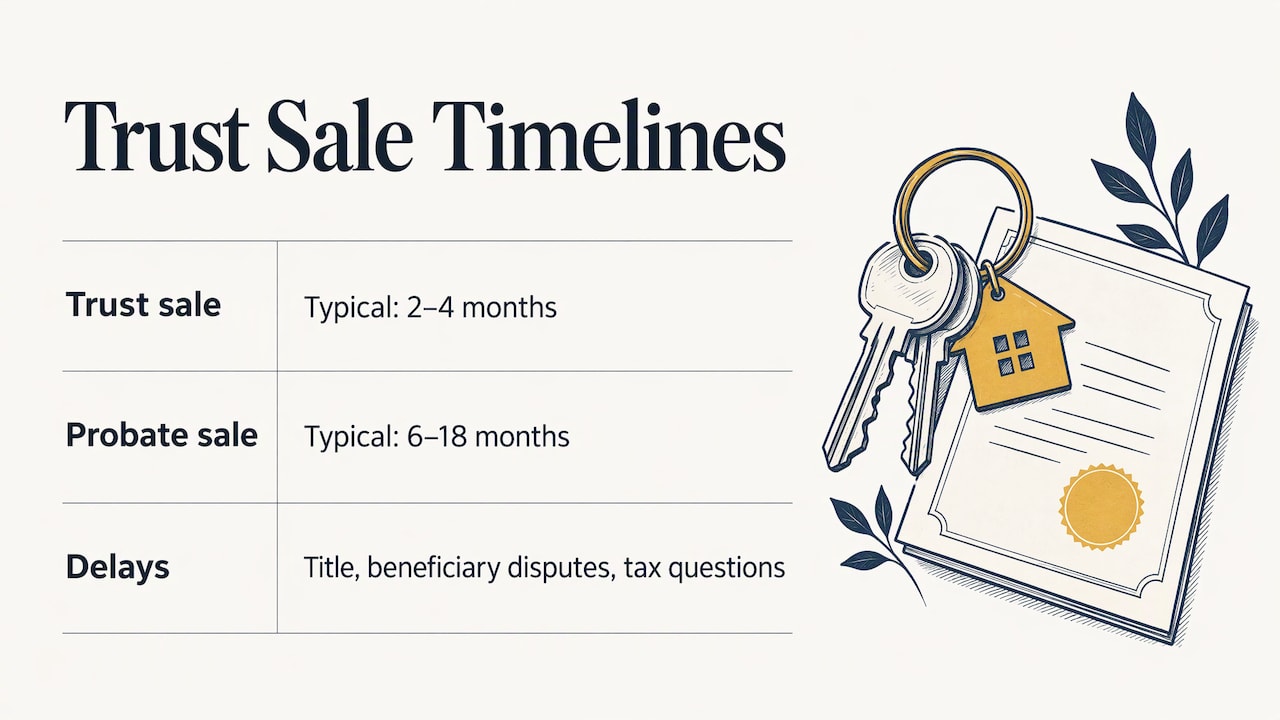
Our step-by-step page on selling a house after a death walks heirs through the order of tasks. If you are not sure whether a house is in the trust or in the estate, settle that before anything else, because it decides who signs.
What the trustee owes the beneficiaries
A trustee is a fiduciary. That means the trustee must act loyally and prudently for the beneficiaries and avoid self-dealing. A trustee should not sell to themselves or a relative at a discount, or pick a deal because it is easier for the trustee and not because it is good for the trust. Zeus Estate Planning notes that a beneficiary’s status alone gives no veto, though the trust may grant consent rights.
Two habits protect the trustee:
- Keep the beneficiaries informed. Tell them the house is being sold, why, and how the price was reached, even where the document does not require it.
- Keep a paper trail. Save offers, comparisons of net proceeds, repair estimates and carrying costs such as taxes, insurance and utilities.
Comparing offers by what the trust actually keeps is the sound approach. Our guide to home sale net proceeds shows how to calculate it, and cash offers versus financing compares the two routes on that basis.
Where the sale money goes
The proceeds of a trust sale belong to the trust, not to a beneficiary personally. According to NY Estate Lawyer, the trustee deposits the money into a trust account, pays closing costs, liens and taxes, then holds, reinvests or distributes the rest exactly as the document says. The details differ by trust type. The same source notes that a revocable trust’s creator can use the proceeds freely while alive, while an irrevocable trust may keep them as principal.
So do not promise any beneficiary a share until the trustee has paid the trust’s debts and bills and knows what the document directs.
Taxes on a trust sale
Tax depends on the type of trust and who is treated as owning it, so a tax professional should confirm your own numbers. Two principles are worth knowing.
Inherited property usually gets a stepped-up basis. Basis is the starting figure used to measure your taxable gain. IRS Publication 551 (revised December 2024) says the basis of inherited property is generally its fair market value at the date of death, with alternatives in some cases. If the house is sold soon after a death, the taxable gain is generally limited to the increase in value since then. That is why a date-of-death valuation is worth getting.
Who reports the gain depends on the trust. An IRS ruling says a person treated as owning part of a trust reports the income and capital gain tied to that portion. So a sale from a revocable trust may be treated as the creator’s own sale even though the trustee signs the deed. A non-grantor trust generally keeps capital gains at the trust level, per NY Estate Lawyer. Our page on tax consequences when selling an inherited house covers the inherited-house angle in more detail.
What slows a trust sale down
- A deed that never went into the trust. The house turns out to be a probate asset.
- Missing paperwork. No certification, no amendment showing the new trustee, or no death certificate.
- Co-trustees or beneficiaries who disagree. One missing signature can stall everything.
- A house that needs work. Deferred repairs, clutter, or open permits can scare off financed buyers. If permits are a concern, see our page on selling a Rhode Island house with open permits.
- Carrying costs. Taxes, insurance and utilities keep running on a vacant house while the trust waits.
The last two are the ones a trustee can control. A trustee who has already confirmed authority can shorten the rest of the timeline by choosing a buyer that doesn’t depend on a lender appraisal or on the house being fixed up.
Selling a trust house for cash in Rhode Island
A trust house is often an inherited house: dated, full of belongings, and a long way from the trustee’s own home. Listing it means cleanouts, repairs, agent commissions, showings and waiting for a buyer’s financing. Many trustees would rather settle the trust than manage all that.
We buy homes in Rhode Island and Eastern Connecticut directly, as-is. That means no agent fees or commissions, no repairs and no cleaning. Our offers are based on the After Repaired Value, and the closing happens on the timeline the seller chooses, with no pressure. A trustee can still do everything this article describes: confirm authority, provide the certification or trust excerpts, and get the beneficiaries’ questions answered. After that, the sale is a direct purchase of the house in the condition it is in.
More on the mechanics is on our pages about how cash home sales work and selling as-is. Whether you are a trustee, an heir or a creator selling during their lifetime, you can start with our Rhode Island cash offer page.

Our view on trust sales
Most trustees who contact us are not real estate people. They are a son, a daughter, or a friend who has been handed a house, a stack of documents and a list of people expecting answers. The legal side is the part to get right first: confirm the deed, read the powers section of the trust and keep the beneficiaries informed.
After that, the practical question is how to turn the house into cash for the trust with the least friction. We built our process for exactly that situation. We buy as-is, so there are no repairs to pay for and no cleaning. There are no agent fees or commissions to come out of the trust’s proceeds. And the closing date is set around the trustee’s timeline, not ours.
Our advice is to compare any offer by what the trust keeps at the end, after commissions, repairs and months of carrying costs, not by the headline price. We are comfortable with that comparison because it is the reason many trustees choose a direct sale.
Dave
FAQ
Can a beneficiary sell a house that is in a trust?
Not on their own. The trustee holds legal title and signs the contract and deed. A beneficiary can influence a sale only if the trust gives them a consent right, or by going to court if they believe the trustee is breaching their duties.
Do you need probate to sell a house in a trust?
Usually not, if the deed put the house into the trust and the trust gives the trustee power to sell. In Rhode Island, the statute gives a trustee a power of sale unless the trust says otherwise. If the house was never deeded into the trust, it may need to go through probate.
How long does it take to sell a house in a trust?
A sale after a death often takes about 2 to 4 months once the successor trustee has authority and the home is ready, according to one trustee’s guide. Title problems, disputes and tax questions can extend that. A cash sale as-is skips repairs and listing preparation.
Does the trust pay capital gains tax when the house sells?
It depends on the type of trust and who is treated as the owner for tax purposes. Inherited property generally takes a date-of-death basis under IRS Publication 551, which limits the gain on a prompt sale. Have a tax professional confirm the treatment for your trust.
Sources
- Who Legally Owns the Property in a Trust? (Doane & Doane)
- Using a Power of Attorney with a Trust (Federal Title & Escrow)
- What happens to my home if I transfer it into a family trust (Pierce Law)
- R.I. Gen. Laws § 18-4-2
- Rhode Island Trust Administration
- Selling a House in a Trust: 6 Steps
- California Probate Code § 18100.5
- Selling a House in a Trust After Death: Trustee’s Guide
- Can a Trustee Sell Property in a Trust? (Zeus Estate Planning)
- House Sale Proceeds in a NY Trust (NY Estate Lawyer)
- IRS Publication 551 (Rev. December 2024)
- IRS ruling 200104005