
To sell a house after the owner dies, you first have to prove who is allowed to sign the deed. Then you decide how to sell it: list it, which means repairs, cleaning and months of showings, or sell it as-is for cash. If you are the executor or heir of a Rhode Island home and want a quick, simple sale, we buy houses in any condition, with no agent fees, commissions, repairs or cleaning. You can close on your own timeline.
This guide covers the legal order of events, the money questions that catch heirs off guard, and the choices for selling, so you can move forward while you are also grieving.
TL;DR
- Nobody can sell until they can show authority: usually the court’s appointment as executor or administrator, or recorded documents if the home passed outside probate.
- In Rhode Island, authority to sell comes from a power of sale in the will or from the probate court, so start by finding the will and how the title was held.
- Until the sale closes, the estate carries the mortgage, taxes, insurance and upkeep, so a long listing costs real money.
- Heirs generally get a stepped-up tax basis equal to the home’s value on the date of death, which often means little or no capital gain on a prompt sale.
- A cash sale as-is removes repairs, cleanouts, showings and agent commissions from the process.
Table of Contents
- Who can legally sell the house after the owner dies
- What to do in the first weeks
- The money side: what the estate pays while it waits
- How long does it take, and what slows it down
- When heirs disagree about selling
- Your options for selling
- What a cash sale after a death looks like with us
- Ready to talk about the house?
- Our perspective
- FAQ
- Sources
Who can legally sell the house after the owner dies
The person who inherits the house is not always the person who can sell it. Authority depends on how the owner held title.
House in the deceased owner’s name alone. This usually goes through probate, the court process that confirms the will, pays debts and passes property to heirs. In that case, usually only the court-appointed personal representative (called the executor if there is a will, the administrator if there is not) can sign the deed. Title companies generally ask for proof of that authority, such as the court’s letters, before they will insure a sale to a buyer, according to a title-data publisher’s 2026 overview.
House held in a trust, or owned jointly with survivorship rights. Property held this way can often be transferred without probate by recording the right documents, such as an affidavit of death. The Sacramento County Public Law Library explains that this route can avoid full probate but does not wipe out liens or every creditor claim. The details vary by state, so confirm yours.
House with a will that names an executor. The executor starts the process, but does not always get to sell freely. Rules differ by state and by what the will says about selling.
How Rhode Island handles it
In Rhode Island, the authority to sell estate real estate comes from either a power of sale written into the will or an order of the probate court. The statute also lets the court allow an executor or administrator to sell real estate to settle the estate promptly. A house that was specifically left to one person needs that person’s written consent, as Rhode Island General Laws § 33-12-6 provides.
Probate in Rhode Island is run by the probate court of the city or town where the person lived. We explain the local process in more detail in our guide to probate laws in Rhode Island. For questions about your specific will or title, speak to a Rhode Island probate attorney. The attorney establishes your authority. The sale itself is a separate step that we can handle.
What to do in the first weeks
You do not need to decide about the sale right away. You do need to protect the property and gather the paperwork.
- Order certified death certificates. Banks, the court, the mortgage servicer and the title company will each ask for one.
- Find the will and the deed. The deed shows how the house was owned. Local tax records can confirm it. USAA’s executor guide suggests reviewing the will, any trust deed and tax records, then contacting the lender and the county clerk.
- Secure the house. Collect all the keys, change the locks or alarm codes, and stop any mail or deliveries that signal that nobody lives there.
- Call the insurance company. Tell it the owner has died and the home may be vacant. Vacancy can affect coverage, so ask what the policy requires.
- Contact the mortgage servicer. Find out the balance, whether payments are current and what a payoff would look like.
- Speak to a probate attorney. This is the step that tells you whether you need to open probate and who signs.
The money side: what the estate pays while it waits
A house does not stop costing money because the owner has died. Until it sells, the estate generally carries the mortgage, property taxes, insurance, utilities, and upkeep.
The mortgage does not go away
A mortgage stays attached to the home after a death. The personal representative should continue authorized payments when the estate has the funds, which helps avoid default and foreclosure, as the Alameda County Superior Court notes. It also notes that the representative must deal with the estate’s debts, taxes and liabilities and may need to file tax returns for the person who died or for the estate.
If payments have already fallen behind, time matters. A listing that takes months to prepare and sell adds more missed or advanced payments. If you are worried the house is heading toward foreclosure, a faster sale is worth looking at early.
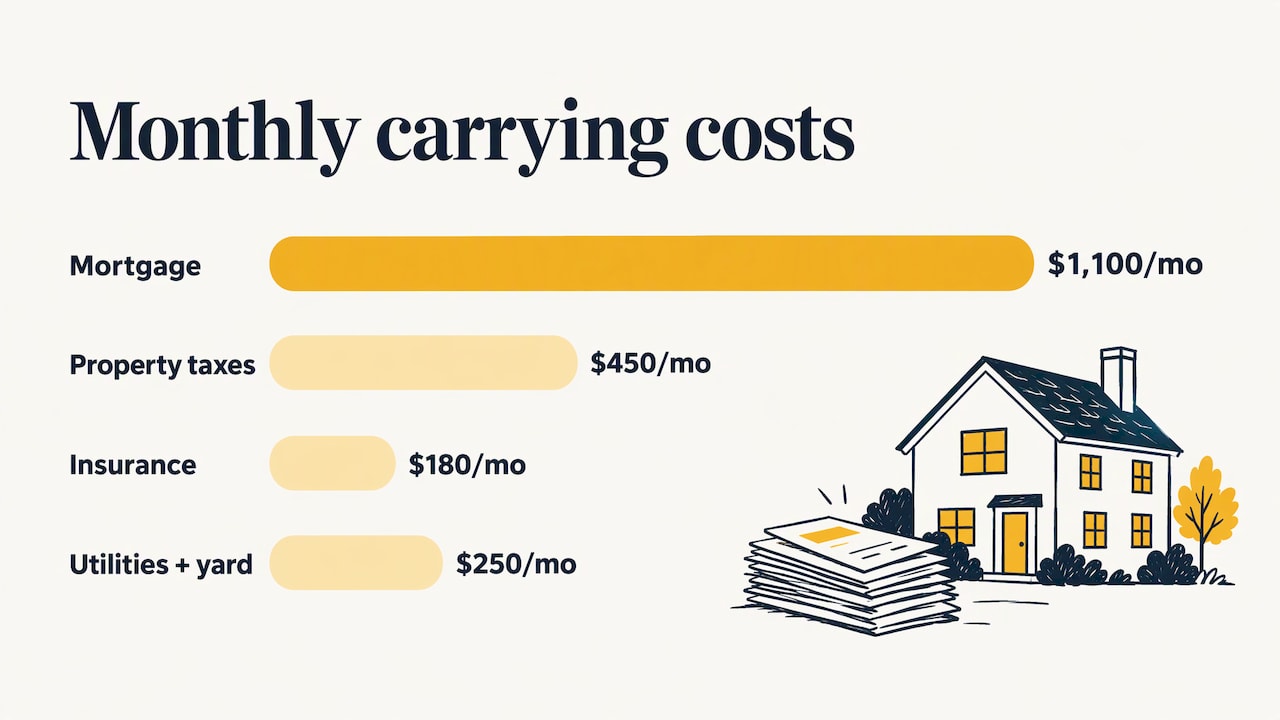
A realistic monthly carrying cost
Here is a simple worked example with made-up numbers, to show how it adds up. Say the home has a $1,100 monthly mortgage payment, $450 a month in property taxes, $180 for insurance and $250 in utilities and yard care. That is about $1,980 a month. Over a six-month process, the estate puts about $11,880 into a house that nobody lives in. Your numbers will differ, but the habit of adding them up is the same.
Taxes: usually lighter than heirs fear
Two separate taxes cause most of the worry.
Capital gains. The tax basis of inherited property is generally its fair market value on the date of the owner’s death, according to the IRS. So if the house was worth $380,000 on the date of death and sells for $380,000, there is generally no gain to report. A written appraisal from near the date of death is the document that supports that number. Our page on tax consequences when selling an inherited house goes into more detail.
Estate tax. This federal tax applies only to very large estates. The Congressional Research Service reports that the federal exemption rose to $15 million per person in 2026, up from $13.99 million in 2025. Most family homes fall far below that. Other states can set their own thresholds, so ask the estate’s attorney or tax preparer about Rhode Island and Connecticut rules.
How long does it take, and what slows it down
With a traditional listing, the timeline has several stages: probate or title work, cleanout, repairs, listing, showings, a buyer’s financing and inspections. Each stage can stall.
A Realtor.com account of an inherited-home sale closed about four months after the work began. Probate paperwork, yard cleanup, and missing ownership papers for solar panels on the roof all slowed it down. The lesson is that delays often come from the house and its title, not from the market.
Common delays include:
- Waiting on court letters. You cannot sign a deed without them.
- Unclear title or liens. Old mortgages, tax liens or unpaid bills can surface once a title search is run.
- A house full of belongings. Clearing decades of a life’s contents takes time and emotional energy.
- Deferred repairs. A buyer with a mortgage often needs the home to pass an appraisal and inspection.
- Open permits or utility issues. Unfinished work can stall a closing. See our page on selling a Rhode Island house with open permits.
- Medicaid or other liens. If a parent received long-term care benefits, a claim against the estate may exist. Read about selling a Rhode Island house with a Medicaid lien.
When heirs disagree about selling
Siblings often disagree: one wants to keep the family home, another wants the money. Your options, in rough order of escalation:
- Talk through a written agreement. Put what everyone has agreed to in writing before anyone spends money.
- Get a neutral valuation. A documented value takes much of the argument out of price.
- Offer a buyout. An heir who wants the house can buy out the others, subject to financing and written legal documents.
- Use mediation. A neutral third party can help when family history gets in the way.
- Go to the court. While probate is open, an heir can raise concerns with the probate court. If heirs already co-own the property and cannot agree, state partition law may allow a court-ordered buyout or sale, as the Alameda County court’s overview describes in general terms.
A personal representative with enough authority may be able to sell without every heir’s consent, but heirs usually agree faster when the process is clear and the numbers are on the table. A single as-is offer in writing, with no repairs for anyone to argue over, often gives everyone a concrete figure to talk about.
Your options for selling
Once your authority is clear, there are two practical paths.
| List with an agent | Sell as-is for cash to us | |
|---|---|---|
| Repairs and cleaning | Usually needed to attract buyers | None, we buy as-is |
| Agent fees and commissions | Yes | None |
| Showings and open houses | Yes | None |
| Timing | Depends on the market and buyer financing | You choose the closing date |
| Offer basis | Market listing price | After Repaired Value |
If the house is in good shape, you have months to spare and nobody is stretched financially, listing can make sense. If any of these apply, a direct cash sale usually fits better:
- The house needs work, or is packed with belongings.
- The estate is paying a mortgage, taxes and insurance on an empty house.
- The heirs live out of state and cannot manage showings.
- The house is behind on payments or in preforeclosure.
- The family simply wants it done so everyone can move on.
We lay out the trade-offs in comparing net proceeds on cash offers vs. financing. The right comparison is what ends up in the estate’s account after fees, repairs, carrying costs and time, not the headline price. Our page on selling without showings, open houses or staging explains what the process looks like when nobody has to open the door to strangers.
What a cash sale after a death looks like with us
We are a direct buyer of Rhode Island homes, and we also buy in Eastern Connecticut. We buy as-is, so there is nothing to fix and nothing to clean out before we make an offer. We base our offers on the After Repaired Value, and we do not charge agent fees or commissions.
The process for an inherited home usually runs like this:
- Tell us about the house. Give us the address and what you know about its condition and any mortgage.
- Get a fair cash offer. The offer reflects the After Repaired Value of the home.
- Confirm authority. The executor, administrator or heirs show the proof of authority the title company needs, and we work around the probate steps your attorney guides you through.
- Pick your closing date. You close on your terms, without pressure.
If you want the longer explanation of each step, see how cash home sales work and selling your house as-is.
Ready to talk about the house?
If you are handling a loved one’s Rhode Island home and want a straightforward, no-obligation conversation about a cash offer, start with our cash home buying page. Tell us about the property and your timeline, and we will take it from there.

We buy homes in any condition, so the state of the house is not a reason to wait. If the home is behind on payments or the family is facing foreclosure, tell us at the start so we can plan the timing around it.
Our perspective
Families who call us after a death are rarely thinking about real estate. They are thinking about a parent, about the funeral, and about a house full of memories that now has bills attached to it.
Our view is that the sale should not add to that weight. You should not have to patch a roof, rent a dumpster or host strangers in a loved one’s kitchen just to get the estate settled. That is why we buy as-is, with no agent fees or commissions, and why we let you set the closing date.
We base offers on the After Repaired Value and we explain how we got there. The legal side belongs with your probate attorney, and we work alongside that process. Once the paperwork says who can sign, the sale itself can be simple.
Dave
FAQ
Can I sell my parent’s house before probate is finished?
Usually not by signing a deed yourself. If the house was in your parent’s name alone, only the court-appointed representative can sign, and the title company will want proof. You can, however, talk to a buyer and line up an offer while probate is moving, so the sale is ready when authority is in place.
Do all the heirs have to agree to sell?
Not always. A personal representative with enough authority may sell without every heir’s consent. If the heirs already co-own the house, though, they generally have to agree or go to court. Getting agreement in writing early prevents most disputes.
Do I pay capital gains tax when I sell an inherited house?
Generally, the basis is the home’s value on the date of death, so a sale near that value usually produces little or no gain. Ask your tax preparer to confirm how that applies to your numbers. Our page on selling an inherited house covers the tax questions in more depth.
What happens to the mortgage if the owner has died?
The mortgage stays with the property. The estate should contact the servicer, find out the balance and payments due, and keep authorized payments going where the estate can afford them. At closing, the payoff comes out of the sale proceeds.
Do I have to clean out the house before selling to a cash buyer?
No. We buy as-is, so you do not need to clear, clean or repair the house first. You can keep what the family wants and leave the rest.
Sources
- Rhode Island General Laws § 33-12-6, sale of real estate to settle an estate
- Administering the Estate, Superior Court of California, County of Alameda
- Affidavits of Death: Transferring Property without Probate, Sacramento County Public Law Library
- Who Can Sell a House After the Owner Dies? (2026)
- Estate planning: Executor’s guide for selling a loved one’s home, USAA
- Gifts & inheritances, Internal Revenue Service
- The Estate and Gift Tax: An Overview, Congressional Research Service
- The Unsettling Challenges of Selling an Inherited House, Realtor.com