
Probate in Rhode Island is the court-supervised process of settling a person’s estate. The local Probate Court names someone to act for the estate, debts and taxes are paid, and what is left goes to the heirs under the will or state law. A house goes through probate only if it was titled in the deceased person’s name alone. Every estate must stay open at least six months. Small estates can use a faster shortcut.
This guide covers what probate is, which assets skip it, the steps and fees, the shortcut for small estates, realistic timelines, and what it takes to sell an inherited house. It is general information, not legal advice. For a specific estate, talk to a Rhode Island probate attorney and the Probate Court clerk in the right city or town.
TL;DR
- A house goes through probate when it was owned solely by the deceased. Jointly owned property and property with a named beneficiary generally does not.
- Estates with $15,000 or less in personal property (not counting tangible personal property) may qualify for voluntary administration, a much lighter process.
- Every regular estate stays open for at least six months, because creditors have that long to file claims.
- An executor or administrator needs the Probate Court’s authority before selling real estate that belongs to the estate.
- If an inherited house is a burden, you can plan a cash, as-is sale once the person in charge has legal authority to sign.
Table of Contents
- How probate works in Rhode Island
- Which assets go through probate, and which skip it
- Steps, forms and court fees
- The small estate shortcut: voluntary administration
- How long probate takes
- Selling a house that is part of a probate estate
- Our perspective
- Selling an inherited house as-is for cash
- A practical checklist for the first 60 days
- FAQ
- Sources
How probate works in Rhode Island
The process starts with a petition filed in the Probate Court of the city or town where the person lived at death. If there is a will, the person holding the original must deliver it to the court. Rhode Island law sets a deadline of 30 days after notice of the death, as General Laws § 33-7-5 is summarized in the search results. Check the current statute text before relying on that number.
The court then appoints a personal representative. With a will, that person is the executor. Without one, the court appoints an administrator and the estate follows Rhode Island’s intestacy rules. The representative’s job has four parts:
- Notify heirs, interested parties and creditors.
- Inventory the assets.
- Pay funeral costs, expenses of administration and debts in the order the law sets.
- Distribute what remains.
The order of payment matters. Under R.I. Gen. Laws § 33-24-1, a voluntary administrator must first cover the necessary expenses of the funeral and last sickness and the expenses of administration. Debts are paid next in the statutory order, and the balance goes to the surviving spouse or the persons the statute names. Representatives who pay heirs before creditors can create personal problems for themselves, which is one reason many families hire an attorney even for modest estates.
Which assets go through probate, and which skip it
Probate covers property titled only in the deceased person’s name at death. Property that passes by operation of law or by designation generally does not. Nolo’s guide to Rhode Island probate shortcuts lists joint tenancy property, property in a living trust and payable-on-death bank accounts as nonprobate property.
| Asset | Usually goes through probate? |
|---|---|
| House titled only in the deceased’s name | Yes |
| House held as joint tenants with survivorship | Generally no, it passes to the surviving owner |
| House held in a living trust | Generally no |
| Bank account with a payable-on-death beneficiary | Generally no |
| Account or property titled only in the deceased’s name | Yes |
A few details are worth knowing:
- Tenants in common. Co-owners who hold as tenants in common each own a separate share. That share does not pass automatically to the other owner, so the decedent’s share generally needs probate.
- Vehicles. A decedent’s motor vehicle passes to the surviving spouse unless the will provides otherwise, per R.I. Gen. Laws § 31-3.1-37 as summarized by Settled Estate.
- Transfer-on-death deeds. A 2020 bill, H7729, proposed letting an owner name a beneficiary who would receive real property at death without probate, with the deed recorded before death. That was a proposal. Confirm with an attorney or the city or town recorder whether such deeds are available now before planning around one.
So does a house automatically go to probate? No. It depends entirely on how title is held. Pull the deed from the city or town land evidence records to see.
Steps, forms and court fees
A typical regular estate moves through these stages.
Filing the petition
The petition is filed with the Probate Court where the person was domiciled. You will need the death certificate and, if there is one, the original will. The filing fee for a petition to probate a will or appoint an administrator is 1.0% of the decedent’s personal property over which the court has jurisdiction, with a $30 minimum and a $1,500 maximum, under R.I. Gen. Laws § 33-22-21. The same statute sets a $5 fee for a certificate of appointment. Since the fee is tied to personal property, a house does not raise it, though other costs apply, such as publication of notice.
Notice to creditors
The representative publishes notice so creditors can come forward. Creditors have six months to file claims, and that is the reason no regular Rhode Island estate can close sooner. The town of East Greenwich explains this in its probate guide for residents.
Estate tax and the real estate lien
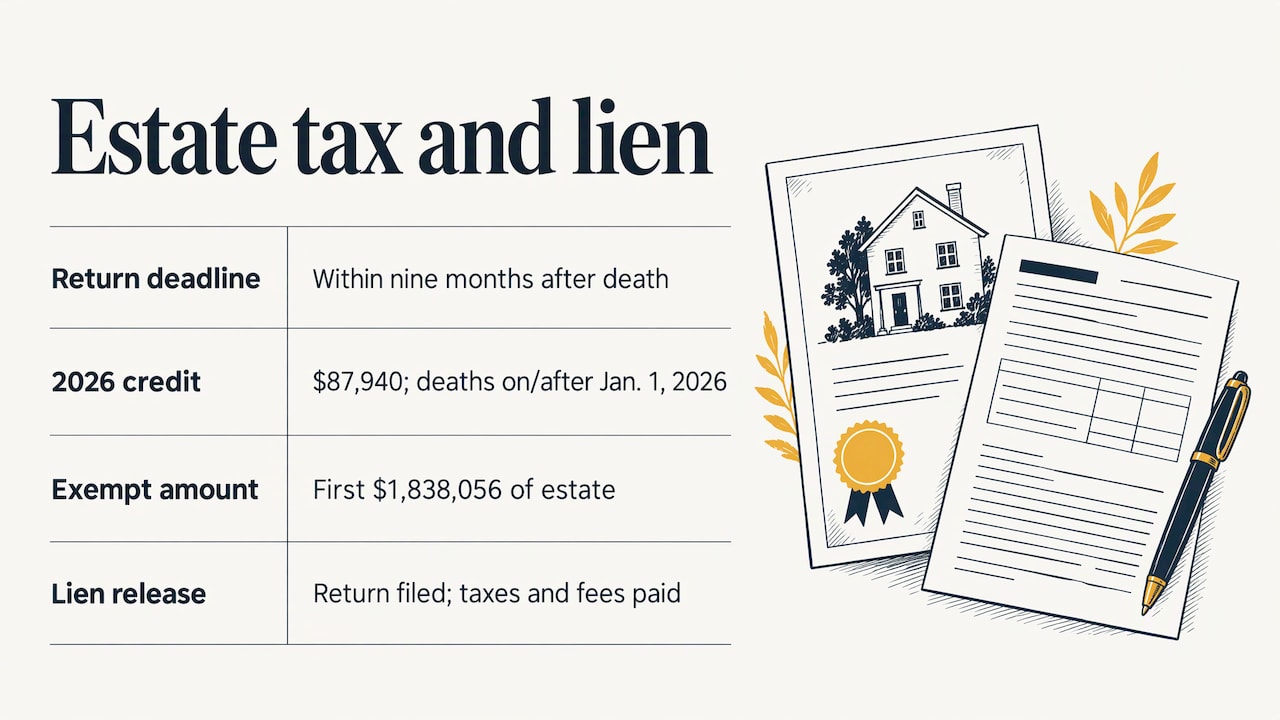
Rhode Island has its own estate tax. The return is due within nine months after the date of death, and the executor, administrator or personal representative must file it, according to the RI Division of Taxation. The same page explains that a statutory lien attaches to Rhode Island real estate and certain securities, and it cannot be discharged until the return is filed and taxes and fees are paid in full. For anyone planning to sell an inherited house, that lien is the practical point: the title company will want it cleared.
Most estates owe no tax. For people who died on or after January 1, 2026, the credit is $87,940, which exempts the first $1,838,056 of an estate, according to the Division of Taxation’s 2026 advisory. An estate at or under that net taxable value generally owes no Rhode Island estate tax. A return may still be required to release the lien, so ask the Division of Taxation or your attorney.
Accounting and closing
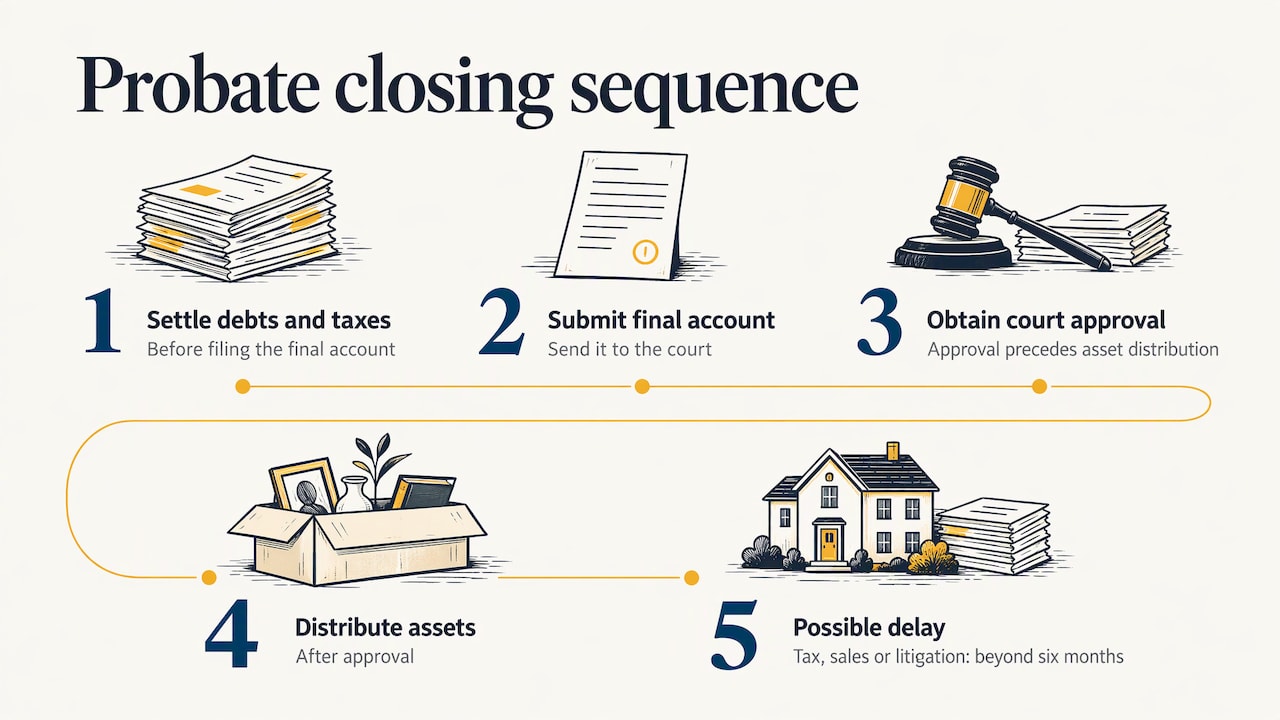
The executor must give the court an account of the estate’s activity. After debts and taxes are settled, the final account goes to the court for approval, then assets are distributed. The East Greenwich guide notes that closing can take much longer than six months because of tax issues, the need to sell property, or litigation.
The small estate shortcut: voluntary administration
Rhode Island does not follow the Uniform Probate Code’s informal and formal terms. Its lighter option for small estates is voluntary administration under R.I. Gen. Laws § 33-24-1. It applies when:
- A Rhode Island resident died leaving personal property, not counting tangible personal property, of no more than $15,000.
- No petition for letters has been filed.
- At least 30 days have passed since the death.
The statute sets a $30 statement fee and a $5 certification fee. Nonprobate property such as joint accounts or trust assets does not count toward the $15,000, as Nolo explains. A qualifying estate can often resolve in weeks after the 30-day wait, per Recording Law.
Be careful with this route when real estate is involved. The shortcut is built around personal property, so an estate that includes a house in the decedent’s sole name will usually need a different path. Ask the clerk of the Probate Court or an attorney which one fits.
How long probate takes
The floor is six months. After that, the length depends on complexity.
- Simple, uncontested estates: commonly cited at six months to a year, such as in this Rhode Island firm’s overview.
- Estates with real estate to sell, tax questions or family disputes: longer. One Warwick firm puts full administration at 9 to 18 months depending on complexity, creditor claims and court schedule.
- Voluntary administration: often weeks once the 30 days pass.
How will beneficiaries know it is finished? The court approves the final account, the representative distributes assets, and the estate is formally closed. If you are an heir and have not heard anything, ask the representative for a copy of the account, or ask the Probate Court clerk about the status of the file.
Selling a house that is part of a probate estate
This is where families get stuck. The heirs may live out of state, the house may need work, and the taxes and utilities keep running while the estate is open.
Two statutes set the rules for who can sell:
- Under R.I. Gen. Laws § 33-19-3, the Probate Court that issued the letters may authorize an executor or administrator to sell a deceased person’s real estate, for cash or on credit. The executor files a petition describing the property and the facts behind the request.
- Under R.I. Gen. Laws § 33-12-6, the representative may sell real estate even when personal property is enough to pay debts, if the court sees it as helping a prompt and efficient settlement. That authority is not given for real estate specifically devised unless the specific devisees consent in writing.
In practice, that means:
- No one can sell before appointment. A buyer, cash or otherwise, can only close with the person the court has authorized. Heirs cannot sign a deed on their own while the estate holds title.
- A will may leave the house to a named person. If so, that person’s written consent is part of the picture.
- Timing is under your control once authority exists. The court’s authorization and the six-month creditor period run on their own schedule, but the choice of buyer and closing date is yours.
If the house carries other complications, these pages from our site cover them: tax consequences when selling an inherited house, selling a Rhode Island house with a Medicaid lien, and selling a house during bankruptcy. If the owner lives elsewhere, see our guide for absentee owners.
Our perspective
We talk with Rhode Island families who have just inherited a house and are dealing with grief, paperwork and a property they never planned to own. The biggest source of stress is rarely the law itself. It is not knowing what comes first.
Our advice is the same every time: get the legal authority in place first, with a probate attorney and the right Probate Court. Then decide what the house should do for the family. Some heirs want to keep it. Many do not, because of distance, repairs, taxes or the cost of carrying an empty home.
That is where we come in. We buy houses as-is for cash, with no agent fees or commissions, and no repairs or cleaning. Our offers are based on the After Repaired Value, and we close on the timeline that suits the estate, not ours. The executor keeps control, and the sale follows whatever the court has authorized.
We focus on homeowners in Rhode Island and Eastern Connecticut, and we explain every step plainly, with no pressure.
Dave
Selling an inherited house as-is for cash
A traditional listing means cleaning out a lifetime of belongings, fixing deferred repairs, staging, showings and agent commissions, all while the estate waits. For many representatives, selling as-is is simpler. We buy Rhode Island homes in any condition, with no agent fees and no repairs. You can see how our as-is process works or compare cash offers against financing by net proceeds.

If you are the executor or administrator and have, or are getting, court authority to sell, tell us about the property through our Rhode Island cash offer page. We will explain our offer, how we arrive at it, and how closing fits around the court’s requirements. Your attorney should review any contract before you sign.
A practical checklist for the first 60 days
- Find the original will and confirm who holds it.
- Order several certified copies of the death certificate.
- Check how each asset is titled. Look for joint owners, beneficiaries, trusts and payable-on-death designations.
- Contact the Probate Court in the city or town where the person lived, and ask about forms and fees.
- Secure the house. Change locks if needed, keep insurance in force, and forward the mail.
- Keep a ledger of every expense paid for the estate, with receipts.
- Ask an attorney about the estate tax return and the real estate lien if the estate is large or the house will be sold.
- Decide the house’s future only after you know who has authority to act on it.
FAQ
Does a house automatically go to probate in Rhode Island?
No. A house goes through probate when it was titled in the deceased person’s name alone. Property held in joint tenancy or a living trust generally avoids probate, as Nolo notes. Check the recorded deed to see how title is held.
How long does probate take in Rhode Island?
At least six months, because creditors have that long to file claims, per the East Greenwich probate guide. Simple estates often take six months to a year, and more complex ones take longer. Small estates using voluntary administration can finish in weeks.
How much does it cost to open an estate?
The court filing fee is 1.0% of the decedent’s personal property, with a $30 minimum and a $1,500 maximum, under R.I. Gen. Laws § 33-22-21. A certificate of appointment costs $5. Publication of notice and attorney fees are separate.
Can I sell an inherited house before probate ends?
Yes, if the Probate Court has appointed a representative and authorized the sale where required. The court that issued the letters can authorize a sale of real estate under § 33-19-3. Heirs cannot sell on their own while the estate holds title.
Is there a faster process for small estates?
Yes. Voluntary administration applies when personal property, excluding tangible personal property, is $15,000 or less, no petition for letters has been filed, and 30 days have passed since death, per § 33-24-1. The fees are $30 for the statement and $5 for certification.
Sources
- R.I. Gen. Laws § 33-24-1, voluntary administration
- R.I. Gen. Laws § 33-24-1, small estate eligibility and fees
- R.I. Gen. Laws § 33-22-21, probate court fees
- R.I. Gen. Laws § 33-19-3, sale of real estate by executor or administrator
- R.I. Gen. Laws § 33-12-6, sale of real estate
- R.I. Gen. Laws § 33-7-5, will custody
- Rhode Island H7729 (2020), transfer-on-death deeds
- RI Division of Taxation, Estate Tax
- RI Division of Taxation, 2026 estate tax advisory
- Town of East Greenwich, Probate: What Should I Know About It?
- Nolo, Probate Shortcuts in Rhode Island
- Settled Estate, Rhode Island Probate Guide
- Recording Law, Rhode Island Probate and Intestate Succession
- McCormick Law, What Happens During Probate in Rhode Island
- Probate Attorney in Warwick, RI