
The fastest way to price a house is to anchor on recent comparable sales of homes in the same condition, then decide how much speed is worth to you. Price at or slightly below what buyers have actually paid and you get showings in the first two weeks. Price above it and the listing sits. If the house needs work or time is short, an as-is cash sale replaces guesswork with one number and a closing date you pick.
This guide walks through how pricing really works, what the data says about speed, how to adjust for repairs, and how to compare a listing price with a cash offer fairly.
TL;DR
- List price is a marketing price. Its job is to reach the widest pool of qualified buyers, not to test how much the market will pay.
- Data from Indiana REALTORS shows homes priced right go under contract fastest, and pricing far below the right number adds little extra speed.
- For a house needing repairs, start with comps of similar-condition homes, subtract repair costs, and expect a discount to a renovated home’s value.
- Compare a listing and a cash offer by net proceeds: agent fees, repairs, carrying costs and time all count.
- If you face foreclosure, act early. Talk to your servicer before you pick any price.
Table of Contents
- What a pricing strategy actually does
- Start with comparable sales
- What the data says about pricing and speed
- Price for your timeline
- Pricing a house that needs repairs
- How a cash offer is priced
- Adjusting the price when nobody calls
- Pricing when time is running out
- Our perspective on pricing
- Get a cash offer for your Rhode Island house
- FAQ
- Sources
What a pricing strategy actually does
A home’s price decides who sees it and how many people walk through. HousingWire explains that the list price is a marketing price rather than the final sale price, and that the goal is a number that appeals to the broadest set of qualified buyers and builds demand.
That changes how you think about the decision. You are not asking “what is my house worth to me?” You are asking “what number gets the right buyers to call this week?”
The National Association of Realtors says agents weigh size, location, amenities and condition when recommending a price. It also notes that a seller who wants to sell quickly may price more competitively, while a seller who can wait may start higher. Speed and price pull against each other, and your timeline decides where to land.
Start with comparable sales
Every sound pricing method starts with comps. A comparative market analysis looks at similar properties in your area that recently sold, are under contract or are active. Each tells you something different:
- Sold homes show what buyers paid.
- Pending homes show what buyers agree to pay now.
- Active listings are your competition, and show what buyers can choose instead of you.
Pending sales deserve extra weight. An agent quoted by NAR calls them “next month’s data” because they show what buyers are willing to pay today, while closed sales can be months old.
How to pick good comps
- Stay close: the same neighborhood or a few streets away, not a different town. In Rhode Island, prices can shift noticeably between neighboring towns and between coastal and inland streets.
- Match size and style: similar square footage, bedroom count and lot.
- Match condition: a gutted, dated house is not comparable to a fully renovated one.
- Use recent sales, ideally the last three to six months.
- Throw out the outliers, such as a family sale or a house sold during a bidding war that no longer reflects the market.
Write down three to five comps and a range, not a single number. That range is your starting point.
What the data says about pricing and speed
Most sellers assume that pricing very low guarantees a fast sale. The numbers say it is more nuanced.
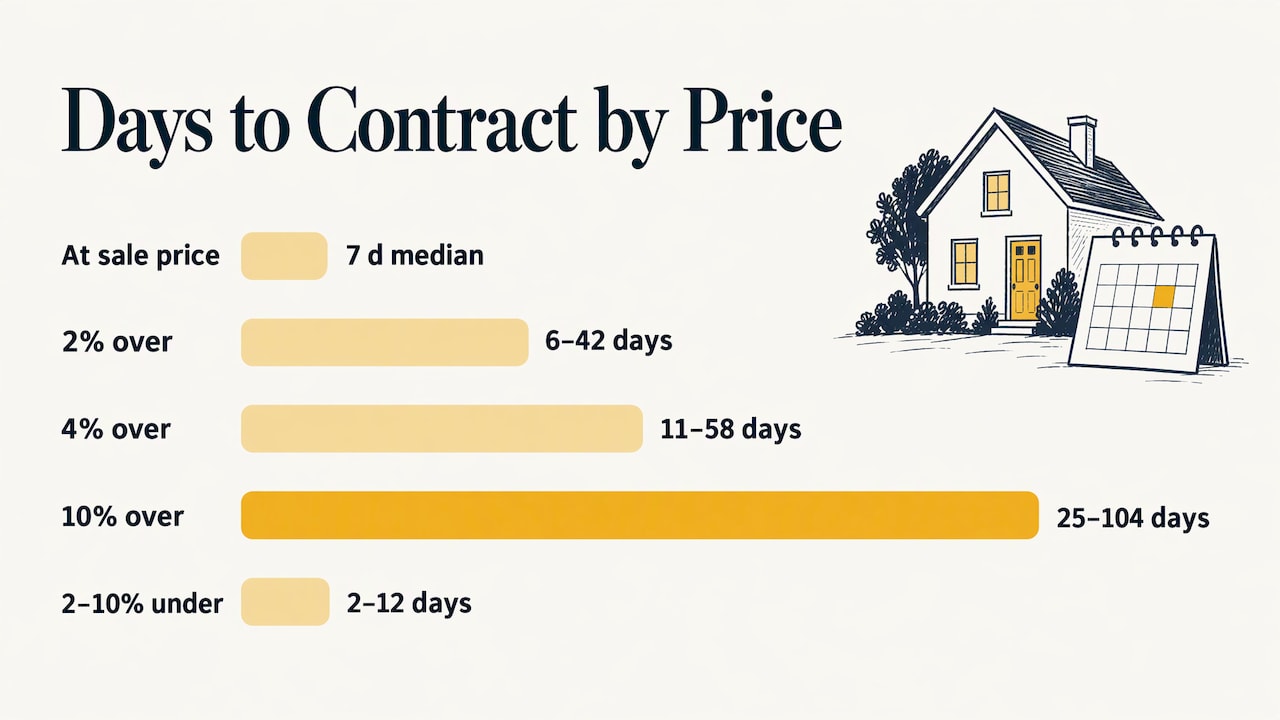
Indiana REALTORS tracked listing price against days to contract. In its 2026 update, a home listed at its eventual sale price went under contract in a median of 7 days. Pricing 2% too high opened the window to 6 to 42 days, 4% over to 11 to 58 days, and 10% over to 25 to 104 days.
| Listed relative to eventual sale price | Typical days to contract |
|---|---|
| At the sale price | Median of 7 days |
| 2% over | 6 to 42 days |
| 4% over | 11 to 58 days |
| 10% over | 25 to 104 days |
| 2% to 10% under | About 2 to 12 days |
The same report found that homes priced 2% to 10% below their eventual sale price went under contract in roughly 2 to 12 days, barely faster than correctly priced homes. Underpricing makes sense when speed is the overriding priority, but the gain is smaller than most sellers assume. An earlier Indiana REALTORS report shows the same pattern. Homes listed within 1% of their final price had a 50% chance of going under contract in 1 to 14 days.
Two caveats: this is Indiana data, and Rhode Island markets move differently. But the lesson holds anywhere. Overpricing is the expensive mistake, and the cure is accurate comps, not a deep discount.
Pricing just below the market
Some agents recommend listing 3% to 5% under recent comparable sales. One agent quoted by NAR argues that a $15,000 gap can be the difference between zero showings and several. HousingWire’s author makes a similar case: price low and let offers push it up rather than price high and chase the market.
A small psychological edge also helps. Many search filters work in round-number brackets, so a price like $499,000 sits inside a lower bracket than $500,000 and shows up for more buyers.
Price for your timeline
Your deadline matters more than any formula. Here is a simple way to match strategy to situation.
| Your situation | Pricing approach |
|---|---|
| Can wait 60 to 90 days, house in good shape | Price at the top of your comp range and be ready to adjust |
| Want a sale within 30 to 45 days | Price at or just under the middle of your comp range |
| Need to close within weeks | Price just under recent pendings, or skip the listing and get a direct cash offer |
| House needs major work or has been damaged | Price on as-is comps, or compare a cash offer against your repair-adjusted number |
The market backdrop matters too. In July 2026, the national median list price was $428,950, down 2.4% from a year earlier. The share of listings with a price cut had risen to 20.0%, and the median home spent 57 days on the market. A buyer today sees plenty of reductions and expects room to negotiate. Starting too high puts your home in the group that needs a cut.
Pricing a house that needs repairs
Repairs change the math more than almost anything else. A buyer does not pay renovated-home prices for a house that needs a roof, a kitchen or a dry basement.
A national listing portal’s guide says sellers of homes needing repairs should expect to sell for about 10% to 20% below full market value. It also recommends comparing with sales of similar-condition homes rather than renovated ones. Its repair-adjusted method looks like this:
- Take the average of comparable sales.
- Subtract estimated repair costs.
- Add a 10% to 20% buffer for negotiations.
- Adjust for current market conditions.
A worked example with made-up numbers: comps average $350,000, repairs are estimated at $40,000, and you leave a buffer of 10%. Subtract the repairs and you get $310,000. A buyer who knows the house needs work will negotiate from there, so list with that cushion in mind.
Get real repair quotes before you commit to a number. Water problems are a common surprise in New England, and basement waterproofing costs can run into thousands depending on the method and the size of the space. If you are trying to price a fixer-upper, a contractor’s written estimate beats a guess every time. For Rhode Island properties with specific problems, our pages on failed inspections, pet damage and flood zone houses cover the pricing questions that come with each.
How a cash offer is priced
A cash offer is built differently from a list price, which is why the two do not compare directly until you run the net numbers.
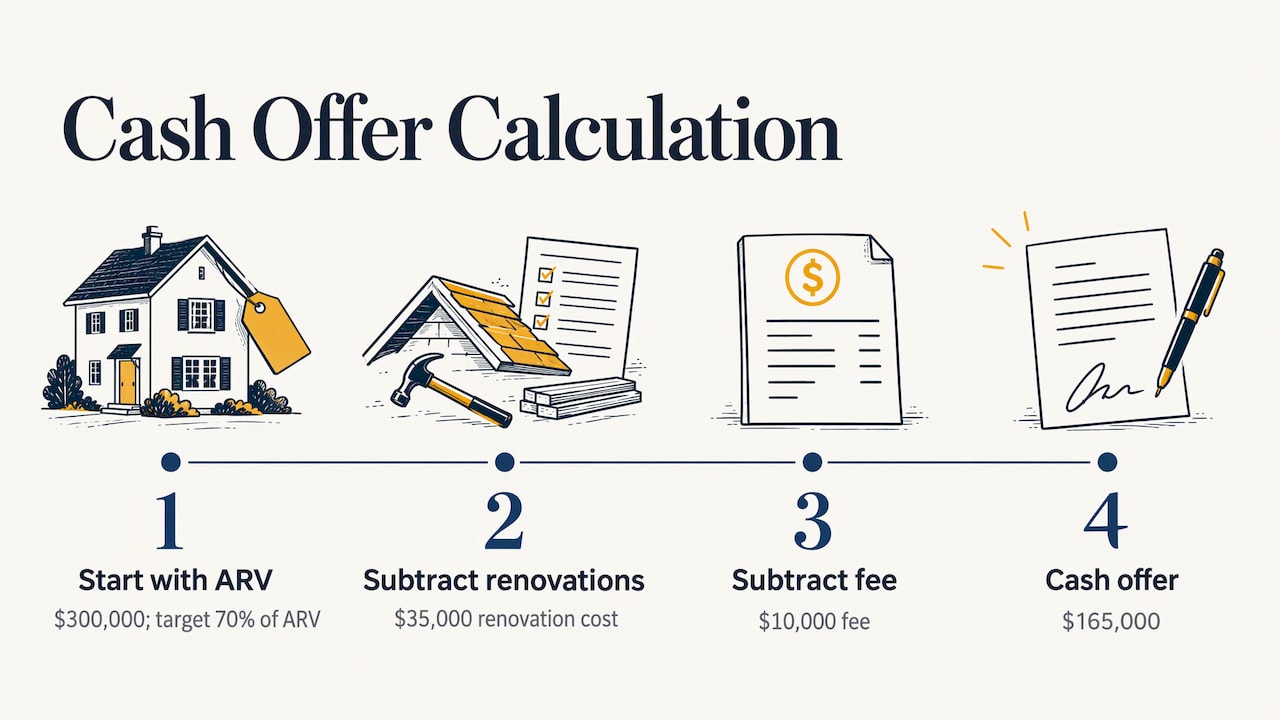
Cash buyers typically work backward from the home’s after-repair value (ARV), the price it would bring once fixed up. CNBC reports that wholesalers and cash buyers commonly aim for 70% of ARV, minus repair costs and fees. Its example: a $300,000 ARV, $35,000 of renovations and a $10,000 fee produce an offer of $165,000. The same article notes that this route usually makes sense when a seller needs to sell sooner and cannot afford or does not want renovations.
On the other side of the ledger, a listing carries costs a cash sale does not. A national listing portal’s explainer notes that a buyer of an as-is home may offer 10% to 20% below market value, which on a $400,000 house means roughly $40,000 to $80,000. That discount is the price of selling without repairs, and the question is what the listing route would cost you in repairs, fees and months of payments.
Compare net proceeds, not headline prices
For each route, write down:
- Sale price (or offer)
- Agent commission and closing costs (none of our offers carry agent fees)
- Repairs and cleaning you would have to pay for first
- Carrying costs per month: mortgage, taxes, insurance, utilities
- Months to close, including a buyer’s financing and inspection
- Risk of a deal falling through
Then subtract. Our guides on net proceeds when you repair or sell as is and cash offers versus financing show the comparison step by step. For the full range of what to expect, see selling without repairs.
Adjusting the price when nobody calls
If you list and the phone is quiet, the price is the first thing to question. NAR’s Melissa Dittmann Tracey suggests giving the market about two weeks, then making a 2% to 5% reduction, timed midweek, if showings are slow.
One decisive cut works better than several small ones. A national listing portal reports that the typical U.S. listing received $25,000 in cumulative price cuts, and warns that many small reductions prolong the sale before buyers notice.
Watch these signals:
- Few online views or saves in the first week: the price or the photos are off.
- Showings but no offers: buyers like the home but not the number.
- Offers far below asking: your comps may be stale.
If you have already cut once and carrying costs are climbing, that is a good moment to request a cash offer as a comparison. It gives you a firm number and date while the listing continues to age.
Pricing when time is running out
Pressure changes the strategy. If you are behind on payments, the right price is the one that closes before the bank takes control.
Under most circumstances, federal rules require a borrower to be more than 120 days delinquent before a servicer can officially start foreclosure. Nolo notes that acting before that point is usually the best time to sell. Check fair market value, get a payoff quote from your lender, and add up preparation costs, commissions, closing costs and moving costs. If the sale cannot cover the debt, a short sale may be possible with lender approval.
Fannie Mae explains that a short sale closes below the mortgage balance, that offers should be as close to fair market value as possible, and that forgiven debt may carry tax consequences. Speak to a tax professional about that last point.
Before you choose any price, call your servicer. Fannie Mae’s foreclosure guidance says a default notice can be prepared as early as 60 days after the first missed payment. It also says relief such as forbearance and repayment plans may let you stay in the home. If a sale is the right call, our page on selling before bankruptcy lays out the steps.
Inherited homes bring their own pricing pressure, especially when heirs disagree. In New Hampshire, for instance, a sibling can force a sale through partition. A clear, early price from a direct buyer can help families settle before it gets that far.
Our perspective on pricing
Most pricing advice assumes you have months, money for repairs and the patience to host showings. A lot of the Rhode Island and eastern Connecticut homeowners we talk to have none of those, and that is fine. A different route should not feel like a compromise.
Our offers are based on the After Repaired Value of the home, adjusted for the work it needs. That means you do not have to guess at contractor quotes, decide what is worth fixing or clean out the house. We buy as-is, with no agent fees or commissions, and you choose the closing timeline.
Our advice is to price your options, not just your house. Get your comp range, estimate what a listing would cost you in repairs, fees and carrying months, then ask us for an offer and compare net to net. We aim to be clear about how we reach our number so the comparison is simple.
Dave
Get a cash offer for your Rhode Island house
If you need to sell quickly, we buy houses in Rhode Island and eastern Connecticut in any condition. There are no agent fees, no commissions and no repairs or cleaning. You pick the closing date, and our offer is based on the After Repaired Value of your home. Read how our process works, or go to our main page to request your offer.

You can also see how selling as is and closing quickly works before you decide.
FAQ
How do I price my house to sell quickly?
Use recent comparable sales of similar-condition homes, give extra weight to pending sales, and list at or slightly below the middle of that range. Overpricing slows a sale more than a modest discount speeds it up. If you need to close in weeks, a direct cash offer removes the listing period entirely.
Does pricing below market value make a house sell faster?
Somewhat, but less than most sellers expect. Indiana REALTORS found that homes listed 2% to 10% below their eventual sale price went under contract in about 2 to 12 days, barely faster than correctly priced homes. Accurate pricing captures most of the speed benefit.
How much less will I get if my house needs repairs?
A national listing portal’s guidance puts the discount for homes needing repairs at roughly 10% to 20% below full market value. Your number depends on the work needed and local comps. Contractor estimates help you set a realistic figure.
When should I lower my asking price?
If showings are slow after about two weeks, NAR’s guidance suggests a 2% to 5% reduction. One meaningful cut generally works better than several small ones. Check your comps again before you decide how much to cut.
How is a cash offer calculated?
Cash buyers commonly start from the home’s after-repair value, then subtract repair costs and their costs. We base our offers on the After Repaired Value of your home. Ask any buyer to explain their number so you can compare net proceeds across your options.
Sources
- NAR: Consumer Guide, What Goes Into Pricing Your Home
- NAR: Listing Price Reduction? How to Navigate It With Buyers, Sellers
- HousingWire: How to Price Properties to Sell Faster
- Indiana REALTORS: The Price Is (Still) Right, 2026 Update
- Indiana REALTORS: The Price is Right
- Realtor.com July 2026 Housing Report
- Guide to selling a house that needs repairs
- CNBC: What Do We Buy Houses For Cash Companies Do?
- How much do you lose selling a house as-is
- When to lower the price of your house
- Nolo: How to Sell Your House Before Foreclosure
- Fannie Mae: What is a short sale?
- Fannie Mae: How to avoid foreclosure
- Basement waterproofing cost
- Inherited house and partition sale