
You can sell a home to pay for assisted living, memory care or a nursing home, and a care facility cannot simply take it from you. The hard parts are the order of the steps and the speed. Someone has to be legally able to sign. Medicaid rules can turn the sale proceeds into a countable asset. Every month the house sits empty or on the market adds to the bills. If the house needs work or must be emptied, an as-is cash sale to a direct buyer such as Rhody Home Buyer removes agent commissions, repairs and cleaning from that timeline.
TL;DR
- Selling a home is a recognized way to pay for care. The National Institute on Aging lists proceeds from a home sale among the personal funds families use, alongside public programs and private financing.
- Before anything is signed, settle who has legal authority to sell: the owner, an agent under a power of attorney that covers real estate, a successor trustee, or a court-appointed guardian.
- Sale proceeds can count toward Medicaid’s asset limit, and selling below market value or gifting the house inside the five-year look-back can trigger a penalty. Talk to an elder law attorney first.
- The IRS lets many sellers exclude up to $250,000 of gain on a main home, or $500,000 on a joint return, so the sale is often less taxable than families fear.
- A cash sale as-is, with no agent fees, repairs or cleaning, shortens the time between deciding to sell and having money for care.
Table of Contents
- Can a nursing home or assisted living facility take your house?
- Who can legally sign the sale
- What the sale does to Medicaid eligibility
- Taxes on the sale
- The steps and a realistic timeline
- Why the way you sell matters when care bills are running
- Perspective
- Selling to Rhody Home Buyer
- FAQ
- Sources
Can a nursing home or assisted living facility take your house?
No facility can take a house to settle a bill. What exists is a set of Medicaid mechanisms, run by the state, that apply only if Medicaid pays for long-term care.
First, the cost problem. The NIA says Medicare generally does not cover long-term nursing home stays, while Medicaid may cover some costs for people who meet their state’s eligibility rules. It also says professional care in assisted living and continuing-care retirement communities is almost always paid for out of pocket, though some state Medicaid programs may cover certain costs for eligible people.
That gap is why the house comes up. For many families it is the largest asset available.
Second, the Medicaid side. Medicaid.gov explains two separate tools:
- A lien during life. A state may place a lien on the real property of a permanently institutionalized enrollee. There are exceptions, including a resident spouse, a child under 21, a blind or disabled child, or a sibling with an equity interest. A lien must be removed if the enrollee returns home.
- Estate recovery after death. For enrollees age 55 or older, states must seek to recover the cost of nursing facility services, home- and community-based services and related hospital and prescription-drug services from the estate. States may recover more, subject to the stated exceptions.
So the real question is not whether a facility can grab the house. It is whether Medicaid will be involved, and how the sale proceeds are treated if it is. If a lien is already attached, our page on selling a Rhode Island house with a Medicaid lien covers that situation.
Who can legally sign the sale
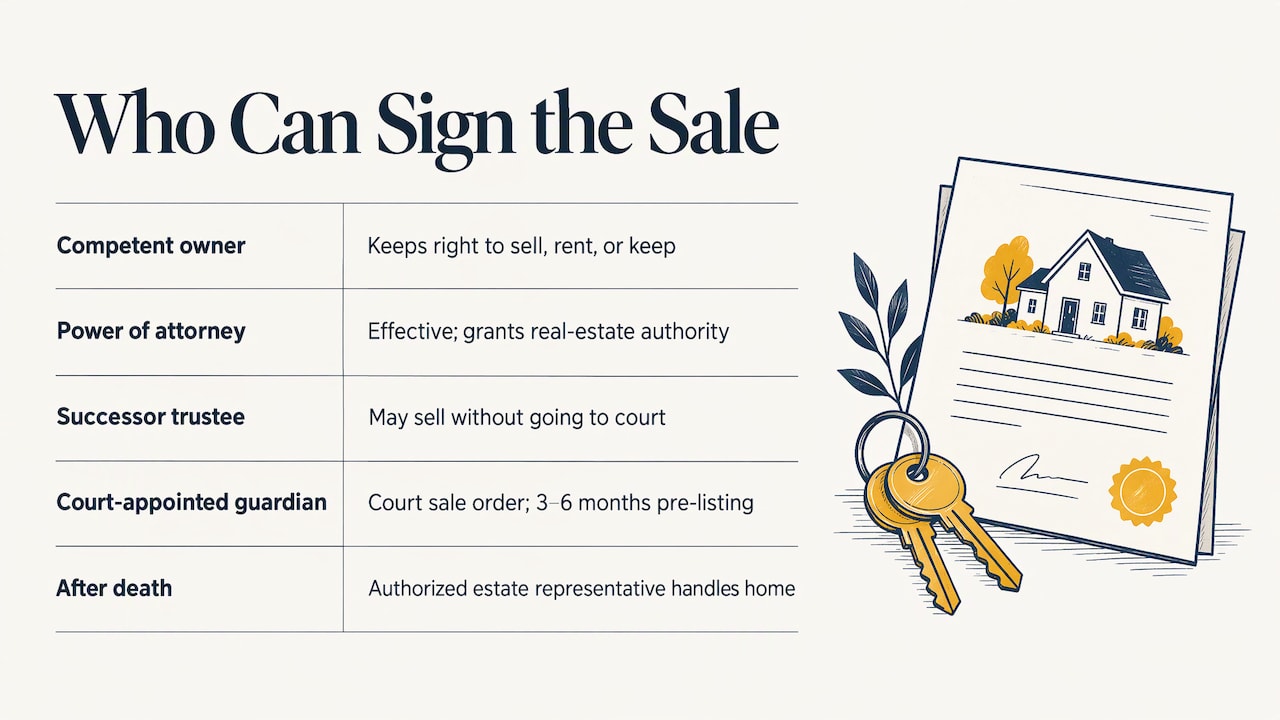
Before a buyer, cash or otherwise, can close, the person signing must have the authority to do so. This is the step that most often delays a sale, and it is worth sorting out in the first week. The paths below come from legal and caregiver guidance, and the details vary by state, so confirm them with an attorney.
The owner, if competent. A parent who still has legal capacity keeps the right to sell, rent or keep their home. Needing care does not remove that right. Capacity is a legal question, so if there is doubt, ask an attorney before relying on a signature.
An agent under a power of attorney. A financial power of attorney works only if the document is in effect and expressly grants authority over real estate. The agent must follow the document, state law and fiduciary duties. An elder law attorney, Ryan Riggins, warns that a general power of attorney signed years ago often lacks the specific real-property authority needed to sign a deed. Check the wording early. Do not wait until a buyer is ready to close.
A successor trustee. If the owner placed the home in a revocable living trust, the successor trustee named in the trust may be able to sell without going to court.
A court-appointed guardian. If the owner lacks capacity and has no suitable power of attorney or trust, a family member may need to be appointed guardian. The same source says a guardian often needs a court order specifically approving the sale, and that the process can take three to six months before the house is even listed. That is the longest delay in the whole process, so start the paperwork as soon as the need is clear.
After death. A power of attorney ends when the parent dies. From then on, an executor or personal representative, a trustee or another person authorized under the estate plan and state law is responsible for the home. If that is where you are, see our guide on how to sell a house after a death.
What the sale does to Medicaid eligibility
This is where families make expensive mistakes, so slow down here.
While a person lives in a home, or intends to return to it, Medicaid usually treats it differently from cash. Once it is sold, the proceeds become money in the bank, and cash counts toward the asset limit. According to a Medicaid planning resource, the owner may need to pay for care privately until assets drop back to the limit and eligibility is regained. The same guide notes that proceeds reinvested in another Medicaid-exempt home within three months may be treated differently. Treat that as general guidance only. Rules differ from state to state. Wisconsin’s Medicaid handbook is one example of a three-month escrow rule for a homestead. Rhode Island’s rule is its own, and an attorney should confirm it.
Then there is the look-back. The CMS transfer-of-assets backgrounder describes a 60-month look-back for long-term care applications, with penalties for transfers below fair market value. In practice:
- Selling at fair market value and spending the money on the owner’s care is generally not a problem.
- Selling to a relative at a discount, or giving the house away, can create a penalty period during which Medicaid will not pay.
- Moving the house into a trust to “protect” it, without an attorney’s approval, can trigger the same penalty.
The lesson is to sell at a fair price to an unrelated buyer and keep the paperwork. If Medicaid will be part of the plan, hire an elder law attorney before anything is listed, signed or retitled. This is one of the few steps where a specialist is required, and the attorney’s advice should shape the closing terms.
Taxes on the sale
The tax picture is usually friendlier than families expect. The IRS says qualifying sellers may exclude up to $250,000 of gain on a main home, or up to $500,000 on a joint return filed with a spouse. The general test is ownership and use of the home as a main home for at least 24 months in the five years before the sale. Gain above the exclusion may be taxable and reportable. If you receive a Form 1099-S, the sale must be reported even when the gain is fully excluded.
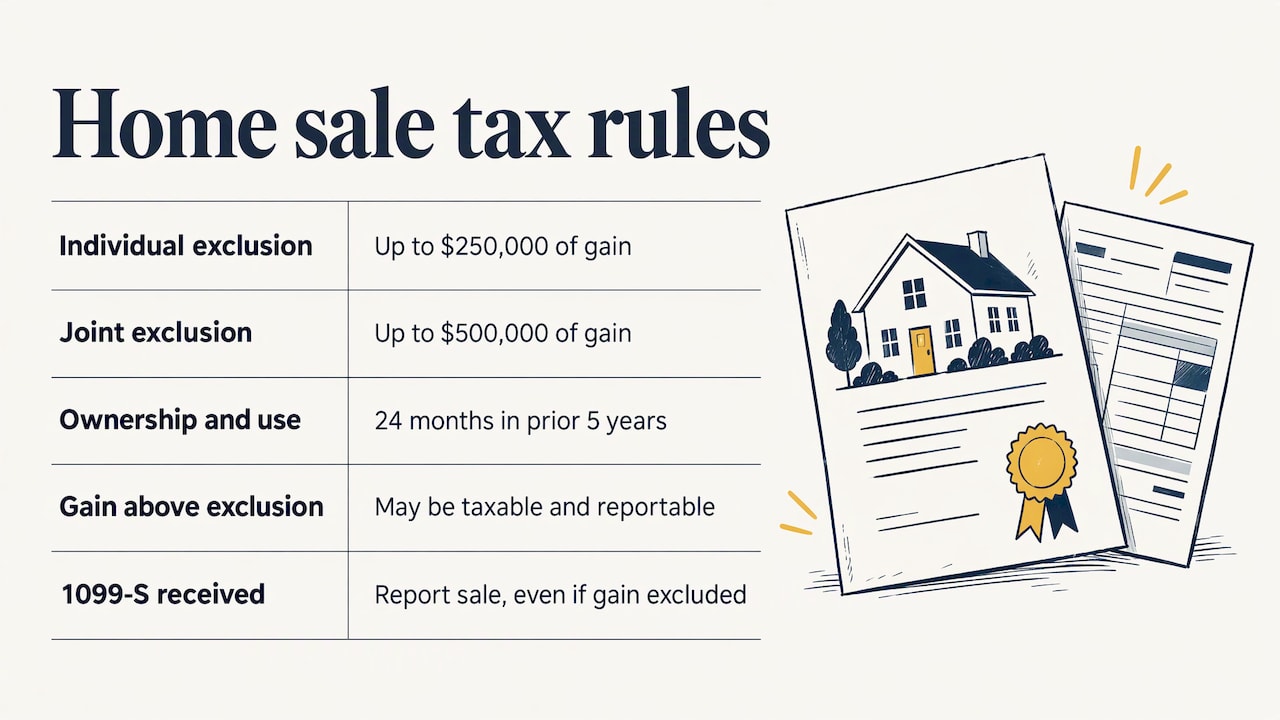
A worked example: a widowed owner bought the home decades ago for $140,000 and sells it for $390,000. The gain is $250,000 before selling costs and improvements, so with the single-filer exclusion it would generally fall at or under the limit. A seller with a much larger gain could owe tax on the excess. Keep records of the purchase price, major improvements and selling costs, since they reduce the gain.
Time spent in care matters too. A law firm’s guide points to a provision in the tax code that counts time in a licensed care facility toward the residency test when the owner could no longer care for themselves and had lived in the home at least one year of the prior five. Because this turns on details, confirm it with a tax professional before relying on it. If the home was inherited rather than owned by the person in care, a different set of rules applies, covered in our article on tax consequences of selling an inherited house.
The steps and a realistic timeline
One attorney guide lays out an order of steps and a rough 60 days when authority papers are in order, with court time added if a guardian is needed. The sequence below is built on that, adapted to a family that needs money for care soon.
- Measure the monthly gap. Add up care costs and subtract income such as Social Security, pensions and any long-term care insurance. The NIA notes that insurance coverage depends on the policy type, the services included and how long benefits last, so read the actual policy. This number tells you how long the proceeds need to last.
- Confirm who can sign. Use the section above. If a guardianship is needed, begin it now, since it is the slowest step.
- See an elder law attorney. Do this before listing, gifting or retitling. Ask about Medicaid, the look-back and how the proceeds should be handled.
- Gather records. Find the purchase price, improvement receipts, the deed and any mortgage or lien statements.
- Choose how to sell. A listing means preparing the house, paying commissions, showing it and waiting for a buyer’s financing. A direct cash sale does not require any of that. More on this below.
- Close and pay for care. Keep proceeds in an account titled to the owner, record where every dollar goes, and report the sale on the tax return.
Meanwhile, keep an eye on the cost of the empty house. Property taxes, insurance, utilities and maintenance keep running. One estate attorney recommends weighing those carrying costs against the care bills when deciding when to sell an unoccupied house. If you live elsewhere, our guide for absentee owners selling in Rhode Island walks through the practical side.
Why the way you sell matters when care bills are running
Care costs arrive monthly, but a traditional sale pays out on the market’s schedule. That mismatch is the real pressure. The typical house a family sells for care has decades of belongings, deferred repairs and sometimes a tenant-free but neglected yard and roof. Getting it market-ready means money and weeks before the first showing, and the family is usually managing a parent’s move at the same time.
A cash buyer who purchases as-is changes that:
- No agent commission or listing fees. The offer is not reduced by a percentage taken at closing.
- No repairs. The house is bought in its current condition.
- No cleaning or clearing out first. Our page on selling a house without cleaning it explains what you can leave behind.
- A closing date you choose. If the move into care is scheduled, the closing can follow it. If the need is urgent, it can be fast.
It is also worth comparing net proceeds, not headline prices. A higher listing price can shrink once commissions, repairs, carrying costs and months of waiting are subtracted. Our cash offers vs. financing page shows how to run that comparison.
Perspective
When families call us about selling for care, the house is rarely the only thing on their minds. There is a parent moving, a sibling in another state, a stack of forms and a monthly bill that does not wait. Our view is simple: the sale should be the easy part.
That is why we buy homes as-is, in any condition, with no agent fees, commissions, repairs or cleaning. Our offers are based on the After Repaired Value of the home, and we let you set the closing timeline, so the sale can follow the care schedule instead of the other way around.
We work with homeowners across Rhode Island and Eastern Connecticut, and we keep the process clear and free of pressure. Bring us the questions about the house, and bring the legal and Medicaid questions to your elder law attorney, so the two tracks move together.
Dave
Selling to Rhody Home Buyer
If the house is the way you plan to pay for care, we can make you a cash offer on it as it stands, anywhere in Rhode Island or Eastern Connecticut. You do not repair it, clean it or pay a commission, and you decide when to close. Our page on how our cash buying works walks through it, and you can start with a request on our main page.

If you are still weighing the choice, our guide on selling as-is and closing quickly shows when a cash sale is the better fit.
FAQ
Will Medicaid know if I sell my home?
Yes, plan on it. A Medicaid long-term care application asks about assets and about transfers made in the previous 60 months, according to the CMS backgrounder. A fair-market sale with documented proceeds is straightforward to show. A discounted sale or gift is what draws a penalty.
Do I have to sell my house to pay for a nursing home?
Not automatically. The NIA lists several ways to pay, including personal funds, long-term care insurance and government programs. Whether selling makes sense depends on your finances, the type of care and Medicaid eligibility. An elder law attorney can tell you how it applies to your situation.
Can I sell my parent’s house if they can no longer decide for themselves?
Only if someone has legal authority. That might be an agent under a power of attorney that covers real estate, a successor trustee, or a court-appointed guardian. Without one of these, a sale cannot close. Have an attorney review the documents before the house goes to market.
Will I owe tax on the sale?
Many owners owe nothing. The IRS allows up to $250,000 of gain to be excluded on a main home, or $500,000 on a joint return, if the ownership and use tests are met. Larger gains, or homes that were not a main home, can be taxable. A tax professional can confirm your figures.
Sources
- Paying for Long-Term Care, National Institute on Aging
- Long-Term Care Facilities: Assisted Living, Nursing Homes, National Institute on Aging
- Estate Recovery, Medicaid.gov
- Transfer of Assets in the Medicaid Program, CMS
- Topic no. 701, Sale of your home, IRS
- 16.8 Real Property, Wisconsin Medicaid handbook
- Selling a Home to Pay for Long Term Care, Medicaid FAQ
- Keeping or Selling a Parent’s House, A Place for Mom
- Do You Need Power of Attorney to Sell Your Parent’s Home?, Riggins Strategic Solutions
- How to handle real estate decisions when a parent has dementia
- Selling a House to Pay for a Nursing Home: Tax & Medicaid, Goldstein & Co.
- Selling a Parent’s Home to Pay for Long-Term Care, Karen Langsfeld