
Your net proceeds are the sale price minus everything that has to be paid out of it: your mortgage payoff, liens, agent commissions, closing costs, credits to the buyer and repairs. The number you keep is almost always far below the number on the offer. If you are selling in Rhode Island and need speed, a direct cash sale changes the math, because the commission and repair lines disappear. We buy homes as-is for cash, so you can run the same formula both ways and compare. Our cash offer process shows how that works.
TL;DR
- Net proceeds = sale price − mortgage and lien payoffs − commissions − closing costs − credits and repairs. Tax is a separate calculation.
- Sellers typically lose roughly 8% to 10% of the price to selling costs, before the mortgage is paid.
- Use your lender’s written payoff figure, not the balance on your statement. It includes interest up to the payoff date.
- Rhode Island’s conveyance tax rose to $3.75 per $500 of the price on October 1, 2025.
- A cash sale as-is has no agent commission and no repair bill, so compare the two nets, not the two prices.
Table of Contents
- What net proceeds actually mean
- The formula, line by line
- A worked example
- When the number comes out negative
- What about taxes on the gain?
- How to build your own net sheet in five steps
- Where a cash sale changes the math
- Perspective
- Ready to compare your numbers?
- FAQ
- Sources
What net proceeds actually mean
Gross proceeds are the price the buyer pays. Net proceeds are what is left after the seller subtracts all costs and expenses from that gross amount: the mortgage, liens, commissions, taxes and closing costs. If the result is negative, you would have to bring money to closing or get your lender’s approval for a short sale, where the lender accepts less than it is owed.
Two ideas get mixed up all the time, so keep them apart:
- Net proceeds is cash math. It tells you how much money lands in your account at closing.
- Taxable gain is tax math. It compares what you received with what you paid for the home, plus improvements. It may be zero even when your net proceeds are large. Paying off a mortgage lowers your cash received but does not by itself lower your taxable gain.
The formula, line by line
A clean version of the formula, which HomeLight publishes, is: sale price minus mortgage payoff, home prep costs, agent commissions, concessions and closing costs. Here is what goes in each line.
1. Sale price
This is the figure in the contract. For a cash sale it is the offer. For a listing it is what you realistically expect after negotiation, not the asking price. The price matters more than anything else on the sheet: in one U.S. Bank example, a $700,000 sale leaves $300,000, while a 10% lower price of $630,000 leaves $230,000 with the same costs. A 10% drop in price cut the seller’s take by about 23%.
2. Mortgage, HELOC and lien payoffs
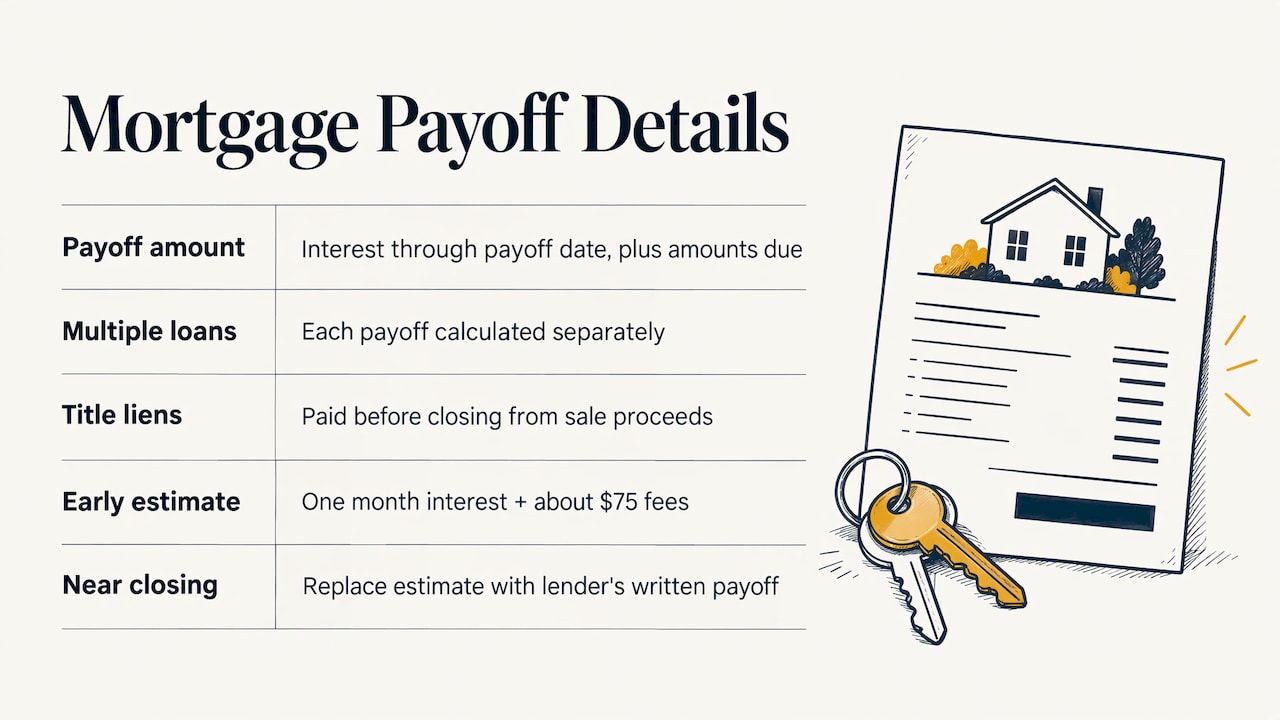
This is usually the biggest deduction, and the one people get wrong. Your payoff amount is not the balance on your statement. It includes interest through the payoff date and other amounts due, and if the property secures more than one loan, each payoff is calculated separately and the total is subtracted.
Also list anything that attaches to the title. Home equity loans, tax liens, mechanic’s liens and overdue HOA dues must be paid before closing and are typically paid from the sale proceeds. Judgments and second loans work the same way. For an early estimate, Land Title Guarantee suggests adding one full month of interest and about $75 in statement fees to your balance. Then replace the estimate with the lender’s written payoff as closing nears.
3. Agent commissions
This is the line a direct cash sale removes. Rosenblatt Real Estate puts total commission at 5% to 6% of the price. HomeLight’s figures are a little lower on average, 3% to 5.8%, with the listing agent at about 3% and the buyer’s agent at about 3% if you offer it. Commissions are negotiable, so use the number in your listing agreement once you have one.
4. Seller closing costs
These include title insurance, escrow or attorney fees, transfer taxes, notary fees and unpaid property taxes or HOA dues. Estimates vary by source. Rosenblatt gives 1% to 2%, while Veterans United says costs beyond commissions typically run 2% to 4%. Use the higher end if you are not sure.
5. Rhode Island’s conveyance tax
Rhode Island charges a real estate conveyance tax on the price. The state Division of Taxation says the rate increased from $2.30 to $3.75 per $500 on October 1, 2025. A second tier applies only to the part of a residential sale above $800,000. On a $350,000 sale, the first tier works out to 700 × $3.75 = $2,625. Check with the closing attorney which side pays what in your contract.
6. Credits, concessions and repairs
If the buyer’s inspection turns up problems, you may credit them at closing or fix the problems first. HomeLight lists concessions of up to 2% to 6% and staging and prep at 1% to 4%. Rosenblatt’s range for pre-sale preparation is $500 to $5,000 or more. A roof, HVAC or landscaping job all come straight off your take-home.
7. Prorations and moving
Property taxes, HOA dues and utilities are split by closing date, so you may owe or be owed a small amount. Land Title notes that a minimum $500 escrow may be required for final utility bills. Moving costs are not on the settlement statement, but they belong in your own budget.
A worked example
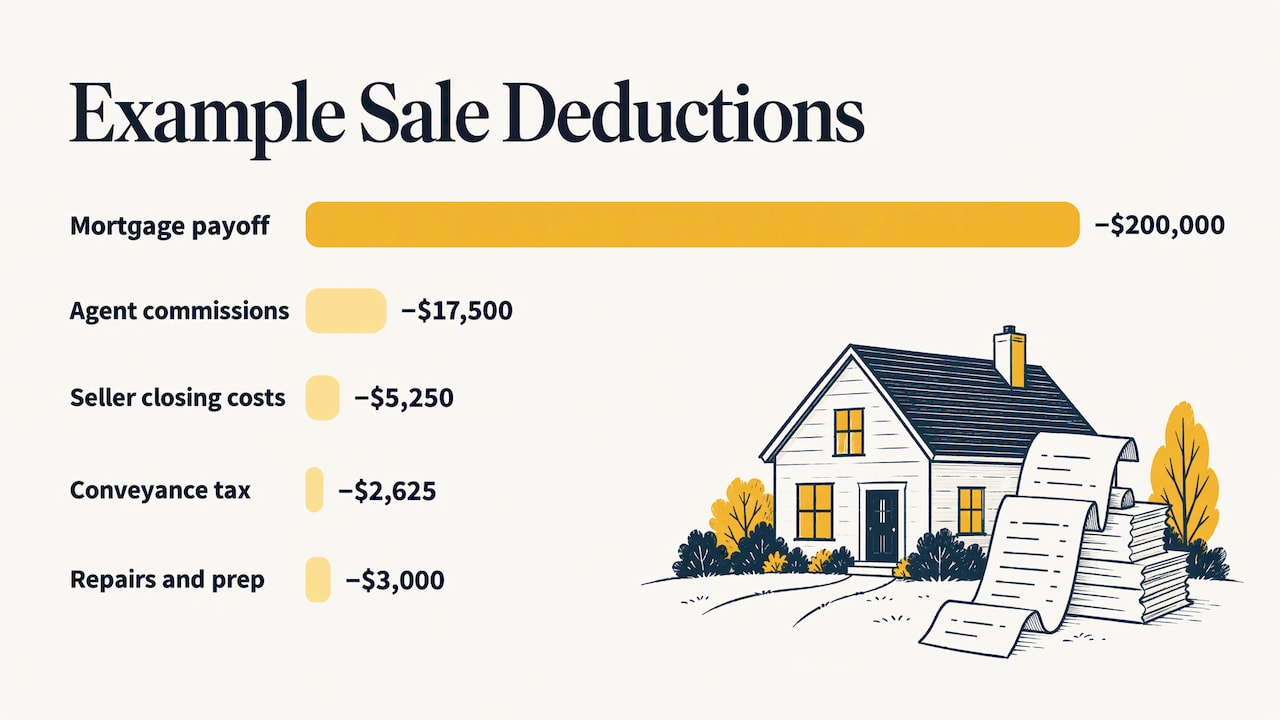
This is an illustration with assumed numbers, not an offer or a quote. Say a Rhode Island homeowner expects to sell a house for $350,000 on the open market, with a $200,000 payoff.
| Line | Amount |
|---|---|
| Sale price | $350,000 |
| Mortgage payoff (including interest to closing) | −$200,000 |
| Agent commissions at 5% | −$17,500 |
| Seller closing costs at 1.5% | −$5,250 |
| Rhode Island conveyance tax (first tier) | −$2,625 |
| Repairs and prep | −$3,000 |
| Estimated net proceeds | $121,625 |
The house sold for $350,000, but $128,375 of it went somewhere else, and $200,000 of that was your own loan. Selling costs alone took about 8%, which fits the 8% to 10% total that Veterans United reports for commissions plus other costs.
Now run the same sheet for a direct sale. Put the cash offer on the first line, keep the payoff, and delete the commission and repair lines. Keep the closing and tax lines in until you have confirmed them in the contract. Whatever offer you receive, subtract your payoff and check the total against the $121,625 above. That is the comparison that tells you which route leaves more money in your hands, and it also shows how many months of carrying costs and mortgage payments the faster route saves.
When the number comes out negative
If your payoff plus costs exceeds the price, you have negative equity. Redfin lists the options: wait, rent the home out, or negotiate a short sale. When you are already behind on payments, time is the constraint, so read about your options when behind on the mortgage and the pre-foreclosure options in Rhode Island early. If debt is the driver, this guide to selling a house to pay off debt walks through the decision. If you are in bankruptcy, our page on selling a house during bankruptcy in Rhode Island covers what changes.
What about taxes on the gain?
Most sellers who lived in the home owe no federal tax on the sale, but check before you spend the money. IRS Topic 701 says you can exclude up to $250,000 of gain on your main home, or $500,000 if married filing jointly, if you owned it and lived in it for at least 24 of the last 60 months. You generally cannot use the exclusion again within two years of a previous one.
How to measure the gain:
- Start with the amount you receive. IRS Publication 523 counts all money received, debts the buyer assumes and real estate taxes the buyer pays for you.
- Subtract selling expenses such as commissions, advertising, legal fees and points you paid.
- Subtract your adjusted basis, meaning what you paid plus lasting improvements. A new roof counts, routine repairs do not.
- Apply the exclusion if you qualify.
Gain above the exclusion is generally taxed at long-term rates of 0%, 15% or 20%. Congress has discussed raising the limits, but as of June 2026 those bills were still in committee, so use the limits above. For the specific cost basis situation of an inherited house, we explain the tax consequences of selling an inherited house. A tax professional should confirm the final figures on any large gain.
How to build your own net sheet in five steps
- Gather documents. You need the latest mortgage statements, HOA statements, and water and sewer bills. Land Title lists these as the starting set.
- Request a written payoff from every lender with a claim on the house, including any home equity line. Ask for the figure through your expected closing date.
- Check the title for liens. Tax liens, judgments and unpaid HOA dues come out of your proceeds.
- Enter the costs using the ranges above, and use the high end when unsure.
- Do it twice. Run one sheet for a listing and one for a direct sale. Then compare the final lines. A debt payoff planner can help you see what the leftover cash does against other balances.
On closing day, compare the settlement statement line by line with your sheet: price, payoffs, credits, closing costs and prorations. Ask the escrow officer to explain any large unexpected difference before you sign.
Where a cash sale changes the math
The lines a direct sale affects:
- Commissions: we charge no agent fees or commissions.
- Repairs and cleaning: we buy as-is, so you do not pay for repairs or clean-out.
- Timeline: you choose the closing date that suits you, so fewer months of mortgage, taxes and utilities pile up.
- Offer basis: our offers are based on the After Repaired Value, which is the value of the home once it is fixed up.
That is why a lower headline number can still compare well. In the example above, $11,000 or more of the cost was commission and prep, and the listing route also took time, showings and the risk of a buyer backing out. If that has happened to you, read what to do when a buyer backs out.
Perspective
Most sellers who call us have never seen a net sheet. They look at the price on the offer and forget that the loan payoff, fees and repairs are coming out of it.
Our advice is to do the subtraction before you decide anything. Build the sheet for a normal listing, then build one for a sale to us. We buy houses as-is, with no agent fees and no commissions, and you pick the closing timeline. For a homeowner facing foreclosure, an inherited house full of repairs, or a job loss, those lines often matter more than a higher asking price.
We want you to understand your number before you sign, because a fair offer makes sense once you can see the whole page.
Dave
Ready to compare your numbers?
If you own a home in Rhode Island or Eastern Connecticut, we can give you a cash offer for it in any condition. You pay no agent fees and make no repairs. Tell us about the house through our cash home buying page, then set the offer against your own net sheet.

You can also read how our cash sale process works before you reach out.
FAQ
How much should I estimate for closing costs as a seller?
Most estimates for a traditional sale land between 8% and 10% of the price once commissions are included. Commissions are about 5% to 6%, and other seller closing costs run 1% to 4%, depending on the source. In Rhode Island, add the conveyance tax, which is $3.75 per $500 of the price.
Why is my payoff higher than my mortgage balance?
The payoff includes interest through the date the loan is paid and other amounts due, such as fees. Your lender can give you a written figure through a specific date. Use that number in your net sheet.
Do I pay capital gains tax on my house sale?
Only on gain above the exclusion. A single seller who owned and lived in the home for at least 24 of the last 60 months can exclude up to $250,000, and joint filers can exclude up to $500,000. For a large gain or an inherited home, speak to a tax professional.
What if my net proceeds are negative?
It means you owe more than the home will bring after costs. You can wait, rent the home, or ask the lender about a short sale. If you are behind on payments, act early, because your options narrow as foreclosure gets closer.
Do cash buyers pay agent commissions?
When you sell to us directly, there are no agent fees or commissions, and we buy as-is without repairs or cleaning. Your net still depends on your payoff, liens and any other closing items, so build the sheet first.
Sources
- Net Proceeds Explained, Investopedia
- Home Sale Proceeds, U.S. Bank
- Home Sale Net Proceeds Calculator and Seller Cost Guide, HouseResolve
- Here’s How Much Money You’ll Keep After Selling a House, HomeLight
- Net Proceeds Calculator, HomeLight
- How to Calculate Net Proceeds From a Home Sale, Home On Your Own
- Home Sale Proceeds Calculator, Veterans United
- Seller Net Sheets Calculator, Land Title Guarantee Company
- How to Estimate Net Proceeds From a Sale, Rosenblatt Real Estate
- Conveyance Tax Increase, Rhode Island Division of Taxation
- Can You Sell a House With a Mortgage?, Redfin
- Topic no. 701, Sale of your home, IRS
- Publication 523, Selling Your Home, IRS
- What Happens to the Money You Make When You Sell Your House, U.S. News
- Home Sale Capital Gains Calculator 2026, National Tax Tools
- Home Sale Capital Gains Exclusion 2026, The Arca Labs
- Free Debt Payoff Planner, PsyFi