
Yes, you can sell a house in Rhode Island while you are in bankruptcy, but you can’t do it on your own timeline. Once a case is open, the home is generally part of the bankruptcy estate, so a sale needs court approval and notice to creditors. If you haven’t filed yet, you have more freedom, along with more risk if the sale looks like an attempt to dodge creditors. Either way, talk to a bankruptcy attorney before you sign anything.
This guide explains how a sale works in Chapter 7 and Chapter 13, what happens to your equity, how foreclosure fits in, and where to get free help in Rhode Island. We are a Rhode Island cash home buyer, so we also explain where a fast as-is sale can fit and where it can’t.
TL;DR
- An open bankruptcy case means the sale needs court approval, and in most cases the trustee’s sign-off and notice to creditors too.
- Rhode Island’s homestead exemption protects up to $500,000 of equity in your primary residence, but you must claim it on your bankruptcy schedules.
- Filing triggers an automatic stay that generally halts foreclosure. Selling before you file is possible, but a trustee can scrutinize it.
- Free HUD-approved counseling and legal help are available in Rhode Island. Use them before you list or accept any offer.
- We buy homes as-is for cash. We can talk through timing with you and your attorney, but your attorney decides what is allowed in your case.
Table of Contents
- What bankruptcy does to your house
- Do you need court approval to sell?
- What happens to your equity and sale proceeds
- Foreclosure, missed payments and the automatic stay
- Selling before you file
- Steps to take before you list or accept an offer
- Where to get free help in Rhode Island
- Our perspective
- How a cash sale can fit
- FAQ
- Sources
What bankruptcy does to your house
Bankruptcy in Rhode Island is a federal process run through the U.S. Bankruptcy Court for the District of Rhode Island. The court explains that a case can involve liquidating a debtor’s property or reorganizing debts through a repayment plan. The rules are federal, not the state-court rules you may know from a regular sale or foreclosure.
That split is the whole story for your house:
- Chapter 7 (liquidation): a trustee looks at what you own. If your home has equity that your exemptions don’t protect, the trustee may sell it.
- Chapter 13 (repayment plan): you generally keep your property and pay creditors over time through a court-approved plan. You can sell, but with permission.
The practical result is the same in both: the home is no longer simply yours to list. A sale outside the ordinary course of business needs notice and approval.
Do you need court approval to sell?
Yes. Under 11 U.S.C. § 363(b), a trustee or debtor in possession may sell estate assets outside the ordinary course of business, subject to notice and court approval. The U.S. Trustee Program says such sales are generally governed by § 363 and Bankruptcy Rule 6004, and ordinarily require notice to creditors and a hearing.
In Rhode Island, the court’s local rules give a 21-day response period for a motion or notice of intended sale. Plan for that window. Creditors can object, and the judge decides.
The local court has approved this kind of sale before. In one Rhode Island case, the court approved a Chapter 7 trustee’s proposed sale under § 363 after overruling objections. A sale isn’t automatic, but it is a normal part of the process.
Chapter 7: the trustee drives the sale
In Chapter 7, a trustee may sell real estate that has equity not protected by exemptions, according to a 2025 title-industry summary of sales out of bankruptcy. If your equity is fully protected, the trustee may have little reason to sell. If it isn’t, the trustee, not you, usually controls the listing, the price and the buyer.
That is why timing matters. A homeowner with a lot of equity who wants a say in who buys, and when, should ask an attorney about the options before filing.
Chapter 13: you sell with permission
In Chapter 13, debtors may sell property voluntarily or as the plan requires, with court and trustee approval, per the same 2025 summary. A 2025 bankruptcy court opinion from another district describes the general pattern: before plan confirmation a debtor generally needs court permission. After confirmation, if the plan returned the property to the debtor, permission may not be required, but the debtor still has to notify the Chapter 13 trustee, who can ask to modify the plan.
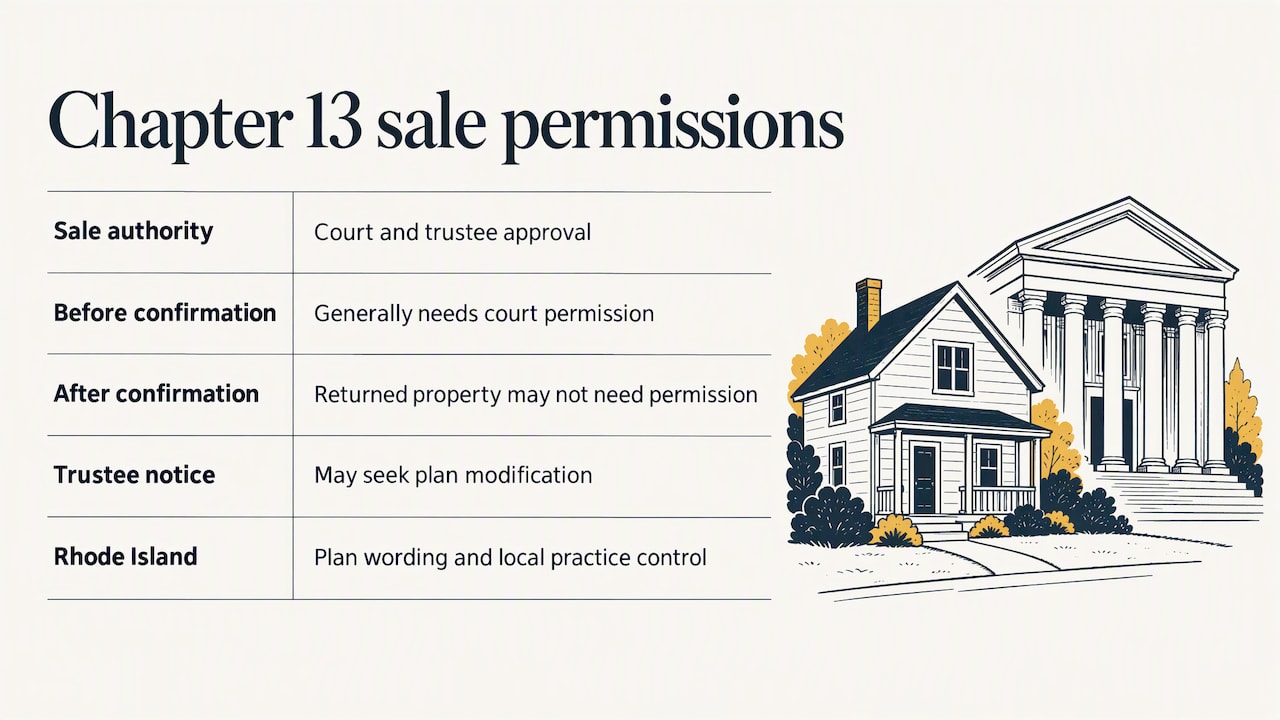
That opinion is from Illinois, so treat it as an illustration of how the rules can work. Your plan’s wording and the Rhode Island court’s practice control. Your attorney will tell you which applies.
What happens to your equity and sale proceeds
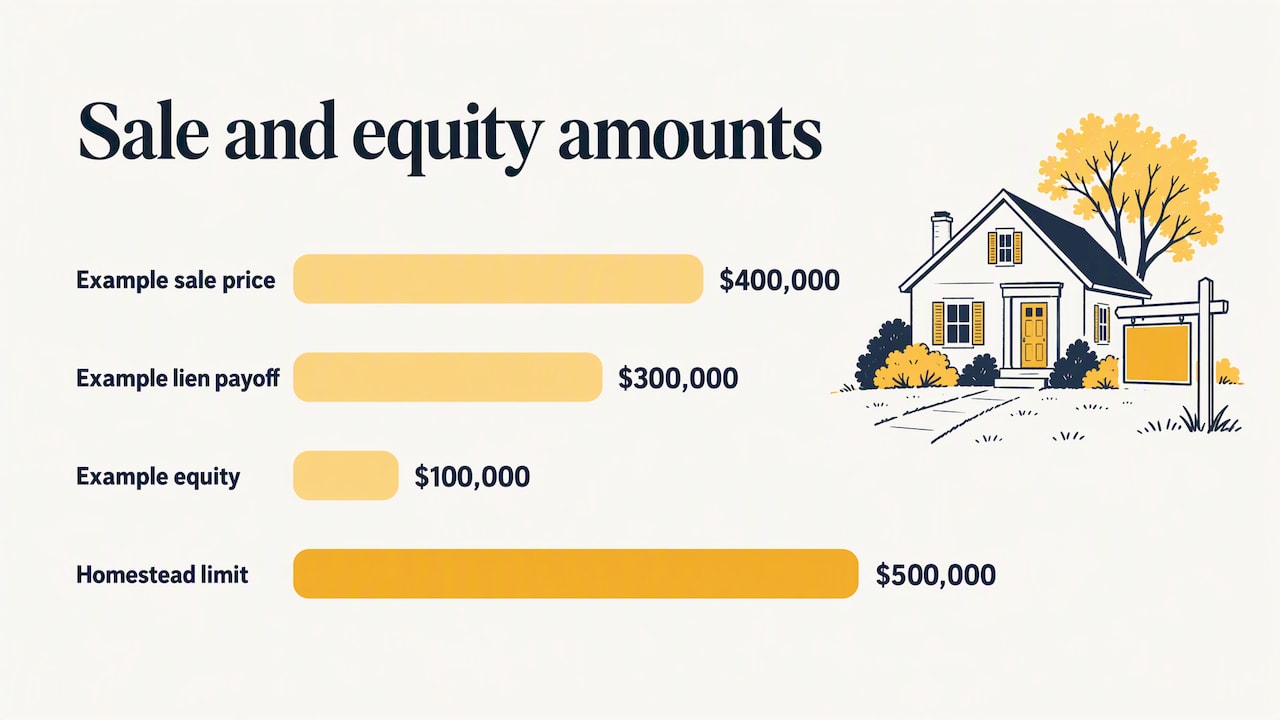
Equity is what’s left after the mortgage and other liens are paid. Rhode Island’s homestead exemption is $500,000, protecting up to that much equity in a primary residence from creditors. Many Rhode Island homeowners have less equity than that, which means their equity may be fully protected.
Two details matter:
- The exemption applies automatically, but you must list your residence and claim the exemption on the required bankruptcy schedules.
- In a Chapter 7 trustee sale, proceeds can pay off the mortgage and liens, pay you the exempt amount, and send what remains to creditors, per the same Nolo guide.
Here is a simple, made-up example to show the order of payment. The numbers are illustrative only, not a prediction for any home.
| Step | Illustrative amount |
|---|---|
| Sale price | $400,000 |
| Mortgage and liens paid off | $300,000 |
| Equity | $100,000 |
| Protected by homestead exemption (limit $500,000) | $100,000 |
| Left for creditors | $0 |
In that example, the equity sits well inside the exemption. If the numbers were bigger than the exemption, the excess is what a trustee could use. Before relying on any example, have your attorney run your actual figures, including closing costs and any tax liens.
Foreclosure, missed payments and the automatic stay
If your home is headed to foreclosure, filing bankruptcy triggers the automatic stay under 11 U.S.C. § 362, which protects you from foreclosure actions as soon as the petition is filed. In Chapter 13, you can catch up on missed mortgage payments through your repayment plan. In either chapter you may also surrender the home.
The stay is a pause, not a permanent fix. If you can’t keep up with the mortgage or the plan, the lender can ask the court for relief. That is why many owners compare three paths:
- keep the home through Chapter 13 and catch up over time;
- surrender the home and let the process run;
- sell the home and use the proceeds to settle the mortgage and other debts.
If you are earlier in the process, RIHousing advises contacting your lender early, exploring loss mitigation and watching for foreclosure rescue scams that target vulnerable owners. It also warns that ignoring mortgage problems makes it harder to reinstate the loan. Our guides on pre-foreclosure options in Rhode Island and how to stop a foreclosure auction walk through the steps in more detail.
Selling before you file
Some owners decide to sell first and then deal with their debts. That can work, and it is often cleaner than selling inside a case. But the timing and the price matter.
Per Nolo, you can sell a house before filing Chapter 7 or Chapter 13, but the proceeds must be protected by an available exemption. Otherwise, unprotected proceeds may be used to pay creditors. The same page notes that a trustee may scrutinize a pre-filing sale, that a sale for less than fair market value may be challenged, and that preferential payments may be recoverable.
What that means in practice:
- Get a fair price. A rushed, below-market sale to a relative or friend is the classic red flag.
- Keep records. Save the contract, the settlement statement and proof of where the money went.
- Don’t pay favored creditors from the proceeds without advice. Paying one creditor ahead of others can be undone later.
- Ask your attorney whether to sell first or file first. The answer depends on your equity, your debts and your goals.
We cover this in our own checklist for selling before bankruptcy.
Steps to take before you list or accept an offer
If a case is open, or you’re about to file, work through this order:
- Pull your paperwork. Gather your mortgage statement, any lien notices, your bankruptcy schedules and, in Chapter 13, your confirmed plan.
- Confirm what the court has allowed. Review the plan and any orders so you know what approval is still needed, as the title-industry summary advises.
- Talk to your attorney and trustee. Ask whether a sale makes sense and who must file the motion.
- Get a realistic number. Compare what a sale would net after the mortgage, liens and costs against your exemption.
- Allow for the notice period. The local rules’ 21-day response period applies to a motion or notice of intended sale, so build that into any closing date.
- Make the offer contingent on approval. Any contract should say that it depends on court approval, so you aren’t bound to close without it.
Car loans, credit cards and other debts also look different in bankruptcy than a mortgage does. If you’re sorting out your whole picture, it helps to read about car title loans and bankruptcy, since a vehicle can be on the table in a Chapter 13 plan alongside your home.
Where to get free help in Rhode Island
You don’t have to pay for advice to get started. RIHousing provides free HUD-approved counseling and foreclosure prevention services, including mediation under the Mortgage Foreclosure and Sale Act (R.I. Gen. Laws § 34-27-9), on its homeowner assistance page. The same page says homeowners may qualify for free legal help through RI Legal Services.
The bankruptcy court’s public information pages also explain the basics of each chapter. Use them to prepare questions, then take those questions to a licensed Rhode Island bankruptcy attorney. Choosing between Chapter 7 and Chapter 13 can be challenging because several factors weigh on the decision, and that is a job for a professional who sees your full financial picture.
Our perspective
Most of the homeowners who call us about bankruptcy aren’t asking about law. They are asking how they get out from under a house they can’t carry, without losing everything or being pushed around.
Our view is simple. Your attorney decides what is allowed in your case, and the court has the final word. Our job is to give you a clear, fair, no-pressure cash offer for the house as it stands, based on its After Repaired Value, so you know what a sale would really look like.
Because we buy as-is, there are no agent fees, commissions, repairs or cleaning to coordinate. That matters when the clock is set by a creditor, a court date or a foreclosure notice, and when every dollar of equity counts. We also let you pick the closing timeline that fits your situation, so a sale can line up with your attorney’s plan rather than fight it.
If you’re weighing a sale before filing, or you already have a case and want to see whether a buyer can work within it, ask us for an offer and bring it to your attorney.
Dave
How a cash sale can fit
A traditional listing means repairs, showings, agent commissions and weeks of waiting on a buyer’s financing. When time and equity are both tight, that’s a lot to carry. We buy Rhode Island homes in any condition for cash, with no agent fees and no repairs. You can see how our cash buying process works, or request an offer on our Rhode Island cash home buyer page.

If a job loss is behind the debt, our guide on selling after a job loss covers that situation, and our page on choosing your closing date shows how to line a sale up with your own timeline.
FAQ
Can I sell my house in Rhode Island if I’m in Chapter 13?
Yes, with permission. Before your plan is confirmed, you generally need court approval, and the Chapter 13 trustee has to be notified either way. After confirmation, whether you need approval depends on what your plan says about the property. Ask your attorney to review the plan before you list.
Will the trustee take my sale proceeds?
Only the part that isn’t protected. Rhode Island’s homestead exemption covers up to $500,000 of equity in your primary residence, as long as you claim it on your schedules. In a Chapter 7 sale, the mortgage and liens are paid first, then you receive the exempt amount, and any remainder goes to creditors.
Does filing for bankruptcy stop a foreclosure?
It generally does, at least for a time. The automatic stay takes effect when you file and pauses most collection actions, including foreclosure. It doesn’t erase the mortgage, so you still need a plan to catch up, surrender or sell.
Is it a problem to sell my house just before filing?
It can be. A trustee may review a pre-filing sale, and a sale below fair market value may be challenged. Sell at a fair price, keep complete records and speak with a bankruptcy attorney before you sign.
Where can I get free help in Rhode Island?
RIHousing offers free HUD-approved counseling and foreclosure prevention help, including mediation. You may also qualify for free legal assistance through RI Legal Services. Contact either as early as you can.
Sources
- Understanding Bankruptcy, U.S. Bankruptcy Court for the District of Rhode Island
- Sales out of Bankruptcy Proceedings, 2025 New England update
- U.S. Bankruptcy Court, District of Rhode Island, opinion on a Chapter 7 trustee sale
- U.S. Trustee Program, Chapter 7 trustee guidance
- Bankruptcy court opinion on Chapter 13 sales (2025)
- Rhode Island Homestead Exemption: Bankruptcy 2026 Guide, Nolo
- Rhode Island Homestead Laws, FindLaw
- Homeowner Assistance Programs RI, RIHousing
- Local Bankruptcy Rules, District of Rhode Island (December 1, 2024)
- Selling Property Before Bankruptcy, Nolo