
Yes, you can sell a Rhode Island house that squatters occupy, but you cannot clear them out yourself first. Removal has to go through the courts, and that takes time. A buyer who purchases as-is and understands the occupancy risk can let you sell without waiting for every step to finish. Below is how the law treats squatters, what the court process involves, what can stall a closing, and how a cash sale fits in.
TL;DR
- Rhode Island does not let owners remove occupants by changing locks or throwing belongings out. Possession is recovered through a notice and then a court case.
- Adverse possession is real but demanding: a claimant needs at least 10 continuous years and must prove every element by clear and convincing evidence.
- A court judgment for possession is followed by a five calendar day appeal period before the sheriff can act, so even a clean case takes weeks or longer.
- You can sell the house as-is or for cash while the occupant issue is open, but the sale does not let you bypass the legal process.
- Talk to a Rhode Island real estate or landlord-tenant attorney before you act, because the facts of how the person entered decide which rules apply.
Table of Contents
- Who counts as a squatter in Rhode Island?
- Can squatters actually take your house?
- What you cannot do: self-help removal
- How legal removal works
- Protect the property while you sort it out
- Can you sell while squatters are still in the house?
- Perspective: what we tell owners in this spot
- How a cash sale to Rhody Home Buyer works
- How to decide: sell now or evict first
- FAQ
- Sources
Who counts as a squatter in Rhode Island?
People use “squatter” for several different situations, and the law treats them differently. That distinction matters before you decide anything about a sale.
- A trespasser has no right to be on the property. Rhode Island’s willful trespass statute, § 11-44-26, covers people who stay on another’s land without a legitimate purpose after being told to leave.
- A tenant who stays too long is treated differently. The same statute exempts tenants who entered the premises rightfully and remain after the tenancy has ended or is alleged to have ended. For them, the owner uses civil proceedings to recover possession.
- A long-term occupant who claims the home as their own may eventually raise adverse possession, which we cover below.
The gray area is large. A relative who stayed in a late parent’s house, a former tenant, a person who moved into a vacant home and handed someone a fake lease: each starts from different facts. A lawyer will ask how and when the person got in, whether anyone gave permission, and whether rent ever changed hands.
There has been legislative interest in a clearer statutory definition. House Bill 5919 in the 2025 session proposed defining squatters and speeding up removal, but it did not pass. Check the Rhode Island General Assembly site for any later change before you rely on the current picture.
Can squatters actually take your house?
It is possible, but rare and difficult. Rhode Island General Laws § 34-7-1 lets title vest through adverse possession after 10 years of uninterrupted, quiet, peaceful, actual possession, with the claimant treating the property as their own. The Rhode Island Supreme Court has said a claimant must show actual, open, notorious, hostile, continuous and exclusive use under a claim of right for at least 10 years, by clear and convincing evidence.
That is a high bar. A few points from the case law:
- Open and notorious use means the claimant used the property the way owners of similar property would, and the use drew enough attention to put the world on notice. The court looks for objective acts adverse to the true owner.
- Light activity is not enough. In one case, placing crushed stone twice, planting trees in an already wooded area and occasionally clearing debris did not qualify.
- Continuity can be combined. Successive occupants can sometimes add their periods together through tacking, but the elements must still be proven across the whole period.
- Title vests at ten years, but it is not recorded automatically. A claimant has to prove it in court, and Rhode Island’s quiet-title chapter sets the procedure, including notice, service and judgment.
For most owners who find someone in a vacant house, the practical risk is not losing title. It is losing months to a legal process while taxes, insurance and utilities keep running. If the home has been empty for years and you have never checked on it, the long-term risk is worth taking seriously, and you should tell a lawyer about the timeline.
The courts also look at how the claim surfaces. A 2025 decision, New Phase Realty v. Fournier, shows adverse possession being raised inside a dispute over ownership, trespass and an injunction. Mere occupancy did not automatically establish title there either.
What you cannot do: self-help removal
The most expensive mistake is acting on your own. Changing locks, shutting off utilities, removing belongings or confronting the occupant can create liability and weaken your position, even when the person has no right to be there. Rhode Island’s Landlord Tenant Handbook describes a formal process, and the state’s trespass statute itself points owners to civil proceedings to recover possession from people who entered rightfully.
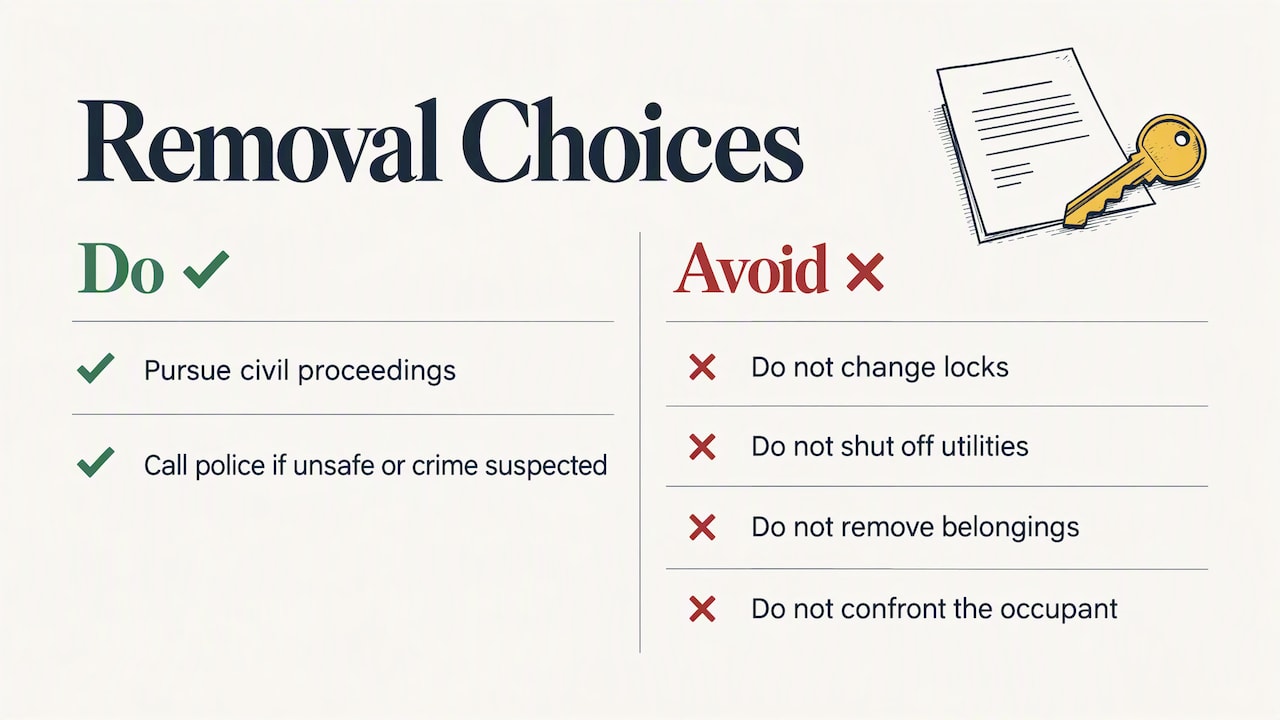
If you feel unsafe, or you suspect a crime such as a break-in or property damage, call the local police. Whether they treat the situation as a criminal trespass or a civil matter depends on what the occupant can show, such as a lease, rent receipts or mail addressed to them.
How legal removal works
The steps below follow the state’s handbook and court guidance. Details vary by situation, so confirm them with an attorney.
- Written notice. Depending on the facts, this may be a notice of termination or, for unpaid rent, a 5-day notice.
- Complaint in court. If the occupant does not leave, you file in District Court or Housing Court.
- Prove your right. Under § 34-20-2, an owner need not prove an actual entry under title if they prove an estate in the premises and a right of entry when the action begins. Deeds and tax records matter here.
- Judgment for possession. If the judge rules for you, a five calendar day appeal period follows, weekends and holidays included, during which you cannot act on the judgment.
- Execution and removal. After the appeal period, you obtain an execution, which the sheriff uses to remove the occupant.
The handbook notes that removal can take weeks or longer depending on court scheduling and any appeals. If the occupant was a tenant whose holdover is willful and not in good faith, § 34-18-38 lets the landlord recover possession, reasonable attorney’s fees, and up to three months’ periodic rent or threefold actual damages, whichever is greater. That remedy applies to tenants, not to every squatter.
Protect the property while you sort it out
An occupied or empty house with a legal dispute attached carries risks beyond the occupants: damage, unpaid utilities, fire, and insurance problems. Many standard homeowners policies restrict coverage once a home has been vacant for a period. Read how vacant property insurance and vacancy definitions work, then call your agent and ask in writing what your policy covers while the house is vacant or contested.
A few practical habits help whatever you decide:
- Keep records of every notice, photo, text message and date.
- Keep paying property taxes and insurance, since lapses make a sale harder.
- Visit or have someone check the exterior regularly. Regular, documented owner activity also undercuts any claim that your ownership was ignored.
- Do not enter the occupied living space without legal advice.
Can you sell while squatters are still in the house?
Legally, yes. Owning the house means you can sign a purchase contract. The research we reviewed is clear that homeowners can sell as-is or for cash, but they cannot skip the eviction procedure, and a sale does not give anyone permission to force occupants out without a court order.
What changes is who carries the problem. Here is how the paths compare.
| Path | Who handles the occupant | Typical effect on timing | Main drawback |
|---|---|---|---|
| Evict first, then list with an agent | You, through court | Weeks or longer for removal, then a normal listing period | Carrying costs, repairs and cleaning, agent commission |
| Evict first, then sell for cash | You, through court | Removal time, then a fast closing | Still waiting on the court |
| Sell as-is to a cash buyer with the occupant in place | Negotiated in the contract | Closing date can be set around the legal process | Offer reflects the added risk and work |
A traditional buyer using a mortgage faces a lender appraisal and inspection, and lenders and inspectors expect access. An occupied house that nobody can enter is hard to finance. A cash buyer who buys without those requirements can work around the access problem, though the buyer will still want to understand who is in the home and what their claim is.
What can affect access, title or closing
- Access for inspections and walkthroughs. Occupants who refuse entry can stall a conventional sale. A final walkthrough often happens before closing.
- Title questions. A title company will search records. If an occupant has a recorded claim, a lawsuit pending, or a disputed lease, expect the title company to ask about it. An adverse possession claim can be tested through a quiet-title action.
- Delivery of possession. The contract must say whether the home is delivered vacant or occupied. Both can be done, but the price and the closing date should reflect which.
- Attorney involvement. In Rhode Island, drafting a deed is the practice of law, so an attorney must prepare or review it. A non-attorney closing a sale has to give a specific written notice that they are not an attorney and cannot give legal advice.
- Tax certificate on higher-priced homes. For sales of residential property assessed above $1 million, the Division of Taxation says a Certificate of No Tax Due is required starting July 1, 2026, requested at least 10 business days before closing. Confirm whether it applies to you.
Perspective: what we tell owners in this spot
We buy houses in Rhode Island in any condition, and we hear from owners who inherited a house that someone moved into, or who left a property vacant and came back to a mess. Our view is simple. Do not take the law into your own hands, and do not assume your only choice is to wait out a court case before you can get paid.
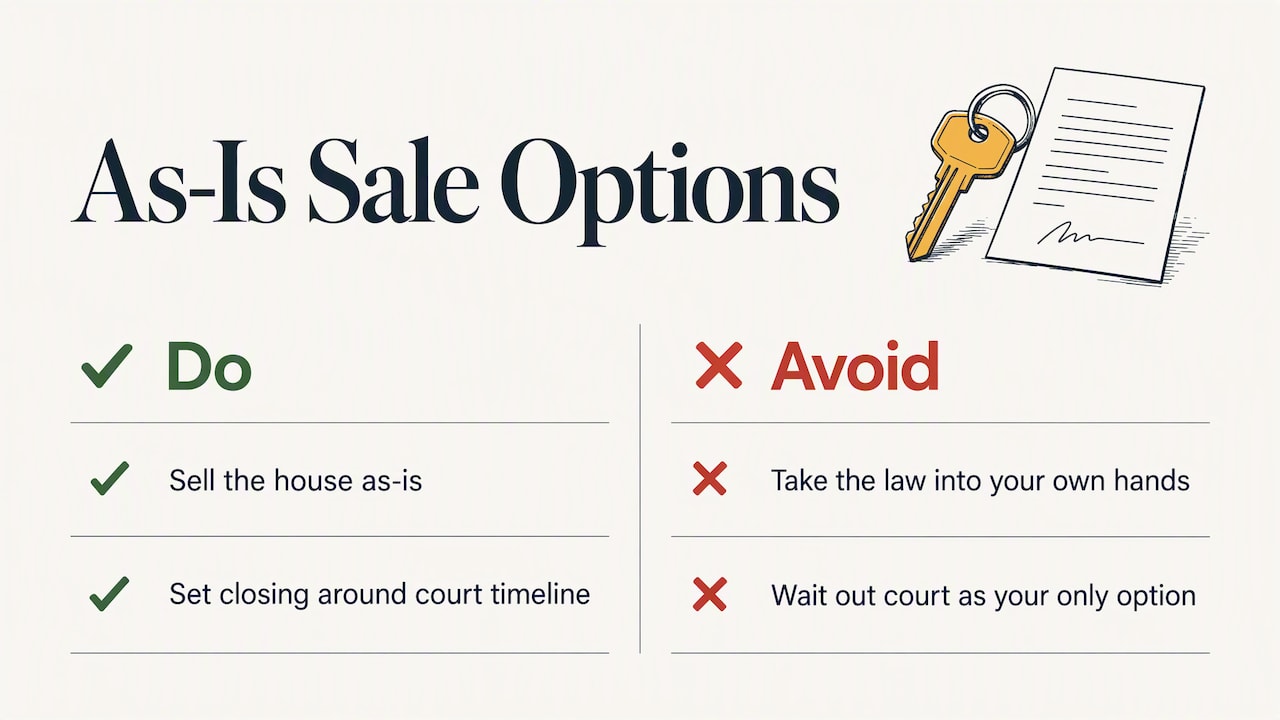
The owners who get stuck are the ones who spend months and money fixing and cleaning a house they never wanted to keep, while the taxes, insurance and utilities keep piling up. Selling as-is is a way to stop that clock. We make offers based on the After Repaired Value of the home, we do not charge agent fees or commissions, and you do not have to repair or clean anything. We would rather tell you honestly that a situation needs a lawyer first than sell you something that will not close.
The closing date is yours to shape. If the occupant situation needs to be handled through the court, a timeline can be built around that, and you should hear exactly what happens at each step.
— Dave
How a cash sale to Rhody Home Buyer works
If you want to explore selling instead of evicting first, we can look at the house as it is. You tell us what you know about the property and the occupants, we review the situation, and we make a fair cash offer based on the After Repaired Value. There are no agent fees or commissions, and you do not repair or clean the house.
You can read how our cash home sales work, see how choosing your closing date works, or learn about selling a house without repairs. When you are ready to talk, start on our Rhode Island cash home buyer page.

How to decide: sell now or evict first
Neither option is right for everyone. Use these questions.
- How did the person get in? A former tenant, a family member, a stranger and a person with a forged lease raise different legal issues. Get this answered by an attorney.
- How long has the house been occupied? Longer periods deserve faster legal advice, given the 10-year adverse possession threshold.
- What are your carrying costs? Add monthly taxes, insurance, utilities and any mortgage. Time in court costs real money.
- Do you need the proceeds soon? If a foreclosure, back taxes or an estate settlement is pressing, speed has a value. Our guide on stopping a foreclosure auction in Rhode Island covers that situation.
- Compare net proceeds, not headline price. Subtract commissions, repairs, legal fees and months of carrying costs from a traditional route, then compare it with a cash offer. We explain this in our piece on cash offers versus financing.
Whatever you choose, keep the paper trail, avoid self-help, and verify current procedures with the Rhode Island Judiciary or an attorney, since eviction rules and court procedures can change.
FAQ
Do squatters have rights in Rhode Island?
Occupants have the right to a legal process before removal, and in rare cases a right to claim title. Adverse possession requires at least 10 continuous years of open, hostile, exclusive use, proven by clear and convincing evidence. Most short-term occupants do not meet that standard, but they still cannot be removed without court action.
Can I just call the police to remove squatters?
Sometimes, but not reliably. Police may treat it as criminal trespass if the person clearly has no right to be there. If the person claims a lease or permission, police often call it a civil matter, and you will need to go through the District or Housing Court.
How long does it take to remove an occupant?
It depends on court scheduling and on whether the occupant appeals. After a judgment for possession, there is a mandatory five calendar day appeal period before the sheriff can act. Plan for weeks at minimum, and ask an attorney about your local court.
Can I sell a house with squatters in it?
Yes. You still own it, and you can sell as-is or for cash. You cannot skip the legal process for removing occupants, so the contract should say clearly whether the house is delivered occupied or vacant.
Do I need a lawyer to sell my house in Rhode Island?
An attorney must prepare or review the deed, because drafting a deed is the practice of law in the state. With an occupancy dispute or possible title claim, a Rhode Island real estate attorney is worth hiring before you sign anything.
Sources
- Rhode Island General Laws § 11-44-26, willful trespass
- RI H5919 bill detail
- Rhode Island Supreme Court, Sepulveda opinion on adverse possession
- Rhode Island Supreme Court opinion 09-277
- Rhode Island Supreme Court opinion of May 10, 2023
- Rhode Island Law Review survey of adverse possession cases
- Rhode Island quiet title chapter, 34-16
- New Phase Realty, LLC v. Fournier
- Rhode Island Landlord Tenant Handbook
- Rhode Island District Court FAQs
- Rhode Island General Laws § 34-20-2
- Rhode Island General Laws § 34-18-38
- Rhode Island Supreme Court opinion on deed drafting and closings
- Rhode Island Division of Taxation, Certificate of No Tax Due presentation