
You can sell a house in a flood zone in Rhode Island, and many owners do. The harder part is that buyers who need a mortgage will usually face a flood insurance requirement, and that can shrink your pool of buyers, slow closings and push offers down. The best route depends on the map designation, the house’s flood history, its condition and how fast you need to be done. Below we explain how to check your zone, what to disclose, what listing on the open market looks like, and when a direct cash sale is the simpler path.
TL;DR
- Check your zone first on the FEMA flood maps. Rhode Island’s Emergency Management Agency and the Coastal Resources Management Council both point owners to the official maps.
- If the home is in a high-risk zone and the buyer has a federally backed mortgage, the lender must require flood insurance. That is why financed buyers can be harder to find and slower to close.
- Disclose any known flooding or drainage problems. A home being in a flood zone is public record, but hiding past water damage can create real legal exposure.
- A cash sale to a direct buyer skips the mortgage and insurance underwriting. It also skips repairs, cleanup and agent commissions, but you should expect a price that reflects the risk.
Table of Contents
- Is your house actually in a flood zone?
- Why a flood zone changes who can buy your house
- What you must tell buyers about flooding
- Can you get the property out of the flood zone?
- Your four ways to sell
- Our perspective: what we see with flood zone sellers
- Prepare before you sell, whichever route you choose
- Should you carry flood insurance while you wait?
- When a cash sale makes sense for a flood zone house
- Selling to us
- FAQ
- Sources
Is your house actually in a flood zone?
Start with facts, not hearsay. A neighbor’s flood story or an old insurance letter does not tell you your current designation.
In Rhode Island you check a property against FEMA’s Flood Insurance Rate Maps (FIRMs). The CRMC’s coastal property guide explains that you can look up an address through the FEMA Map Service Center or the state’s floodplain mapping tool. Your city or town hall also keeps the maps. The state emergency management agency explains the mapping program: FIRMs go to municipalities that commit to managing development in high-risk areas.
What you are looking for is whether the structure sits inside a Special Flood Hazard Area (SFHA). That is the designation that triggers the lending rules. Write down:
- The zone letter shown on the map for your parcel.
- The map panel date.
- Whether the house itself, not just part of the lot, is inside the boundary.
If you are unsure, a surveyor or your insurance agent can help read the map against your property lines.
Why a flood zone changes who can buy your house
Most buyers use a mortgage. If your house is in an SFHA and the buyer’s loan is federally backed or from a federally regulated lender, Congress requires the lender to make sure flood insurance is in place. FEMA’s mandatory purchase rule comes from the Flood Disaster Protection Act of 1973 and covers people buying, building or improving property in these areas.
In practice, that creates three friction points for a seller.
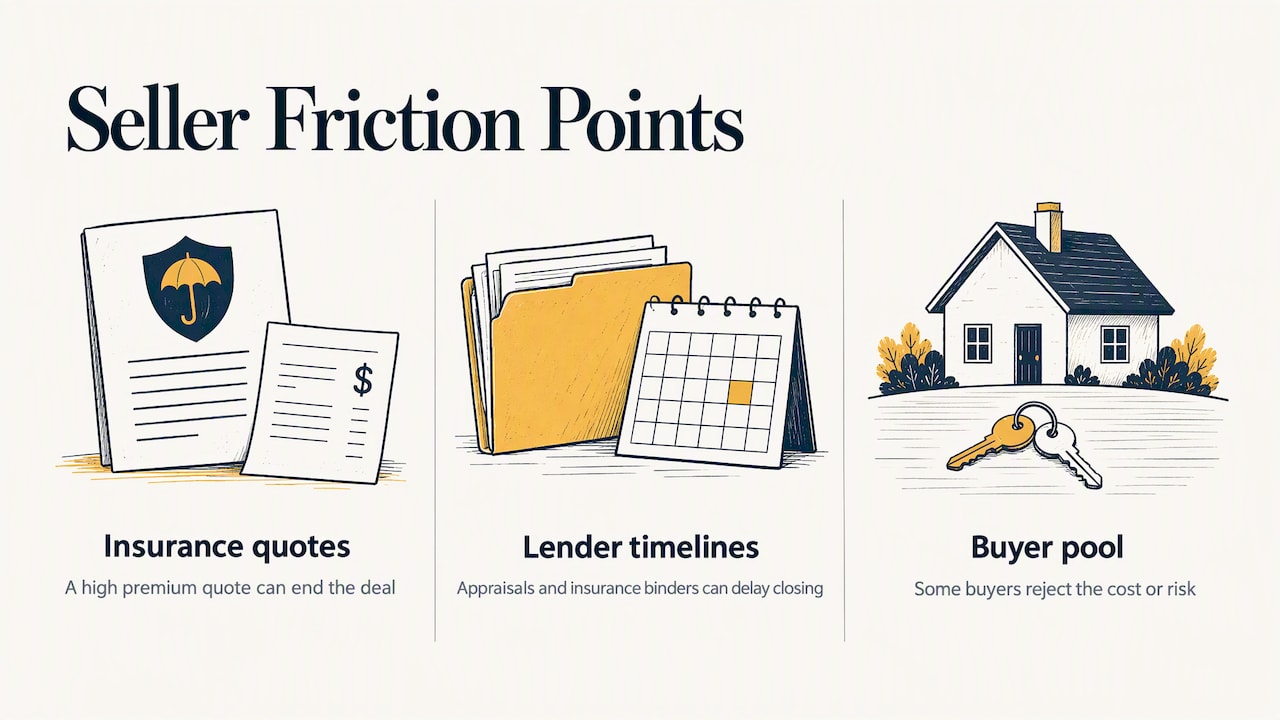
Insurance quotes before closing. The buyer needs a policy, and the premium becomes part of their monthly cost. A high quote can end the deal.
Lender timelines. Appraisals, flood determinations and insurance binders add steps. Every step is a chance for a delay or a renegotiation.
A smaller buyer pool. Some buyers simply do not want the cost or the risk, so your house may sit longer.
Do not pass your own premium to the buyer
Sellers often tell buyers what they pay for flood insurance and assume the buyer will pay the same. The CRMC cautions that this is risky: because of recent changes to the National Flood Insurance Program, a new owner’s premium may differ significantly from what you paid. Buyers should get their own estimate from an insurance agent using the property’s elevation data. If you quote your number as fact and it turns out to be wrong, you invite a dispute.
What flood insurance costs
FEMA reported in January 2025 that the average flood claim was close to $30,000, while average premiums were under $900 a year, with about $400 to $500 for lower-risk areas. Those are national averages. Coastal Rhode Island properties in high-risk zones can sit well above them, so treat the figure as a baseline and get a real quote for your address.
What you must tell buyers about flooding
Two separate questions get mixed up here.
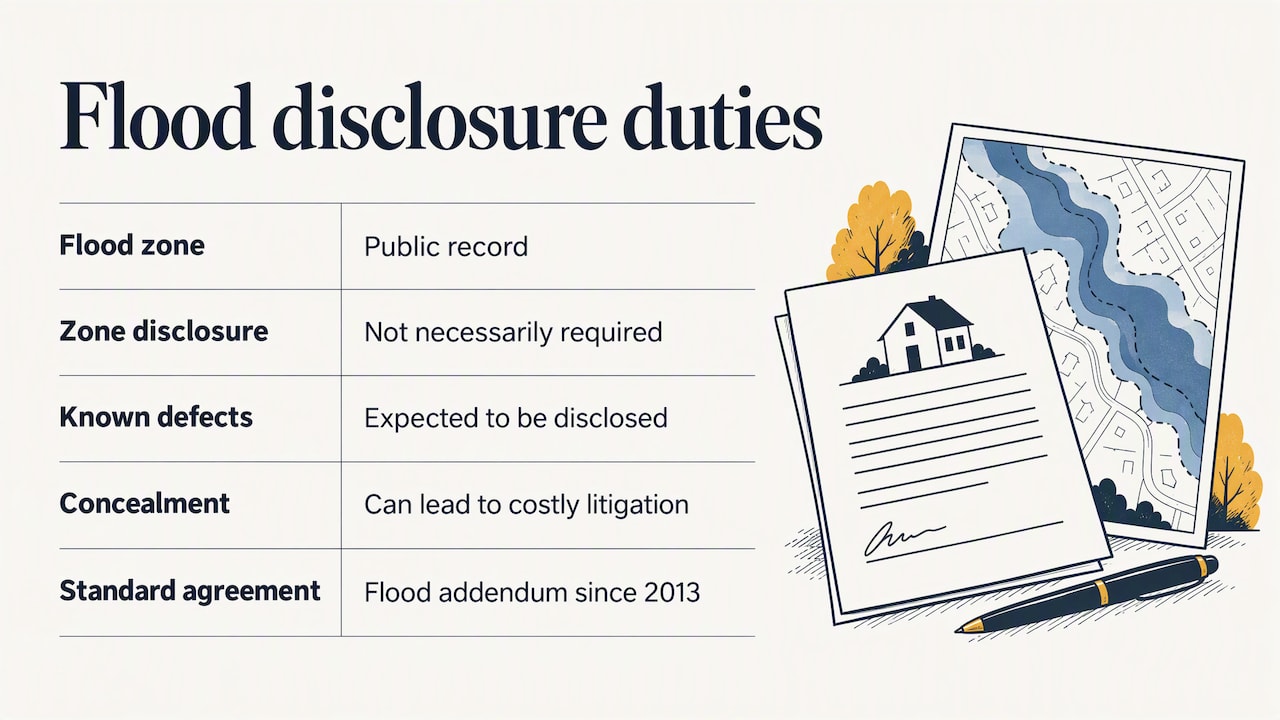
The zone itself. The flood zone designation is public record. Based on the research we reviewed, you are not necessarily required to volunteer it, though it is almost always in the buyer’s interest to know, and their lender will find it anyway.
Known flood history. Past water in the basement, repeated drainage problems, storm surge damage and prior insurance claims are different. Rhode Island sellers are expected to disclose known defects, and concealing known flooding can lead to costly litigation. If you have a history of water damage, write it down, share it, and keep a record of what you disclosed and when. Ask a Rhode Island real estate attorney to review your disclosure before you sign anything, because the details of your situation matter.
One more Rhode Island detail: the state’s standard purchase and sales agreement has included a flood insurance addendum since October 2013, according to the 2023 local market commentary that appears in search results. Ask your attorney or agent what is in the current form, since contract language can change.
Can you get the property out of the flood zone?
Sometimes, if the map is wrong about your property. FEMA’s guide to map revisions describes two tools. A Letter of Map Amendment (LOMA) applies when a property was mapped into a high-risk area by error. A Letter of Map Revision Based on Fill (LOMR-F) applies when fill has raised the ground. Both need precise survey data, and if approved, they can remove the mandatory flood insurance requirement for federally backed loans.
Be realistic about this:
- It requires a licensed surveyor and elevation data, so it costs money up front.
- It takes time, which matters if you are facing a foreclosure date, an estate deadline or a move.
- It only works if the data supports it. A house that is truly low-lying will not qualify.
An elevation certificate is worth considering even if you do not pursue a map change. The CRMC notes that an official certificate from a surveyor can help a buyer understand the real risk and may avoid the highest insurance tiers. If you have time, it is a useful document to hand to serious buyers.
Your four ways to sell
| Route | Best when | Watch out for |
|---|---|---|
| List with an agent | The house is in good shape, you have months, and the flood risk is moderate | Commissions, showings, repair requests, buyer financing falling through over insurance |
| Fix up, then list | Damage is minor and you can fund repairs | Upfront cost, the time repairs take, no guarantee the price recovers |
| Flood buyout program | The property is in a repeatedly flooded neighborhood with an active program | Long timelines and limited availability |
| Sell directly for cash | You need speed and certainty, or the house has water damage or deferred repairs | Offers reflect the condition and risk, so compare them |
Traditional listing
This can produce the highest price for a well-kept house in a manageable zone. It also asks the most of you: cleaning, staging, open houses, inspection negotiations and the possibility that a buyer’s insurance quote ends the deal two weeks before closing.
Repairing first
If the flood damage is real, such as mold, ruined drywall, a damaged furnace or a failing foundation wall, repairs can be large and unpredictable. Our own guide to whether to repair or sell as is walks through comparing net proceeds both ways before you spend a dollar.
Flood buyout programs
Some Rhode Island neighborhoods have had government buyouts. In East Providence, the NRCS Emergency Watershed Protection Program put $7 million toward buying 13 homes and 5 vacant lots near the Runnins River, according to Rhode Island Sea Grant. These programs are voluntary and targeted at specific areas, so they are not something you can opt into from anywhere. If you live in a repeatedly flooded area, ask your city or town hall whether a program is active.
Selling directly for cash
A direct buyer pays cash, so there is no lender, no flood insurance requirement tied to a mortgage and no appraisal contingency. That removes the main obstacle a flood zone creates. It is not magic: the buyer is taking on the property’s risk and the repair bill, and that is reflected in the offer. What you get in exchange is speed, certainty and no cleanup.
Our perspective: what we see with flood zone sellers
We buy houses in Rhode Island directly from homeowners, as is, and flood zone properties come up often. Here is how we think about them.
The flood zone label alone is rarely the problem. A well-maintained house on a street where owners carry insurance will sell. The trouble starts when a flood zone combines with something else: a lender-driven timeline, deferred repairs, a past water claim, an inherited property nobody wants to manage, or a mortgage that is behind. Each of those on its own is manageable. Together they make a traditional listing slow and stressful.
We base our offers on the After Repaired Value, meaning what the house would be worth once repaired, less the work it needs. That means we look at the house as it is. You do not clean, repair or stage anything, and there are no agent fees or commissions. We would rather give you a straight number and an honest explanation than a high figure that falls apart later.
Our advice to any seller, whether or not you call us: find out your zone, gather your records, disclose what you know, and compare at least two routes with real numbers. Net proceeds matter, not the headline price. If a cash offer leaves you with similar or better net proceeds than a listing, because you skip commissions, repairs, carrying costs and months of waiting, it is worth serious consideration. If a listing clearly nets you more and you have the time, list it.
— Dave
Prepare before you sell, whichever route you choose
A little preparation protects your price and your peace of mind.
- Confirm the zone and date of the map. Print the map panel for your file.
- Gather insurance records. Policies, claims, and any elevation certificate. Share facts, but do not promise the buyer will pay what you pay.
- List known water issues. Basement seepage, sump pump history, storm damage, past repairs. Include dates and who did the work.
- Photograph the property as it is. This helps with disclosure and with any dispute later.
- Check your mortgage status. If you are behind, speed matters more. Our page on how to avoid foreclosure explains what selling before a sale date can look like.
- Talk to a Rhode Island real estate attorney. Especially if there is prior litigation, an inherited title or a disclosure question.
If the house also needs significant work, our overview of selling as is without repairs explains the price trade-offs honestly, including why as-is sales usually come in below a fully repaired listing.
Should you carry flood insurance while you wait?
If you still own the house, yes, you should think carefully about it. Standard homeowners policies do not cover flood damage, so the loss falls on you. The Rhode Island Department of Business Regulation tells property owners to consider flood insurance regardless of location, because flood risk exists even far from water.
The risk is not limited to mapped high-risk areas either. FEMA says more than 25% of flood insurance claims come from outside high-risk areas. Maps also change. FEMA notes that a property now considered low-risk could be reclassified into a high-risk zone later. If you are in a moderate-to-low risk area, ask your agent about the lower-cost Preferred Risk Policy.
A lapse in coverage while the house sits on the market is one of the avoidable ways a flood zone sale goes wrong. A storm during a three-month listing is your loss, not the buyer’s.
When a cash sale makes sense for a flood zone house
A cash sale tends to fit when:
- The house has flood damage, mold or deferred repairs you cannot or do not want to fund.
- Buyers’ insurance quotes have already cost you a contract.
- You inherited the property and do not live nearby.
- A foreclosure date, tax bill or other deadline is close.
- You do not want showings, open houses or months of uncertainty.
It makes less sense when the house is in excellent condition, the flood risk is low, and you can wait for the best retail price. We would rather tell you that than waste your time.
Selling to us
Rhody Home Buyer buys Rhode Island houses directly for cash, in any condition. There are no agent fees or commissions, and you do not have to repair or clean. We make offers based on the After Repaired Value and close on a timeline that suits you. You can see the full process on our page about how cash home sales work, or tell us about your house to get a straightforward offer with no pressure to accept it.
FAQ
Do I have to tell buyers my house is in a flood zone?
The designation is public record, so it is not usually the part that gets sellers in trouble. Known flooding, water intrusion and drainage problems are different, and failing to disclose them can create legal liability. Disclose what you know in writing and have a Rhode Island real estate attorney review it.
Does a flood zone lower a home’s value?
It can, mostly because insurance costs and lender requirements reduce the number of buyers and what they will pay. The effect varies by zone, elevation, condition and the local market, so there is no single figure. An elevation certificate and a real insurance quote help you and buyers price the risk accurately.
Can I sell a flood zone house for cash in Rhode Island?
Yes. A cash buyer does not need a mortgage, so the federal flood insurance requirement that applies to federally backed loans is not part of the purchase. The offer will still reflect the property’s condition and risk. Compare it with your net proceeds from listing before deciding.
How do I get my property out of a flood zone?
If the map is wrong, you may apply to FEMA for a Letter of Map Amendment, or a Letter of Map Revision Based on Fill if fill raised the ground. Both require survey and elevation data and take time. They will not work for a property that is actually low-lying.
Sources
- RI Coastal Resources Management Council: Coastal Property Guide, FEMA flood zones and insurance
- Rhode Island Emergency Management Agency: Floodplain Mapping
- FEMA: Understanding Flood Risk for Real Estate, Lending or Insurance Professionals
- FEMA: Mandatory Purchase
- FEMA: Buy Flood Insurance Now
- FEMA: Community Members’ Guide to Initiating Map Revisions
- FEMA: Flood Insurance
- Rhode Island Department of Business Regulation: Flood insurance questions
- Rhode Island Sea Grant: Behind the Scenes of Flood Buyouts in Rhode Island