
Yes, you can sell a house with termite damage. Your two practical paths are repairing and treating before listing for the strongest price, or selling as-is to a cash buyer for speed. What you cannot do legally is hide known damage from a buyer. Start with a pre-listing inspection so you know exactly what you’re dealing with before you commit to either route.
TL;DR:
- Active infestations with live termites can prevent mortgage approval until they are treated and documented.
- Documented treatments, repairs, and transferable warranties can help sellers avoid significant price reductions and facilitate faster sales.
- Selling as-is to a cash buyer is a practical option when repair costs outweigh potential price increases or when time and cash are limited.
- Sellers must disclose all known termite activity regardless of inspection results; under-disclosure risks legal liability.
- Costs for treatment and repairs vary widely, with minor fixes costing a few hundred dollars and major structural repairs exceeding ten thousand dollars.
Table of Contents
- Does Termite Damage House Sale Success Depend on Severity?
- How Do You Repair Termite Damage Before Listing?
- Should You Sell As-Is to a Cash Buyer Instead?
- What Do You Legally Have to Disclose About Termite Damage?
- What’s the Real Price Impact of Termite Damage?
- What’s a Realistic 30 to 90 Day Timeline?
- When Does an As-Is Cash Sale Make Sense for Termite Damage?
- A Simple Framework for Choosing Your Path
- Get a No-Obligation Cash Offer for Your Termite-Damaged Home
- Where to Learn More About Inspections and Disclosure
- Sources
- FAQ
Does Termite Damage House Sale Success Depend on Severity?
Not all termite damage is equal, and buyers, appraisers, and lenders don’t treat it that way either. An active infestation with live termites still feeding is the scariest category for a buyer, and it’s the one most likely to trigger a lender’s refusal to fund the loan until treatment is complete. A prior infestation that’s already been treated and repaired, with paperwork to prove it, is a completely different conversation. Purely cosmetic damage, old tunneling in a support beam that’s since been reinforced, tends to spook buyers far less than fresh mud tubes on a foundation wall.
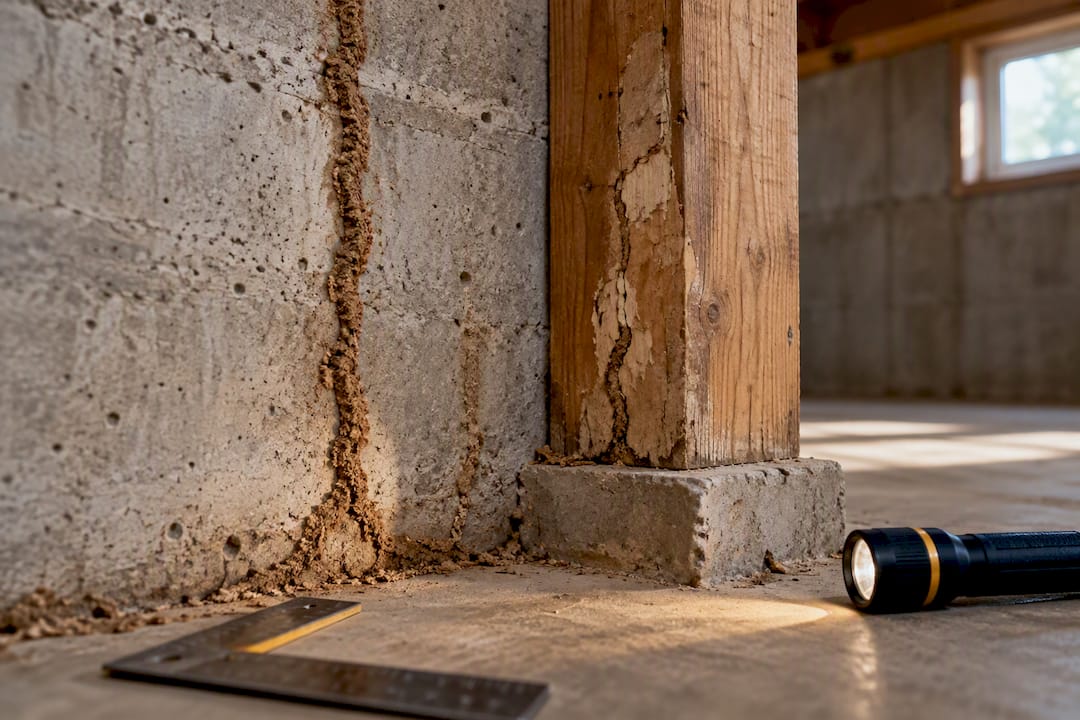
Lenders in termite-prone states, particularly across the South and parts of the mid-Atlantic, routinely require a clean Wood-Destroying Insect (WDI) report before closing. FHA and VA loans are especially strict about this. If the report flags active activity, expect the lender to hold funding until a licensed pest company signs off that the problem has been resolved.
Regional tolerance varies more than most sellers expect. In Florida, Texas, and Louisiana, where subterranean termites are practically a fact of homeownership, buyers and agents shrug off a treated-and-documented history. In parts of the Northeast or Midwest where termites are less common, the same disclosure can trigger outsized alarm, even when the damage is minor.
- Active infestation: highest risk, often halts financing until treated
- Treated and repaired history: manageable with documentation
- Cosmetic or historic-only damage: usually a non-issue if disclosed clearly
A pre-listing WDI report helps you avoid a nasty surprise during the buyer’s own inspection, since a pre-listing termite inspection helps sellers avoid last-minute renegotiation and gives lenders in termite-prone regions the paperwork they’ll ask for anyway.
How Do You Repair Termite Damage Before Listing?
If you have the time, budget, and a house that’s otherwise in decent shape, repairing first usually nets you more money. Here’s the sequence that works.
- Order a licensed WDI inspection. Don’t skip this even if you already suspect the extent of the problem. A documented inspection is the foundation every other step depends on, and a pre-listing inspection often yields better outcomes than waiting for a buyer’s inspector because you control the timing and can fix issues quietly, on your own schedule.
- Treat the infestation. Whether it’s liquid termiticide, bait stations, or fumigation depends on species and severity. A licensed pest control company will recommend the method.
- Complete structural repairs with permits. Anything involving load-bearing framing, sill plates, or joists should go through a licensed contractor, with a permit pulled and closed out by the local building department. Skipping the permit is a red flag that surfaces during a title search or buyer’s due diligence.
- Get a transferable termite warranty. Most licensed pest companies offer a renewable bond or warranty that transfers to the new owner, and this single document does more to reassure a nervous buyer than almost anything else you can hand them.
- Compile everything for your listing packet. Inspection report, treatment invoice, repair invoices, permits, and the warranty all go in one folder your agent can hand to any interested buyer upfront.
Costs vary widely by severity. Localized treatment and minor repairs often run a few hundred dollars up to around $3,000, while whole-house treatments and structural repairs can climb past $8,000 to $10,000 or more. The math on whether repairs pay for themselves depends on your market. In a competitive market where buyers are comparing multiple similar homes, resolving the issue before listing frequently returns more than it cost, because a house with a clean WDI report and a transferable warranty sells faster and closer to asking price than one flagged with unresolved damage.
Pro Tip: Ask your pest control company for a “clearance letter” separate from the treatment invoice. Lenders and buyer’s agents often want a one-page document that plainly states the property is currently free of active infestation, and it moves faster through underwriting than a full multi-page treatment report.
Should You Sell As-Is to a Cash Buyer Instead?
Selling as-is makes sense when you don’t have the cash, the time, or frankly the interest in managing contractors and permit inspections. It’s also the more realistic choice for an inherited property with years of deferred maintenance, or when the termite damage is extensive enough that repair costs would eat deeply into your equity anyway.
Cash buyers calculate offers using a straightforward formula: they estimate the home’s After Repaired Value, then subtract the cost of repairs, their holding costs, and their resale costs. A house with significant termite damage will get a lower offer than an identical home in good condition, but you’re trading that price gap for speed, certainty, and zero repair hassle. There’s no financing contingency to worry about either, since cash buyers don’t need lender sign-off on a WDI report the way a traditional buyer’s mortgage does.
One thing that trips up sellers: an as-is sale does not erase your disclosure duty. You still have to answer seller disclosure questions honestly. “As-is” describes the condition of the sale, not a license to conceal what you know. If you know about a termite problem and check “no” on the disclosure form anyway, that’s the same legal exposure you’d face in a traditional sale.
If you’re weighing multiple cash offers, here’s what actually separates a serious buyer from one wasting your time:
- Ask for proof of funds, not just a verbal number.
- Compare the actual closing timeline each buyer commits to, not just the headline offer.
- Request a written disclosure schedule so you know exactly what you’re both agreeing to before signing.
- Confirm whether the offer is truly final or subject to a follow-up “re-inspection” that lowers the number later.
Some cash buyers use a soft opening offer, then chip it down after their own walkthrough. A reputable buyer states the number clearly and honors it. For sellers weighing this route, guidance on negotiating as-is sales and buyer due diligence covers what to expect at each stage.
What Do You Legally Have to Disclose About Termite Damage?
Most states require sellers to disclose known termite activity on a standard property disclosure form, and these forms commonly include wood-destroying insect questions, with an attached pest report often required in termite-prone markets. The exact form varies by state, but the WDI report and an industry-standard NPMA-33 form (used by pest professionals to document findings) are the two documents buyers, agents, and lenders will ask for most often.
What counts as “known” damage isn’t just what you were formally told by an inspector. If you patched a hole, painted over stained wood, or noticed mud tubes along the foundation and never followed up, that generally counts as knowledge you’re expected to disclose. Evidence like fresh paint over termite-eaten wood or newly installed drywall hiding structural damage is exactly the kind of thing used to prove a seller knew and hid it.
Disclosure duties genuinely differ by state, and it’s worth knowing which side of the line yours falls on. Florida’s Johnson v. Davis ruling created a broad duty to disclose known, hidden material defects, while states like Alabama start from a caveat emptor standard, though exceptions still apply under state suppression statutes.
Documents worth gathering before you list:
- WDI inspection report (dated within the last few months)
- NPMA-33 form from your pest control company
- Treatment invoices and receipts
- Contractor invoices and closed permits for structural repairs
- Transferable warranty documentation
Over-disclosing costs you almost nothing. Under-disclosing can cost you a lawsuit. When known defects go undisclosed, sellers can face severe liability, including treble damages and attorneys’ fees in some jurisdictions, Texas’s Deceptive Trade Practices Act being one clear example. If you suspect concealed damage from a previous owner, or you’re unsure how a transferable warranty carries forward to a new buyer, talk to a local real estate attorney before you sign anything.
What’s the Real Price Impact of Termite Damage?
Every seller wants the same answer: how much does this actually cost me? The honest answer is it depends more on documentation than on the damage itself.
Treatment and minor repairs commonly run a few hundred dollars up to about $3,000, while significant structural work climbs into the $8,000 to $10,000-plus range depending on how much framing needs replacing. Blanket price cuts to “make up for” termite history tend to underperform compared to targeted fixes. Buyers consistently respond better to specific proof than to a vague discount, and buyers value a recent clean inspection, a transferable warranty, and professional invoices more than a generic price cut.
That’s the core negotiation insight most sellers miss: a $2,000 credit tied explicitly to a completed treatment and a transferable warranty reassures a buyer far more than a $5,000 blanket discount with no explanation attached.
- A transferable warranty or a prepaid annual inspection often costs less than a large price concession and does more to close the deal.
- Present offers with the paperwork attached, not promised. A buyer who sees the invoice and the warranty in hand negotiates less aggressively than one who has to take your word for it.
- If the damage is purely cosmetic and fully resolved, don’t over-explain it in your listing. Let the documentation speak for itself during due diligence.
Pro Tip: If you’re deciding between a $3,000 price cut and a $1,200 transferable warranty plus a $500 prepaid inspection, take the warranty route almost every time. It costs less and buyers trust it more than a number they can’t verify.
What’s a Realistic 30 to 90 Day Timeline?
Here’s a compact plan for the first three months, whichever path you choose.
- Days 1 to 10: Order a WDI inspection, pull together any past treatment records, and get contractor bids if repairs are needed.
- Days 10 to 20: Decide your path based on the inspection results, your budget, and your timeline. This is the fork in the road.
- If repairing (Days 20 to 60): Schedule treatment, complete structural repairs with permits pulled and closed, and secure your transferable warranty before you list.
- If selling as-is (Days 10 to 30): Request offers from multiple cash buyers, verify proof of funds on each, and prepare a disclosure packet with whatever inspection history you have.
- Days 60 to 90 (either path): Finalize paperwork with escrow, stay transparent in every buyer communication, and close.
The as-is path compresses most of that into the first month. The repair path takes longer but positions the home for a stronger sale price once it’s ready.
When Does an As-Is Cash Sale Make Sense for Termite Damage?
Some cash buyers purchase homes as-is, base offers on After Repaired Value, and can close without requiring repairs or agent commissions. That structure exists specifically for sellers who don’t have the runway for the repair-and-list path.
The sellers who benefit most tend to share a few traits: an urgent timeline that doesn’t leave room for a multi-week treatment and repair schedule, a lack of available cash to fund structural work upfront, or an inherited property where termite damage is one of several deferred maintenance issues stacked on top of each other. In all three cases, waiting to fix everything before selling can cost more in carrying costs and stress than accepting a fair as-is offer today.
Cash buyers typically assist with paperwork and disclosure transparency alongside sellers; as covered above, an as-is sale never removes your legal duty to disclose known issues honestly. Sellers exploring this route can learn more about the company’s cash-buy process directly.
A Simple Framework for Choosing Your Path
Most sellers overthink this decision. It really comes down to three variables: how much time you have, how much cash you can put toward repairs, and how much price uplift the repair would realistically buy you.
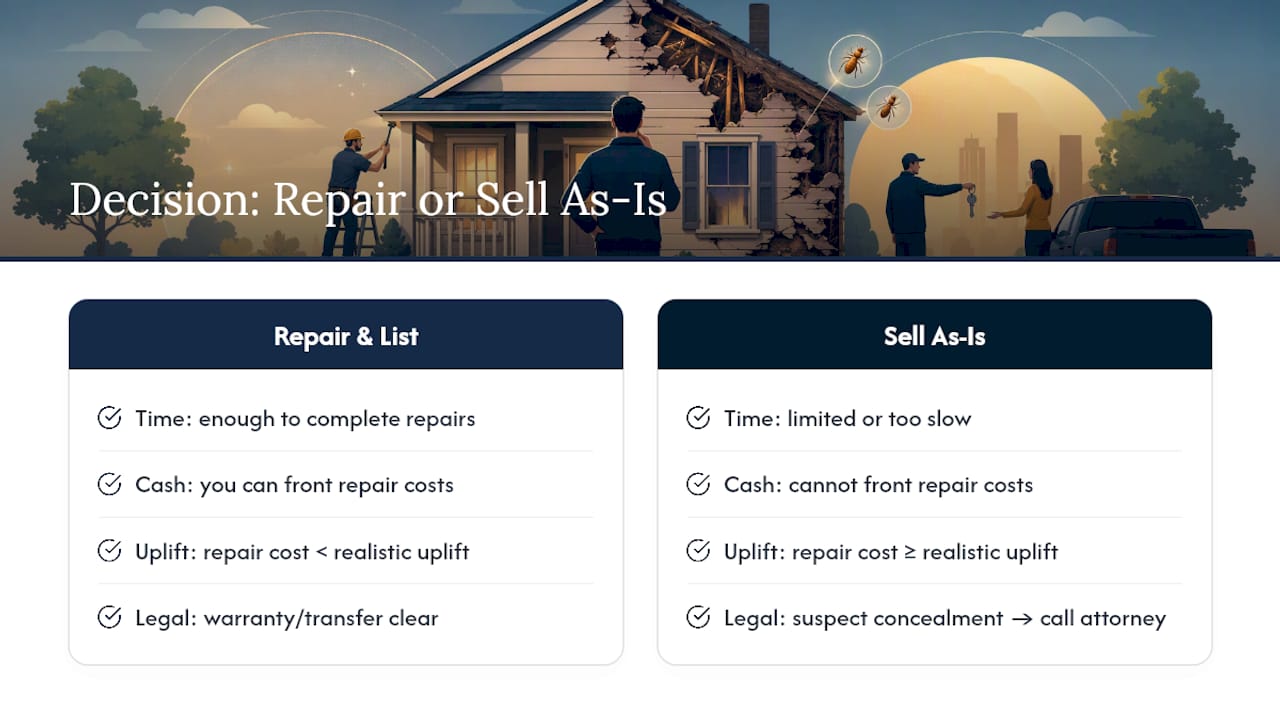
If you have the time, the repair costs less than the uplift you’d gain, and you can front the money, repair and list. If any one of those three breaks down, badly, as-is starts looking like the smarter move, not the fallback.
Where this gets legally complicated is when you suspect a previous owner concealed damage, or a warranty’s transfer terms are murky. That’s when a quick call to a real estate attorney beats guessing. And whichever path you take, get at least one pre-listing inspection. It’s the cheapest insurance against a surprise that blows up your closing.
— Dave
Get a No-Obligation Cash Offer for Your Termite-Damaged Home
Some companies serve as alternatives to the repair-and-list approach for termite-affected homes, offering to buy properties as-is without requiring treatment invoices, contractor bids, or agent commissions. Such buyers often base offers on After Repaired Value and may close on flexible timelines rather than buyer mortgage schedules.

To get a fair cash offer, have a few basics ready: the property address, recent photos of the damage if you have them, and any past inspection or treatment reports if they exist. None of that is required to start, but it speeds up the process. Submit your property details through Rhodyhomebuyer’s offer request page, and expect a straightforward cash offer back with no repairs, no cleaning, and no pressure to accept. If the numbers work for you, you pick the closing date.
Where to Learn More About Inspections and Disclosure
For finding a licensed pest professional or understanding termite biology and treatment options, PestWorld from the National Pest Management Association is the industry’s go-to resource. For legal guidance specific to your state’s disclosure requirements, a local real estate attorney is worth the consultation fee, especially if you’re unsure whether past repairs or a previous owner’s history need to be disclosed. If you want more on how as-is sales work in practice, Rhodyhomebuyer’s blog covers related seller scenarios in more detail.
This article is general information, not a substitute for advice from a qualified lawyer. Consult a qualified legal professional about your own circumstances before acting on anything here.
Sources
- Do you have to disclose termites when selling a home? — Catalyst Legal
- Termite inspection before selling a house — TermiteHQ
- Termite trouble: How to sell your home with termite damage — HomeLight
- Failure to disclose in Texas real estate transactions — Weaver Lawyers
FAQ
How Hard Is It to Sell a House With Termite Damage?
It’s harder than selling a termite-free home, but far from impossible. Most transactions close successfully once the damage is disclosed and either treated with documentation or priced into an as-is offer.
Is It Bad to Buy a House With Termite Damage?
It depends entirely on whether the infestation is active or historic and treated. A house with a clean WDI report, a transferable warranty, and documented repairs carries little added risk for a buyer.
Do Sellers Have to Fix Termite Damage Before Selling?
No, sellers aren’t required to fix termite damage before selling, but they are required to disclose it. Most states require disclosure of known termite activity, and selling as-is to a cash buyer is a common way to sell without completing repairs first.
How Much Does Termite Damage Affect Home Value?
The impact depends more on documentation than the damage itself. Repair and treatment costs typically range from a few hundred dollars for minor fixes up to $10,000 or more for major structural work, and buyers generally respond better to proof of remediation than to a blanket price cut.