
Yes, you can sell a house with back taxes owed, and it happens more often than most homeowners realize. In a standard closing, the title company or closing attorney pays off the delinquent taxes directly from your sale proceeds. The catch is timing: once a county has scheduled a tax sale or tax-deed auction, your options shrink fast, and speed becomes the priority.
TL;DR:
- Most county property tax liens are nearly impossible to delay once they reach the sale or foreclosure stage, leaving little time to act.
- The payoff process involves requesting current amounts from escrow, with county or IRS payment handling, which can take a week or more depending on the lien type.
- Understanding whether your tax debt is county, IRS, or municipal influences priority, payoff timing, and the possibility of negotiating settlement options if sales proceeds fall short.
- Early verification of payoff amounts, including opening title, is crucial to avoid last-minute surprises and to meet tight deadlines when a tax sale looms.
- Cash buyers who can close within one to two weeks can often navigate short timelines, but it’s essential to confirm who pays the taxes and how at every step.
Table of Contents
- Selling With Back Taxes: Which Lien Type Are You Dealing With?
- How Does Lien Payoff Work at Closing?
- How Fast Does a Tax Debt Escalate Into a Tax Sale?
- What Happens if Sale Proceeds Don’t Cover the Lien?
- Selling to a Cash Buyer With Back Taxes: What to Verify
- What Should You Actually Do First?
- Rhody Home Buyer: A Fast Path When Back Taxes Are on the Clock
- Where to Verify Payoffs and Get Official Guidance
- Sources
- FAQ
Selling With Back Taxes: Which Lien Type Are You Dealing With?
Not every tax debt behaves the same way, and the type of lien on your property determines how much room you have to maneuver before selling.
County property tax liens are the most common. If the debt sits long enough, the county can sell a tax certificate to a private investor, who then holds the right to collect that debt (plus interest) or eventually pursue foreclosure through a tax deed. This escalation path is why waiting rarely helps.
Federal IRS liens work differently. The IRS attaches a lien to all property you own once a tax debt goes unpaid and unaddressed, and it can cover far more than just your house. The IRS outlines specific administrative remedies for sellers stuck in this position, including a certificate of discharge (Form 14135), subordination (Form 14134), and lien withdrawal (Form 12277). Each serves a different purpose, and a real estate attorney or tax professional can tell you which one actually applies to your sale.
State and municipal liens cover things like unpaid sewer assessments, special district fees, or state income tax debts. These sit outside the general property tax bucket but still cloud your title.
Why does the source matter?
- Lien priority determines who gets paid first at closing, and county property tax liens almost always jump ahead of even a first mortgage.
- Title insurers won’t issue a clean policy until every lien type is accounted for and resolved.
- Payoff mechanics differ: a county sends a payoff statement, but an IRS lien discharge can take weeks to process through the agency.
How Does Lien Payoff Work at Closing?
The mechanics are simpler than most sellers expect, but the order of operations matters.
- The title company or closing attorney requests a current payoff. They contact the county tax collector (or the IRS, if applicable) for the exact amount owed as of the closing date, not the amount from your last tax bill.
- The buyer’s funds land in escrow. Nothing gets disbursed to you until the settlement agent has the full picture.
- Settlement subtracts everything owed before you see a dime. That includes back taxes, accrued interest, penalties, recording fees, and any other lien payoffs. What’s left is your net proceeds.
- Funds get disbursed. The taxing authority gets paid directly from escrow, and you receive whatever equity remains.
There’s one wrinkle worth understanding: if your county has already sold a tax certificate to an investor, the payoff process usually runs through that certificate holder rather than the county treasury directly. That can add a few extra days to the payoff request, so it pays to know early which scenario you’re in.
Pro Tip: Open title the moment you decide to sell, even before you have a buyer. Payoff statements from counties and certificate holders can take a week or more to process, and starting early keeps a slow response from derailing your closing date.
How Fast Does a Tax Debt Escalate Into a Tax Sale?
The timeline varies by state and county, but the general pattern holds almost everywhere:
- Delinquency triggers interest and penalties, often within 30 to 60 days of the missed due date.
- After a set redemption window (commonly one to three years, though some states move faster), the county can sell a tax certificate or lien to a private buyer.
- That certificate holder typically has to wait out another redemption period before initiating a tax deed sale or foreclosure.
- Once a tax deed sale gets scheduled, your ability to simply list and sell the house the normal way disappears. You may need to redeem the debt in full, immediately, just to keep the property marketable.
If you’re not sure where your property sits on that timeline, call the county tax office today and request a written payoff statement. That single phone call tells you whether you have months to plan a sale or days to act. State escalation mechanics can move faster than sellers expect once a certificate has already changed hands, so don’t assume you have the standard grace period.
What Happens if Sale Proceeds Don’t Cover the Lien?
Negative equity after taxes changes your options, but it doesn’t eliminate them.
- Short sale: Your mortgage lender and the taxing authority both have to agree to accept less than what’s owed. It’s slower and requires more documentation, but it’s a legitimate path when the math doesn’t work otherwise.
- Negotiated settlement or payment plan: Some taxing authorities will accept a reduced lump sum or a structured payment arrangement, particularly for owner-occupied homes. An offer-in-compromise with the IRS follows a similar logic for federal debt.
- Voluntary deed or quitclaim transfer: In limited cases, a municipality will accept the deed in place of collecting the debt in cash. This resolves the lien but usually means walking away with zero equity.
- Bring in a professional early. A real estate attorney, tax professional, or HUD-approved housing counselor can tell you which of these actually applies before you commit to a strategy that wastes weeks you don’t have.
Selling to a Cash Buyer With Back Taxes: What to Verify
Cash buyers and real estate investors handle a large share of back-tax sales, mainly because they’re structured to absorb the payoff complexity that scares off traditional buyers waiting on mortgage financing.
Here’s what typically happens: the buyer’s offer reflects the tax debt already baked in, meaning the number you’re quoted is often net of what will get paid out at closing, not a gross figure you’ll be surprised by later. That’s normal. What’s not normal is a buyer who won’t explain how.
Before accepting any offer, ask:
- Who pays the county or IRS directly, and when in the closing process does that happen?
- Will a licensed title company or attorney handle escrow, or is the buyer trying to skip that step?
- Can they show you a sample settlement statement so you understand exactly where your proceeds go?
Pro Tip: If a buyer pushes to close without title or escrow involvement, that’s a red flag, not a shortcut. Legitimate cash buyers use the same settlement process as any other sale, they just move faster because there’s no lender underwriting delay.
When a tax sale date is already on the calendar, a cash buyer able to close within one to two weeks is often the only realistic way to avoid losing the property to auction entirely.
What Should You Actually Do First?
If you’re staring down a tax bill and a deadline, the order of operations matters more than the paperwork. Pull a written payoff statement from the county before you do anything else. That number, not last year’s tax bill, is your real starting point. Open title next, even if you haven’t picked a buyer yet, because payoff verification is usually the slowest part of any closing involving delinquent taxes.
A reputable cash buyer will give you a written offer that spells out exactly how the tax payoff gets handled at settlement, not a vague promise to “take care of it.” Ask to see how the numbers break down before you sign anything. Escrow and title involvement isn’t a formality here, it’s what protects you from finding out at the closing table that the payoff was higher than expected. Sellers under time pressure make their worst decisions when they skip that verification step.
— Dave
Rhody Home Buyer: A Fast Path When Back Taxes Are on the Clock
If a tax sale deadline is closing in, a cash buyer might offer a route that doesn’t require you to pay anything upfront or wait on a buyer’s mortgage approval to clear underwriting. Such buyers often purchase homes as-is for cash, factor the tax payoff directly into the settlement numbers, and can close on a timeline that matches how urgent your situation actually is, sometimes in days rather than the 30 to 45 days a financed sale typically takes.

Before reaching out, gather what you can: your deed, the property’s parcel number, and any notices you’ve received from the county or the IRS. A reputable cash buyer will walk through those documents, pull the current payoff, and show you exactly how it factors into your offer and closing schedule, so there are no surprises at the settlement table. If you’re weighing your options and want a straightforward answer about what your equity looks like after taxes are settled, get a no-obligation cash offer and talk through the specifics of your lien before your deadline gets any closer.
Where to Verify Payoffs and Get Official Guidance
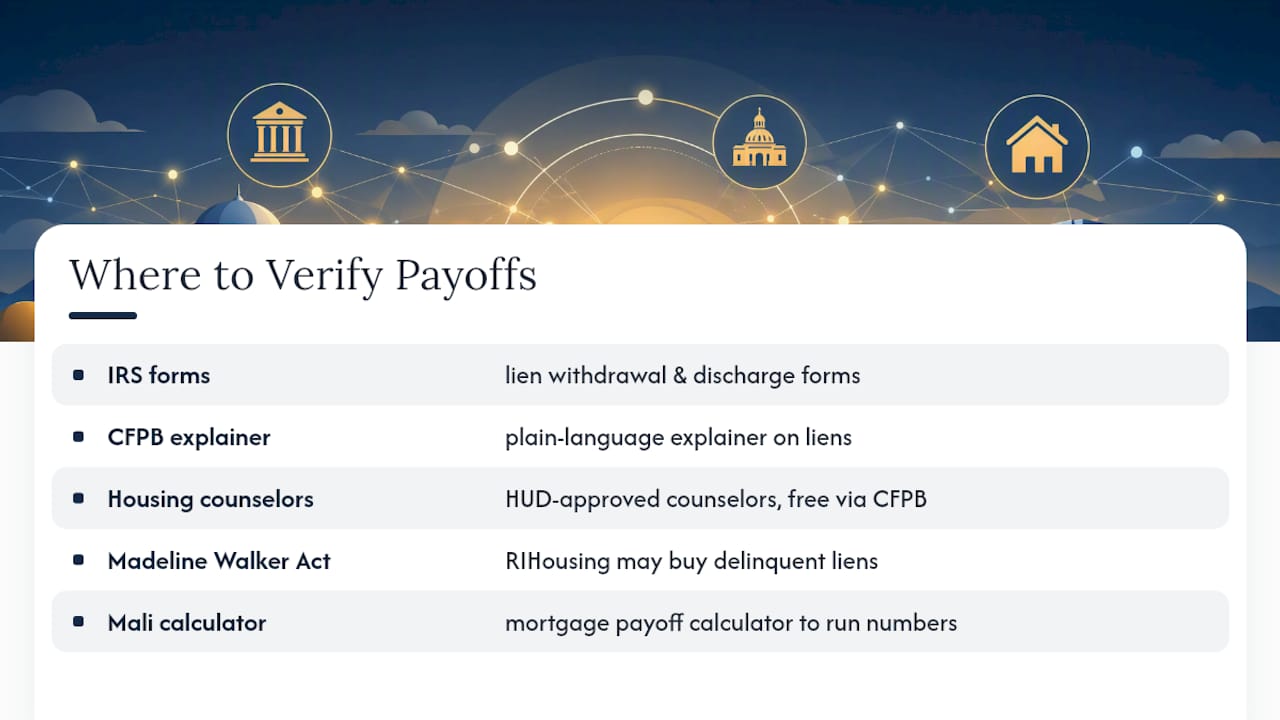
Before you finalize any sale strategy, confirm the details directly with the source rather than relying on secondhand estimates. The IRS’s lien withdrawal and discharge forms are the official documents for resolving federal tax debt tied to your property. The CFPB’s plain-language explainer on liens is a solid starting point if you’re unclear on how a lien affects your title, and its housing counselor finder connects you with HUD-approved counselors at no cost. Rhode Island homeowners should also look into the Madeline Walker Act program, which allows RIHousing to purchase certain delinquent liens and extend redemption timelines. If you’re weighing whether extra mortgage principal payments make more sense than a sale, Mali’s mortgage payoff calculator can help run the numbers.
This article is general information, not a substitute for advice from a qualified financial advisor. Consult a qualified financial professional about your own circumstances before acting on anything here.
Sources
- Can You Sell a House With Back Taxes Owed? — HomeLight
- Understanding a federal tax lien — IRS
- Frequently asked questions — Madeline Walker program — RIHousing
FAQ
Are Tax Lien Sales Worth It for Investors, and What Does That Mean for Me as a Seller?
Tax lien sales can be profitable for investors because unpaid liens accrue interest, sometimes 1% to 2% monthly, that the investor collects when the debt is redeemed. For you as the homeowner, it means a private party, not just the county, may now hold the claim on your property, which can change who you’re negotiating a payoff with.
What Happens if You Owe the IRS Over $10,000 and Want to Sell?
Once federal tax debt crosses that threshold, the IRS is more likely to have already filed a Notice of Federal Tax Lien against your property. You can still sell, but you may need a certificate of discharge from the IRS to clear title, which is a formal request process that takes time, so start it as soon as you list.
How Long Can You Go Without Paying Property Taxes Before Losing the House?
The timeline depends entirely on your state and county, but most jurisdictions move from delinquency to a certificate or lien sale within one to three years, followed by another redemption window before an actual tax deed sale. Contacting your county tax office for a written payoff and timeline is the only reliable way to know exactly where you stand.
Can I Sell My House if a Tax Sale Date Is Already Scheduled?
It’s possible, but your window is narrow and every day counts. A cash buyer capable of closing quickly is often the only realistic option once a sale date is set, since traditional buyers usually can’t get mortgage financing approved in time.
Do I Have to Disclose Back Taxes to a Buyer?
Yes. Tax liens are a matter of public record, and any competent title search will surface them regardless of whether you mention it, so disclosure protects you from later legal disputes. Buyers, especially cash buyers experienced with liens, expect this and build the payoff into their offer rather than treating it as a dealbreaker.