Yes, you can sell a house with solar panels, and the process is straightforward once you know which category your system falls into. First, confirm whether the panels are owned outright, financed through a solar loan, or under a lease or power purchase agreement. Then pull the contract, gather production data, and call the solar company before you list, since transfer requirements vary widely by ownership type.
TL;DR:
- Transfer procedures and approval timelines vary significantly based on whether the solar system is owned outright, financed, leased, or under a PPA, affecting sale complexity.
- Systems with ownership or paid-off status tend to add approximately 6.9% or about $15,000 to the home’s value, but appraisers struggle with consistent valuation due to limited comparable sales.
- Addressing UCC-1 filings, lease assumptions, and buyout timing early is crucial to avoid delaying the closing process and incurring additional costs or approvals.
- Proper documentation such as production data, warranties, and contract details supports valuation and smooths the appraisal process.
- For faster sales, cash offers with no transfer paperwork can bypass most permit, loan, and lease transfer delays but usually do not maximize solar premium benefits.
Table of Contents
- Ownership types: owned, financed, leased, and PPAs
- How solar adds value, and how appraisers size it up
- Transfer mechanics and closing risks you need to plan for
- Documents that prove your system’s value
- Marketing a solar home without scaring off buyers
- Choosing an agent and appraiser who understand solar
- Weighing a market sale against a fast cash sale
- A faster path if solar paperwork isn’t worth the wait
- Sources
- FAQ
Ownership types: owned, financed, leased, and PPAs
The single biggest factor in how smoothly your sale goes is who technically owns the panels. An owned system, paid for outright, transfers with the house like any fixture, with no third party involved in closing. A financed system carries a loan, and that loan is often secured by a UCC-1 filing against the equipment, meaning the debt must be paid off or the loan formally assumed by the buyer. A leased system or power purchase agreement (PPA) means you don’t own the equipment at all: you’re transferring a service contract, and the buyer generally has to qualify for it the way they’d qualify for a phone plan or a car lease.
Buyers react differently to each. Cash buyers and those using conventional financing typically want owned systems, since a lease or unpaid loan complicates the mortgage underwriting. Buyers who like the idea of solar but don’t want to inherit a device or contract they don’t understand often need extra reassurance and documentation, regardless of ownership type.
- Owned systems transfer as part of the property with no lender or lessor approval needed.
- Financed systems usually require a payoff or an assumption approved by the loan company before closing.
- Leased or PPA systems require the buyer to apply for and be approved to take over the contract, SolarReviews reports.
Call your solar loan servicer or lessor as soon as you decide to sell. Ask for a written payoff amount, the assumption criteria for a buyer, and how long approval typically takes.
Pro Tip: Get the payoff or transfer paperwork in writing before you list, so you can quote an accurate number to buyers and their agents from day one.
How solar adds value, and how appraisers size it up
Solar panels tend to raise a home’s sale price, but the size of the bump depends on ownership, system age, and your local market. A 2025 industry report found that homes with owned solar systems sold for an average of 6.9% more than comparable homes without solar. Separately, Berkeley Lab’s analysis puts the average contributory premium for owned arrays at roughly $15,000, though that figure moves with market conditions and how old the system is.
The premium is real but inconsistent: Lawrence Berkeley National Laboratory estimates an average of about $15,000 in added value for owned solar systems, a number that appraisers still struggle to apply consistently because there simply aren’t many paired sales, homes identical except for solar, to compare against directly.
Appraisers generally lean on the sales comparison approach first, then may reference cost or income methods when comparable data is thin. Because paired-sale data is scarce, DOE-linked appraisal guidance stresses that documentation carries real weight in justifying a contributory-value adjustment. The more evidence you hand the appraiser, the easier it is for them to defend a higher number.
- Production logs going back one to three years, exported from the installer’s monitoring portal.
- Warranty documents showing remaining coverage on panels and inverter.
- Inverter age and model, plus the original installer’s contact information for verification.
For a more formal estimate, tools like Pvvalue model contributory value using production data, system age, and local electricity rates, giving you a defensible number to share with your agent or appraiser.
Transfer mechanics and closing risks you need to plan for
Solar can slow a closing if the paperwork isn’t handled early. Three mechanics cause most of the friction: UCC-1 filings, lease or PPA assumptions, and buyout timing.
A UCC-1 financing statement is what a solar lender files to secure its loan against the equipment, and title companies flag it during the title search the same way they’d flag a second mortgage. According to AppraisalBuzz, clearing or subordinating a UCC-1 requires coordination with the lender and can take time, so it needs to start well before your closing date, not during it.
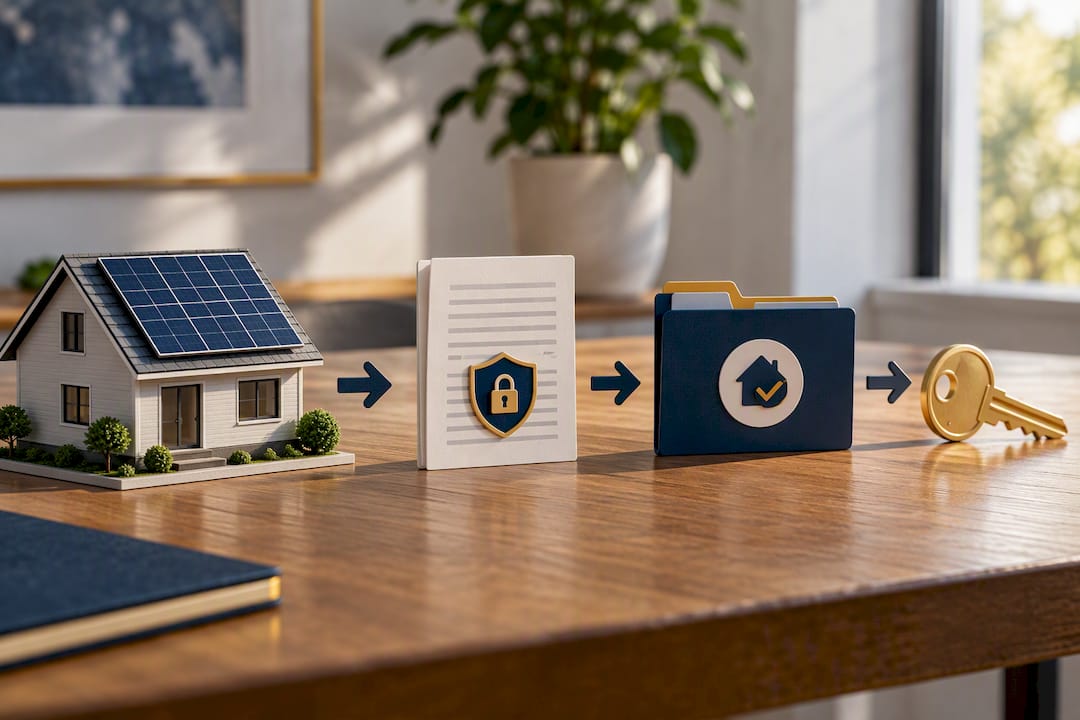
Lease and PPA assumptions follow a different path. Solar.com explains that most leases and PPAs allow a buyer to take over the contract, but the buyer has to clear the lessor’s credit check first. Many lessors run dedicated transfer teams with standard paperwork, and starting that process early reduces the odds of a last-minute scramble.
Buyout or prepayment is the fallback when a buyer doesn’t want to assume anything. Watch for early buyout penalties and, if you claimed a federal solar tax credit, any recapture window tied to selling within a certain period.
- Request a written payoff or buyout figure from your solar loan company or lessor.
- Notify your title company and mortgage lender about the UCC-1 or lease early in the process.
- Get the solar company’s transfer procedure in writing, including expected approval timelines.
- Build a closing timeline buffer of several weeks to absorb approval delays.
- Unresolved UCC-1 filings are a leading cause of solar-related closing delays.
- Buyer credit denials on lease assumptions can force a last-minute switch to a buyout.
A mortgage payoff calculator can help you estimate how a solar loan payoff affects your net proceeds before you set your asking price.
Documents that prove your system’s value
Buyers, appraisers, and lenders all want the same basic proof: that the system works, is covered, and is paid for the way you say it is. Assembling this before you list saves time during escrow.
- Full system specs, including panel count, wattage, and inverter model and serial number.
- One to three years of production history, exported from the installer’s monitoring app or portal.
- Warranty documents for panels, inverter, and workmanship.
- The solar contract or loan agreement showing payment terms and any transfer clauses.
- UCC-1 filing details, if applicable, and recent utility bills showing reduced usage.
Production history matters most to appraisers because it turns a marketing claim into a measurable number. Export it as a simple annual summary rather than raw daily data, something your agent can drop into the MLS listing or hand an appraiser directly. If your contract includes pricing terms you’d rather not publish widely, share the relevant pages with your agent and appraiser under confidentiality rather than posting the full document publicly.
Marketing a solar home without scaring off buyers
Solar sells best when it’s presented as a savings feature backed by numbers, not a mystery box bolted to the roof. Your listing should include annual kWh production, average monthly utility savings, remaining warranty years, and whether the system is owned or financed.
- Lead with the annual production number and estimated utility savings, not just “solar panels included.”
- State plainly whether the system is owned, financed, or leased, since this shapes who qualify to buy.
- Prepare a short answer for “what happens to the payments” before a buyer’s agent has to ask.
Owned systems can be marketed as a straightforward value-add. Financed or leased systems need a slightly different pitch: emphasize that the transfer process is well established and that the solar company handles most of the paperwork. Price the home with the remaining loan balance or lease terms in mind, since a buyer weighing two similar houses will factor in ongoing solar payments when deciding what to offer.
Pro Tip: Have your agent print a one-page solar summary sheet for showings, covering production, savings, warranty, and ownership status, so buyers get consistent answers.
Choosing an agent and appraiser who understand solar
Not every agent or appraiser has handled a solar transfer before, and picking one who hasn’t can cost you money or time.
- Ask agents how many solar-equipped listings they’ve handled and how they document production data in the MLS.
- Ask appraisers whether they’ve used a contributory-value approach for solar before, or worked with tools like pvvalue.com.
- Treat a lack of familiarity with UCC-1 filings or lease assumptions as a red flag, not a minor gap.
- Once you’ve hired an agent, order a production report, request payoff figures, and list the system clearly as “solar: owned” or “solar: leased.”
Weighing a market sale against a fast cash sale
A market sale makes sense when your system is owned, your documentation is solid, and you have time to let an experienced agent capture that premium of 6.9% or roughly $15,000 in added value. A cash sale makes more sense when the loan payoff, UCC-1 cleanup, or lease assumption feels like more hassle than the premium is worth, or when you simply need to close fast.
- Market sale: best when the system is owned, well documented, and you can wait for the right buyer.
- Cash sale: best when you want certainty, a faster close, and no repairs or paperwork chase.
Some home buyers purchase homes as-is, including solar-equipped properties, with flexible closing dates and transparent offer processes that don’t require sellers to resolve every transfer detail before signing.
— Dave
A faster path if solar paperwork isn’t worth the wait
If chasing loan payoffs, lease approvals, and appraisal documentation sounds like more effort than you want to put in, selling directly for cash skips most of it. Certain companies buy homes as-is, with no agent fees, no repair requests, and no cleaning required, often working around the seller’s timeline rather than a buyer’s mortgage schedule.

This route fits sellers who’d rather have certainty than chase the highest possible price, especially when a solar loan or lease adds extra steps to a traditional sale.
- Some buyers make cash offers based on the home’s after-repaired value, solar system included.
- You choose the closing date, and there’s no obligation to accept the offer.
| Sale type | Speed | Repairs needed | Agent fees |
|---|---|---|---|
| Traditional market sale | Weeks to months | Often yes | Standard commission |
| Cash sale with Rhody Home Buyer | Days to weeks | None | None |
If speed and simplicity matter more than maximizing the solar premium, request a cash offer and we’ll walk you through what a sale on your terms looks like.
Sources
For further reading, see Berkeley Lab’s premium analysis, the DOE overview on solar homes, SolarReviews’ home value report, Solar.com’s guide to leased systems, and pvvalue.com for contributory-value estimates.
- Lawrence Berkeley National Laboratory — Berkeley Lab analysis of solar home premiums
- SolarReviews — Selling a house with solar panels
FAQ
Is it difficult to sell a house with solar panels?
Selling a solar home isn’t inherently difficult, but owned systems are simpler than financed or leased ones. The extra steps involve confirming payoff amounts, transferring or clearing a UCC-1, or getting a buyer approved to assume a lease, all of which take longer if you start late.
What happens to my solar panels when I sell my house?
Owned panels transfer with the property like any fixture. Financed panels require paying off or assuming the loan, and leased or PPA systems require the buyer to apply for and be approved to take over the contract, according to Solar.com.
How much do you get paid for selling solar panels?
You don’t sell the panels separately. Instead, an owned system tends to add to your home’s sale price, with a 2025 industry report showing homes with owned solar selling for 6.9% more on average than comparable non-solar homes.
Is it a good idea to remove solar panels when selling my house?
Removing panels usually isn’t worth it, since owned systems tend to add value rather than detract from it, and removal costs money without guaranteeing a smoother sale. It can make sense only if the system is old, poorly maintained, or the lease terms are unusually restrictive for buyers.