
If you need every dollar of your equity right now, selling almost always puts more cash in your pocket. If you want to stay put and just need extra monthly income or a credit line, a reverse mortgage often makes more sense. A homeowner facing medical bills or downsizing usually does better selling outright; someone aging in place with a paid-off house often does better tapping equity slowly. Fees, heirs, and your timeline change the math either way.
TL;DR:
- Reverse mortgages typically unlock 40% to 75% of home equity, translating to $120,000–$180,000 on a $300,000 home, compared to roughly $270,000 from a sale.
- Borrowers face upfront costs, ongoing fees, and accruing interest that can significantly increase the loan balance over time, especially with lump sum options.
- Selling a home generally yields higher net cash, but involves agent commissions, closing costs, and a timeline that can extend 60 to 90 days, or shorter with cash buyers.
- A reverse mortgage requires homeowners to keep paying taxes and insurance, and defaults can occur if these or maintenance obligations are unmet; selling transfers these burdens to the buyer.
- The decision heavily depends on whether the homeowner wants immediate cash, to stay in the property long-term, or leave an inheritance, with each option affecting Medicaid, SSI, and emotional well-being differently.
Table of Contents
- Reverse Mortgage vs Selling: Net Cash, Fees, and Timeline Side by Side
- How Do Reverse Mortgages Actually Work?
- What Does Selling Actually Get You?
- How Do You Decide Between Selling and a Reverse Mortgage?
- Beyond Reverse Mortgage vs Selling: Other Ways to Tap Equity
- What Are the Tax Implications of Each Option?
- Will This Affect Medicaid or SSI Eligibility?
- The Emotional Side of Staying vs Selling
- When a Fast Cash Sale Solves the Real Problem
- Ready to Sell Fast? Here’s How Rhody Home Buyer Works
- Sources
Reverse Mortgage vs Selling: Net Cash, Fees, and Timeline Side by Side
Run the numbers on a $300,000 home and the gap becomes obvious. A reverse mortgage typically unlocks $120,000 to $180,000, or roughly 40% to 75% of your equity, and you keep living there.
Quick math: On a $300,000 home, expect $120,000–$180,000 from a reverse mortgage versus roughly $270,000 net from a traditional sale, minus around $30,000 in selling costs.
The trade-offs go beyond the headline number:
- Reverse mortgage costs: origination fee, 2% upfront mortgage insurance, 0.5% annual mortgage insurance, appraisal, servicing fees, and accruing interest that grows the loan balance every month.
- Selling costs: agent commission, closing costs, prep and repair costs, and staging or holding costs while the home sits on the market.
- Mobility: a reverse mortgage locks you into staying; selling frees you to relocate.
- Maintenance: reverse mortgage borrowers must keep paying property taxes, insurance, and upkeep or risk default; sellers hand that burden to the buyer.
- Heirs: selling leaves a clean inheritance in cash; a reverse mortgage leaves heirs a shrinking equity cushion and a repayment deadline.
Neither option is universally cheaper. It depends on how long you plan to stay and how much you value keeping the house in the family.
How Do Reverse Mortgages Actually Work?
A Home Equity Conversion Mortgage, or HECM, is available to homeowners age 62 and older who live in the property as their primary residence. Before you can close one, HUD requires mandatory counseling so you understand the terms, the costs, and what alternatives exist. That single requirement catches a lot of people off guard. It also protects them.
You can take the money as a lump sum, fixed monthly payments, or a line of credit you draw on as needed. The line of credit option tends to preserve more equity over time because you only pay interest on what you actually borrow, while a lump sum starts accruing interest on the full amount immediately.
The fees add up faster than most borrowers expect. Upfront mortgage insurance premium runs about 2% of the home’s value, and annual MIP adds roughly 0.5% of the outstanding balance every year. Layer on origination fees, appraisal costs, closing costs, and ongoing servicing fees, and the loan balance climbs steadily even if you never take another draw.
A reverse mortgage becomes due when you die, sell the home, or move out permanently, typically defined as being away for more than 12 months. When that trigger hits, heirs generally get about six months to repay the balance or sell the property, though HUD allows extensions in some cases.
- Falling behind on property taxes or homeowners insurance can trigger default, even if you never missed a loan payment.
- Watch for aggressive sales pitches that gloss over fees or push you toward a lump sum you don’t need.
Pro Tip: Ask your counselor to run a side-by-side projection showing your loan balance in 10 years under the lump sum versus the line of credit option. The gap usually surprises people.
What Does Selling Actually Get You?
Selling converts your entire stake in the house into cash, minus the cost of getting it sold. A traditional listing typically costs 6% to 10% of the sale price once you add agent commissions and closing costs, which on a $300,000 home works out to roughly $18,000 to $30,000. That leaves you with a lump sum, no ongoing loan balance, and no lender watching whether you pay your taxes on time.
Timeline is where the two selling paths diverge sharply. A traditional sale with an agent, showings, and financing contingencies commonly takes 60 to 90 days, sometimes longer if the market is slow or the house needs work to pass inspection. A cash sale to a direct buyer can close in days to a few weeks, since there’s no lender approval process, no repair negotiations, and no waiting on a buyer’s financing to clear.
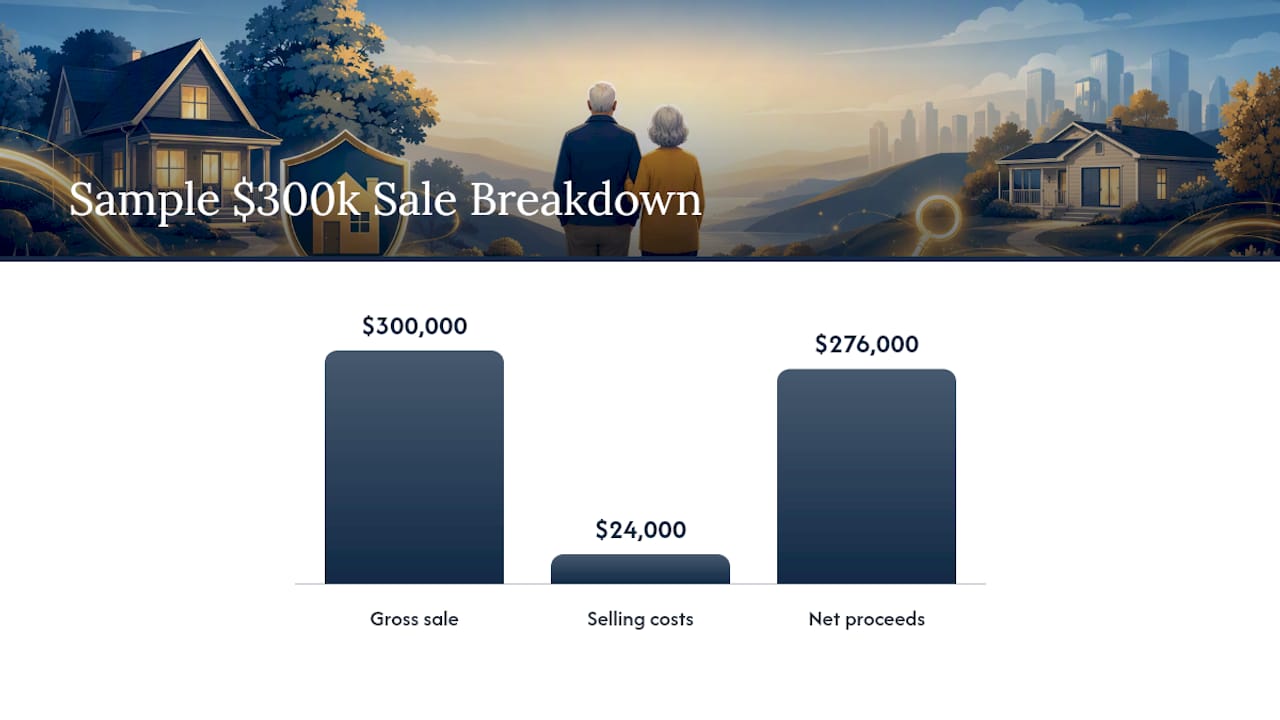
Sample math: sell for $300,000 through a traditional agent, subtract $24,000 in commissions and closing costs, and you net $276,000 before moving expenses. That number drops if the home needs repairs to attract buyers or pass an inspection.
- Pros of selling: a clean break, no future upkeep, no loan balance eating into equity, and full liquidity to fund a move, medical care, or retirement elsewhere.
- Cons of selling: you have to actually move, and you may face capital gains considerations depending on how much the home appreciated.
Selling as-is to a cash buyer makes the most sense when the home has deferred maintenance that would fail a lender’s appraisal, when you need money fast, or when you simply don’t have the time or energy to manage repairs and showings. If a reverse mortgage isn’t an option because the property can’t meet HUD’s minimum standards, selling as-is often becomes the only realistic path forward.
How Do You Decide Between Selling and a Reverse Mortgage?
Work through these questions in order, and bring the answers to a financial advisor or HUD-approved counselor before signing anything.
- How much cash do you actually need, and when? A large lump sum for medical bills or debt points toward selling; steady monthly income points toward a reverse mortgage.
- Do you want to stay in this home for the next 5 to 10 years? Staying favors a reverse mortgage; planning to relocate favors selling.
- Run the net number both ways. Estimate 40% to 75% of your home’s value for a reverse mortgage payout versus roughly 90% to 94% of sale price after a traditional sale’s costs.
- Can you keep up with taxes, insurance, and maintenance? A reverse mortgage requires it; missing payments risks default.
- Does leaving equity to heirs matter to you? If yes, selling preserves more of it; a reverse mortgage typically leaves less.
- Gather your documents and get counseling. HUD-required counseling for HECMs will walk through your specific numbers.
Pro Tip: Write down your answer to question 3 before you talk to a lender or agent. Salespeople on both sides are good at reframing the math in their favor.
Beyond Reverse Mortgage vs Selling: Other Ways to Tap Equity
A reverse mortgage and an outright sale aren’t the only two doors here. If you can handle monthly payments and want to keep more equity long term, a HELOC or cash-out refinance usually costs less over time than a reverse mortgage’s fees and accruing interest.
- Renting out the property instead of selling can generate income, but factor in management costs, vacancy risk, and the work of being a landlord.
- Selling then renting, or a short-term rent-back arrangement, lets you access full equity while buying time to find your next place.
- Reverse mortgage funds spent on necessary home repairs or medical costs make sense; using them for speculative investments or lifestyle spending erodes your safety net fast.
Each of these fits a narrower situation than the two main options, but they’re worth ruling out before committing.
What Are the Tax Implications of Each Option?
Reverse mortgage proceeds aren’t taxable income, since the money is technically loan proceeds rather than earnings. That’s one genuine advantage: you can draw tens of thousands of dollars a year without it affecting your tax bracket or triggering a tax bill.
Selling can trigger capital gains tax, but most homeowners never pay it. If you’ve owned and lived in the home as your primary residence for at least two of the last five years, the primary residence exclusion shields up to $250,000 in gains for single filers and $500,000 for married couples filing jointly. A home bought decades ago for $80,000 and sold today for $300,000 produces a $220,000 gain, comfortably under the exclusion for most filers.
Where it gets trickier: if the home appreciated well beyond the exclusion limits, or if it was a rental or second home at any point, you could owe tax on the excess gain. That’s a conversation for a tax professional, not a rule of thumb.
Interest that accrues on a reverse mortgage is generally not deductible until it’s actually paid, which for most borrowers means only when the loan is repaid at the end. That’s a meaningfully different tax profile than a traditional mortgage where you deduct interest annually.
Neither path is automatically better on taxes. It depends on your gain, your filing status, and how long you’ve owned the home.
Will This Affect Medicaid or SSI Eligibility?
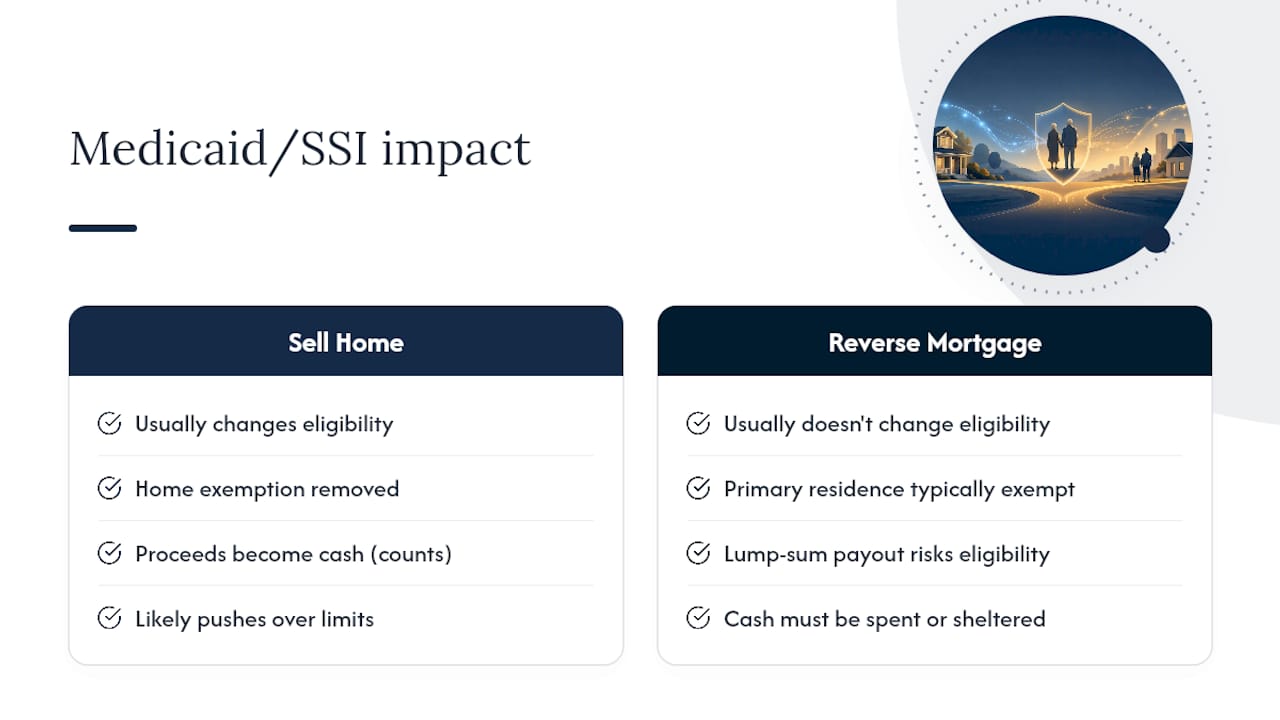
Selling your home usually changes your Medicaid and SSI eligibility, while a reverse mortgage usually doesn’t. This trips up more families than almost any other detail here.
Social Security retirement and disability benefits aren’t affected by either option, since they’re not means-tested. Supplemental Security Income (SSI) and Medicaid are different stories entirely, because both programs cap how much you can hold in countable assets.
A reverse mortgage draws down home equity, but your primary residence is typically an exempt asset for Medicaid and SSI purposes regardless of how much equity sits in it. Taking a lump sum reverse mortgage payout can change that picture if you let the cash sit in your bank account past the end of the month you received it, since cash on hand counts against asset limits.
Selling removes the exempt asset entirely and replaces it with cash, which almost certainly pushes you over Medicaid’s and SSI’s resource limits unless you spend down quickly on qualifying expenses or place proceeds into an appropriate trust. Anyone on or approaching eligibility for either program needs to talk with an elder law attorney or benefits counselor before selling, not after.
This is one area where getting it wrong is expensive and hard to undo. Loop in a professional before the closing date, not the week after.
The Emotional Side of Staying vs Selling
The financial math gets most of the attention, but the emotional weight of each choice often decides which one a family actually goes with. Staying in a reverse mortgage keeps you in the house where you raised kids, know the neighbors, and don’t have to pack a single box. For a lot of people, that certainty is worth real money.
Selling carries a different kind of relief. No more worrying about the roof, the furnace, or whether you can keep up with a big yard. A clean break from maintenance and market exposure often brings a sense of certainty that outweighs the loss of the physical space, especially for owners who’ve been quietly stressed about upkeep for years.
Both choices come with grief that’s rarely discussed openly. Downsizing means letting go of decades of belongings and memories tied to specific rooms. Staying with a reverse mortgage can carry its own quiet anxiety, watching the loan balance grow every year and wondering how much will be left for the kids.
Family disagreements are common here too. Adult children sometimes push a parent toward selling for safety reasons, while the parent wants to stay for independence. Neither side is wrong, but the decision belongs to the homeowner, and a good counselor can help the whole family talk it through instead of around it.
When a Fast Cash Sale Solves the Real Problem
Some homeowners don’t need a reverse mortgage’s monthly income. They need out, fast, without fixing a roof or waiting on a buyer’s financing. That’s the situation Rhodyhomebuyer sees most often: as-is purchases, no agent fees, and a closing timeline measured in days, not months.
If speed or skipping repairs changes your decision, that’s worth weighing before assuming a reverse mortgage is your only path to cash. Always get HUD counseling and run your own numbers first.
— Dave
Ready to Sell Fast? Here’s How Rhody Home Buyer Works
This option provides an alternative to a slow traditional sale or a reverse mortgage’s ongoing fees, especially for homeowners who need cash quickly without repairs, showings, or commissions. Sellers can receive a cash offer based on the home’s condition, sell as-is, and close on a timeline that works for them, sometimes within days.

This process involves no agent commissions and does not require repairs before closing. If the home has deferred maintenance that might disqualify it from other options, this pathway can provide a quicker solution to access home equity. Read more about how cash home sales work or check out our guide to selling without making repairs first.
When you’re ready, request your no-obligation cash offer through Rhody Home Buyer’s sell your house page. You’ll need basic details about the property and your timeline. Most sellers hear back with an offer within a day or two, and you pick the closing date that works for you.
Sources
- Reverse mortgages | Consumer Financial Protection Bureau
- Reverse mortgages | Federal Trade Commission