
Yes, a house can be sold during probate once a court appoints a personal representative with legal authority to act. The deciding factor is whether that authority is independent or requires court confirmation, which shapes everything from timeline to buyer risk. Before listing anything, confirm your Letters Testamentary or Letters of Administration and ask the court directly whether confirmation is required.
TL;DR:
- Executors with independent authority can sell probate houses faster and with less court oversight, avoiding hearings for acceptance or overbids.
- Confirming whether court approval is required before listing saves time and prevents wasted effort or legal issues during the sale process.
- Getting certified Letters of Administration or Testamentary early is crucial, as failure to do so can void contracts or cause delays.
- Probate sales generally take 30 to 60 days with independent authority but can extend beyond 120 days if court confirmation or disputes are involved.
- Cash offers or proof of funds are preferred by courts and can expedite sales, especially when estate costs are piling up or quick closure is desired.
Table of Contents
- What Is a Probate House Sale and When Does It Apply?
- Who Can Legally Sell the House and What Do the Authority Levels Mean?
- Executor Checklist: Step-by-Step From Opening Probate to Closing
- How Probate Sales Work for Buyers: Offers, Overbids, and Financing
- Timeline and Costs: What to Actually Budget For
- Tax and Proceeds: How the Money Actually Gets Distributed
- Common Mistakes, Red Flags, and Practical Tips
- When a Fast Cash Sale Makes Sense for an Estate
- A Faster Path Through Probate: Selling As-Is for Cash
- Sources
What Is a Probate House Sale and When Does It Apply?
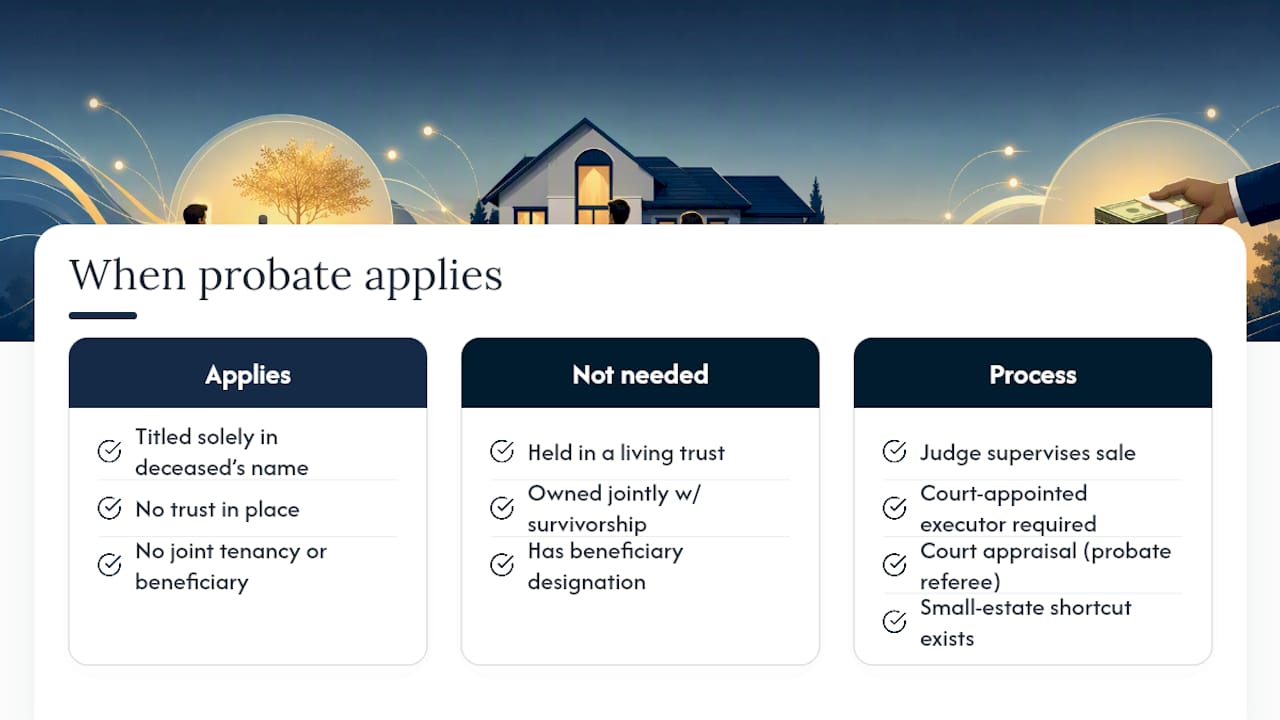
A probate house sale happens when the legal owner has died and the property must pass through court-supervised administration before it can be transferred or sold. This applies whenever real estate is titled solely in the deceased person’s name, without a trust, joint tenancy, or beneficiary designation that would let it bypass probate entirely. If the home was held in a living trust or owned jointly with rights of survivorship, probate usually isn’t necessary at all.
The process itself is court-regulated, which means a judge and, in many cases, a court-appointed appraiser called a probate referee get involved before a sale closes. According to Experian, this typically requires a court-appointed executor or administrator and an appraisal before the property can go to market. Some states also distinguish between formal probate and a simplified “small estate” process for lower-value estates, which can skip many of the formal steps described here. If the estate qualifies, small estate procedures are usually faster and cheaper than full probate.
Who Can Legally Sell the House and What Do the Authority Levels Mean?
The person selling the house must be the legally appointed executor (named in a will) or administrator (appointed when there’s no will). Neither can sign a purchase agreement or accept an offer without official proof of authority from the court. Title companies almost universally require certified copies of Letters Testamentary or Letters of Administration before they’ll insure the transfer, so getting these documents early isn’t optional paperwork. It’s the gate everything else passes through.
Once appointed, the executor’s authority falls into one of two tracks, and the difference matters enormously:
- Independent or full authority lets the executor sell the house much like a normal real estate transaction, following a required notice period to heirs but without needing a judge to approve the sale itself.
- Limited or supervised authority requires court confirmation of the sale, meaning the accepted offer goes before a judge at a hearing where other buyers can outbid it.
Ask your probate attorney to confirm, in writing, which authority level applies to your case before you sign a listing agreement. This single question determines pricing strategy, marketing timeline, and how much buyer risk you’re willing to accept, as probate listing specialists frequently point out to executors who assume the process is identical everywhere.
Executor Checklist: Step-by-Step From Opening Probate to Closing
Selling a home in probate follows a fairly predictable sequence, even though timing varies by county and by how contested the estate is.
- Open probate and get appointed. File the petition, get appointed executor or administrator, and request certified Letters right away.
- Order the appraisal. A probate referee or court-approved appraiser sets the property’s value, which anchors pricing and, in confirmation cases, sets the minimum bid.
- File the inventory and prepare the property. Complete required disclosures, handle basic cleanup, and choose a real estate agent who has actually closed probate sales before.
- Send required notices. Heirs and beneficiaries typically get a Notice of Proposed Action (NOPA) or equivalent, giving them a window to object before the sale proceeds.
- Handle objections or prepare for confirmation. If court confirmation is required, prepare for hearing logistics, including how overbids are handled in the courtroom.
- Close escrow and settle the estate’s books. Pay debts and fees from proceeds, then file the final accounting with the court.
Pro Tip: Order the appraisal before you pick a listing price. Pricing a probate home based on a Zillow estimate instead of the probate referee’s number is one of the most common reasons offers fall apart at a confirmation hearing.
Notices to heirs deserve extra attention. A beneficiary who feels blindsided by a sale price can file an objection that stalls everything for weeks, even when the price is fair. Documenting every notice in writing, with proof of delivery, protects the executor from personal liability down the line.
How Probate Sales Work for Buyers: Offers, Overbids, and Financing
Buyers looking at probate real estate face a different rulebook than a standard resale, and the risk profile shifts depending on which authority track the executor holds.
Every probate property sells strictly as-is. Executors rarely have the estate cash or personal interest in funding repairs, and most probate listings explicitly disclose that no seller concessions are on the table. Inspections still happen, but they’re for information, not negotiating leverage.
- Deposits often need to be cashier’s checks rather than personal checks, especially in confirmation sales.
- Financing is workable in independent-authority sales, but a hearing date creates a hard closing deadline that can eliminate slower loan products.
- Cash offers or strong proof of funds tend to get preferred treatment because they remove financing contingency risk entirely.
- At a confirmation hearing, any qualified bidder can appear and outbid the accepted offer, usually requiring a deposit on the spot to participate.
Overbid rules vary by court, but many require a minimum increase over the accepted offer, plus the initial deposit amount, before a new bidder is recognized. This is where appraisal values matter most: the minimum overbid threshold is often calculated directly from the probate referee’s number, not the negotiated price.
That overbid exposure, combined with longer timelines, is a big reason probate homes often sell below comparable retail listings. Experian notes this discount reflects buyer hesitation and market friction, not any legal requirement to sell cheap. For a patient buyer willing to accept as-is condition and some schedule uncertainty, that gap can be the whole appeal.
Timeline and Costs: What to Actually Budget For
Independent-authority sales move close to normal market speed: list, negotiate, close, typically inside 30 to 60 days once Letters are in hand. Court-confirmation sales run longer, often 60 to 120 days or more, because the hearing date itself depends on court calendar availability. Backlogged counties can add weeks beyond that on their own, a pattern documented in California guides covering how local court practice extends probate timelines even after a buyer is under contract.
Executors and buyers should plan for these recurring cost categories:
- Appraisal or probate referee fee, paid early and often required before listing.
- Attorney fees, which can be a percentage of the estate or hourly, depending on the state and complexity.
- Court filing fees, due at multiple points from petition through final accounting.
- Real estate commission, negotiated like any listing, though some probate specialists structure fees differently.
- Title and closing costs, standard for any sale but sometimes complicated by liens against the estate.
- Overbid deposit funds, which buyers need ready as certified funds, not financing promises.
Most of these costs come out of sale proceeds at closing. Attorney retainers and the appraisal fee sometimes need interim payment by the estate before a dollar from the sale ever arrives, so executors without immediate cash access should ask the attorney about deferred billing early.
Tax and Proceeds: How the Money Actually Gets Distributed
Sale proceeds don’t go straight to heirs. They follow a strict priority order set by probate law: secured debts like the mortgage get paid first, then administrative costs and fees (attorney, court, appraisal), then unsecured debts such as credit cards or medical bills, and only then distributions to heirs.
- Secured debts and liens against the property
- Administrative and court costs, including attorney and appraisal fees
- Unsecured creditor claims
- Remaining balance distributed to heirs per the will or intestacy law
On the tax side, heirs generally benefit from a stepped-up basis, meaning the property’s value resets to fair market value at the date of death rather than what the original owner paid decades earlier. That adjustment can dramatically reduce or eliminate capital gains tax if the home sells close to its appraised probate value. The IRS Publication 559 covers how estates handle these tax mechanics in more detail, and it’s worth reading before assuming any sale is tax-free. State-level estate or inheritance tax exposure varies widely, so a tax professional familiar with your state’s rules, not just federal basics, should review the numbers before distribution.
Common Mistakes, Red Flags, and Practical Tips
The most expensive mistake executors make is acting before Letters arrive. Signing a listing agreement or accepting an offer without certified authority documents can void the contract entirely and delay the sale by weeks while paperwork catches up. A close second: skipping or delaying the appraisal, then pricing the home on guesswork.
Misreading the authority level causes real damage too. An executor who assumes independent authority when the estate actually requires confirmation can lose a buyer who isn’t willing to wait for a hearing date.
On the buyer side, weak proof of funds is the top reason offers get rejected or fail at confirmation. Courts and executors want certified funds and clean financing pre-approval, not a promise.
Pro Tip: Ask your probate attorney for a one-page summary of the exact authority level, notice requirements, and hearing status before you list. Having it in writing prevents costly assumptions later.
When a Fast Cash Sale Makes Sense for an Estate
Executors juggling probate rarely have the luxury of optimizing for the highest possible price. Mortgage payments, insurance, utilities, and property taxes keep accruing while paperwork moves through the court, and family disagreements over a drawn-out sale can turn a manageable job into a stressful one. Speed and certainty often matter more than squeezing out another few percent.
A cash buyer who purchases as-is removes financing contingencies, repair negotiations, and the overbid uncertainty that comes with court confirmation. That’s a real advantage when carrying costs are piling up or heirs just want the estate closed. For executors weighing that tradeoff, a direct cash sale through a service built for this exact situation is worth a serious look before committing to a long retail listing.
— Dave
A Faster Path Through Probate: Selling As-Is for Cash
Executors don’t have to choose between a slow retail listing and a stressful confirmation hearing. Some cash buyers purchase probate properties as-is, with no repairs, no cleaning, and no agent commissions eating into the estate’s proceeds. Offers may be based on the home’s After Repaired Value, giving executors a clear number to compare against the appraisal before deciding which route fits the estate’s timeline.

This matters most for estates carrying real pressure: unpaid mortgage payments, heirs who need a fast resolution, or a property that needs more repair work than the estate can fund upfront. Skipping the listing process also means skipping the overbid uncertainty that comes with court confirmation sales. If you’re an executor weighing your options, request a no-obligation cash offer to see how a direct sale compares to a traditional listing before you commit either way.
Sources
Check IRS Publication 559 for estate tax basics, and review your county probate court’s own procedural pages, since forms, deposit rules, and confirmation processes vary by jurisdiction.
This article is general information, not a substitute for advice from a qualified lawyer. Consult a qualified legal professional about your own circumstances before acting on anything here.
- Publication 559 (IRS) – Survivors, Executors, and Administrators
- What Is a Probate Sale? | Experian
- Can you sell a house while in probate? | LegalClarity
- Probate real estate: The complete guide for heirs and executors | Inherited Property Match
- Probate: What it is and how it works | Investopedia