
Physical cash is legal tender, but it’s practically useless for an earnest money deposit. Escrow and title companies won’t touch stacks of bills because of compliance and audit-trail problems, so if you’re making a cash offer, your money still has to move through a wire transfer or cashier’s check. Get your proof of funds letter ready today, and confirm your deposit deadline the moment your offer gets accepted. That single step separates a serious cash buyer from a stalled deal.
TL;DR:
- Proof of funds must be prepared and verified quickly, especially in cash deals, to meet deposit deadlines and satisfy seller requirements.
- Cash offers typically require a 1% to 3% earnest money deposit, but higher amounts may be necessary in competitive or luxury markets to demonstrate seriousness.
- Physical cash is generally unacceptable for deposits due to anti-money laundering rules; traceable methods like wire transfers or cashier’s checks are mandatory.
- Buyers should convert savings into a documented, verifiable form before making offers to avoid delays or deal failures caused by unproofed cash.
- Negotiating deposit size, timing, and contingencies can give cash buyers an advantage, but clear proof of funds remains the critical factor for seller trust.
Table of Contents
- What Is Earnest Money and How Does Escrow Handle It?
- How Does a Cash Offer Change the Earnest Money Timeline?
- How Much Earnest Money Should You Offer in a Cash Deal?
- Why Can’t You Just Hand Over Physical Cash?
- How Do You Protect Your Earnest Money Deposit?
- How Rhody Home Buyer Approaches Earnest Money in Cash Deals
- Can You Negotiate Earnest Money Terms on a Cash Deal?
- Why the Standard Advice on Earnest Money Misses the Point
- Selling for Cash? Here’s What Actually Matters
- Sources
- FAQ
What Is Earnest Money and How Does Escrow Handle It?
Earnest money is the deposit a buyer puts down after an offer gets accepted, showing the seller the deal is serious. It’s not an extra fee. It’s an advance on money you’d owe anyway, and a neutral third party holds it until closing.
That third party is typically a title company, escrow agent, or attorney, depending on your state. The money sits untouched in a trust or escrow account rather than going straight to the seller, which protects both sides from someone walking off with the funds mid-transaction.

At closing, the deposit gets applied toward your down payment or closing costs. It doesn’t disappear. It just reduces what you owe at the finish line. If the deal falls apart, whether you get that money back depends entirely on the contract’s contingencies and your state’s escrow rules, according to NAR’s guidance on earnest money.
Here’s the short version of how it typically works:
- A neutral escrow or title holder keeps the deposit until closing.
- The funds count toward your down payment or closing costs at settlement.
- Refunds hinge on contingencies written into the purchase agreement.
- State escrow rules can affect how and when the money moves.
How Does a Cash Offer Change the Earnest Money Timeline?
Sellers love cash offers because they skip the two things that blow up financed deals: underwriting delays and appraisal contingencies. Cash purchases typically close faster precisely because there’s no lender in the chain demanding weeks of paperwork before they’ll release funds.
But faster doesn’t mean less scrutiny. A seller who agrees to a cash deal still wants proof you actually have the money. That means a bank statement or a letter from your financial institution, delivered fast, often within a day or two of an accepted offer. Sellers taking their home off the market on a promise want evidence, not a handshake.
If you’re moving on a compressed cash timeline, a few things need to line up quickly:
- Have your proof of funds letter drafted before you even submit the offer.
- Know your escrow deadline and wire the deposit within that window, not after.
- Confirm with your title company in advance which wire instructions are legitimate, since wire fraud targets real estate closings specifically.
- Line up a private inspector early, since even cash buyers benefit from an inspection before waiving contingencies.
How Much Earnest Money Should You Offer in a Cash Deal?
Most earnest money deposits fall between 1% and 3% of the purchase price, though Wells Fargo notes that competitive markets can push that number higher. In a multiple-offer situation, buyers sometimes stretch to 5% or more to signal they’re not going anywhere.
Here’s what that looks like at real price points:
| Purchase Price | 1% Deposit | 2% Deposit | 3% Deposit |
|---|---|---|---|
| $250,000 | $2,500 | $5,000 | $7,500 |
| $400,000 | $4,000 | $8,000 | $12,000 |
| $600,000 | $6,000 | $12,000 | $18,000 |
Higher deposits make sense in specific situations: a hot market with multiple bidders, a luxury listing where the seller wants assurance you can actually close, or a property that’s been sitting and the seller is nervous about flaky buyers. The tradeoff is real. A bigger deposit means more of your cash is locked up and, if you lose it over a contingency dispute, more of it is at risk.
Local norms matter too. A regional guide on typical deposit sizes shows percentages can shift depending on the market you’re buying in, so it’s worth checking what’s customary where you’re shopping.
Pro Tip: Never offer more earnest money than you’re prepared to lose if you walk away without a valid contingency. Sellers notice a big deposit, but it only helps you if the contract terms actually protect you.
Why Can’t You Just Hand Over Physical Cash?
Physical cash creates a paper trail problem, not a legal one. It’s legal tender, but escrow and title companies almost universally refuse it for deposits because of anti-money-laundering rules and reporting burdens tied to IRS Form 8300, which kicks in for cash transactions over $10,000.
Escrow agents don’t want the compliance headache, and frankly, neither do you. Wire transfers and cashier’s checks leave a clean, verifiable trail that protects everyone if a dispute ever surfaces.
The traceability gap is the real issue. A pile of bills tells no story about where it came from. A wire transfer or bank statement does, which is exactly why title companies build their entire deposit process around traceable instruments instead.
Acceptable methods generally include:
- Wire transfer, the fastest and most common choice for cash buyers.
- Cashier’s or certified check, drawn directly from your bank.
- Personal check, though expect a clearing hold before funds count as received.
If your savings really are in physical cash, deposit that money into your bank account well before you start making offers. Mortgage lenders and Fannie Mae guidelines flag large, unexplained deposits as red flags, so give the money time to season and keep the deposit slip.
How Do You Protect Your Earnest Money Deposit?
Your earnest money is only as safe as the contingencies you write into the contract. Strip those out and you’re gambling the entire deposit on nothing going wrong.
- Include an inspection contingency. This lets you walk away, deposit intact, if the property fails a private inspection.
- Add an appraisal contingency, even on a cash deal, if you want protection against overpaying for a property that doesn’t hold its value.
- Confirm the title contingency so you’re not stuck if a lien or ownership dispute surfaces before closing.
- Deliver funds by the contract deadline. Most agreements specify one to three business days after acceptance, and missing it can forfeit your protections entirely.
- Keep every wire receipt and confirmation email. If a dispute lands you in front of an arbitrator, paper trail wins arguments.
Zillow’s research on refund conditions confirms that deposits are typically refundable when a deal falls through under a valid contingency, but not when a buyer simply gets cold feet.
Pro Tip: If a dispute drags on, most purchase agreements require written notice before either side can claim the funds. Read that clause before you sign, not after something goes wrong.
How Rhody Home Buyer Approaches Earnest Money in Cash Deals
Sellers working with a cash buyer want one thing above everything else: certainty that the money is real and the closing date will hold. Cash buyers benefit from verifying available funds before making an offer so sellers aren’t left guessing.
That upfront verification changes the entire tone of the transaction. Sellers aren’t wondering whether a deposit will clear or whether the buyer’s financing might fall through weeks later.
Operationally, that means:
- Funds are typically handled through established escrow and title partners rather than informally.
- A clear, written timeline for deposit and closing dates is provided before commitment.
- Explaining how the cash sale process works so there are no surprises between acceptance and settlement.
Can You Negotiate Earnest Money Terms on a Cash Deal?
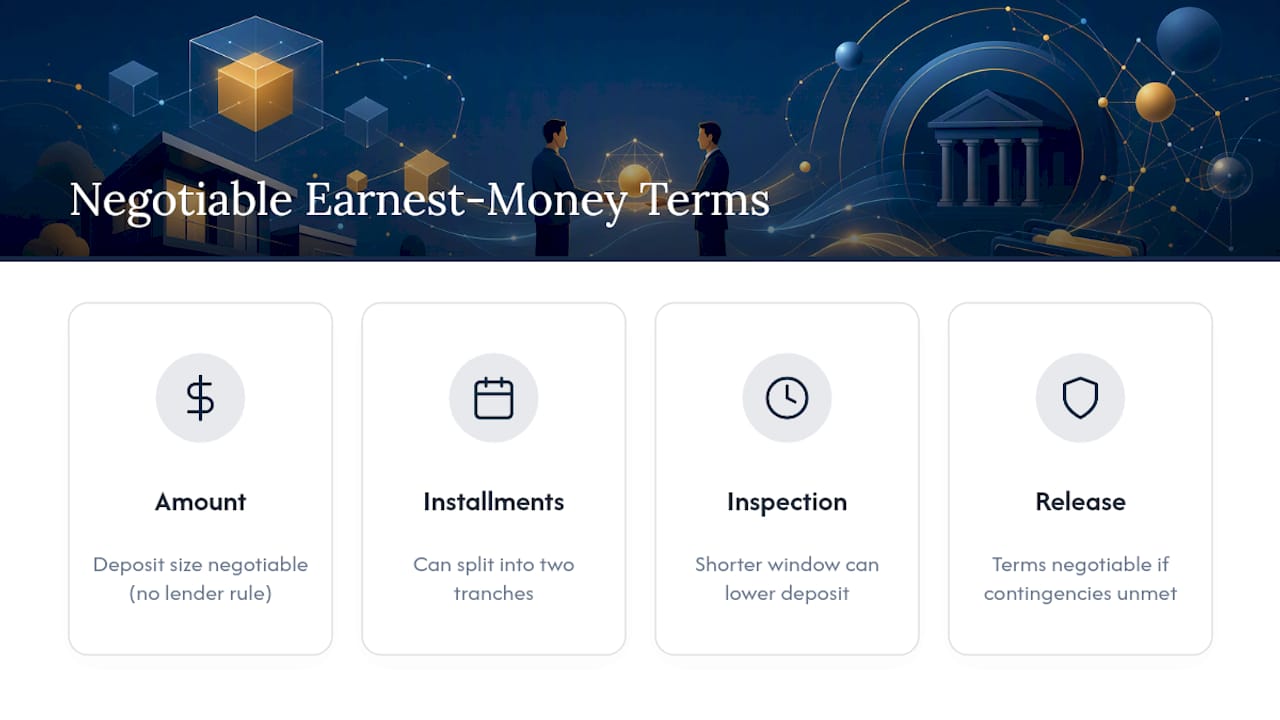
Yes, and cash buyers actually have more room to negotiate than financed buyers do. Without a lender setting rigid requirements, both sides can shape the deposit terms to fit the deal.
One common lever is deposit size.
Timing is negotiable too. Some contracts split the deposit into two installments, an initial amount at signing and a second tranche once the inspection period closes. This structure, which NAR notes varies by state and local practice, gives buyers a chance to limit their exposure early while still showing good faith.
You can also negotiate what happens to the deposit if specific contingencies aren’t met. A buyer might ask for a shorter inspection window in exchange for a smaller deposit, or offer a bigger deposit with a longer due diligence period. Sellers weighing multiple cash offers often favor whichever buyer offers the cleanest, fastest path to closing, so a well-structured deposit can matter more than the purchase price itself.
The mistake most buyers make is treating earnest money terms as fixed boilerplate. They’re not. Everything from the amount to the release conditions to the installment structure is fair game at the negotiating table, especially in a cash transaction where there’s no lender dictating terms from the sidelines.
Why the Standard Advice on Earnest Money Misses the Point
That’s not wrong, but it skips the part that actually trips up cash buyers: the gap between having money and having usable money.
Plenty of buyers with real savings lose time, or lose a deal entirely, because they assumed cash meant cash. It doesn’t, not in a transaction where escrow agents are legally cautious about anything that looks like an untraceable pile of bills. The buyers who move fastest are the ones who convert savings into a documented, traceable form well before they start making offers.
If there’s one thing to prioritize above deposit size, contingency wording, or negotiation tactics, it’s this: get your funds liquid, traceable, and provable before you need them. A seller comparing two similar cash offers will almost always lean toward the buyer whose proof of funds looks clean and immediate. That’s not a technicality. It’s the entire game.
— Dave
Selling for Cash? Here’s What Actually Matters
If you’re a seller weighing a cash offer against a traditional listing, the earnest money conversation above cuts both ways. Cash buyers typically eliminate financing risks, appraisal contingencies, and agent commissions, reducing uncertainty for sellers.

Cash home buyers often buy homes as-is, based on estimated repaired value, so sellers may avoid repair requests, cleaning, and lender underwriting delays. Sellers typically have some control over the closing date. For a full breakdown of how the process moves from offer to settlement, check out how fast cash sales actually work. If you’re ready to see what a no-obligation cash offer looks like for your property, get started with Rhody Home Buyer today.
Sources
- What is earnest money, and how much do you need? — Wells Fargo
- Buying a house with cash vs. mortgage — Zillow
- Earnest money in real estate: refunds, returns and regulations — NAR
FAQ
How Much Is Earnest Money on a $250,000 House?
At the typical 1% to 3% range, earnest money on a $250,000 home runs between $2,500 and $7,500. Competitive markets or multiple-offer situations can push that figure higher.
Is It Better to Accept a Cash Offer on a House?
Cash offers often close faster because they skip lender underwriting and appraisal delays, which many sellers value over a slightly higher financed bid. That said, sellers should still confirm proof of funds before taking a property off the market for any buyer, cash or financed.
Is $1,000 Earnest Money Good?
It depends entirely on the purchase price. On a $100,000 home, $1,000 sits at the low end of the typical 1% range; on a $400,000 home, it’s less than a third of a percent and may signal weak buyer commitment to the seller.
How Much Is Earnest Money on a $600,000 House?
Using the standard 1% to 3% guideline, earnest money on a $600,000 home typically falls between $6,000 and $18,000. Sellers in hot markets sometimes expect figures at the higher end of that range as proof of serious intent.