
If your home still has equity or you can attract a buyer within a few months, a short sale usually protects your credit better and keeps you in more control. If you need a fast, clean exit and your title is clear of junior liens, a deed in lieu resolves things quicker. Either beats foreclosure, and Rhode Island homeowners have both routes available through their loan servicer.
TL;DR:
- Short sales typically take three to six months to complete, while deeds in lieu usually settle within one to two months after approval.
- A short sale impacts credit scores less severely and for a shorter period than a deed in lieu, with score drops of 60 to 125 points versus 100 to 150 points.
- Lenders often require clear title and may need lienholder consent before accepting a deed in lieu, whereas short sales can sometimes avoid lien issues through cooperation.
- A short sale allows homeowners to negotiate sale terms and select their buyer, unlike a deed in lieu which hands control to the lender.
- Homeowners should gather comprehensive documentation, including hardship letters, lien lists, and financial statements, before initiating either process.
Table of Contents
- Short Sale Vs Deed in Lieu at a Glance
- How a Short Sale Works Step by Step
- How a Deed in Lieu Works Step by Step
- Which Option Protects Your Credit and Control Better?
- How Do You Decide Between the Two?
- Timeline and Mortgage Waiting Periods Explained
- Deficiency Judgments and Tax Traps to Avoid
- What to Do Right Now in Rhode Island
- A Straight Answer From Someone Who Sees These Cases Weekly
- Need a Faster Way Out Than Short Sale or Deed in Lieu?
- Where to Get More Help
- Sources
Short Sale Vs Deed in Lieu at a Glance
A short sale means selling your house for less than what you owe, with your lender’s written approval. A deed in lieu of foreclosure means signing your property over directly to the lender to cancel the debt, skipping the sale process entirely.
The differences show up fast once you compare them side by side:
- Timeline: Short sales often take several months; deed in lieu can close more quickly once approved.
- Credit impact: Short sales tend to impact credit scores less severely and for a shorter reporting window than deed in lieu, though both are generally less damaging than foreclosure.
- Control: You negotiate the sale price and buyer in a short sale; a deed in lieu hands control to the lender.
- Liens: Junior liens can derail a deed in lieu almost entirely; short sales can sometimes work around them with lienholder cooperation.
- Mortgage wait: Fannie Mae guidance allows a new conventional mortgage in as little as 2 years after a short sale with documented hardship, versus roughly 4 years after a deed in lieu.
How a Short Sale Works Step by Step
The process starts with a loss mitigation application to your servicer, including a hardship letter, pay stubs, bank statements, and tax returns. Your servicer wants proof the hardship is real and that you can’t keep the loan current.
Once approved for the program, you list the house, usually with an agent experienced in short sales, and submit any offer you receive to the lender for review. The lender orders a valuation, typically a broker price opinion or a full appraisal, to confirm the offer reflects fair market value.
- Submit hardship documentation and loss mitigation application.
- List and market the property, then forward offers to the servicer.
- Lender reviews value through a BPO or appraisal.
- Junior lienholders must consent before closing, since their liens still attach to the title.
- Negotiate any lender concessions and get a written deficiency waiver before signing anything.
Pro Tip: Never close a short sale without a written deficiency waiver in hand. A verbal promise from a loan officer means nothing if the lender later sells that unpaid balance to a collection agency.
How a Deed in Lieu Works Step by Step
A deed in lieu transfers your property title directly to the lender in exchange for canceling your mortgage debt, according to Rocket Lawyer’s guide on deed in lieu versus short sale. No buyer, no listing, no showings.
Lenders almost always require clear title before accepting one, and many ask you to attempt a short sale first, often for around 90 days of marketing, before they’ll even consider it, according to Foreclosure Defense Group. If a second mortgage, HELOC, or judgment lien sits on the property, the deed in lieu typically stalls unless those lienholders agree to release their claims.
- Sign an estoppel affidavit confirming the transfer is voluntary and accurate.
- Lender orders an inspection and valuation of the property.
- Servicer reviews and approves the transfer, often within a few weeks.
- You vacate on an agreed date, sometimes with a cash-for-keys relocation payment.
Pro Tip: Ask specifically about relocation assistance before you sign. Some servicers offer a few thousand dollars to move out on schedule, but they rarely volunteer it unless you ask.
Which Option Protects Your Credit and Control Better?
The consequences that matter most to homeowners boil down to four things: your credit, your legal exposure, your say in the outcome, and how fast you can move on.
- Credit damage: Short sales often cause roughly a 60 to 125 point score drop, while deed in lieu tends to run closer to 100 to 150 points, according to Foreclosure Defense Group. Both remain on your credit report for years, but short sale damage generally fades sooner.
- Deficiency risk: Both carry the risk of a deficiency judgment unless you secure a written waiver, though lenders more commonly negotiate waivers into short sale agreements since they’re already avoiding foreclosure costs.
- Control: A short sale lets you pick your buyer and negotiate terms; deed in lieu removes that leverage entirely.
- Speed and relocation: Deed in lieu usually closes faster and sometimes includes a relocation payment, since the lender wants a clean handoff.
How Do You Decide Between the Two?
Start by pulling together a document checklist before you call your servicer: recent mortgage statements, two years of tax returns, a written hardship letter, and a list of every lien on the property, including HELOCs and judgment liens.
When you get your servicer on the phone, ask direct questions and get answers in writing:
- Will you accept a deed in lieu, or do I need to attempt a short sale first?
- Will you waive any deficiency balance in writing?
- Do you offer relocation assistance, and how much?
- What’s your realistic timeline for approval?
Pro Tip: If your servicer won’t put deficiency waiver terms in writing, or keeps changing the requirements each time you call, that’s a red flag. Contact a Rhode Island foreclosure attorney or a HUD-approved counselor before signing anything.
Timeline and Mortgage Waiting Periods Explained
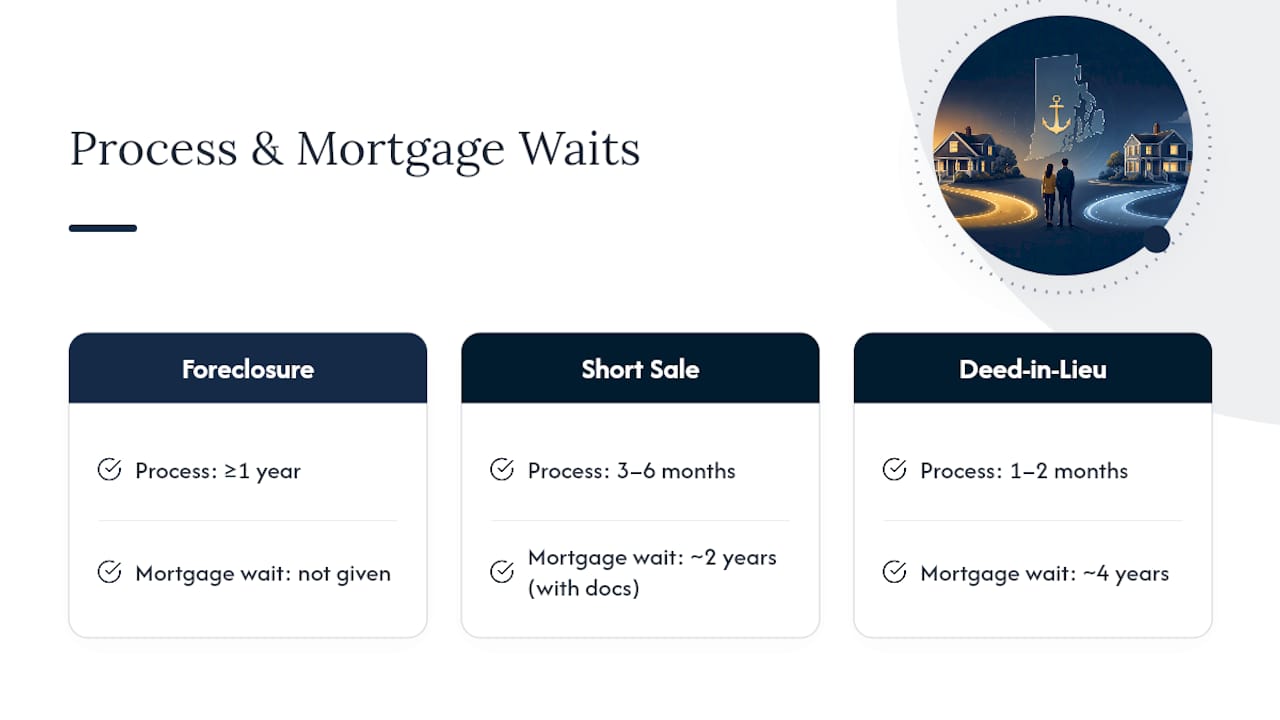
Foreclosure itself can drag on for a year or longer in Rhode Island once legal proceedings start, while a short sale often wraps up in 3 to 6 months and a deed in lieu can finish in 1 to 2 months after approval.
The bigger number to plan around is when you can qualify for a mortgage again. Fannie Mae guidance sets that window at roughly 2 years after a short sale if you document extenuating circumstances, compared to about 4 years after a deed in lieu. That gap alone pushes many homeowners toward the short sale route when they have the time to pursue it. Detailed hardship documentation, job loss letters, medical bills, divorce decrees, is what unlocks the shorter waiting period, so keep records organized from day one.
Deficiency Judgments and Tax Traps to Avoid
Lenders can pursue a deficiency judgment for the gap between what you owed and what they recovered, unless your agreement specifically waives it in writing. Rhode Island law on deficiency judgments varies by lender and loan type, so don’t assume you’re protected just because the sale closed.
Canceled debt can also trigger a Form 1099-C, and that forgiven amount may count as taxable income above $600 unless you qualify for an insolvency exception, per Rocket Lawyer.
- Get every deficiency waiver in writing before closing.
- Ask your lender directly whether they’ll issue a 1099-C.
- Talk to a tax preparer about insolvency exceptions.
- Consult a Rhode Island attorney or HUD counselor given how much state law varies.
What to Do Right Now in Rhode Island
Call your servicer today and request loss mitigation review, don’t wait for a foreclosure notice to force the conversation. Gather your mortgage statements, hardship letter, and lien list while you wait for a callback, and look up a HUD-approved housing counselor for free, unbiased help navigating your options.
If you’re out of time, unwilling to deal with showings, or simply need certainty over a drawn-out sale process, a direct cash sale becomes worth considering. Selling to a local cash buyer skips agent commissions and repair demands entirely. Before signing with any cash buyer, ask for proof of funds, a firm closing date, and a clear breakdown of your net proceeds after fees.

A Straight Answer From Someone Who Sees These Cases Weekly
Most homeowners waste weeks agonizing over the “right” choice when the real question is simpler: do you have time to market the house, or not? Rhody Home Buyer steps in when the answer is no, offering a fast, as-is cash purchase instead of a drawn-out negotiation with a servicer. If you’ve got equity and breathing room, pursue the short sale route first. If you don’t, expect a straightforward conversation and a real offer within days.
— Dave
Need a Faster Way Out Than Short Sale or Deed in Lieu?
Both routes above take months of paperwork, lender back-and-forth, and no guarantee of approval. Rhody Home Buyer skips all of it: as-is cash offers based on your home’s after-repaired value, no agent commissions, no repairs, no cleaning, and a closing date you actually control.

The first call is simple. Tell us your situation, we look at the property, and you get a fair cash number within days, not months. There’s no obligation to accept, and no fees taken out of your proceeds. If foreclosure is bearing down and you need certainty now, get your cash offer from Rhody Home Buyer and see your numbers before you commit to any other path.
Where to Get More Help
For deeper guidance beyond this comparison, these sources cover the legal and financial details in full:
- Fannie Mae for official mortgage waiting-period rules after short sale or deed in lieu.
- Rocket Lawyer’s legal guide for process and tax details.
- HUD’s counselor directory to find free, local housing counseling in Rhode Island.
This article is general information, not a substitute for advice from a qualified financial advisor. Consult a qualified financial professional about your own circumstances before acting on anything here.
Sources
- Fannie Mae
- Rocket Lawyer — Deed in lieu of foreclosure vs. short sale
- Foreclosure Defense Group — Short sale vs deed in lieu: key differences