
If you need to stop foreclosure fast, selling your house for cash to a reputable investor is usually the fastest, most reliable route. It won’t fetch top dollar, but it trades some price for speed and certainty. Some cash home buyers offer Rhode Island homeowners a direct path: request a written cash offer, get a firm mortgage payoff statement from your lender, and compare the two before deciding.
TL;DR:
- Cash sales typically close within 7 to 21 days because they do not involve mortgage underwriting, appraisal, or financing contingencies.
- Investors use the 70% rule based on after-repair value estimates to determine maximum purchase price, which usually results in offers below current market value.
- Requesting a recent firm payoff statement and proof of funds before signing ensures that the mortgage payoff and closing costs are accurate and up-to-date.
- Starting title searches and verifying lien statuses early can prevent delays and ensure smooth closing, especially if liens or unpaid taxes exist.
- A cash sale avoids foreclosure damage to credit and can be completed before an auction date, providing a faster, more certain exit for homeowners in financial distress.
Table of Contents
- What Does a Cash Sale to an Investor Actually Involve?
- How Do Investors Calculate Their Cash Offers?
- Step-by-Step: Selling Fast for Cash This Week
- How Do You Vet a Cash Buyer Before Signing?
- How Mortgage Payoff and Liens Get Handled at Closing
- What Alternatives Exist Besides a Cash Sale?
- What’s the Timeline From Missed Payment to Foreclosure?
- What Does Each Option Actually Cost You?
- How Do You Choose the Right Option for Your Situation?
- How Should You Talk to Your Lender’s Loss Mitigation Team?
- How Does Each Option Affect Your Credit and Future Borrowing?
- Why a Cash Sale Is the Right Call for Urgent Situations
- Get a Cash Offer From Rhody Home Buyer This Week
- Sources
- FAQ
What Does a Cash Sale to an Investor Actually Involve?
A cash sale to an investor means selling your house “as-is” for a set price, with no financing contingency and no lender-mandated appraisal slowing things down. That single difference is why these deals close so much faster than a traditional listing.
Investor and iBuyer transactions typically close in 7 to 21 days because there’s no underwriting queue and no appraisal gap to wait through. A financed buyer on the open market often needs 30 to 60 days just to get to closing, assuming their loan doesn’t fall through first.
“As-is” covers more than most sellers expect:
- No repairs, painting, or staging required before the buyer walks through
- No professional cleaning or hauling away old furniture and clutter
- No inspection contingency that can reopen price negotiations mid-contract
- In many investor deals, the buyer covers closing costs and sometimes the title fees
Pro Tip: Ask any buyer upfront who pays which closing costs. “As-is” should mean as-is on the house, not a surprise bill for you at the table.
A cash sale makes the most sense when your timeline is tight. If you’re facing an auction date, sitting on a property that needs work you can’t afford, or you simply want to avoid neighbors watching a “For Sale” sign go up during a hard financial stretch, speed and privacy outweigh squeezing out an extra few thousand dollars on the open market.
How Do Investors Calculate Their Cash Offers?
Investors don’t price a house off what you paid for it or what you owe. They work backward from After Repair Value (ARV), the estimated resale price once the home is fully fixed up, based on comparable sales in your neighborhood.
From there, most investors apply a version of the 70% rule: Max purchase price = (ARV × 0.70) minus estimated repair costs. It covers rehab costs, months of holding expenses (taxes, insurance, utilities), agent and closing fees when the investor resells, and their profit margin for taking on the risk.
Here’s how that math plays out on a real number:
- An appraiser or investor estimates the home’s ARV at $300,000
- Multiply by 70%: $300,000 × 0.70 = $210,000
- Subtract estimated repairs, say $30,000 for a roof, kitchen, and flooring
- The resulting offer lands around $180,000
This doesn’t excuse a lowball offer, but it does explain why a cash number sits well under retail value.
Pro Tip: Ask any buyer for the ARV and comps they used to build their number. A serious investor will show you the math without hesitation.
Step-by-Step: Selling Fast for Cash This Week
Getting from “behind on payments” to “closed and paid off” takes a specific sequence, not a single phone call. Here’s the order that actually works:
- Request offers from multiple buyers. Contact two or three cash buyers, including Rhody Home Buyer, and get written offers within 24 to 72 hours.
- Get a firm payoff statement. Call your lender’s loss mitigation line and request the exact reinstatement amount, including any late fees and legal costs already tacked on.
- Verify proof of funds. Every serious buyer should hand you a bank statement or escrow letter dated within the last few days, not a form letter.
- Confirm the closing agent. Find out which title company will handle the transaction before you sign anything.
- Order the title search early. Clearing any known liens takes time, so start this step immediately rather than waiting until under contract.
- Set a realistic closing date. Seven to 21 days is standard for cash deals, but build in a few extra days if your title has any complications.
- Negotiate net proceeds and sign. Confirm who pays which closing costs, then sign through a neutral, licensed title company rather than the buyer’s own attorney.
Two things matter more than any other step here:
- A payoff statement that’s more than a few days old can be wrong. Late fees and legal costs accrue daily.
- Never sign a purchase agreement before you’ve seen proof of funds in writing.
Pro Tip: Get everything moving in parallel, not sequentially. While the title search runs, you can already be comparing offers and calling your lender.
How Do You Vet a Cash Buyer Before Signing?
Not every buyer who says “I pay cash” can actually close on the date they promise. Vetting takes ten minutes and saves you from a deal that collapses two weeks before an auction date.
Start with proof of funds. Acceptable documentation looks like a recent bank statement or an escrow account confirmation, not a screenshot or a verbal promise. Check the date. A proof-of-funds letter from three months ago tells you nothing about whether the money is still there.
Next, confirm the title company or closing agent by name and ask them directly for a timeline on lien payoff and wire procedures. A buyer who won’t name their title company, or insists on using their own in-house closer with no outside oversight, is a warning sign.
Ask for references from recent local closings. Reviews matter less than verifiable transaction history. Inexperienced or underfunded buyers can still cause delays even with cash in hand, so a track record of actually closing beats a five-star testimonial every time.
Watch for these red flags:
- Refusal to use a neutral, licensed title company
- Vague or unverifiable proof of funds
- Pressure to sign before you’ve seen any paperwork
- Requests for unusually high up-front fees or deposits
How Mortgage Payoff and Liens Get Handled at Closing
Get your firm payoff statement early. Daily late fees and legal costs accumulate on a delinquent mortgage, which means the number your lender quotes today can be wrong by closing day if you don’t lock it in writing.
The title company handles the actual mechanics: paying off your mortgage lender and any recorded liens directly from sale proceeds, then recording clear title to the new owner. Clearing that process typically takes several business days once the payoff figures are confirmed, so build that into your closing schedule rather than assuming it happens instantly.
A few surprises show up more often than sellers expect:
- Junior liens (second mortgages, judgment liens) that reduce what you walk away with
- Unpaid property taxes that get deducted at the closing table
- HOA fines or assessments that weren’t on your radar
On closing day, confirm the final closing disclosure matches what you agreed to, verify the wire instructions independently (never trust an emailed change), and make sure the lender payoff number on paper matches what you were quoted.
What Alternatives Exist Besides a Cash Sale?
A cash sale isn’t the only path off a mortgage default, and it’s worth knowing what else is on the table even if it’s not the right fit for your timeline.
Loan modification restructures your existing loan, often stretching the term or lowering the rate, so your monthly payment drops to something you can sustain. It usually takes weeks to months of paperwork and lender review, with no guarantee of approval.
Refinancing replaces your current mortgage with a new one, but most lenders won’t approve a refinance once you’re already delinquent. It works better as a preventive move, not a rescue plan once you’re behind.
Forbearance pauses or reduces payments temporarily, usually for a few months, with the missed amount added back later as a lump sum or spread across future payments. It buys time without solving the underlying shortfall.
Repayment plans split your missed payments into extra installments added to your regular monthly bill until you’re caught up. That works if your income has recovered enough to absorb the extra amount. If it hasn’t, you’re just delaying the same problem.
Each of these options keeps you in the home, at least for now, but all of them require sustained income and lender cooperation. If your finances haven’t stabilized, or you simply don’t want the process, a cash sale sidesteps the whole negotiation.
What’s the Timeline From Missed Payment to Foreclosure?
Understanding the clock helps you know how much runway you actually have. The exact schedule varies by lender and by Rhode Island’s specific foreclosure process, but the broad pattern holds across most mortgages.
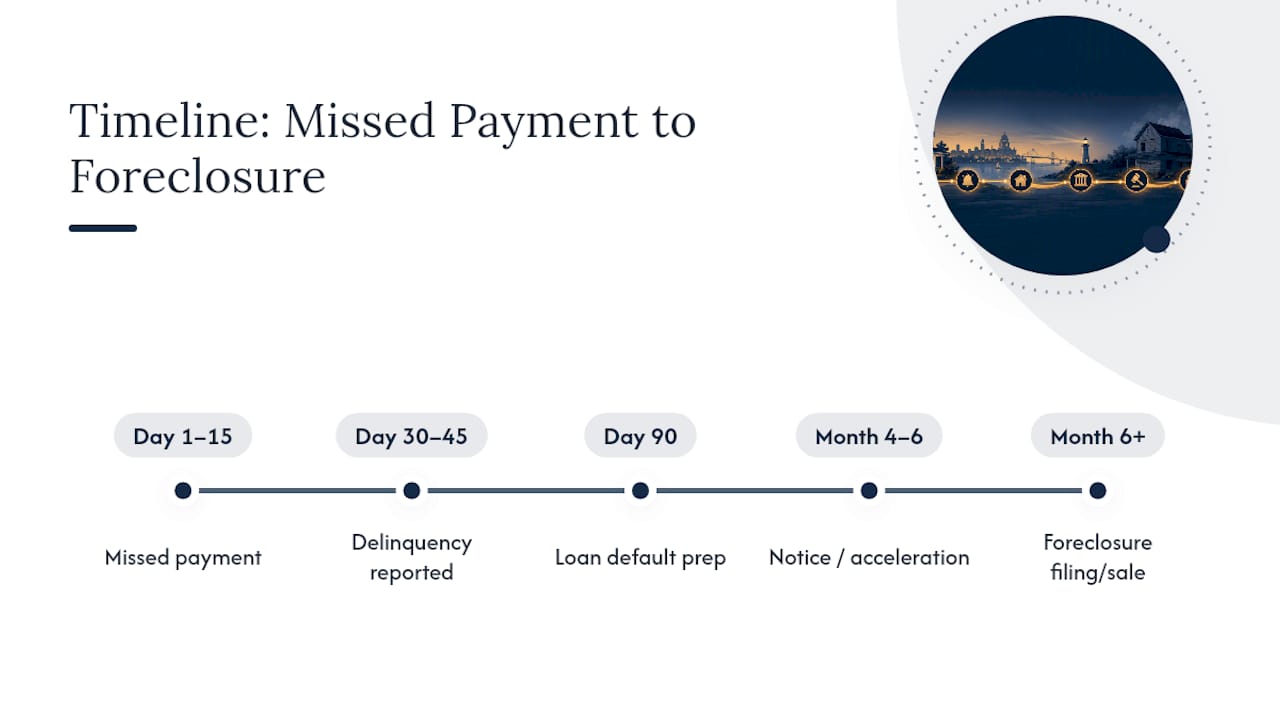
Day 1 to 15: You miss a payment. Most loans have a grace period before a late fee hits.
Day 30 to 45: The loan is reported delinquent. Your servicer typically starts calling and mailing notices, and this is when loss mitigation and HUD-approved housing counseling become available if you want to pursue that route.
Day 90: After three consecutive missed payments, most lenders classify the loan as default and begin preparing a formal notice.
Month 4 to 6: A notice of default or acceleration letter arrives, demanding the full balance or the start of legal proceedings.
Month 6 and beyond: Depending on whether your state uses judicial or non-judicial foreclosure, the lender files suit or schedules a sale. This stretch can run several more months before an auction date is actually set.
By the time an auction date is on the calendar, options narrow fast. A cash sale can still close before that date if you move quickly, but the earlier you start requesting offers and payoff figures, the more room you have to negotiate rather than scramble.
What Does Each Option Actually Cost You?
The sticker price isn’t the whole cost. Every path off a delinquent mortgage carries fees, time, and credit consequences that don’t show up until you’re already committed.
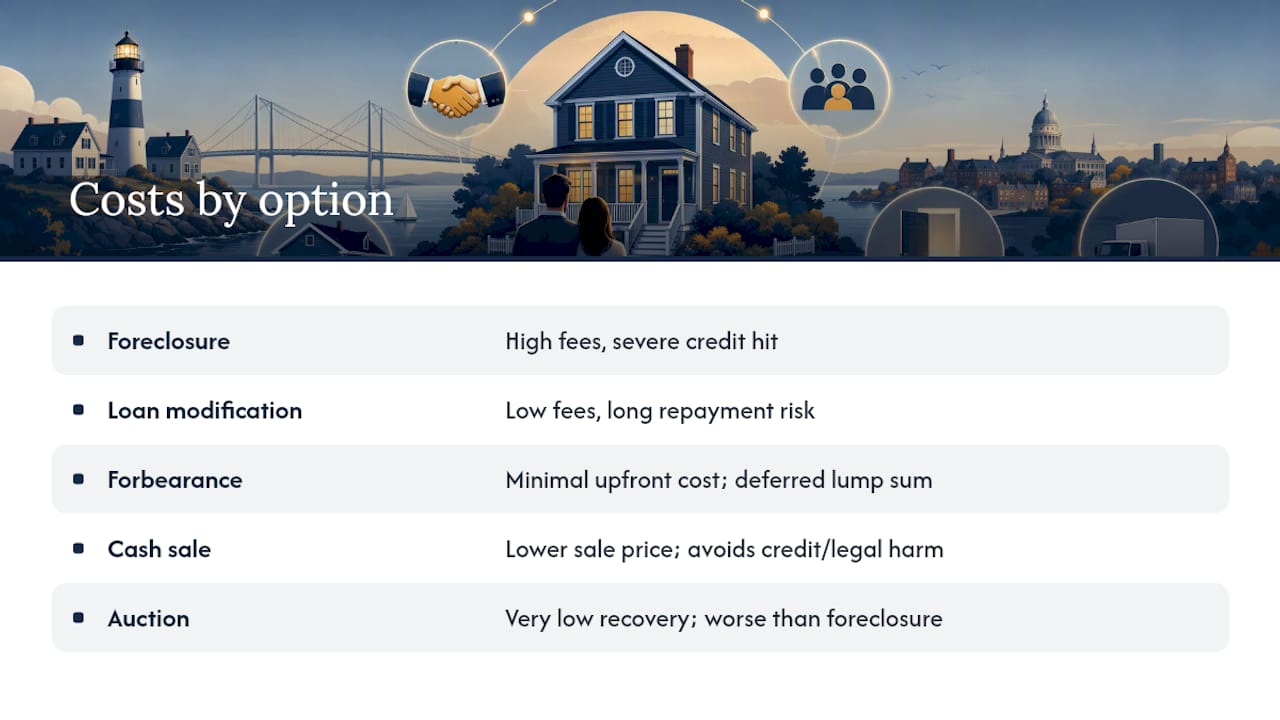
Completed foreclosure costs the most in every dimension. Legal fees, court costs, and accumulated late charges get added to your balance, and if the sale doesn’t cover the full debt, you can still owe a deficiency judgment in some cases. The credit hit is severe and can stay on your report for years.
Loan modification and repayment plans carry lower direct fees, often just administrative costs, but demand months of sustained payments you may not be able to guarantee. If you default again mid-plan, you’re back where you started, only later.
Forbearance has minimal upfront cost but defers the shortfall rather than eliminating it. Once the forbearance period ends, that missed amount comes due, often as a lump sum you need to have ready.
A cash sale costs you in price, not fees. You’ll likely net less than a financed, fully-marketed MLS sale would bring, but you avoid legal costs, avoid a completed foreclosure on your credit file, and walk away with cash in hand instead of a deficiency balance.
Weighed against an auction, where recovery is often far below market value, a cash offer that’s below retail can still outperform the foreclosure outcome on a dollars-and-cents basis, especially once you factor in what foreclosure does to your ability to borrow again.
How Do You Choose the Right Option for Your Situation?
The right answer depends on three honest questions, not a generic checklist.
How much time do you actually have? If an auction date is set or close to being set, loan modification review windows and repayment negotiations may simply take longer than you have left. A cash sale can close in the same window a lender takes just to review your paperwork.
Can your income realistically sustain a repayment plan? If the shortfall was temporary (a medical emergency, a short layoff) and your income has recovered, a repayment plan or modification might genuinely work. If the drop in income is permanent or ongoing, adding payments back on top of your regular bill just sets up the next default.
What does the house need, and do you want to fix it? A property needing a new roof, updated systems, or major cosmetic work is expensive to list traditionally. Selling as-is removes that burden entirely.
Ask yourself: would you rather spend the next several months negotiating with a lender for an uncertain outcome, or have cash and a clean exit in three weeks? There’s no universally correct answer, but for homeowners with a short runway, a cash sale usually wins on certainty alone.
How Should You Talk to Your Lender’s Loss Mitigation Team?
Even if you’re leaning toward a cash sale, contact your lender’s loss mitigation department early. It costs nothing and gives you the exact numbers you need either way.
Call and ask specifically for the loss mitigation or default resolution department, not general customer service. Request your current reinstatement amount in writing, including all late fees and legal costs accrued so far. Ask what the foreclosure timeline looks like specifically for your loan and your state.
If you want to explore lender-side options before deciding, HUD-approved housing counselors offer free or low-cost help understanding your paperwork and negotiating directly with your servicer. That counseling is free, and using it doesn’t cost you anything even if you end up selling.
Document every call: date, representative name, and what was said. Loss mitigation departments are large operations, and getting the same answer twice from different representatives is not guaranteed. A written payoff statement carries more weight than any phone conversation.
How Does Each Option Affect Your Credit and Future Borrowing?
Every route here shows up on your credit report differently, and the differences are bigger than most homeowners expect going in.
A completed foreclosure is one of the most damaging events a credit file can show, often dropping scores by well over 100 points and staying on the report for up to seven years. It also triggers a multi-year waiting period before you can qualify for another conventional mortgage.
Missed payments themselves, even before foreclosure, already report as 30, 60, and 90-day late marks that drag your score down month by month. The damage accumulates the longer the account stays delinquent, regardless of what happens next.
Loan modification typically shows up as a settled or modified account, which is less damaging than foreclosure but can still flag to future lenders that the loan wasn’t paid under its original terms.
A cash sale before foreclosure completes lets you pay off the mortgage in full. That stops new late marks from accumulating and avoids the foreclosure notation entirely, though any late payments already reported before the sale still remain on your file for their standard reporting period.
If preserving your ability to buy again soon matters to you, closing the loan out through a sale before foreclosure finalizes is the cleanest way to limit the damage.
Why a Cash Sale Is the Right Call for Urgent Situations
Most homeowners who reach out to us aren’t looking for the top possible price. They’re looking at a short window before an auction, a house that needs more repair work than they can afford, or they simply want the situation handled quietly without a “For Sale” sign advertising their finances to the neighborhood.
Some cash buyers build offers from ARV, and may work with a neutral title company so the payoff and closing numbers are clear on signing day. When time is the scarce resource, certainty beats chasing an extra few thousand dollars that might never materialize.
— Dave
Get a Cash Offer From Rhody Home Buyer This Week
Some cash buyers offer an alternative to negotiating with a lender or listing on the open market when you’re racing a foreclosure deadline. Instead of repair estimates, agent commissions, and weeks of showings, you may get a straightforward number based on your home’s After Repair Value, with no fees taken out of your proceeds.

Getting started takes three steps: request a written offer, share your mortgage payoff information so we can help you understand your net proceeds, and pick a closing date that works for your timeline, often as soon as seven to 21 days out. We handle the title work and lender payoff directly, so there’s nothing to coordinate on your end beyond signing. If you’re behind on payments and the clock is running, request your cash offer today and see the number in writing before you decide anything else.
Sources
- Pros and Cons of Selling Your House to Investors | Zillow
- Avoiding foreclosure (HUD)
- After repair value guide | ARVCalc
- How do we find out the mortgage payoff amount and the reinstatement amount? | Pierce Law
FAQ
How fast can I sell my house for cash in Rhode Island?
Most investor cash sales close in 7 to 21 days since there’s no lender appraisal or underwriting delay involved.
Will a cash offer be lower than my home’s market value?
Yes, typically. Investors calculate offers using ARV and the 70% rule, which builds in repair costs, holding costs, and profit margin.
Do I need a firm payoff statement before accepting an offer?
Yes. Late fees and legal costs accrue daily on a delinquent mortgage, so an outdated quote can leave you short at closing.
Can a cash buyer close before my foreclosure auction date?
In many cases, yes. Cash buyers often work toward closing dates as fast as seven to 21 days, though every timeline depends on your specific title and payoff situation.
Is a cash sale better than foreclosure for my credit?
Generally yes, since paying off the mortgage in full through a sale avoids the foreclosure notation, which can otherwise stay on your credit report for years.