
If you owe more on your mortgage than your home would sell for, you can still sell it. The shortfall does not disappear, though: it has to be paid at closing, forgiven by your lender in a short sale, or settled some other way. The fastest way to find your best route is to put real numbers on the gap, then take out every cost that makes it bigger. Agent commissions, repair bills and months of carrying costs all widen it. We buy Rhode Island homes for cash, as-is, with no agent fees, so you can see exactly what a sale would look like before you commit to anything.
TL;DR
- Negative equity means your mortgage payoff is higher than what the home is worth. The difference is your shortfall.
- Your main options are paying the gap yourself, a lender-approved short sale, a deed in lieu of foreclosure, or waiting until you break even.
- Rhode Island lets lenders pursue a deficiency judgment after a foreclosure sale if they file a lawsuit, so a written waiver matters in any shortfall deal.
- Commissions, repairs and delay all add to the gap. A cash, as-is sale with no agent fees removes several of them.
- If you are behind on payments, call a HUD-approved housing counselor early and never pay anyone upfront for foreclosure help.
Table of Contents
- What negative equity means when you sell
- How to calculate your real shortfall
- Your options when you owe more than the home is worth
- What Rhode Island adds to the picture
- Compare the routes side by side
- When a traditional listing is part of the picture
- Before you agree to any sale with a shortfall
- When waiting can make sense
- Our view on selling underwater
- Ready to see where you stand?
- FAQ
- Sources
What negative equity means when you sell
Home equity is the market value of your house minus everything you owe against it. When the result is below zero, you have negative equity. You will also hear it called an underwater or upside-down mortgage.
The cause is usually one of three things: prices in your area fell after you bought, you put little or nothing down, or you borrowed against the house through a second mortgage or home equity line. Falling prices are the most common trigger.
Here is the example Finder uses. A homeowner took out a $450,000 mortgage, the home’s value fell to $400,000, and $430,000 was still owed. That is $30,000 of negative equity. If the owner sells at that value, $30,000 is still left on the mortgage and has to be paid off.
How to calculate your real shortfall
The gap on paper is not the gap at the closing table. Work through these steps with your own figures.
- Get your payoff amount. Ask your servicer, the company you send payments to, for a written payoff statement. It includes interest accrued to the closing date and any late fees, so it is higher than the balance on your last statement.
- List every other lien. A second mortgage, home equity line or unpaid property tax lien also has to be satisfied or approved for release.
- Estimate a realistic sale price. Look at what similar homes nearby actually sold for, not what they were listed at. Be honest about your home’s condition.
- Subtract the costs of selling. On a traditional sale this means agent commissions, closing costs, any repairs a buyer asks for, and the monthly cost of carrying the house while it sits on the market.
- Compare. Net sale proceeds minus total payoff is your true shortfall.
A simple illustration: your payoff is $310,000 and similar homes sell for $295,000. On paper you are $15,000 underwater. List with an agent, add commissions, closing costs and a few thousand dollars in repairs, and the real gap can be far larger. The more of those costs you can remove, the smaller the check you need to write, or the smaller the loss you ask a lender to absorb.
Your options when you owe more than the home is worth
Sell for cash, as-is, and keep the costs down
A direct cash sale to a home buyer is the simplest route for many owners because it targets the costs, not the debt. There is no agent on the other side, so no commission. The house is bought as-is, so no repairs, no cleaning and no waiting for a buyer’s financing to clear. Closing can happen on your timeline, which matters when payments are piling up.
Our offers are based on the After Repaired Value, the value the home would have once fixed up. Because you are not paying to get the house ready, you are not spending money to reach that number. If you want to see how your numbers compare, you can request a cash offer and then set it against your payoff statement.
Be clear-eyed about what a sale does and does not do. Whoever buys the house, the mortgage still has to be satisfied at closing, either from the proceeds plus money you bring, or through an arrangement your lender approves. That is why the calculation above comes first.
Pay the difference yourself
If you can cover the shortfall from savings, or with a personal loan, you can sell on the open market and close normally. Finder lists this alongside the other main routes: a short sale, paying the difference out of pocket or with a personal loan, letting the bank foreclose, or a deed in lieu of foreclosure. Paying the gap protects your credit best, but it needs cash most owners in this situation do not have. Think hard before draining retirement savings to do it.
Short sale
In a short sale, the home sells for less than the mortgage balance, and the lender agrees to accept the proceeds. The Consumer Financial Protection Bureau (CFPB) describes it as a form of loss mitigation: you find the buyer, your servicer has to approve the sale, and any other mortgage holders must approve and forgive their balances too.
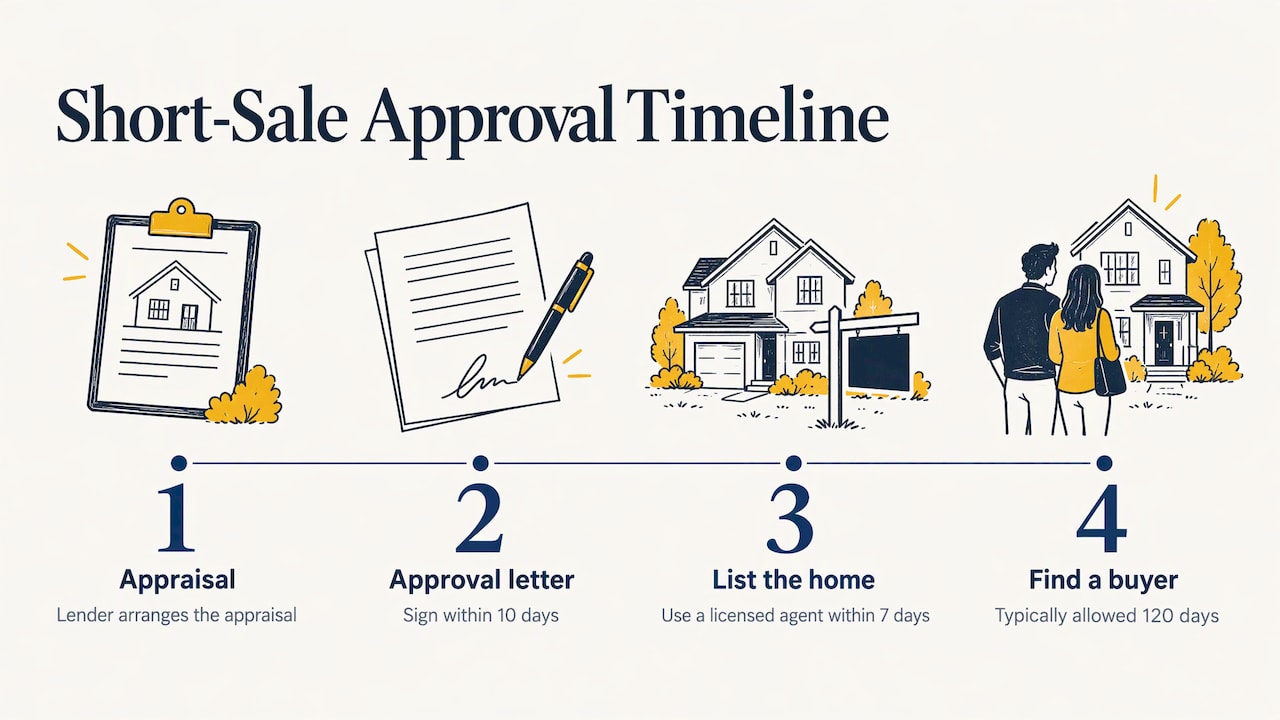
A short sale is not a fast process. As one example, a major servicer’s FHA short sale program says the lender arranges an appraisal, sets a minimum price in an approval letter that must be signed within 10 days, requires the home to be listed with a licensed agent within 7 days, and typically allows 120 days to find a buyer, according to Bank of America’s FHA short sale page. That means agent fees and months of waiting are built in.
The approval step is also where the gap can come back. Investopedia explains that the lender may forgive the remaining balance or pursue a deficiency judgment, a court order to pay all or part of the difference. The CFPB advises asking the lender to waive the deficiency and getting the waiver in writing before closing.
Fannie Mae’s fact sheet adds that when it owns the loan and a short sale is completed, the borrower is relieved of responsibility for any remaining balance. The same sheet notes the borrower may qualify for $7,500 in relocation help or be asked to make a financial contribution. Terms depend on who owns your loan, so ask your servicer.
Deed in lieu of foreclosure
With a deed in lieu, you hand ownership of the home to the lender and move out without selling it. The CFPB notes that if you qualify, no deficiency may have to be paid, and options like this are typically less expensive and faster than foreclosure, with less credit damage. Finder points out that a deed in lieu can still hurt credit as much as a foreclosure, but you may be able to negotiate a longer move-out period or cash to help you relocate.
Let the lender foreclose
This is the option with the highest cost. Finder says a foreclosure damages credit for seven years and likely blocks a new mortgage during that time. It also can leave you open to a deficiency claim, which brings us to Rhode Island’s rules.
What Rhode Island adds to the picture
Rhode Island lenders can sell a home through a power of sale clause in the mortgage, without going through court first. According to a Nolo summary of Rhode Island foreclosure law, a deficiency judgment is allowed after that kind of foreclosure if the lender files a lawsuit, and there is no right to redeem the home after the sale. The same source notes the state does not give you a right to reinstate the loan to stop a foreclosure, although some mortgage contracts allow it.
In plain terms: waiting for the foreclosure sale does not guarantee the debt goes away, and it takes away your say over the timing and the price. Selling before that point keeps the decisions in your hands. If a sale date is already set, our guides on how to stop a foreclosure auction in Rhode Island and on pre-foreclosure options in Rhode Island walk through the timeline.
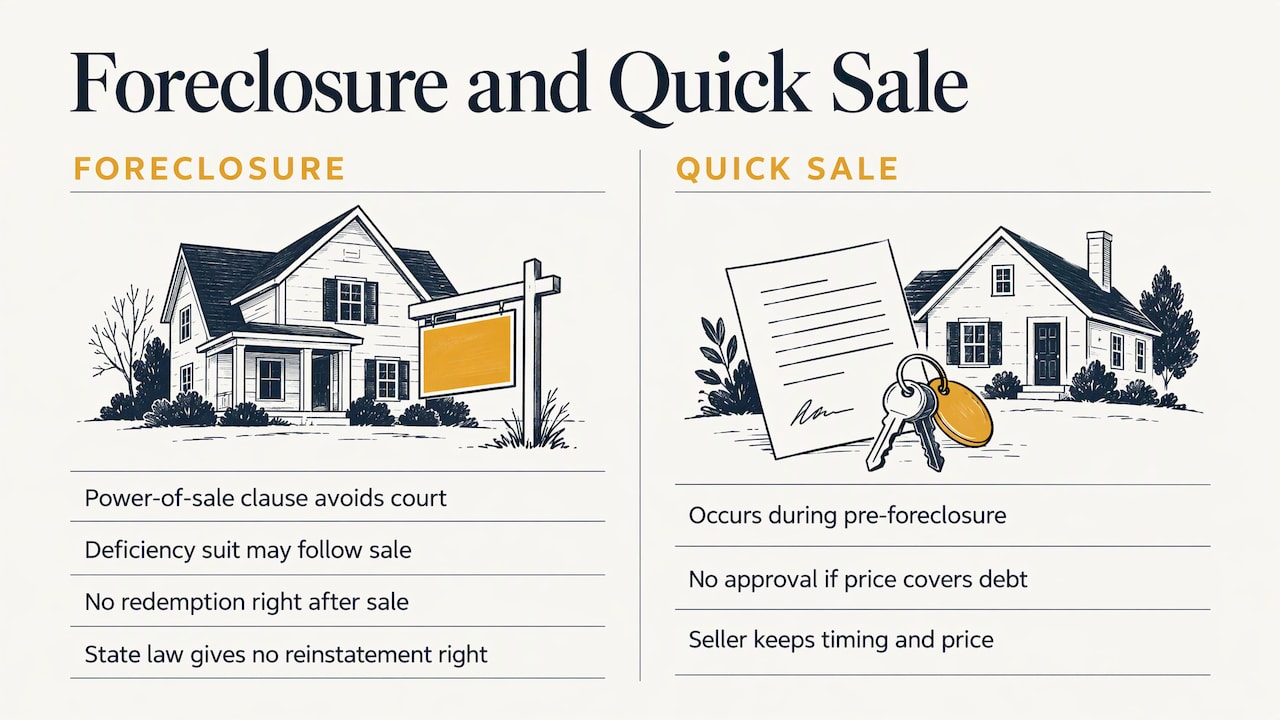
Freddie Mac’s guide describes a quick sale, sometimes called a fast sale, as a sale during the pre-foreclosure period, often at a steep discount. Unlike a short sale it does not require lender approval as long as the home is not sold for less than what is owed. That makes the payoff figure the number everything else hangs on.
Compare the routes side by side
| Route | Agent fees | Repairs needed | Lender approval | Speed | Main risk |
|---|---|---|---|---|---|
| Cash sale as-is to a direct buyer | None | None | Payoff still has to be settled at closing | You choose the closing timeline | Shortfall, if any, must be covered |
| Traditional listing | Yes | Often | Not if the price covers the payoff | Depends on the market and buyer financing | Costs and delay widen the gap |
| Short sale | Yes | Often | Required | Slow, with long approval steps | Deficiency if no written waiver |
| Deed in lieu | None | None | Required | Depends on the lender | Credit damage, may not be offered |
| Foreclosure | None | None | Not applicable | Set by the lender | Deficiency judgment, seven years of credit damage |
When a traditional listing is part of the picture
Some owners ask whether listing the usual way will net more. It can, if the home is in good shape and you have time. The cost is that everything a buyer finds becomes a negotiation. Roof condition is a typical example, and a roof inspection for sellers shows what a buyer’s inspector may flag before you list. When you are already underwater, each repair credit comes straight out of your pocket. Selling as-is for cash takes that whole negotiation off the table.
Before you agree to any sale with a shortfall
These steps keep a hard situation from getting worse.
- Call your servicer first. The CFPB says you do not need servicer approval to sell a home that is worth more than the mortgage, but notifying them helps. If the sale will fall short, their approval is required.
- Talk to a HUD-approved housing counselor. The CFPB recommends one for planning next steps in a short sale. Counseling is free. Freddie Mac warns that no mortgage company or HUD-certified counselor should ever charge a fee for foreclosure-avoidance help, and says suspected scams can be reported to 1-888-995-HOPE (4673).
- Get any deficiency waiver in writing. A verbal promise is not enough. If a lender will not waive the balance, see a Rhode Island real estate or bankruptcy attorney before you sign.
- Ask about the tax side. Forgiven mortgage debt can count as taxable income in some cases. A tax professional can tell you how it applies to your year and situation.
- Ask about relocation help. The CFPB suggests asking about relocation assistance through private cash-for-keys programs.
- Plan for the next mortgage. Credit and waiting periods differ by loan type and by how the house was exited, so ask a lender what applies to you before you choose a route.
When waiting can make sense
Sometimes the best sale is a later one. Finder says that in most cases it is better to keep the property and wait until you break even or build equity, by paying down the mortgage, looking at a refinance, or renting the home out. Taking the loss can be better if repairs are unaffordable or the home’s condition is getting worse.
The question is whether you can keep making payments while you wait. If you are current and the house is stable, time can help. If you are falling behind, have inherited a house you cannot afford to carry, or lost your income, the monthly cost of waiting is itself a loss. Our guide on selling after a job loss in Rhode Island and our piece on whether to sell your house to pay off debt cover those decisions in more detail.
Our view on selling underwater
Most of the homeowners who call us about negative equity are not asking how to make money on the house. They want to stop the bleeding.
What we see in that situation is that the sale price is only half of it. Commissions, repairs, cleaning, showings and months of carrying costs are the other half, and they are the part an owner can control. A direct, as-is cash sale takes those off the table. We do not charge agent fees or commissions, and you do not have to fix or clean anything.
Our offers are based on the After Repaired Value, and we close on your timeline, not ours. Whether you are in pre-foreclosure, dealing with an inherited house, or just tired of watching the balance outrun the value, we think you should have the full picture before you decide. Put your payoff next to an offer and see where you stand.
Dave
Ready to see where you stand?
If you own a home in Rhode Island or Eastern Connecticut and want to know what a cash sale would look like, we will buy it as-is: no agent fees, no commissions, no repairs and no cleaning, with closing on the timeline that works for you. Share the address and your situation on our cash offer page, and compare the result with your payoff statement. You can also read how our process works first.

If a foreclosure date is already on the calendar, start with our page on how to avoid foreclosure, because the options narrow as the date gets closer.
FAQ
What happens if you sell a house with negative equity?
The sale proceeds go to your lender, and you are still responsible for the difference between the payoff and the sale price. You can pay it at closing from savings or a loan, or ask the lender to approve a short sale. In a short sale, get any forgiveness of the remaining balance in writing.
Can I sell my house for less than I owe on the mortgage?
Yes, but only with your lender’s agreement. A short sale requires servicer approval, and any other lienholders must approve too. Without that approval, the sale price plus any money you bring has to cover the full payoff.
How do I get out of negative equity?
There are two routes: close the gap or exit the loan. Closing the gap means paying down principal, refinancing if you qualify, or waiting for values to rise, sometimes while renting the home out. Exiting means a sale, a short sale or a deed in lieu. Cutting selling costs such as commissions and repairs makes any exit cheaper.
Is a cash sale possible when I have no equity?
Yes. A cash sale works on the same math as any other: the payoff has to be settled at closing. What changes is the cost side. With no agent commission, no repairs and no cleaning, less of the sale price is consumed before it reaches your lender. We can look at your home and give you an offer to compare with your payoff.
Sources
- Finder: Selling your house for less than you owe
- CFPB: Avoid foreclosure
- CFPB: What is a short sale?
- Investopedia: What Is a Short Sale on a House?
- Bank of America: FHA Short Sale
- Fannie Mae: Helping borrowers avoid foreclosure
- Freddie Mac: Selling Your Home to Avoid Foreclosure
- Freddie Mac My Home: Options to leave your home
- Nolo: Foreclosure Process and Laws in Rhode Island