
Selling your house to pay off debt makes sense when the money left after your mortgage and every selling cost is enough to clear the debt and still pay for your next place to live. If the sale leaves you short, or the mortgage is not what is holding you back, it solves less than it seems to. The way to know is to run the numbers before you list. If you are in Rhode Island or Eastern Connecticut and want a straight answer on what a sale would net you, Rhody Home Buyer buys homes as-is for cash, with no agent fees or commissions and no repairs or cleaning.
TL;DR
- Selling works when net proceeds (price minus mortgage, liens and all selling costs) cover your target debt and your next housing.
- If you owe more than the house is worth, a sale will not produce cash for other debts, and a deficiency can follow.
- Compare options first: a deferral, a modification or a refinance can sometimes keep the home, and a HUD-approved counselor will walk you through them for free or very little.
- If you are behind on the mortgage, act early. Selling before foreclosure can protect equity and your credit.
- A direct cash sale removes agent fees, repairs and cleaning from the math, which raises what you keep.
Table of Contents
- The quick test: does a sale actually clear the debt?
- What comes off the top before you see a dollar
- When selling to pay off debt makes sense
- When it can make things worse
- Options to look at before you decide
- Should you fix the house first?
- A step-by-step way to decide
- Where a cash sale fits
- Our perspective
- FAQ
- Sources
The quick test: does a sale actually clear the debt?
Start with one number: what you would walk away with. MoneyLion advises calculating net proceeds after paying off the mortgage and every selling cost, then comparing what remains with the debt you want to eliminate. If that figure covers the debt and leaves room for housing afterward, selling is worth a serious look.
The key concept is equity. Fannie Mae defines equity as the amount by which your home’s market value exceeds what you owe on the mortgage and any other debts secured by the home. The same page says that with equity, a sale can pay off the mortgage and let you keep the remaining funds, which can go toward new housing, other expenses or savings.
Here is a simple worked example. These are made-up figures to show the method, not a forecast for your home.
| Line | Amount |
|---|---|
| Expected sale price | $380,000 |
| Mortgage payoff | $255,000 |
| Other liens (for example, a home equity loan) | $20,000 |
| Agent commission and closing costs | $27,000 |
| Repairs, cleanout and moving | $9,000 |
| Left over | $69,000 |
| Credit cards and personal loans to clear | $48,000 |
| Remaining for next housing | $21,000 |
The sale clears the debt, but only $21,000 is left to start over, and rent or a smaller purchase will have its own deposit and monthly cost. That last line is the one people forget.
What comes off the top before you see a dollar
U.S. News points out that selling costs reduce your overall profit, so you need an estimate before you decide. HouseResolve defines net proceeds as the sale price minus mortgage and lien payoffs, commissions, closing charges, buyer credits, repairs or preparation, cleanout, moving and holding costs. Walk down that list for your own house.
- Mortgage payoff. Ask your servicer for a payoff statement. It will differ from the balance on your last statement because of accrued interest and any fees.
- Other liens. A second mortgage, a home equity line, a tax lien or a judgment lien must be paid at closing.
- Commissions and closing costs. On a traditional listing this is usually the largest line after the mortgage.
- Rhode Island conveyance tax. The seller generally pays it. The Rhode Island Division of Taxation sets it at $3.75 for each $500 of consideration, including liens remaining at transfer, with an additional tier above a statutory threshold. On a $380,000 sale that base rate is about $2,850.
- Repairs and prep. Painting, cleaning, a roof patch, a cleanout. These are the costs a traditional sale pushes onto you.
- Holding costs. Mortgage payments, taxes, insurance and utilities while the house sits on the market.
If you are behind on payments, add the fees the servicer has stacked on the loan. The CFPB notes that late charges, title fees, property maintenance charges and legal fees can all reduce proceeds, and that a completed foreclosure cost homeowners about $12,500 on average (in 2021 dollars). Those are costs a timely sale can avoid.
When selling to pay off debt makes sense
Selling tends to work in a few clear situations.
- You have real equity. U.S. News says a sale can make sense when you have enough equity and the market supports a profitable result.
- The house itself is the problem. Ramsey’s guidance, summarized in the U.S. News piece’s research, is that selling to knock out debt generally makes sense when the mortgage is too expensive to let you make progress, or you were already planning to move. If the mortgage payment takes more than about 30% of your income, a smaller or cheaper home can free cash every month. Compare it against your own budget rather than a rule of thumb.
- You are heading toward foreclosure and have equity. The Georgia Attorney General’s consumer guidance says selling before default can work if the proceeds cover the full loan balance and all selling expenses. The Washington Department of Financial Institutions says a pre-foreclosure sale can let you pay off the mortgage, avoid foreclosure and credit damage, and keep some equity. Those are state pages, but the logic of equity applies the same way in Rhode Island.
- You inherited a property you cannot afford to carry, or a house that needs more work than you can fund.
- A job loss or income drop has made the payment unsustainable. Our guide to selling a house after a job loss in Rhode Island covers that situation.
When it can make things worse
Be honest about three situations.
You owe more than the house is worth. U.S. News explains that if you are upside-down, a sale will not generate funds to pay off your debt. If the price will not cover the mortgage, you are looking at a short sale. The CFPB defines a short sale as a sale for less than what is owed on the mortgage, and notes that because it is a sale, you must leave the home. It needs your lender’s agreement.
You might still owe the difference. An attorney writing for Nolo explains that a deficiency judgment lets a lender collect the gap between the debt and the sale price, and the same concept can arise after a short sale or deed in lieu. If you are in this position, get the lender’s release of the balance in writing and talk to a real estate attorney before you sign. The Washington Department of Licensing says all agreements with your lender should be in writing and that you should confirm who has authority to agree.
The mortgage is not the real issue. If your mortgage is affordable and the debt sits in cards or medical bills, selling your home swaps a low-cost, secured payment for rent or a new mortgage at today’s prices. Compare the monthly cost of your next home, not just the debt you clear.
Also keep in mind that once you sell you still need somewhere to live. U.S. News names downsizing to a more affordable home or renting as the usual routes, and a Washington decision checklist makes the same point: confirm you have stable housing before you sell.
Options to look at before you decide
Selling is one tool, not the only one. The CFPB says a payment deferral, a standalone partial claim or a loan modification is often preferred when you are behind, and that a traditional sale is a strategy when those or other home-retention options are unaffordable. It adds that servicers must reach out to delinquent borrowers about loss-mitigation options under Regulation X.
A refinance can also lower a payment or consolidate costs. If you want to see how a lower rate or shorter term would change your balance, you can pay off your mortgage faster by running a payoff comparison against your home’s value and liens. Treat that as a way to compare your equity before you commit to a sale.
If you are behind, talk to a HUD-approved housing counselor early. HUD materials say earlier counseling broadens your options, and counselors can assess your finances, explore options, talk to your lender and help negotiate. HUD-funded counseling is free or very low cost nationwide. Bankruptcy is another path with its own rules for a home sale, which we explain in selling a house during bankruptcy in Rhode Island, and a bankruptcy attorney should guide that decision.
Beware of anyone who promises to rescue your house for an upfront fee. The Washington Department of Licensing warns about predatory foreclosure rescue scams, so confirm every agreement is in writing before you sign.
Should you fix the house first?
A common question is whether to put money into repairs before selling. Run it as arithmetic. Get a repair estimate, estimate what the repaired house would sell for, and subtract the cost of the work, the carrying costs while you do it, and the extra weeks on the market. If the gain does not clearly beat all three, the repairs are not paying for themselves. When you are already behind on payments or short on cash, every month of renovation also adds mortgage interest, taxes and insurance.
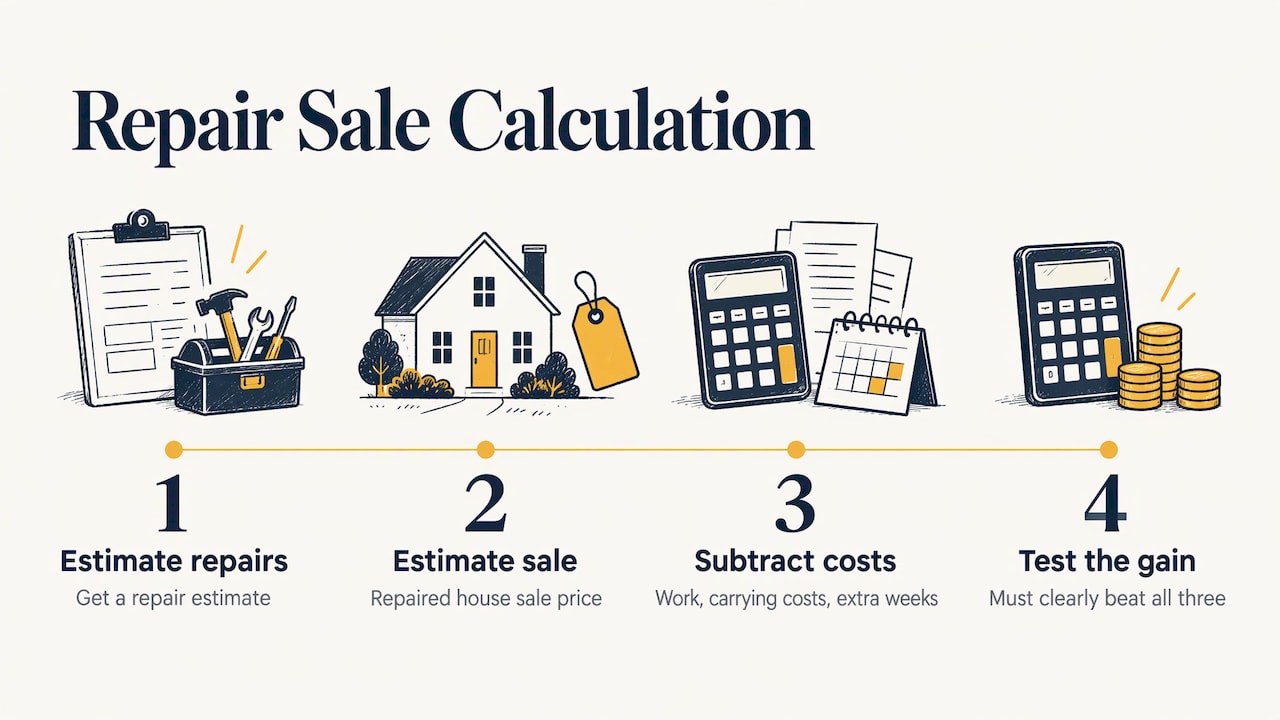
This is where selling as-is changes the picture. A buyer who purchases in current condition removes the repair budget, the cleanout and the staging from your side of the ledger. Our page on what you can skip when selling without cleaning lists what Rhode Island sellers do not need to do.
A step-by-step way to decide
- Get a realistic value. Use recent sales of similar homes nearby, and consider an offer from a direct buyer as one data point.
- Request payoff statements for the mortgage and every lien.
- Build the net proceeds table using the lines above, including the Rhode Island conveyance tax.
- List the debts you want to clear and their interest rates. Pay highest-rate debt first.
- Price your next housing. Rent or a smaller purchase, deposit included, and the monthly cost compared with today.
- Compare with the alternatives a servicer or counselor can offer if you are behind.
- Decide on timing. If an auction date is set, the calendar may decide for you. See how to stop a foreclosure auction in Rhode Island and our overview of pre-foreclosure options.
If step 3 leaves a comfortable cushion, sell. If it leaves a gap, change the plan before the house goes on the market, not after.
Where a cash sale fits
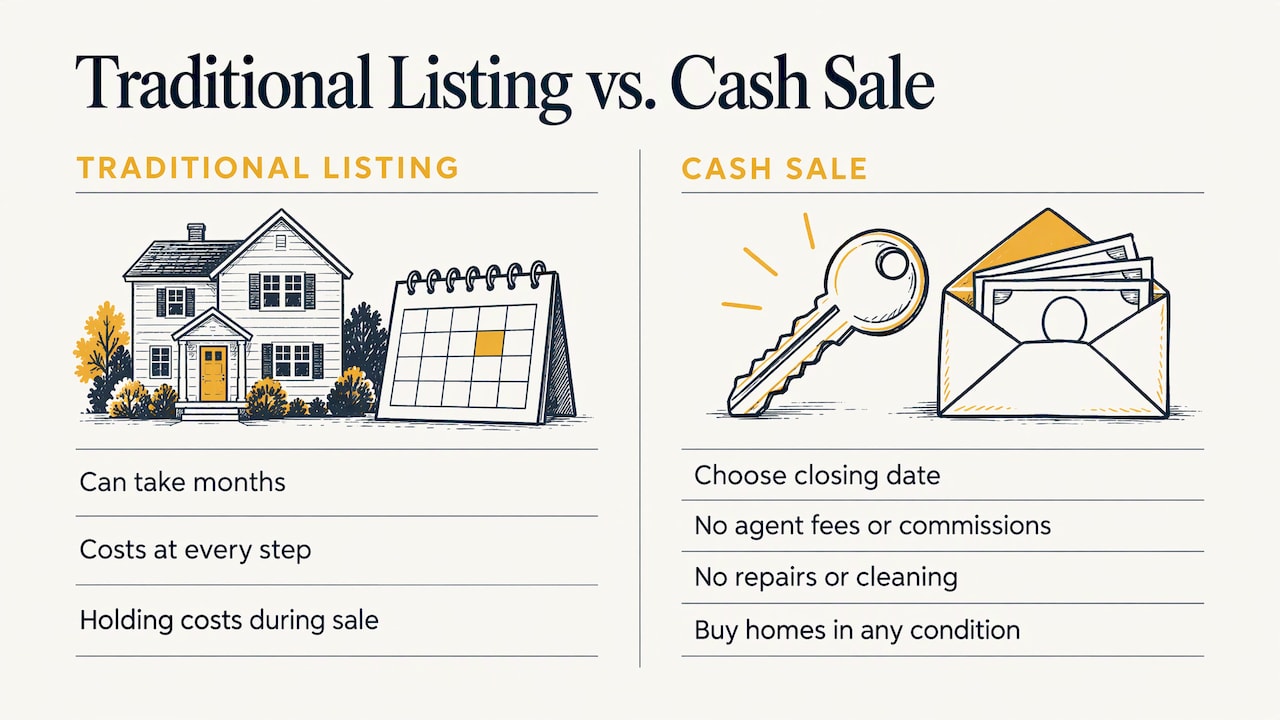
A traditional listing can take months and costs money at every step, which is the opposite of what a stressed budget needs. Rhody Home Buyer purchases homes directly for cash in Rhode Island and Eastern Connecticut, in any condition. There are no agent fees or commissions, no repairs or cleaning, and you choose a closing date that works for you. Our offers are based on the After Repaired Value of the home.
For your calculation, that means the lines for commission, prep, cleanout and months of holding costs can shrink or disappear, so more of the sale price reaches your debt payoff. If you are behind on payments, the page on options when you are behind on your mortgage explains how a direct sale fits. You can also read how a cash home sale works or request an offer and use the number in your net proceeds table.

Our perspective
We talk with Rhode Island homeowners who are sitting on a house and a pile of bills at the same time. The first thing we do is the same arithmetic you just read: price, payoff, liens, costs, what is left.
What we hear most is that people fear the sale will cost more than it brings in. That is usually a question of how the sale happens. A traditional listing stacks commissions, repairs, cleaning and months of payments on top of each other. Buying as-is for cash takes those out, and you pick the closing date.
Our approach is to be clear about the number and the timeline, and never to pressure anyone. If selling is right, we want you to leave with the most possible and no surprises. If you are behind on payments, sooner is better, because more options remain open.
Dave
FAQ
What happens if I sell my house and still owe money?
The sale proceeds go to the mortgage and liens first. If they fall short, the lender may seek the difference. Nolo explains that a deficiency judgment can follow a foreclosure, and the same concept can arise after a short sale if the lender does not release the balance. Get any release in writing.
Is it smart to sell my house to get out of debt?
It is smart when net proceeds clear the debt and still fund your next housing at a monthly cost you can carry. It is a weaker move if the mortgage is affordable and the debt is elsewhere. Do the net proceeds math first.
Can I sell my house if I’m behind on the mortgage?
Yes. If you have equity, selling before foreclosure can pay the loan in full and leave you the remainder. Contact your servicer and a HUD-approved counselor early, and move quickly if a sale date has been set.
How fast can I sell to pay off debt?
That depends on the buyer. A traditional listing depends on showings, buyer financing and inspections. A direct cash purchase lets you choose a closing timeline, so you can match it to your deadline.
Sources
- Mortgage options to leave your home | Fannie Mae
- Should I Sell My Home to Pay Off Debt? | U.S. News
- Should You Sell Your House to Pay Off Debt? | MoneyLion
- Home Sale Net Proceeds Calculator and Seller Cost Guide | HouseResolve
- Real Estate Conveyance Tax | Rhode Island Division of Taxation
- For many struggling mortgage borrowers with home equity, selling could be an alternative to foreclosure | CFPB
- Selling your Home | Georgia Consumer Ed
- Foreclosure Assistance and Information | Washington DFI
- What is a short sale? | CFPB
- Deficiency Judgments and Foreclosure | Nolo
- Short Sale Seller Advisory | Washington Department of Licensing
- HUD-funded housing counseling | MY FCI