
Yes, a Rhode Island house that is tied to a Medicaid claim can be sold. The claim does not have to stop the sale. It has to be dealt with. The state’s Executive Office of Health and Human Services (EOHHS) can recover Medicaid costs from a deceased beneficiary’s estate. When the main asset is a house, that usually means the property is sold or otherwise liquidated and the claim is settled before the heirs receive anything. This guide explains when the lien applies, who is protected, what the paperwork looks like and how a cash sale can fit in.
TL;DR
- Rhode Island’s Medicaid lien applies to property in the probate estate of a deceased person who received Medicaid at age 55 or older. It does not attach while the beneficiary is alive.
- No lien applies if the beneficiary is survived by a spouse, a child under 21, or a child who is blind or permanently and totally disabled.
- EOHHS must give notice 30 days before it records a lien. After the claim is paid, or the remaining estate assets are paid as the rules require, EOHHS issues a discharge.
- Skipping notice to EOHHS in a probate case can freeze all distributions and make heirs personally liable up to what they received.
- We buy houses as-is for cash across Rhode Island and can close on your timeline, so a sale does not wait on repairs or a listing.
Table of Contents
- What a Medicaid lien on a house actually is
- When Rhode Island can place a lien on a home
- Who is protected
- Can you sell a house with a Medicaid lien?
- How the amount is determined and paid
- From notice to clear title: the steps
- What happens if no one tells EOHHS
- Our perspective
- When a cash sale fits
- Related situations we see often
- Mistakes that cost families money
- FAQ
- Sources
What a Medicaid lien on a house actually is
A Medicaid lien is a recorded claim against real estate. It tells title examiners, buyers and lenders that the state has a right to be repaid from the property before clear title can pass. In Rhode Island this is tied to estate recovery, the state’s process of seeking repayment for Medicaid benefits paid on someone’s behalf.
The two terms are related but not identical. Under Rhode Island’s rules on liens and recovery of Medicaid, a lien attaches at death to property included or includable in the decedent’s probate estate. EOHHS separately decides how much it can recover, based on the decedent’s resources and the assistance that can be recovered. A lien against real property is effective only after proper prior notice and recording in the land evidence records.
In plain terms:
- Estate recovery is the state’s right to be repaid.
- The lien is the recorded tool that protects that right against a specific parcel.
- The discharge is the document that removes the lien once the claim is resolved.
This follows a federal framework. Federal Medicaid policy requires states to recover, at a minimum, from assets that pass through probate, and states may choose a broader definition of an estate. So the details differ by state, and Rhode Island’s own rules are the ones that matter for your house.
When Rhode Island can place a lien on a home
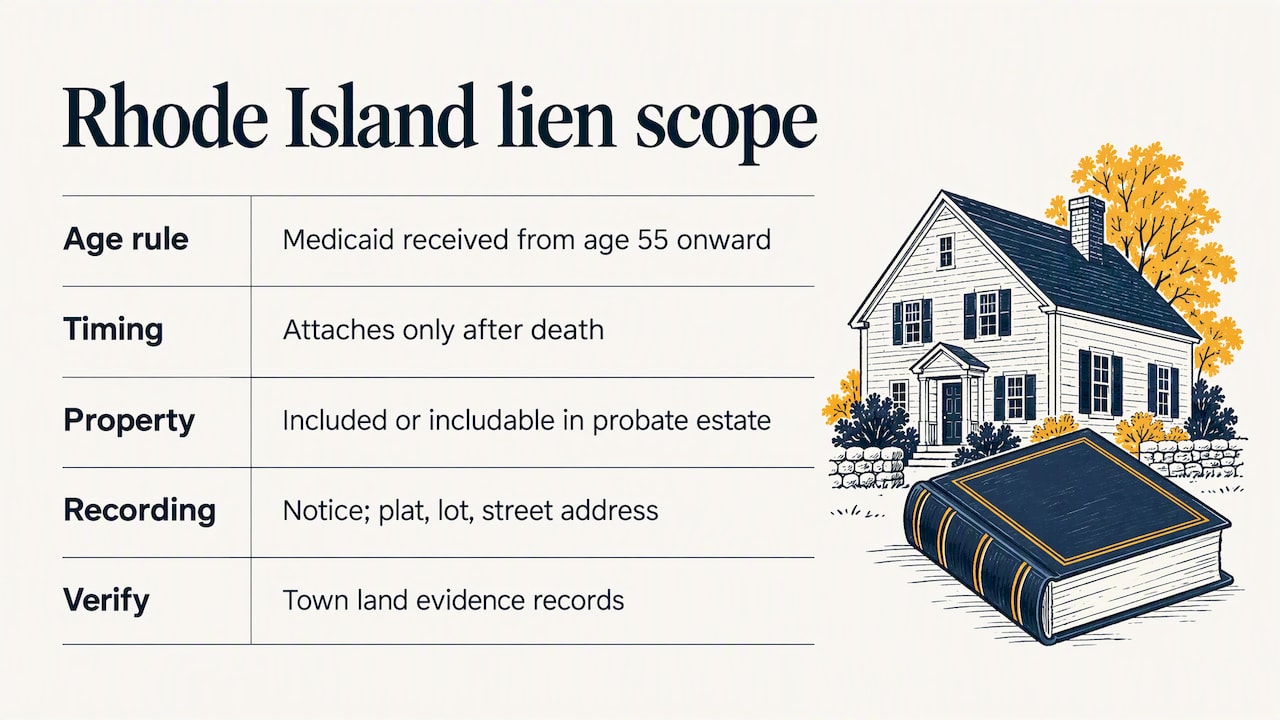
The rules are narrower than many families fear. According to the state regulation, the lien applies to property included or includable in the probate estate of a deceased beneficiary who received Medicaid at age 55 or older. The lien covers Medicaid received from age 55 onward.
Three practical points follow.
It is a claim after death. The lien does not attach during the beneficiary’s lifetime. A living homeowner on Medicaid is not forced to sell because of this lien.
It follows probate property. If the house sits in the probate estate, it is within reach. If it passes outside probate, it is outside the lien process (more on that below).
It needs notice and recording. For a lien to attach to real property, a statement of claim must be recorded in the land evidence records and must describe the property by tax assessor’s plat and lot and street address. If you are researching a specific house, the town’s land evidence records are where you confirm whether a lien has actually been recorded.
Who is protected
The lien does not apply if the Medicaid recipient is survived by any of the following, per the Rhode Island regulation:
- a spouse
- a child under 21
- a child who is blind or permanently and totally disabled
If one of these people survives, the lien process does not proceed in the same way. Confirm which situation you are in before assuming a claim exists. Families sometimes spend weeks worrying over a claim that the rules do not allow.
Property that passes outside probate
Property that passes by operation of law, to beneficiaries under a contract, deed, trust agreement or insurance policy, or otherwise without probate is excluded from Rhode Island’s lien process. How a house is titled matters a great deal. Whether a particular deed, trust or survivorship arrangement qualifies is a legal question about your documents. A Rhode Island elder law or probate attorney should read them before you decide anything.
Can you sell a house with a Medicaid lien?
Yes. The rules expect that estate property may be sold. EOHHS may require the sale or liquidation of non-liquid estate assets, and a house is the classic non-liquid asset. After payment in full, or payment of the remaining estate assets after the specified preferences and court-approved expenses, EOHHS issues a discharge of lien.
That sets the order of events for a sale:
- The estate is opened and EOHHS is notified.
- EOHHS provides its accounting of Medicaid expenditures.
- The house is sold by the personal representative, with court approval where required.
- The claim is paid from the proceeds, after the statutory preferences and court-approved expenses.
- EOHHS issues the discharge, and the buyer’s title is clear.
If the house is worth more than the claim, the heirs receive what remains once the estate’s other obligations are met. If the claim is larger than the estate’s remaining assets, the rules speak of payment of the remaining estate assets, which is the point of the preferences and expenses language. The exact priority order and your numbers are matters for the estate’s attorney.
How the amount is determined and paid
EOHHS provides an accounting of Medicaid expenditures and requests reimbursement from the remaining estate assets after statutory preferences and court-approved expenses. The lien covers only Medicaid received from age 55 onward.
Here is how to use that in practice:
- Ask for the accounting in writing before you list or accept any offer. You need the real number, not an estimate from a relative.
- Check what comes ahead of the claim. Court-approved expenses and statutory preferences can reduce what is left for reimbursement.
- Build the number into your net proceeds. A sale price is not what the estate keeps. Compare offers on net proceeds after the claim, taxes, liens and costs. Our page on comparing cash offers with financing shows how to line them up.
Coordinate payoff timing with the estate’s attorney and the closing agent so the discharge is requested as soon as the claim is satisfied.
From notice to clear title: the steps
Here is the sequence for a probate estate when the decedent was 55 or older at death.
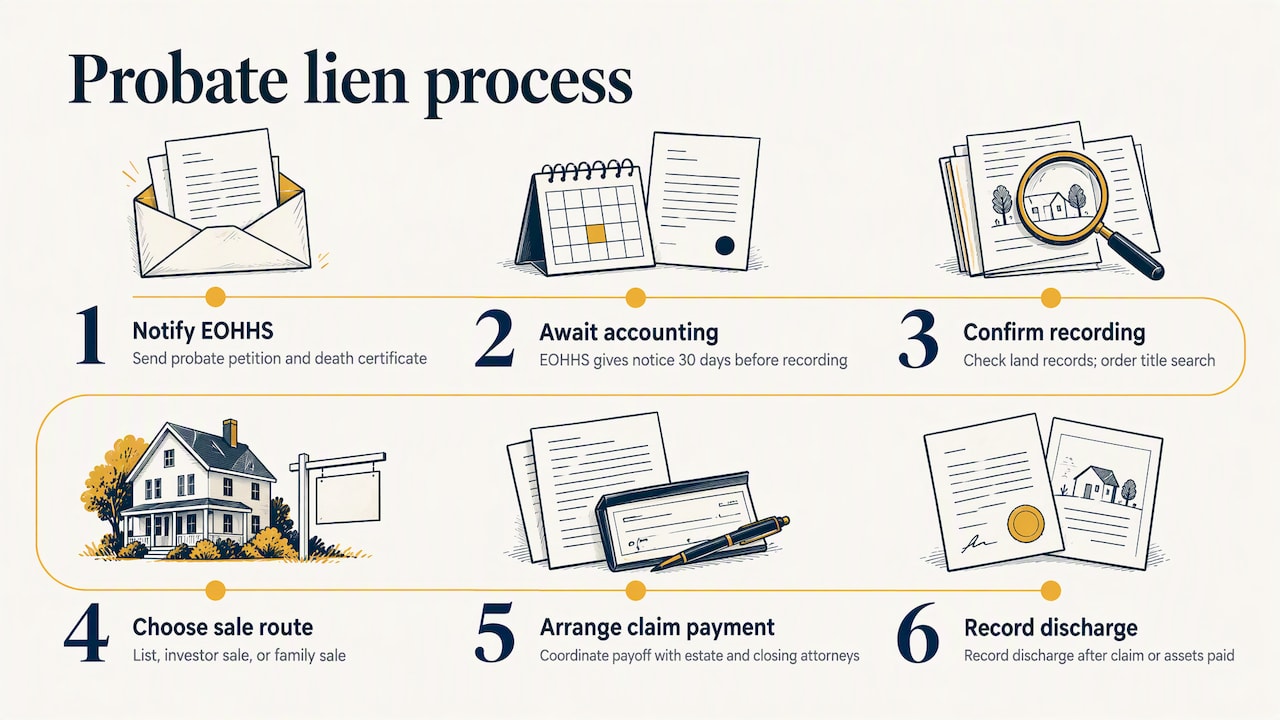
Step 1: Notify EOHHS. Send EOHHS a copy of the probate petition and the death certificate. Per the regulation, probate notices go to the EOHHS Legal Office, Virks Building, 3 West Road, Cranston, RI 02920. A state summary of the statutory changes confirms that probate petitions and death certificates are sent to the Legal Office in Cranston.
Step 2: Wait for EOHHS’s accounting and notice. EOHHS must send notice of the lien 30 days before recording it.
Step 3: Confirm the recording. A real-property lien takes effect only after prior notice and recording in the land evidence records, with the plat, lot and street address described. Order a title search so no one is surprised by what is, or is not, on record.
Step 4: Decide how to sell. The personal representative can list the house, sell to an investor, or sell to a family member. Any buyer will want the title issues closed.
Step 5: Pay the claim at or after closing, as arranged. Work out the payoff mechanics with the estate’s attorney and the closing attorney.
Step 6: Get the discharge and record it. EOHHS issues the lien discharge after payment of the claim, or of the specified remaining estate assets. The discharge is what lets the buyer’s title insurance close cleanly.
What happens if no one tells EOHHS
Do not skip the notice. Under Rhode Island’s recovery rule, if a petitioner fails to notify EOHHS of the probate petition and the decedent received Medicaid that EOHHS may recover, no distributions or payments may be made, including administration fees. Recipients of estate assets are liable to EOHHS to the extent of their distribution.
That has real consequences for a family:
- A sale can be delayed because the proceeds cannot be distributed.
- An heir who already received money can be asked to pay back up to the amount received.
- A late discovery can unravel a closing that looked finished.
Sending the notice early is the cheapest fix in the entire process.
Our perspective
Most families who call us about a Medicaid claim are not dealing with only one problem. They are grieving, the house needs work, taxes are due, and a relative three states away wants answers. The lien rules feel like one more weight.
Here is how we see it. The claim is a number and a process. Once EOHHS sends its accounting and the estate attorney confirms what comes first, you can decide what the house needs to net. Then the question is only how to reach that number with the least delay.
That is where a direct, as-is purchase helps. We do not ask you to clean out the house, fix the roof or pay agent commissions. Our offers are based on the After Repaired Value, and you choose the closing timeline. When the estate has a payoff to settle, a sale that does not depend on a buyer’s financing or on repairs removes several things that can go wrong.
We are not lawyers and we will not pretend to be. Talk to a Rhode Island probate or elder law attorney about the claim itself. Bring us in when you are ready to see what a straightforward cash sale looks like next to listing.
Dave
When a cash sale fits
A cash sale does not erase a Medicaid claim. It makes the sale itself simpler while the claim is handled through the estate. If the house is vacant, outdated, or needs repairs you cannot fund from the estate, listing it traditionally can mean months of carrying costs: taxes, insurance, utilities and upkeep. Those costs come out of what the heirs eventually receive.
We buy houses in any condition across Rhode Island. There are no agent fees or commissions, no repairs and no cleaning required. If you want to see how an as-is offer compares with fixing and listing, our page on selling as-is versus repairing walks through the net-proceeds math. Our as-is sale process explains the steps in order.
If you have a house in an estate and want a no-pressure look at what we could offer, start at Rhody Home Buyer.

We will work around the estate’s attorney and the payoff schedule, not the other way around.
Related situations we see often
A Medicaid claim rarely arrives alone. Families also ask us about:
- Inherited property. Heirs often face capital gains and carrying costs on top of the claim. Our guide to taxes when selling an inherited house covers the basics.
- Money pressure on the family. If the heirs are stretched thin, see our notes on selling after a job loss.
- Other liens on the same house. A mortgage in default can run in parallel with an estate claim. Our page on pre-foreclosure options in Rhode Island explains what to do before a sale is scheduled, and the guide to stopping a foreclosure auction covers the last stretch.
- Unwanted occupants. If someone is living in the house without permission, our article on selling a Rhode Island house with squatters lays out your options.
Mistakes that cost families money
Assuming a lien exists because the parent was on Medicaid. Check the rules on timing, age and surviving family first. A surviving spouse, a child under 21, or a blind or permanently and totally disabled child changes the picture.
Distributing before notifying. As covered above, distributions made without notice can come back on the heirs.
Selling without the accounting. You cannot judge an offer without knowing what the claim will take.
Ignoring how the house is titled. Property that passes outside probate is outside the lien process. Do not make that call alone; have an attorney read the deed.
Waiting for the perfect buyer. Every month of holding costs reduces what the family keeps. Set a target net figure and a deadline, then compare listing, repair-and-sell and an as-is sale against it.
FAQ
Does Rhode Island put a Medicaid lien on a house while the owner is alive?
No. The state’s lien attaches to property in the probate estate of a deceased beneficiary who received Medicaid at age 55 or older. It does not attach during the beneficiary’s lifetime. Planning questions for a living owner belong with an elder law attorney.
Can I sell the house before EOHHS records the lien?
The claim is against the estate, so the sale of estate property still has to account for it. EOHHS must give notice 30 days before recording a lien, and unpaid claims can follow distributions to the heirs. Notify EOHHS first and work out the payoff with the estate’s attorney.
Who pays the Medicaid claim when the house sells?
The claim is paid from the estate’s remaining assets after the statutory preferences and court-approved expenses. EOHHS provides an accounting of the Medicaid expenditures and requests reimbursement. Heirs receive what is left after the estate’s obligations are met.
Where do I send the probate petition and death certificate?
Send both to the EOHHS Legal Office, Virks Building, 3 West Road, Cranston, RI 02920. This applies when the decedent was 55 or older at death and the probate estate is opened. Keep proof that you sent them.
Do you buy houses that have a Medicaid claim attached?
We buy Rhode Island homes as-is, and we can work with the closing timeline the estate needs. The claim itself is settled through the estate and its attorney. Contact us with the address and your situation and we will tell you plainly whether we can make an offer.
Sources
- Rhode Island rules on collections, liens and recovery of Medicaid (210-RICR-10-00-4)
- Rhode Island General Laws, Title 40, Chapter 8, Section 40-8-15
- 210-RICR-10-00-4.9, Recovery
- EOHHS statutory changes to Medicaid intercept and estate recovery
- HHS ASPE report on Medicaid estate recovery