
You can sell a Rhode Island house with an oil tank. Nothing in state rules automatically stops a sale because a heating-oil tank is in the basement or buried in the yard. What changes the sale is the tank’s type, its condition, and whether anyone suspects oil has reached the soil. A basement tank is usually a minor line item. A buried tank with a possible leak can slow a conventional sale or kill it, because buyers, lenders and attorneys want paperwork before they commit.
This guide explains which situation you are in, what removal costs, what the state asks for, where insurance fits, and when selling to a cash buyer is the simpler route.
TL;DR
- Removal is not automatically required before every Rhode Island sale. RIDEM treats residential heating-oil tanks as generally exempt from closure assessment, but it can require one when conditions suggest a release.
- Above-ground and basement tanks are cheap and quick to remove. Underground tanks cost more, take longer and carry the risk of soil contamination.
- Insurance coverage depends on your policy’s wording and the cause of the leak. Get the insurer’s answer in writing before you pay for work.
- If you cannot fund or wait for removal, you can sell the house as-is to a cash buyer and leave the tank question to the buyer.
Table of Contents
- Know which kind of tank you have
- What Rhode Island actually requires
- What removal costs
- Does homeowners insurance pay?
- Your options as a seller
- Perspective: how we look at an oil tank
- Selling as-is for cash when a tank is the sticking point
- Checklist before you decide
- FAQ
- Sources
Know which kind of tank you have
Everything else follows from this question. Rhode Island homes mostly have one of three setups.
| Tank situation | Typical concern for a buyer | How hard it is to fix |
|---|---|---|
| Basement or above-ground tank, in use or empty | Age, rust, leak history, whether it still feeds the boiler | Easy. Often a one-visit job |
| Underground tank, documented as properly closed | Whether closure paperwork exists | Moderate. Find and hand over the records |
| Underground tank, unknown or never closed | Possible leak, soil contamination, unknown liability | Hard. Needs a licensed contractor and likely state involvement |
If you are not sure whether a tank is buried, look for a fill pipe and vent pipe sticking out of the ground or foundation wall with no visible tank inside. Oil-fired heat in an older house with no tank in the basement is another hint. Old deeds, prior inspection reports and former heating-oil delivery bills can also point to a buried tank. Houses built in the 1950s and 1960s are the usual suspects, as many buried heating-oil tanks in the state date to that era, before gas conversions became common.
What Rhode Island actually requires
The rules are less severe than most sellers fear, and less simple than most buyers assume.
RIDEM’s closure guidance says heating-oil tanks used for onsite heating are generally exempt from the closure-assessment requirements. The department can still ask for an assessment when conditions point to a release. If you choose to close an underground tank permanently, the state process involves hiring a qualified contractor, submitting a closure application, having DEM witness the removal when required, screening or sampling soil, reporting any release, and receiving a closure certificate once the paperwork is complete. All of this is laid out in the RIDEM guidelines for closure of underground storage tank systems.
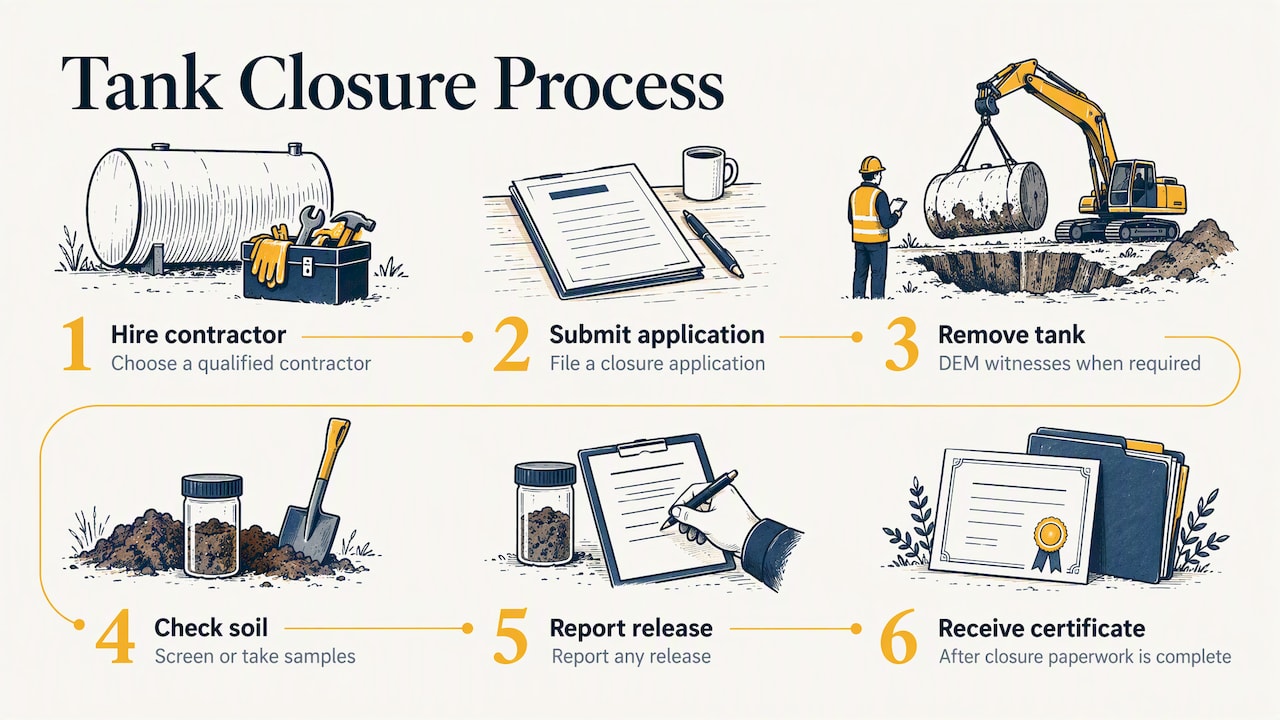
The fees on the state side are small. The 2024 permanent closure application lists a $75 closure fee per tank and says processing may take 10 business days. An additional $100 registration fee may apply to an unregistered tank where registration is required, and residential one-to-three family heating-oil tanks are listed among those not required to pay it. Closures are scheduled subject to inspector availability, so the calendar, not the fee, is what hurts.
For above-ground tanks the paperwork burden is lighter still. One Rhode Island removal company states that no permit is required for above-ground residential oil tank removal. It is a contractor’s statement, so confirm with your contractor and your closing attorney before relying on it.
Why buyers ask for proof anyway
The state’s closure certificate documents that closure met DEM requirements, and the closure assessment exists to determine whether a release occurred. That is why lenders, title companies and buyers’ attorneys often ask for it even where the law does not. A tank that looks clean does not prove the soil is clean. The paper trail is what lowers the buyer’s uncertainty about future liability.
Disclosure
Rhode Island sellers complete a state real estate sales disclosure form, and that form includes questions about underground tanks: whether one is on the property, whether it is in use, closed, filled or removed, and whether documentation exists. Answer honestly and keep any records you have. If you do not know, say so rather than guessing. The general logic of what a seller must tell a buyer, and why leaving things out backfires, is covered well in this overview of seller disclosure obligations, even though it is written from a California luxury-market perspective. Rhode Island’s form and rules are what apply to you, so ask your attorney about the specifics.
What removal costs
There is no state price list. These are contractor-reported figures, and your quote may differ.
- Above-ground or basement tank: one Rhode Island provider advertises a $600 to $650 flat rate under stated conditions. Another publishes a $600 flat rate that includes removing up to 50 gallons of oil and sludge, with a $150 flat fee if the tank holds more. Guides report roughly $400 to $1,000 for this category.
- Standard underground tank: published guides report roughly $1,500 to $3,500, with one to two days on site by a RIDEM-licensed contractor who handles the permit, excavation, soil sampling and closure documentation.
- Contaminated soil: this is where costs run away. One guide reports that cleanup can add $10,000 to $50,000 or more. That is a contractor-reported range, not an official Rhode Island estimate, but it shows why a possible leak changes the whole decision.
Excavation, access (a tank under a deck, driveway or finished patio), disposal, testing and permits all move the total. Ask every contractor what is included, what triggers extra charges, and what documents you will receive. For a buried tank, you want the removal record, soil-screening results, waste manifests, photographs and RIDEM closure documentation handed to you in a single package.
Does homeowners insurance pay?
Sometimes. Sellers get burned by assuming either answer.
The EPA notes that releases from unregulated tanks such as residential heating-oil tanks are handled under state and local requirements rather than the federal UST program, so there is no federal fund or financial-responsibility backstop to lean on for a home tank. Whether your policy pays depends on the cause of loss, any pollution exclusion, endorsements, and the facts of the incident. Rhode Island’s highest court has shown that context matters: in a 2023 decision, it held that a pollution exclusion did not bar coverage for a suit over a home heating oil spill. That ruling turned on the specific policy and facts, so it is no guarantee for yours.
What to do:
- Call your insurer and ask for its position in writing before authorizing any work.
- Ask specifically about tank removal, sudden versus gradual leakage, soil remediation, third-party damage (a neighbor’s property), your deductible, and any pollution or service-line endorsement.
- If a claim is denied or the wording is unclear, a Rhode Island attorney who handles insurance coverage can read the policy. Your closing attorney can tell you how a pending claim affects the sale.
A regulatory issue can also collide with a closing date. In a 2025 enforcement settlement, RIDEM described coordinating the release of an enforcement matter to the closing attorney ahead of a scheduled closing. If you have received any notice about your tank, tell your attorney and DEM early.
Your options as a seller
Option 1: Remove the tank, then list
Best when the tank is above ground or in the basement and you have a few weeks. The cost is modest, the paperwork is short, and it removes a negotiation point. Keep the invoice and any disposal documentation for the buyer.
Option 2: Assess before you market
If the tank is buried or its history is unknown, get a location and condition assessment first. Learning about a problem after you accept an offer is how deals fall apart or get repriced. A buyer who finds an underground tank during the inspection will often demand removal, an escrow holdback or a price cut, and each of those costs you time.
Option 3: Sell as-is and let the buyer handle it
If you cannot pay for removal, cannot wait 10 business days or more for state processing and inspector scheduling, or suspect contamination, selling as-is may fit better. Be realistic about the trade: a cash buyer prices the risk in, so the offer will reflect the tank. In return, you skip the contractor, the closure application, the repairs and the listing period.
A buried tank with suspected contamination does not fit a short conventional closing. RIDEM’s guidance says evidence of a release can turn the property into a Leaking Underground Storage Tank project with a DEM project manager, and the owner may face excavation, soil handling, remediation and restoration. Removal alone does not automatically end liability, so nobody should promise you or a buyer that it does.
Perspective: how we look at an oil tank
We buy Rhode Island houses as-is, so we see this situation from the seller’s side of the table. Most owners who call us about a tank are not worried about the tank itself. They are worried about being stuck: an inherited house they cannot afford to fix, a pending foreclosure, a repair list that keeps growing, or a deadline.
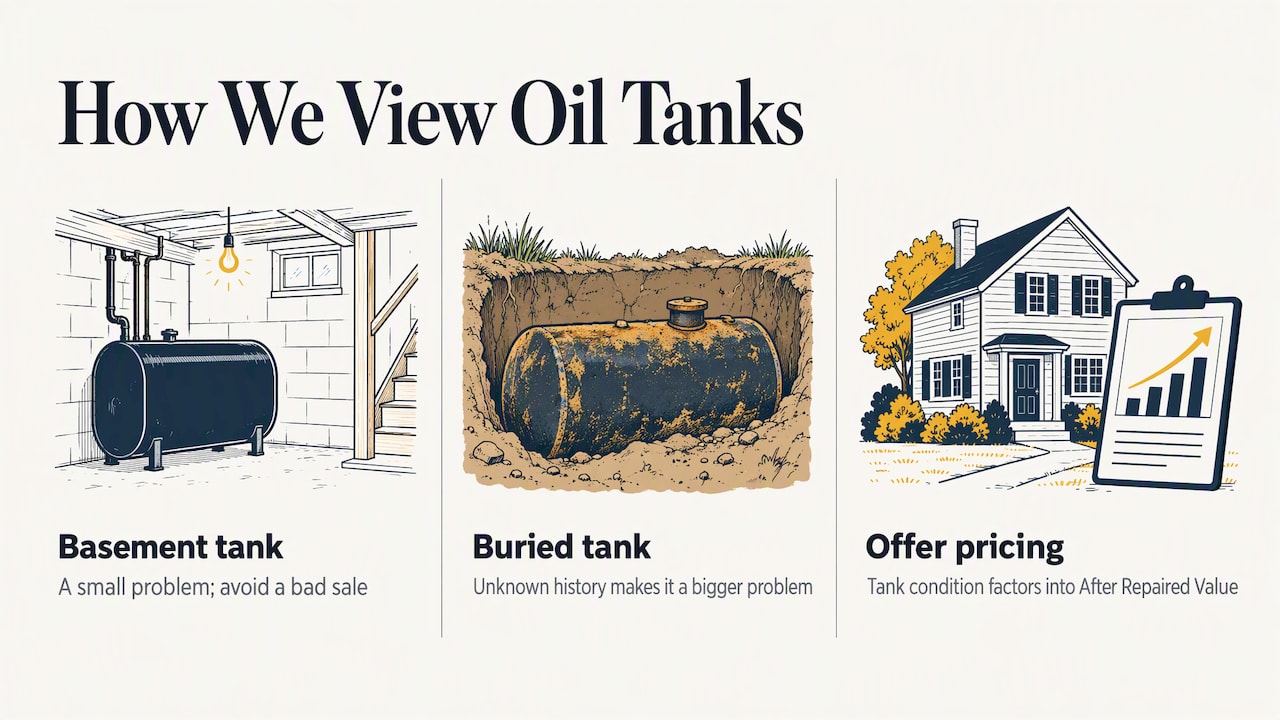
Our view is simple. Sort the tank into the right branch early. A basement tank is a small problem, so do not let it scare you into a bad sale. A buried tank with unknown history is a bigger one, and pretending it is not there only moves the problem to the point where it costs the most. Tell any buyer what you know, give them the records you have, and keep your attorney in the loop.
We make offers based on the After Repaired Value of the home, so the condition of the house, tank included, is part of how we look at the price. We would rather explain that plainly than hide it.
— Dave
Selling as-is for cash when a tank is the sticking point
If a tank is the thing standing between you and a sale, we can look at the house as it is, with no repairs, cleaning or agent commissions on your side. You choose the closing timeline. Our pages on how a fast cash sale works in Rhode Island and on selling a house as-is walk through the steps, and you can request an offer from Rhody Home Buyer when you are ready. Having tank records on hand, even partial ones, helps us give you a clearer answer faster.
Checklist before you decide
- Confirm the tank type and location: basement, above ground or buried.
- Gather paperwork: delivery records, old inspection reports, prior removal or closure documents.
- Call your insurer and request its coverage position in writing.
- Get at least two removal quotes, with written scope and exclusions.
- Ask your attorney how the tank affects your disclosure form and your closing.
- Compare the net result of three paths: repair and list, assess first, or sell as-is for cash.
Do the numbers on net proceeds, not headline price. A higher listing price that needs $3,000 of removal, a month of scheduling, agent commissions and a possible renegotiation is not always better than a lower cash number that closes cleanly. Our page on what you give up when you skip repairs shows how to run that comparison.
FAQ
Can you sell a house with an oil tank in Rhode Island?
Yes. Rhode Island does not prohibit selling a house with a heating-oil tank. Buyers, lenders and their attorneys may ask for proof of removal or closure, especially for an underground tank, so the practical question is how the tank affects price and timing.
Do I have to remove an oil tank before selling?
Not automatically. RIDEM generally exempts residential heating-oil tanks from closure-assessment requirements, but it can require an assessment when conditions suggest a release. A buyer or lender may still make removal a condition of their deal, which you can negotiate.
How much does it cost to remove a home oil tank?
Published Rhode Island contractor figures run from about $400 to $1,000 for basement and above-ground tanks, and about $1,500 to $3,500 for a standard underground tank. Contamination can add far more, with one guide reporting $10,000 to $50,000 or more. Get written quotes for your property.
Does homeowners insurance cover oil tank removal?
It depends on your policy, the cause of the leak, and any pollution exclusion or endorsement. Ask your insurer for its position in writing before you authorize removal or cleanup, and see an insurance attorney if the wording is unclear.
Will a cash buyer take a house with a buried oil tank?
Often yes, because a cash buyer buys as-is and plans for the tank in the offer price. The offer will reflect the tank’s condition and any known or suspected contamination, so share what you know up front.
Sources
- RIDEM: Guidelines for Closure of Underground Storage Tank Systems
- RIDEM: Permanent Closure Application (2024)
- RIDEM: 2025 enforcement settlement, Pawtucket
- US EPA: Releases from Underground Storage Tanks
- Reed Smith: Rhode Island Supreme Court on pollution exclusions (2023)
- Oil Tank Removal RI: licensed contractors and costs
- Rhode Island $600 flat-rate oil tank removal
- Oil Tank Removal Rhode Island: regulations and requirements
- Rhode Island oil tank removal contractors