
Buyers typically cover mortgage and loan-related fees plus several third-party charges, while sellers typically pay agent commissions, transfer taxes, any mortgage payoff, and a handful of settlement fees. As a rule of thumb, buyers budget 2% to 5% of the purchase price or loan amount, while sellers often pay commissions on top of another 1% to 4% in closing fees and taxes. The exact split depends on negotiation, loan program rules, and state custom, so check the Loan Estimate and Closing Disclosure for your specific numbers.
TL;DR:
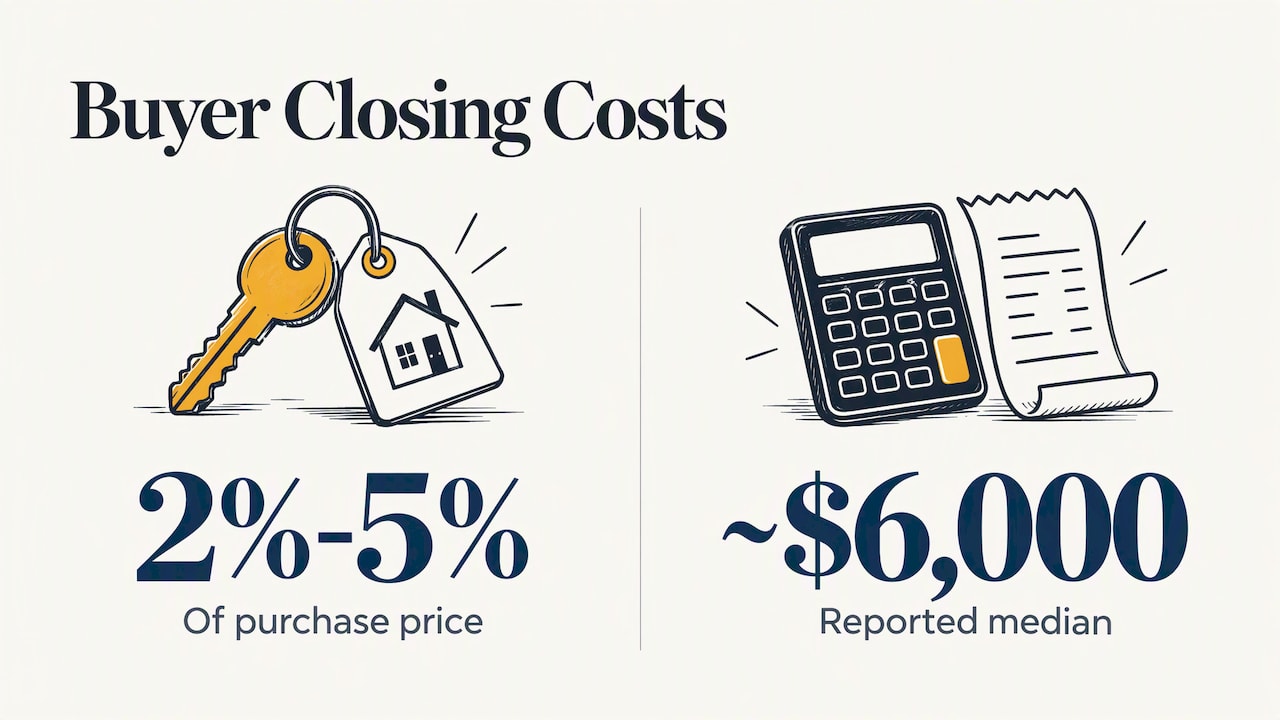
- The reported median closing costs were close to $6,000 in 2022, while buyers typically budget 2% to 5% of the purchase price.
- Sellers pay a negotiable commission averaging near 5.7% of the sale price, plus 1% to 4% in fees and taxes; mortgage payoffs reduce proceeds.
- Check concession limits against the lower of the sale price or appraised value, because excess seller credits can affect loan to value calculations.
- Compare the Closing Disclosure with the Loan Estimate line by line, verify final cash to close, and question increases beyond RESPA tolerance before signing.
- Local custom assigns the seller the buyer’s owner title policy in about 26 states, while buyers may pay for it elsewhere.
Table of Contents
- What buyers usually pay at closing
- What sellers usually pay at closing
- What these costs look like in dollars
- Negotiating who covers closing costs
- Reading the Loan Estimate and Closing Disclosure
- How a cash sale changes seller closing costs
- How Rhody Home Buyer simplifies closing costs for Rhode Island sellers
- FAQ
- Sources
What buyers usually pay at closing
Buyer closing costs fall into three buckets: loan charges, third-party services, and prepaid items. Lenders are tightly restricted in what they can collect before issuing a Loan Estimate: they may charge a reasonable credit report fee, generally under $30, and nothing else until you tell them you want to move forward with the loan, according to the Consumer Financial Protection Bureau.
Once you’re past that stage, the bill grows to include several recurring categories.
- Loan costs: origination fee, discount points, underwriting, and the credit report charge.
- Third-party fees: appraisal, home and pest inspections, title search, the lender’s title insurance policy, recording fees, and a survey when the lender or municipality requires one.
- Prepaids and escrows: prepaid mortgage interest, prorated property taxes, homeowners insurance, and an initial escrow deposit for future tax and insurance bills.
Some of these are shoppable. You can typically pick your own home inspector, and in many states you can choose your own title or settlement agent. The lender’s title policy, however, is generally tied to whichever insurer the lender works with, and both the CFPB and the American Land Title Association have flagged title fee clarity as an area where borrowers should ask questions before signing.
In 2022, the median amount borrowers paid in closing costs and fees was close to $6,000, a figure that lines up with the broader 2% to 5% range lenders quote for most purchases. Costs can be rolled into the loan amount or offset through lender credits, usually in exchange for a slightly higher interest rate.
What sellers usually pay at closing
Seller closing costs reduce the proceeds you walk away with rather than requiring cash upfront, since most are subtracted directly from the sale price at closing. The single biggest line item is almost always the real estate commission.
National commission averages have run near 5.7% of the sale price total, typically split between the listing agent and the buyer’s agent, though the exact rate is negotiable and varies by market and brokerage.
Beyond commissions, sellers commonly see these charges on their settlement statement:
- Transfer taxes and recording fees, which vary by state and locality and are often assigned to the seller by local custom.
- Title-related charges, escrow or settlement fees, and in some states the cost of the buyer’s owner title policy.
- Mortgage payoff and lien releases, plus any HOA dues or prorations owed through the closing date.
- Buyer concessions or credits, when negotiated, which appear as a seller-paid line on the closing statement.
Seller closing costs excluding commission often run 1% to 4% of the sale price, depending on the state and the specifics of the transaction. Sellers carry the largest single expense in most sales, the commission, and then absorb taxes, fees, and mortgage payoff out of their proceeds, according to Freddie Mac. Asking your title or settlement agent for an estimated seller closing statement early in the process gives you a realistic number well before the closing table.
What these costs look like in dollars
Percentages are easier to picture with real numbers attached. A 5.7% total commission, split between listing and buyer agents, works out differently depending on the sale price.
A buyer’s closing costs vary with the purchase price and the fees involved. The reported median of roughly $6,000 is one reference point, while costs at the upper end of the 2% to 5% band can be substantially higher. Freddie Mac advises buyers to set aside money specifically for the appraisal fee, credit report fee, tax service fees, recording charges, and lender origination fees rather than treating closing costs as one lump estimate.
Title insurance adds another wrinkle. In about 26 states, local custom has the seller paying for the buyer’s owner title policy, while in others the buyer covers it. Title companies frequently discount the price when the owner’s and lender’s policies are issued at the same time. On the seller side, an outstanding mortgage balance and any prorated property taxes or HOA dues come directly out of the proceeds before the seller sees a check, which is why a payoff statement matters as much as the sale price itself.
Negotiating who covers closing costs
Seller concessions let a seller agree to pay part of the buyer’s closing costs, prepaid items, or minor repairs instead of lowering the price outright. This tactic shows up most often in buyer’s markets or when a home has sat listed for a while.
Lenders don’t let concessions run unlimited. Fannie Mae caps interested-party contributions based on the lower of the sale price or appraised value, and any amount above the program limit gets treated as a sales concession that can reduce the loan-to-value calculation used for underwriting.
- Define what the concession covers upfront: closing costs, prepaids, or specific repairs, not a vague dollar amount.
- Check your loan program’s contribution limit before writing it into an offer.
- Remember a concession reduces net proceeds just like a price cut would.
- Watch how the appraisal handles a concession, since it can affect final loan terms.
Reading the Loan Estimate and Closing Disclosure
The Loan Estimate and Closing Disclosure use matching formats specifically so you can compare one against the other line by line, per the CFPB’s guide to these forms. Both documents include a Loan Costs and Other Costs section along with a Calculating Cash to Close table.
- Set the Closing Disclosure you receive before closing next to your original Loan Estimate.
- Compare each line item: loan origination, title charges, prepaids, and recording fees, to see what moved.
- Check the Calculating Cash to Close table for the final amount you need to bring, not just the itemized fees.
- Flag any charge that increased beyond what RESPA tolerance rules allow and ask your lender to explain it.
If the numbers on your Closing Disclosure don’t match your Loan Estimate, the CFPB recommends requesting an itemized breakdown from your lender before you sign anything.
Pro Tip: Ask your title company for a line-by-line draft of the Closing Disclosure early so you have time to review it and raise questions.
How a cash sale changes seller closing costs
A cash offer removes the lender-driven delays and several buyer-side fees that come with financing, often shortening the time between contract and closing. You still need to confirm title is clear, nail down your mortgage payoff amount, and account for any prorated taxes or HOA dues.
Ask for an estimated net-proceeds statement regardless of how the buyer is paying. A simple comparison checklist works well: calculate net proceeds after a typical commission and standard closing costs in a traditional sale, then compare that to a cash offer’s net after any investor fees, and weigh the dollar difference against the time and repair work saved.
— Dave
How Rhody Home Buyer simplifies closing costs for Rhode Island sellers
Selling a house the traditional way means budgeting for commissions, buyer financing contingencies, and weeks of uncertainty. We purchase homes across Rhode Island for cash, as-is, without agent commissions.

That approach can make the process more straightforward, with fewer unknowns sitting between you and your net proceeds.
- We buy homes in any condition, so there’s no repair list to budget for before closing.
- We buy homes for cash.
- We offer flexibility to close on your preferred timeline.
If you want to see what a no-obligation cash offer looks like for your property, get started on our Rhode Island cash sale page and we’ll walk you through the numbers.
FAQ
What is the typical application fee for a mortgage?
Before issuing a Loan Estimate, lenders can generally only charge a reasonable credit report fee, typically under $30. Any application, appraisal, or other upfront fee can only be collected after you tell the lender you want to proceed with that loan.
What is a title company?
A title company is a neutral third party that searches public records to confirm a property’s title is clear, then issues title insurance and often handles the closing paperwork and funds. For a deeper look at how owner versus lender title policies show up on your paperwork, a dedicated title primer can help.
Who pays closing costs in 2026?
Buyers and sellers typically split closing costs by category rather than paying one combined bill: buyers generally cover loan and third-party fees, while sellers generally cover commissions, transfer taxes, and mortgage payoff. The exact allocation can shift through negotiation, state custom, and loan program rules, so the Loan Estimate and Closing Disclosure are the documents to check for your transaction.
How much is the closing cost on a $400,000 home?
A buyer on a $400,000 home can expect closing costs of roughly 2% to 5% of the purchase price, or about $8,000 to $20,000. A seller on the same sale would typically pay a commission near 5.7% of the price, or about $22,800, plus another 1% to 4% in other seller-side fees.
Sources
- How much does it cost to receive a Loan Estimate? | Consumer Financial Protection Bureau
- Closing Costs: What Are They And How Much Are They? | Bankrate
- Selling-guide