
Most Rhode Island sellers and landlords of housing built before 1978 must disclose known lead hazards under federal law, and landlords of those rental units also need a valid state lead certificate and must register on the Rhode Island Rental Registry. Required steps include handing over the EPA pamphlet and a signed Lead Warning Statement, giving buyers a 10-day inspection window, and keeping certificates current. Skipping any of these creates real exposure to fines and tenant lawsuits.
TL;DR:
- Before signing, provide the Lead Warning Statement, EPA pamphlet, and existing reports; buyers receive 10 days to inspect unless both sides alter the period in writing.
- Landlords must register covered rentals and upload current certificates annually around October 1; most certificates last two years, but Full Lead Safe certificates do not expire.
- Keep signed disclosures and certificates for at least three years, and obtain written consent from buyers or tenants before sending required forms electronically.
- Landlords face monthly fines for unregistered rentals or lapsed certificates; tenants may petition for rent escrow and seek treble damages in certain lead exposure cases.
Table of Contents
- Federal disclosure rules under Title X: forms, the 10-day window, and recordkeeping
- Rhode Island rental rules: lead certificates and the Rental Registry
- Which properties and transactions are covered, and common exemptions
- Timing, required documents, and recordkeeping for sellers and landlords
- Enforcement, penalties, and tenant remedies in Rhode Island
- Step-by-step compliance checklist before a sale or lease
- What Rhode Island sellers usually miss about lead compliance
- A faster option when lead compliance feels like one more hurdle
- FAQ
- Sources
Federal disclosure rules under Title X: forms, the 10-day window, and recordkeeping
Before a Rhode Island seller or landlord can treat a deal as done, federal law sets the floor. The Lead-Based Paint Disclosure Rule under Section 1018 of Title X applies to nearly all housing built before 1978 and requires a specific sequence of paperwork before anyone signs a sale or lease.
- Provide the Lead Warning Statement and the EPA pamphlet “Protect Your Family from Lead in Your Home,” along with any lead inspection or test reports already in hand.
- Give home buyers (not tenants) a 10-day period to conduct their own lead inspection or risk assessment before the sale becomes binding, unless both sides agree in writing to a different timeframe or waive it.
- Keep every signed disclosure form for at least three years, since that is the record regulators and courts will ask for if a dispute arises.
Electronic delivery of these documents is allowed, but only when the buyer or tenant has agreed to it in writing. None of this requires testing or removing paint. It requires telling people what you know and giving buyers a real chance to check for themselves.
Rhode Island rental rules: lead certificates and the Rental Registry
Rhode Island layers its own system on top of the federal rule, and it is landlords, not home sellers, who feel it most. The Rhode Island Department of Health requires most pre-1978 rental units to carry a valid lead certificate and to be listed on the state’s Rental Registry.
- Get the right certificate. Options include a Certificate of Lead Conformance (CLC), a Conditional Lead Safe certificate, a Full Lead Safe certificate, or a Certificate of Presumptive Compliance for properties that qualify. A RIDOH factsheet on lead certificates explains how each is earned, through dust wipe sampling or XRF testing.
- Track your renewal date. CLC and Conditional certificates generally last two years. A Full Lead Safe Certificate does not expire, which makes it worth pursuing if you want to stop renewing every two years.
- Register and upload proof. Every landlord of a covered rental must register the property on the Rental Registry and upload the current certificate, with annual filing expected around October 1 and a copy given directly to tenants.
Owner-occupied rental properties were pulled into this certificate requirement as of January 1, 2024, closing a gap that used to let small owner-occupied buildings skip it, according to guidance from the Rhode Island Attorney General.
Which properties and transactions are covered, and common exemptions
The federal and state rules both hinge on “target housing,” which covers almost all residential buildings built before 1978. Post-1978 construction falls outside the disclosure and certificate requirements entirely.
- Housing built on or after January 1, 1978 is exempt from both federal disclosure and Rhode Island certificate rules.
- Short-term or seasonal rentals of 100 days or fewer to the same tenant are generally exempt.
- Housing restricted to older adults, where no child under six will reside, can qualify for an exemption.
- A building that was gutted to the studs and rebuilt may qualify as new construction, but owners should confirm this with RIDOH rather than assume it.
Historic properties get no blanket pass. A RIDOH regulation on lead hazard mitigation still requires notice of known hazards, and a Full Lead Safe Certificate changes a property’s compliance status without requiring it to be lead-free.
Timing, required documents, and recordkeeping for sellers and landlords
Disclosure has to happen before anyone signs, not after. For sales, that means the Lead Warning Statement and pamphlet go out before the purchase agreement is executed, and the buyer’s 10-day inspection clock starts running from that point unless it is waived in writing. For leases, the same documents go to the tenant before the lease is signed.
- Keep every signed disclosure and certificate for a minimum of three years.
- If delivering forms electronically, get the buyer’s or tenant’s written consent first.
- Budget one to two weeks for a lead inspection and certificate turnaround, longer if remediation is needed before a pass.
Before closing or move-in, have on hand: the signed Lead Warning Statement, a copy of the EPA pamphlet given to the buyer or tenant, any prior inspection or risk assessment reports, and, for rentals, the current lead certificate and Rental Registry confirmation.
Enforcement, penalties, and tenant remedies in Rhode Island
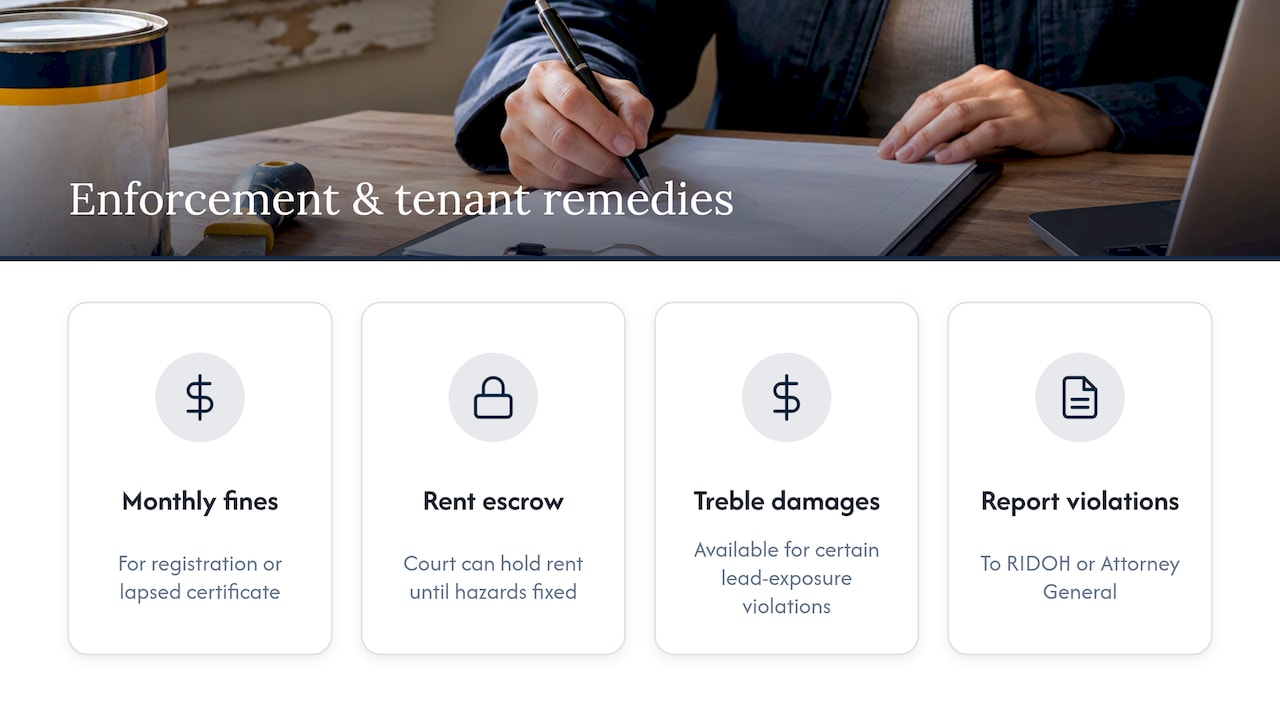
Rhode Island backs these requirements with real consequences. Landlords who fail to register a covered property or who let a certificate lapse face civil fines that can accrue monthly, and RIDOH has been actively issuing them. Recent legislative changes described by the Rhode Island Attorney General’s guidance also gave tenants two sharper tools: the right to petition a court to place rent in escrow until lead hazards are addressed, and the right to seek treble damages in certain violations tied to lead exposure. Violations can be reported to RIDOH or the Attorney General’s office, both of which share enforcement authority over these rules.
Step-by-step compliance checklist before a sale or lease
Compliance is sequential, and skipping a step tends to cost more time than doing it in order.
- Sellers: pull together any existing lead reports, sign and deliver the Lead Warning Statement and EPA pamphlet, and hold the sale open for the buyer’s 10-day inspection period.
- Landlords: schedule a licensed lead inspector, do a thorough wet cleaning and fix obvious chipped or peeling paint beforehand, obtain the appropriate certificate, upload it to the Rental Registry, and hand tenants their own copy along with the pamphlet.
- Everyone: file every signed form and certificate where you can find it again in three years.
Owners of older or historic homes can get tailored prep advice from the Rhode Island Historical Preservation & Heritage Commission, since historic buildings can pass inspection without being stripped of original materials.
Pro Tip: Wet-clean floors, sills, and window troughs and touch up any visible chipping a few days before your inspection. That small prep step often turns a first-time fail into a pass.

What Rhode Island sellers usually miss about lead compliance
The paperwork itself rarely trips people up. What catches sellers off guard is timing: discovering mid-contract that a certificate lapsed, or that nobody budgeted for the 10-day inspection window, or that an inherited property needs a lead inspection before anyone even listed it. Understanding these rules early, well before a buyer or tenant is lined up, turns a legal requirement into a non-issue instead of a last-minute scramble. Sellers who treat disclosure as step one, not an afterthought, tend to close faster and with fewer surprises.
— Dave
A faster option when lead compliance feels like one more hurdle
If gathering inspection reports, chasing a certificate renewal, or prepping a rental for a lead inspection sounds like more than you want to take on, selling as-is for cash is worth considering. We buy Rhode Island houses in their current condition, with no agent commissions, no repair lists, and a closing timeline set by you rather than a listing calendar.

- Our offers do not require fixing peeling paint or passing a lead inspection before selling.
- Closings can happen more quickly than traditional sales, which helps when a certificate has lapsed or a sale is time-sensitive.
- You still need to disclose any known lead hazards up to the point ownership transfers, cash sale or not.
Request a cash offer through Rhody Home Buyer and see what a straightforward, as-is sale looks like for your property.
FAQ
What is the lead paint law in Rhode Island?
Rhode Island requires sellers and landlords of pre-1978 housing to follow federal disclosure rules (the Lead Warning Statement, the EPA pamphlet, and a buyer’s 10-day inspection window) and adds its own requirement that rental units carry a valid lead certificate and appear on the Rental Registry. Owner-occupied rentals were brought under the certificate requirement starting January 1, 2024.
Is lead testing mandatory in RI?
Testing itself isn’t mandatory for a home sale, but disclosure of known hazards is, and buyers always get the right to test during the 10-day inspection period. For rental units, landlords generally do need an inspection to obtain the lead certificate required for the Rental Registry.
What are the new lead laws in Rhode Island?
Recent changes expanded the certificate requirement to owner-occupied rental properties as of January 1, 2024, and strengthened tenant remedies, including rent escrow petitions and treble damages for certain lead-related violations, according to Attorney General guidance. RIDOH has also stepped up enforcement, issuing civil fines for unregistered or uncertified rentals.
When was lead paint banned in RI?
Rhode Island follows the federal timeline: residential lead-based paint was banned nationwide for housing built on or after January 1, 1978, which is why that date marks the line for “target housing” under both federal and state rules.
Sources
- Lead-Based Paint Disclosure Rule (Section 1018 of Title X) | US EPA
- Lead poisoning & mitigation — Rhode Island Department of Health
- Guidance from the Rhode Island Attorney General to landlords (Jan 11, 2024)