
Yes, you can sell water-damaged homes and electronics, and you have three realistic paths: repair and list on the open market, sell as-is to a cash buyer or investor, or send devices to trade-in and parts buyers. Disclose everything and document it. If speed matters more than top dollar, an as-is cash buyer or a device recycler is often the faster, less stressful route.
TL;DR:
- Selling water-damaged houses as-is to cash buyers or investors often results in faster closings and fewer repairs but typically yields lower offers compared to repaired listings.
- Electronics with water damage are best sold through trade-in programs, parts buyers, or recyclers, with local options providing immediate cash and national programs offering higher offers for better condition devices.
- Proper documentation, including professional inspections and repair records, significantly increases the value and buyer confidence for both homes and devices with water damage.
- Disclosing water damage accurately on seller disclosure forms and providing supporting documentation is legally required and protects sellers from future legal liabilities.
- Repair decisions should consider repair costs, expected resale value increases, timeline constraints, and buyer financing requirements, with getting multiple quotes guiding the most cost-effective choice.
Table of Contents
- What are your options for selling something with water damage?
- How do you prepare a water-damaged house or device before selling?
- How much value do you lose to water damage?
- What do you have to disclose about water damage?
- Should you repair the damage or sell as-is?
- How do you sell a water-damaged phone, tablet, or laptop?
- How does Rhody Home Buyer handle water-damaged houses?
- What mistakes do sellers make with water-damaged property?
- Why honesty beats speed when selling damaged property
- Ready to sell your water-damaged house without the repair headache?
- Where to go for more detailed guidance
- Sources
- FAQ
What are your options for selling something with water damage?
The right path depends on how much time and cash you have, not just how bad the damage looks.
For houses, you generally choose between three routes. Repairing and listing on the open market usually nets the highest price, but it requires cash upfront, a contractor, and weeks or months before you see a buyer. Selling as-is to a cash buyer or real estate investor skips the repair step entirely: these buyers price the property based on its current condition and what it would be worth after repairs, then make an offer that reflects that math, as explained in Sell Your House As-Is in San Diego and Still Net Top Dollar. Selling through a traditional agent while disclosing damage still works, but expect a smaller buyer pool willing to take on the project.
For electronics, the paths are narrower but faster to execute:
- Trade-in programs run by carriers or retailers accept damaged devices at reduced values tied to a condition grade.
- Parts buyers and specialized resellers pay for the components that still function, even in a phone or laptop that will not power on.
- Recyclers like ecoATM offer instant, on-the-spot cash for devices in almost any condition, including ones that are fully dead.
- Local repair shops sometimes buy broken units for parts if you would rather sell face to face.
The biggest difference between local and national channels for electronics is speed versus price. A national trade-in partner may pay more for a mid-condition phone, but a local repair shop can hand you cash the same day for a device no one else wants. Houses follow a similar pattern: a licensed agent might get you a higher price over time, while a cash buyer can close in weeks without requiring a single repair.
How do you prepare a water-damaged house or device before selling?
Preparation is what separates a smooth sale from a drawn-out argument over price. The goal is to know exactly what you are selling and to prove it.
- Get a professional inspection or restoration assessment. Visible staining can hide bigger problems behind walls or under flooring, and a professional assessment should be the first step because hidden moisture, wiring damage, or mold can be far worse than what you can see.
- Collect your paperwork. Save dated photos of the damage, contractor invoices, moisture-meter readings, drying logs, and any insurance correspondence tied to the event.
- Decide which repairs are worth doing. Fixing a stained ceiling tile might make sense; replacing an entire kitchen floor may not pay for itself if you are selling as-is.
- Prepare electronics separately. Back up any data you can access, remove SIM and SD cards, unlink accounts and trusted devices, and attempt a factory reset. If the device is dead, FTC guidance on removing personal information recommends disclosing that limitation and choosing a buyer or recycler with a clear data-handling process.
- Photograph liquid contact indicators. Most phones have small stickers inside the SIM tray or battery compartment that change color when exposed to moisture. Photograph them so buyers can see the condition you are describing.
Pro Tip: Keep every document in one folder, digital or physical, so you can hand it over the moment a serious buyer or inspector asks for it.
How much value do you lose to water damage?
Water damage rarely destroys all of a property’s or device’s value, but it changes the math on both.
For homes, the discount depends on the extent of the damage, whether it affected structural elements, whether mold developed, and how comparable sales in the area have handled similar issues. A repaired water loss with clean documentation tends to worry buyers far less than an unresolved one:
- Structural or foundation involvement pushes buyers toward investors rather than traditional financing.
- Mold growth almost always triggers a bigger price reduction than surface staining alone.
- Documented, professionally completed repairs make a home easier to sell than one with an active, undocumented leak, which can also affect a buyer’s ability to get a loan.
For devices, condition labels do most of the pricing work: Good, Fair, Broken, or Non-Functional. A water-damaged phone that still powers on and passes basic function tests will land in Fair or Broken, while one that will not turn on at all lands in Non-Functional, the lowest tier trade-in partners accept.
A repaired water problem with paperwork to prove it is worth more than the same damage left unexplained, according to Redfin’s guidance for sellers on how documentation affects buyer confidence and negotiation.
Here’s a simple break-even example: say a contractor quotes $4,000 to repair water damage in a basement, and comparable homes without that damage sell for $8,000 more than comparable homes with visible damage. Repairing likely pays off. If the same repair quote came back at $9,000 against an $8,000 price lift, selling as-is makes more financial sense.

What do you have to disclose about water damage?
Honesty is not optional, and in most cases it is the law. Most states require sellers to disclose known past or current water damage, flooding, or mold on a standard seller disclosure form, and skipping that step creates legal exposure that follows you well after closing.
Put your disclosure in writing every time, using more than just a checkbox:
- Seller disclosure forms required by your state, filled out completely and honestly.
- Inspection reports from any professional assessment you had done.
- Remediation invoices showing what was repaired, by whom, and when.
- Written addenda attached to the purchase agreement describing the history of the damage in plain language.
If you fail to disclose known water damage and a buyer discovers it after closing, you can face a lawsuit for damages, rescission of the sale, or worse if the issue involved an active leak or structural problem. Talk to a real estate attorney before closing if the damage is severe or ongoing.
For electronics, the same principle applies on a smaller scale: if you could not factory reset a dead device, say so, and explain what data-removal steps you did manage to complete.
Should you repair the damage or sell as-is?
This decision comes down to five numbers: the repair estimate, the expected price lift from making that repair, how long repairs will take, whether your likely buyers are paying cash or need financing, and any insurer or lender requirements tied to the property.
- Get a firm repair estimate from a licensed contractor, not a ballpark figure.
- Estimate the price lift by comparing recent sales of similar homes with and without visible damage history.
- Check your timeline. If you need to sell in weeks, not months, repairs may not be realistic.
- Consider your buyer pool. Homes with unresolved damage often fail to meet loan-required habitability standards, narrowing you to cash buyers.
Repair when the work is modest, local demand is strong, and you can front the cost without financial strain. Sell as-is when you are on a tight timeline, the repair cost exceeds the expected price lift, or the property is unlikely to pass an appraisal tied to a buyer’s loan.
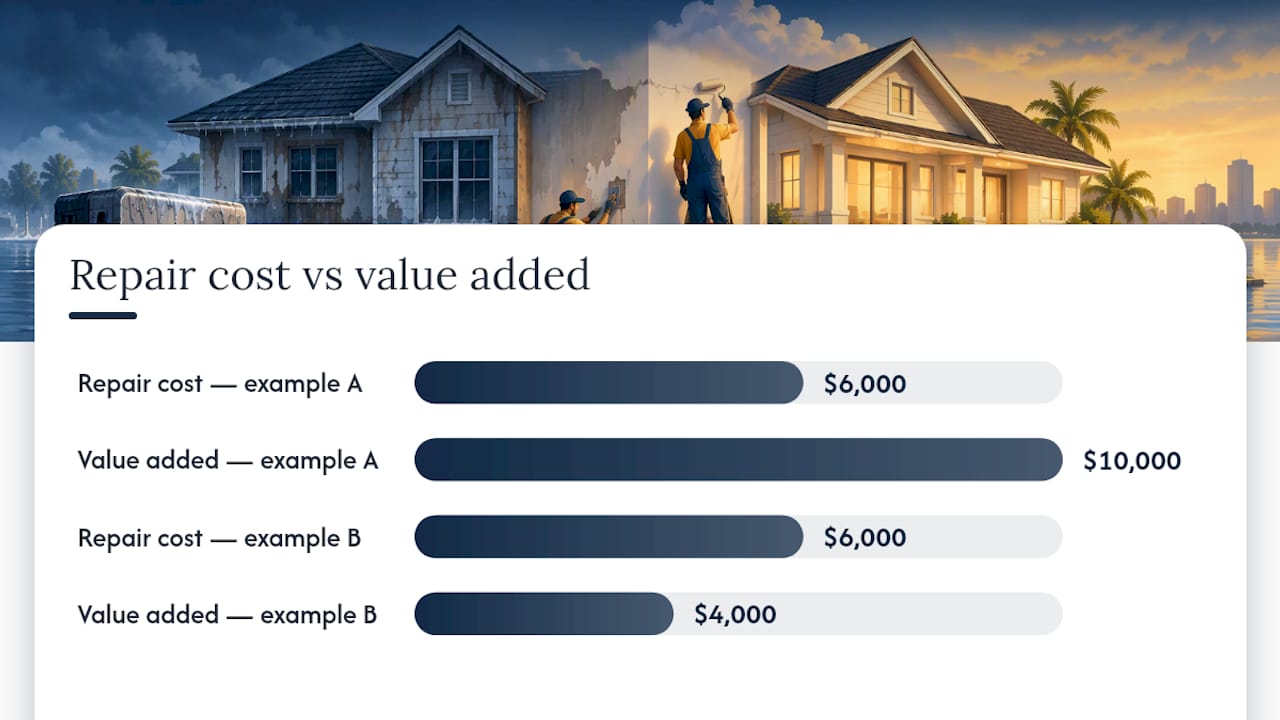
Sample math: a $6,000 repair that adds $10,000 in resale value is worth doing if you have the cash and the time. A $6,000 repair that adds $4,000 in value is not.
Pro Tip: Get one repair quote and one as-is cash offer before deciding anything. The comparison alone often makes the choice obvious.
How do you sell a water-damaged phone, tablet, or laptop?
Selling a damaged device is mostly a data-security task wearing a resale hat. The FTC’s guidance on removing personal information treats it that way for good reason: a phone that looks dead can still hold account access, saved passwords, and authenticator data that a buyer could exploit.
Before listing or shipping a device anywhere:
- Back up what you can, then remove SIM and SD cards and unlink accounts and trusted devices.
- Attempt a factory reset. If the device won’t power on, disclose that clearly and choose a recycler or buyer with a documented data-handling process.
- Photograph corrosion and liquid contact indicators so buyers know exactly what condition they are bidding on.
Repair costs on older phones often exceed what you’d gain in resale value, according to Consumer Reports’ guidance on used smartphones, which recommends comparing repair quotes against as-is offers before spending anything.
For quotes, check trade-in programs through your carrier or retailer, marketplaces with trade-in partners that accept broken or water-damaged phones like Swappa, specialized parts buyers, ecoATM kiosks, and local repair shops willing to buy for parts. Get at least two or three quotes. Offers on damaged devices vary widely between programs, and the difference between the low and high offer can be significant enough to matter.
How does Rhody Home Buyer handle water-damaged houses?
Rhody Home Buyer buys homes as-is, meaning no repairs, no cleaning, and no waiting for a contractor’s schedule to clear. Offers are based on the property’s After Repaired Value, so the water damage is priced into the deal rather than treated as a dealbreaker, and closing happens on a timeline the homeowner sets.
This route tends to fit specific situations:
- An urgent sale where you cannot wait through a repair-and-list timeline.
- An inherited property with water damage you did not cause and do not want to fix.
- A home you cannot afford to repair, especially when contractor quotes exceed what the repair would add in value.
- A vacant or unsafe property sitting empty while damage potentially worsens.
Before reaching out, gather basic photos of the damage, any documentation you already have such as inspection notes or insurance correspondence, and general property details like square footage and age. From there, the process typically moves through a property review, a cash offer, and a closing date you choose, without agent commissions or last-minute repair demands. Homeowners considering this path can read more about how cash home sales work and what the offer process looks like from request to closing.
What mistakes do sellers make with water-damaged property?
The same handful of mistakes show up again and again, whether someone is selling a flooded basement or a soaked phone.
Hiding the damage instead of documenting it is the costliest one. Buyers who discover undisclosed water damage after closing can pursue legal action, and a seller who tries to paint over a stain instead of explaining it usually ends up with a worse outcome than if they had disclosed it upfront.
Skipping the professional assessment is a close second. Without it, you are guessing at the scope of the problem, and guesses do not hold up during buyer negotiations or appraisal.
Spending money on repairs that do not pay off. Not every fix adds resale value, and some homeowners sink cash into cosmetic work that a cash buyer would have priced around anyway.
Selling a device without checking for data exposure. A phone that will not turn on can still hold account access, and skipping the removal steps risks exposing personal information to whoever handles it next.
Accepting the first offer without comparison. Whether it is a repair quote, a cash offer on a house, or a trade-in quote on a phone, one number tells you nothing. Get at least two or three before deciding.
Ignoring minor cleanup that costs little. A quick wipe-down, removing debris, and airing out a space cost almost nothing and can shift how a buyer or inspector perceives the whole property.
Why honesty beats speed when selling damaged property
Disclosure is not a formality you get through so you can move on. It is the thing that protects you after the sale closes and the buyer moves in.
I tend to advise repair when a seller has the cash on hand, the timeline to spare, and a contractor they trust to finish the job right. I advise a cash sale when someone is dealing with an inherited home they never wanted to manage, a property they cannot afford to fix, or a timeline that repairs simply will not fit.
Whatever path you choose, the sequence stays the same: inspect first, document everything, get two or three offers before committing to anything, and call a cash buyer if speed is the priority. Skipping steps to save a week almost always costs more later.
— Dave
Ready to sell your water-damaged house without the repair headache?
If you have decided that repairs do not make financial sense, or you simply do not have the time, Rhody Home Buyer offers homeowners in Rhode Island a way to sell as-is for cash, with no agent fees, no commissions, and no repair or cleaning requirements before closing.

Getting started is straightforward. Share basic property details and a few photos of the damage, and the more documentation you can include, inspection notes, insurance correspondence, or contractor quotes, the faster an accurate offer can come together. From there, the timeline is flexible: some homeowners want to close in a couple of weeks, others need more time to sort out logistics, and Rhody Home Buyer works around that rather than forcing a fixed schedule.
If you are ready to see what an as-is cash offer looks like for your property, request an offer through Rhody Home Buyer and find out what your home is worth without spending another dollar on repairs.
Where to go for more detailed guidance
For readers who want to dig into the primary sources behind this guide, a few are worth bookmarking. The FTC’s personal information removal guidance covers exactly what to do before selling or recycling any phone. Swappa’s trade-in FAQ on broken and water-damaged devices explains how partners handle damaged units and condition grading. Redfin’s guide to selling a house with water damage walks through inspection, documentation, and disclosure in more depth. Consumer Reports also publishes practical advice on used-phone disposal and trade-ins worth reading before you commit to repairing or replacing a damaged device.
Sources
- How to remove your personal information before you get rid of your phone – FTC
- Am I able to trade in a broken phone or water-damaged phone? – Swappa
- Can you sell a house with water damage? – Redfin
- What to do with your used smartphone – Consumer Reports
FAQ
Can you sell a water-damaged iPhone for cash?
Yes, trade-in partners, parts buyers, and recyclers like ecoATM regularly accept water-damaged iPhones, though the price depends heavily on condition and whether the device still powers on. Many trade-in partners buy broken or water-damaged phones at reduced values tied to a condition grade, so getting a few quotes before committing to one buyer is worth the extra few minutes.
How much does water damage lower a home’s value?
The discount depends on the extent of the damage, whether mold developed, and how well the repair was documented, since a professionally repaired and documented water loss is easier to sell than an unresolved one. Comparable local sales and a contractor’s written repair estimate give you the clearest read on what your specific situation is worth.
Do sellers have to disclose water damage to buyers?
In most states, yes, sellers are required to disclose known past or current water damage, flooding, or mold on a standard seller disclosure form. Failing to disclose known issues can expose a seller to legal action after closing, so put it in writing every time.
How much is a water-damaged iPhone worth?
There is no single published figure since offers vary by trade-in partner, device model, and condition grade, ranging from Good down to Non-Functional. Getting multiple quotes from trade-in programs and parts buyers is the most reliable way to find out what your specific device is worth right now.