
A credible cash offer rests on two documents above all: the buyer’s proof of funds and the seller’s clear deed or title. Beyond that, buyers need a photo ID, wiring instructions, and entity paperwork if buying through an LLC. Sellers need payoff information, tax records, and any required disclosures, including the lead-based paint pamphlet for older homes. Closing still involves settlement paperwork and possible tax reporting through Form 1099-S.
TL;DR:
- A strong proof of funds letter must be recent, signed by a bank officer, and show a balance at least equal to the purchase price plus closing costs.
- Buyers should include verified wiring instructions and government-issued ID, and consider consolidating funds into fewer accounts before submitting an offer.
- Sellers need to gather and prepare deed, payoff statements, recent tax bills, and disclosures, including lead-based paint documents for homes built before 1978.
- The closing process involves the same documents as financed deals, such as the settlement statement and deed transfer, with faster timelines due to the absence of loan approval.
- Verifying bank letters by phone and confirming wiring instructions beforehand significantly reduce risks of fraud during a cash transaction.
Table of Contents
- 1. Buyer paperwork checklist before submitting an offer
- 2. Seller paperwork checklist for a cash sale
- 3. What makes a proof of funds letter strong or weak
- 4. Required federal forms and closing paperwork to expect
- 5. Disclosures and compliance for homes built before 1978
- 6. Verification and fraud prevention steps for both sides
- 7. How Rhody Home Buyer handles paperwork in a fast cash purchase
- 8. Notarization and witnessing rules for cash sale paperwork
- 9. The typical cash offer paperwork process and timeline
- 10. Purchase agreement details specific to cash offers
- 11. The role of escrow documents in a cash transaction
- 12. Balancing speed against paperwork thoroughness
- How Rhody Home Buyer can simplify paperwork for sellers who need a fast cash sale
- Sources
- FAQ
1. Buyer paperwork checklist before submitting an offer
A cash offer only carries weight when the paperwork behind it does. Sellers and their agents will scrutinize the buyer’s proof of funds (POF) before taking an offer seriously, so getting this right first saves time later.
Acceptable POF formats include a bank letter on official letterhead, recent bank or brokerage statements, or a combination of both. According to proof of funds guidance, the strongest letters show a balance equal to or greater than the purchase price plus estimated closing costs, an account holder name that matches the contract, a date within 7 to 30 days, and a bank officer’s signature with contact information. Combining a letter with statements adds credibility, particularly for higher-value deals.
Buyers should also prepare:
- A government-issued photo ID matching the name on the offer.
- Verified wiring instructions, confirmed by phone rather than trusted from email alone.
- Evidence of the earnest money deposit, such as a receipt or transfer confirmation.
- Entity authorization documents (operating agreement, trust certificate) when purchasing through an LLC or trust.
A few practical steps make the process smoother. Redact account numbers before sharing statements, since only the balance and name matter to the seller. Where funds are spread across several accounts, consolidating into fewer accounts ahead of time avoids confusion. Timing matters too: request the letter close to the offer date so it does not read as stale by the time it reaches the seller’s desk.
Pro Tip: Ask your bank for a POF letter that already includes an officer’s direct phone number. It shaves days off the seller’s verification step and signals a serious offer.
2. Seller paperwork checklist for a cash sale
Sellers who gather their paperwork before listing avoid the scramble that slows down a fast closing. The goal is to have proof of ownership, property history, and disclosures ready before a buyer ever makes an offer.
Title and ownership documents come first: the current deed, a prior title insurance policy if one exists, and any mortgage payoff or release documents. A lender payoff statement in particular tells everyone how much equity is actually available at closing.
Property records round out the file. Recent property tax bills, a survey if one was done, HOA documents where applicable, utility account information, and any past inspection reports all help a buyer (or their title company) confirm what they are purchasing.
- Current deed and, if available, the prior title insurance policy.
- Mortgage payoff statement or lien release documentation.
- Recent property tax bills and any existing survey.
- HOA paperwork, utility account details, and past inspection reports.
- State-required seller disclosure form and, for homes built before 1978, the federal lead-based paint disclosure.
Disclosures deserve their own attention. Every state has its own seller disclosure form covering known defects, and sellers should list anything from a leaky roof to a pending boundary dispute. Federal law layers on an additional requirement for pre-1978 housing, covered in detail below.
Assemble originals where possible, along with certified copies of the deed if the original has been misplaced. Keep a valid ID and tax identification number on hand, since both are typically required at the closing table regardless of how quickly the deal moves.
3. What makes a proof of funds letter strong or weak
Not all proof of funds letters carry equal weight, and sellers have learned to spot the difference quickly. A strong letter includes several specific elements together, not just one or two.
| Element | Strong POF | Weak POF |
|---|---|---|
| Format | Bank letterhead, signed | Screenshot or edited PDF |
| Date | Within 7 to 30 days | Older or undated |
| Balance | Round-number free, matches offer plus costs | Suspiciously round figures |
| Account type | Checking, savings, money market, brokerage | Retirement account needing conversion |
| Contact info | Bank officer name and number included | No signature or contact listed |
According to proof of funds guidance, liquid accounts such as checking, savings, money market, and brokerage holdings are the accepted standard because they can close without conversion delays. Retirement accounts or assets that require liquidation raise questions about timing and are viewed as weaker support for a fast cash close.
Weak POF letters tend to share a few traits: screenshots instead of official documents, balances that land on suspiciously round numbers, a large deposit that appears just a day or two before the letter’s date, or no signature at all. Sellers and their agents typically verify a letter by calling the bank at a publicly listed number rather than any number printed on the letter itself, according to cash buyer verification guidance. Buyers who authorize this verification in writing ahead of time speed up the process considerably.
Pro Tip: If your funding includes a gift from family, ask for a signed gift letter plus proof of transfer. It heads off questions about whether the money is a disguised loan.
4. Required federal forms and closing paperwork to expect
Cash deals skip a mortgage application, but they do not skip the paperwork tied to transferring title and reporting the sale. Buyers and sellers should expect a version of the same closing documents used in financed transactions, just without lender-specific forms.
- A Closing Disclosure or equivalent settlement statement itemizing all costs.
- Receipts for closing costs, including title search and recording fees.
- Deed transfer documents prepared for recording with the local land records office.
- Title insurance paperwork confirming clear ownership transfer.
On the tax side, IRS instructions for Form 1099-S explain that the person responsible for closing, often the title company or settlement agent, must file the form to report the sale and furnish a copy to the seller. The form reports gross proceeds from the transaction and matters at tax time because the seller needs it to report the sale accurately.
Two additional triggers apply in specific situations. Form 8300 comes into play when a business receives more than a set threshold in cash payments in a single transaction. Beginning March 1, 2026, FinCEN’s residential real estate rule adds a reporting requirement for certain non-financed transfers where the buyer is a legal entity or trust, meaning title companies will start collecting beneficial-ownership information in those cases.
5. Disclosures and compliance for homes built before 1978
Homes built before 1978 carry an extra layer of federal paperwork tied to lead-based paint risk, and skipping it is not optional.
Under federal disclosure rules, sellers of pre-1978 housing must give buyers the EPA pamphlet “Protect Your Family From Lead in Your Home,” disclose any known lead hazards along with available records or reports, and include a Lead Warning Statement in the purchase contract. Buyers get a 10-day window to test for lead unless they waive it in writing.
- Provide the EPA pamphlet before the buyer is obligated under the contract.
- Disclose any known lead hazards and share existing test reports or records.
- Include a signed Lead Warning Statement in the purchase agreement.
- Retain signed acknowledgments from all parties for three years.
EPA guidance also offers sample disclosure forms in English and Spanish, along with updated language for the Lead Warning Statement and agent acknowledgment sections, which sellers and agents can use directly rather than drafting language from scratch.
6. Verification and fraud prevention steps for both sides
Fraudulent proof of funds letters and wire fraud schemes both target the paperwork stage of a cash sale, and a few simple habits close most of the gaps.
- Call the buyer’s bank at a number found independently, not one listed in the letter itself, to confirm the letter is genuine.
- Confirm wiring instructions by phone using a verified number before sending or receiving any funds, since email-only instructions are a common fraud vector.
- Request corroborating paperwork for unusual funding sources, such as a signed gift letter with proof of transfer or beneficial-owner documentation for entity buyers.
- Get written authorization from the buyer before calling their bank, since some institutions will not discuss account details without it.
Pro Tip: A POF letter that already lists a bank officer’s direct line saves a verification call and signals the buyer expected to be checked.
7. How Rhody Home Buyer handles paperwork in a fast cash purchase
Rhody Home Buyer purchases homes as-is, which cuts most of the paperwork burden typically tied to a traditional listing. Sellers working with us generally supply the deed, a photo ID, and any mortgage payoff statement, without repair estimates, inspection negotiations, or agent-prepared listing packets.
We walk sellers through the required disclosure paperwork, including the lead-based paint pamphlet for pre-1978 homes, and help assemble the disclosure packet so nothing gets missed. That said, some paperwork cannot be shortcut: sellers still need valid title documentation and must complete every legally required disclosure, since no cash buyer can waive those on a seller’s behalf.
8. Notarization and witnessing rules for cash sale paperwork
Notarization requirements for a cash sale generally mirror those for any real estate closing, since the deed itself is the document that must be notarized regardless of how the purchase is funded. A notary public confirms the seller’s identity and witnesses the signature before the deed can be recorded with the local land records office.

Some documents beyond the deed may also require notarization, including powers of attorney used when a seller cannot attend closing in person, and certain affidavits tied to title issues or estate transfers. Witnessing requirements vary more by jurisdiction than notarization does. A handful of states require one or two witnesses in addition to a notary for a deed to be valid, so it is worth confirming local rules with the closing agent or title company handling the transaction rather than assuming a national standard applies.
Most closings today allow remote online notarization in states that permit it, which can matter for a cash sale moving on a compressed timeline. The seller connects with a commissioned notary through video, presents ID, and signs electronically, with the session recorded for the file. Buyers and sellers working across state lines should confirm ahead of time whether the property’s state accepts remote notarization for a deed, since not every state does. Getting this settled early avoids a last-minute scramble to find an in-person notary the day before closing.
9. The typical cash offer paperwork process and timeline
A cash sale moves through the same basic steps as a financed one, just without the underwriting delay that comes with a mortgage.
It typically starts with the buyer submitting a proof of funds letter alongside the offer, since sellers rarely take a cash offer seriously without one attached. Once the offer is accepted, the parties sign a purchase agreement, and the buyer submits an earnest money deposit into escrow. From there, title work begins: a title company searches the property’s history, confirms there are no outstanding liens, and prepares title insurance.
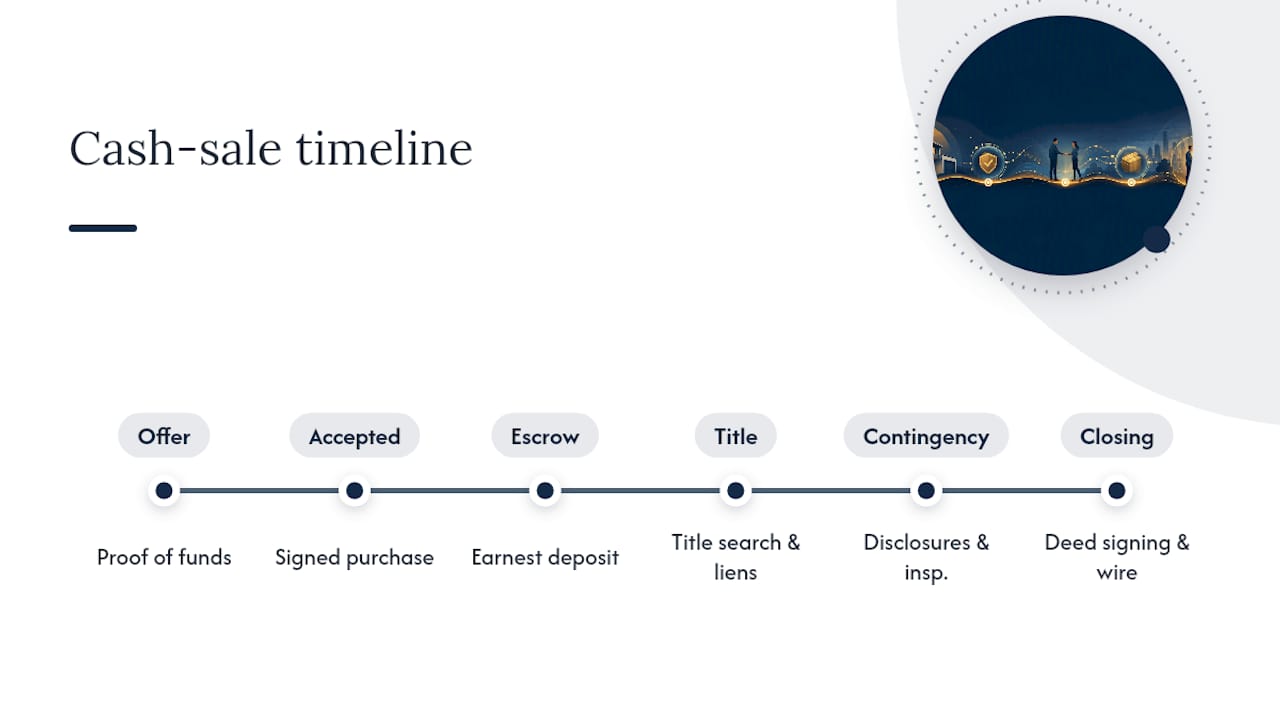
While title work is underway, the seller assembles disclosure paperwork and the buyer arranges any inspection they choose to complete, since cash buyers are not required to get one but many still do. With no lender involved, this stretch moves faster than a financed deal because there is no appraisal requirement and no loan underwriting to wait on.
Closing itself involves signing the deed, reviewing the settlement statement, and transferring funds, often by wire. Because so much of the delay in a typical sale comes from mortgage approval, a cash transaction can move from accepted offer to closed sale in a matter of days once title work clears, though the exact timeline depends on how quickly disclosures, title searches, and any inspection contingencies get resolved.
10. Purchase agreement details specific to cash offers
A cash purchase agreement covers the same core terms as any real estate contract: price, property description, closing date, and contingencies. The differences show up in a few specific clauses written to reflect the absence of a lender.
Financing contingencies disappear entirely, since there is no loan approval to wait on or protect against. In their place, many cash contracts include a proof of funds contingency instead, giving the seller the right to confirm the buyer’s funds before the contract becomes fully binding. Appraisal contingencies also typically drop out, since no lender is requiring the property to appraise at or above the purchase price.
What remains, and often matters more in a cash deal, are inspection and title contingencies. Buyers who waive financing protection often still want the right to inspect the property and back out or renegotiate if problems surface. Title contingencies protect the buyer’s right to receive clear, marketable title free of liens or disputes. The earnest money terms also deserve close attention: cash contracts sometimes call for a larger deposit than a financed deal, since the seller has less protection built into the transaction and wants assurance the buyer will follow through.
Closing timeline clauses tend to be shorter in cash contracts, often specifying a close within one to two weeks rather than the 30 to 45 days common with financed purchases, reflecting the fact that no loan underwriting needs to happen first.
11. The role of escrow documents in a cash transaction
Escrow still plays a central role in a cash sale even though no lender is holding funds in reserve. An escrow or title company acts as a neutral third party, holding the buyer’s earnest money deposit and, later, the full purchase funds until every condition of the contract is satisfied.
The escrow agreement itself, sometimes built into the purchase contract and sometimes a separate document, spells out the conditions under which the escrow holder releases funds: typically, once title is confirmed clear, all disclosures are signed, and both parties have executed the closing documents. Buyers should expect a deposit receipt confirming their earnest money has been received into escrow, which protects them if a dispute arises later over whether funds were sent.
As closing approaches, the escrow or title company prepares a settlement statement itemizing every cost, credit, and prorated expense, such as property taxes split between buyer and seller for the year. This document gets signed by both parties and becomes part of the permanent closing file. The escrow holder also manages recording the deed with the local land records office once funds have changed hands, which is the step that legally finalizes the transfer of ownership.
Because no mortgage payoff needs to route through the transaction beyond the seller’s own existing loan, escrow in a cash deal tends to close and disburse funds faster than in a financed sale, though the underlying documentation looks nearly identical.
12. Balancing speed against paperwork thoroughness
A fast close with minimal paperwork works fine when the seller has clean title, no liens, and a straightforward disclosure history. It stops working the moment something looks off: a POF letter with no bank contact, a deed with a gap in the chain of title, or funding that traces back to an entity nobody can identify.
Those situations call for slowing down, not speeding up. When a transaction involves gifted funds, an LLC buyer, or a property with any legal complication, it is worth bringing in a real estate attorney or tax advisor before signing anything.
*— Dave
How Rhody Home Buyer can simplify paperwork for sellers who need a fast cash sale
Rhody Home Buyer buys houses as-is, which means sellers skip the repair estimates, staging, and agent commissions that usually pile paperwork onto an already stressful sale. We guide sellers through the documents that are actually required and handle the rest.

Sellers working with us typically provide:
- The current deed or proof of ownership.
- A photo ID.
- Any mortgage payoff statement, if applicable.
Closing timelines can be flexible, often allowing a faster process than traditional sales since financing approvals are not involved. If you want to see what a cash offer looks like for your property, get a cash offer from Rhody Home Buyer and ask any paperwork questions along the way.
Sources
For readers who want the primary documents behind this checklist: EPA’s lead-based paint disclosure rule includes sample forms in English and Spanish, the IRS Form 1099-S instructions cover filing and reporting requirements, and a home defects checklist outlines common property conditions cash buyers accept.
- Real estate disclosures about potential lead hazards | US EPA
- Instructions for Form 1099-S (Rev. 4-2025)
- How to show proof of funds to buy a house with cash – LegalClarity
FAQ
How do I show proof of funds for a cash offer?
Provide a bank letter on official letterhead showing your name, account type, and current balance, ideally dated within 7 to 30 days, alongside a signature and contact information from a bank officer, according to proof of funds guidance. Pairing the letter with recent statements, with account numbers redacted, strengthens the offer further.
What are the risks of a cash offer on a house?
The main risks are fraudulent or fabricated proof of funds letters and wire fraud during the closing process, both of which target the paperwork stage rather than the offer terms themselves. Verifying bank letters by phone at a publicly listed number and confirming wiring instructions before sending funds address most of these risks.
How can I get a free proof of funds letter for a cash offer?
Most banks and brokerages issue a proof of funds letter to existing account holders at no charge, typically through a branch visit, phone call, or online banking request. The letter should include the account holder’s name, current balance, and a bank officer’s contact information to be considered credible by sellers.
How do I negotiate a cash offer on a house?
Sellers evaluating a cash offer typically weigh the strength of the proof of funds, the proposed closing timeline, and any contingencies alongside the price itself. A buyer with a clean, verifiable POF letter and a short, flexible closing date often has more room to negotiate on price than one with weaker documentation.
Does a cash sale still require Form 1099-S?
Yes, a cash sale still requires the closing or settlement agent to file Form 1099-S to report the sale, and the seller must receive a copy for tax purposes. This applies regardless of whether the buyer used cash or financing to complete the purchase.