
Your practical choices come down to four: sell the house and split proceeds, one spouse buys out the other, keep co-ownership for a defined period, or trade the house for other assets in the settlement. Selling is the most common route because it gives both parties a clean financial break, and a cash sale makes sense when speed matters more than maximizing price. Start today by ordering a current valuation and mortgage payoff quote, then loop in your attorney and a tax advisor before you sign anything.
TL;DR:
- Selling the house outright provides immediate cash and minimizes ongoing conflicts but depends on market conditions, repairs, and timing cooperation.
- Refinancing after divorce can be hindered by mortgage qualification issues, unpaid debts, and the need for a current approval letter before agreeing to a settlement.
- Accurate valuation, clear deadlines, and detailed settlement language are essential to prevent disputes and delays in house sales or buyouts.
- Fast cash buyers are a practical alternative when divorce deadlines are strict, or when traditional listing and refinancing become unfeasible.
- Tax benefits such as capital gains exclusions are higher when selling before finalizing the divorce, but temporary restraining orders can complicate or delay sales during active litigation.
Table of Contents
- Your Four Options for the Marital Home
- Should You Sell Before, During, or After the Divorce?
- Can You Refinance the Mortgage After Divorce?
- How Do You Calculate Equity and a Fair Buyout?
- Step-by-Step: Selling the House During Your Divorce
- What Belongs in the Settlement Agreement About the House
- Expert Cautions Before You Decide to Keep the House
- A Straight Answer from Someone Who Buys Houses for a Living
- When a Fast Cash Sale Makes More Sense Than Listing
- Where to Verify the Rules Yourself
- Sources
- FAQ
Your Four Options for the Marital Home
A divorce house sale isn’t the only path, though it’s the one most couples land on. Each option carries a different mix of cash, risk, and long-term entanglement.
Sell and split the proceeds. This is the cleanest break financially and legally. You both walk away with cash, no shared mortgage, and no reason to keep talking about the house. The tradeoff is timing risk. A slow market or a home needing repairs can delay the split for months.
One spouse buys out the other. The spouse keeping the house pays the other their share of equity, usually by refinancing to pull cash out or using other settlement assets. This preserves stability for kids staying in the same school district, but it hinges entirely on the buying spouse qualifying for a mortgage alone.
Co-own for a defined period. Some couples keep both names on the title and delay the sale, often until kids finish high school. This avoids uprooting anyone immediately, but it also means two people who are legally separated still share one of the biggest financial decisions in their lives.
Trade the house for other assets. One spouse keeps the house; the other takes a larger share of retirement accounts, investments, or cash to balance the scales. This works when both sides have accurate valuations for everything on the table, since a mispriced house skews the entire trade.
Consider these tradeoffs before committing:
- Selling produces immediate liquidity but requires cooperation on price, repairs, and timing.
- A buyout avoids a public sale but concentrates risk on one spouse’s future income.
- Co-ownership delays disruption but extends financial entanglement past the divorce decree.
- An asset trade simplifies logistics but demands precise valuations on both sides of the ledger.
Should You Sell Before, During, or After the Divorce?
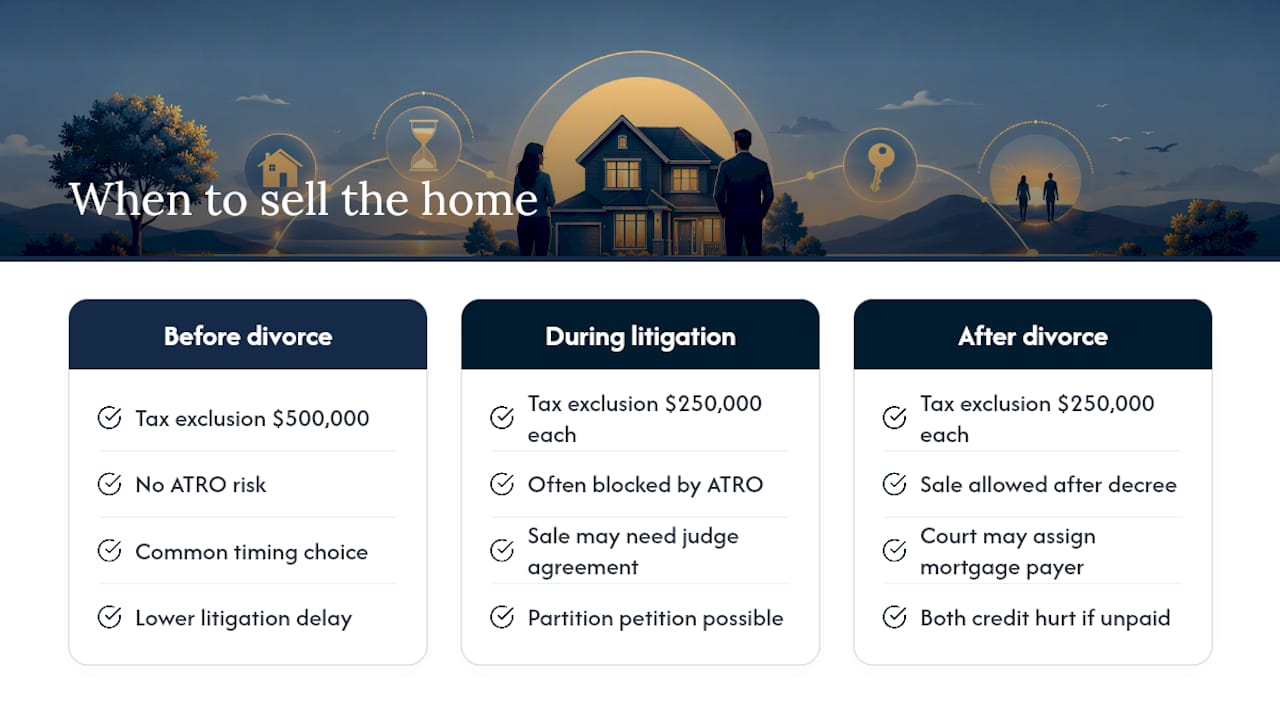
Timing changes your tax bill more than almost any other decision in the process. Sell while still married and filing jointly, and you can exclude up to $500,000 in capital gains on your primary residence. Once you’re divorced, each spouse’s exclusion drops to $250,000 individually, provided you meet the IRS ownership and use tests, which generally require living in the home for two of the last five years.
Pro Tip: If you’re close to finalizing the divorce and the house has appreciated significantly, ask your attorney whether delaying the final decree by a few weeks to close the sale first could preserve the larger $500,000 exclusion.
Selling during active litigation isn’t always possible. Many states issue Automatic Temporary Restraining Orders (ATROs) the moment a divorce is filed, which can freeze major asset transactions, including a home sale, until both parties agree or a judge intervenes. That’s why so many house sales happen either right before filing or after the decree is final.
Mortgage payments in the interim are a frequent flashpoint. Courts often assign temporary responsibility to whoever stays in the home, but if neither spouse pays, both credit scores take the hit. If one spouse simply refuses to sell, the other can petition for a court-ordered partition or sale, though that route typically adds months and legal fees neither side wanted to spend.
Can You Refinance the Mortgage After Divorce?
Refinancing sounds simple in a settlement agreement. In practice, it’s where a lot of divorce plans fall apart.
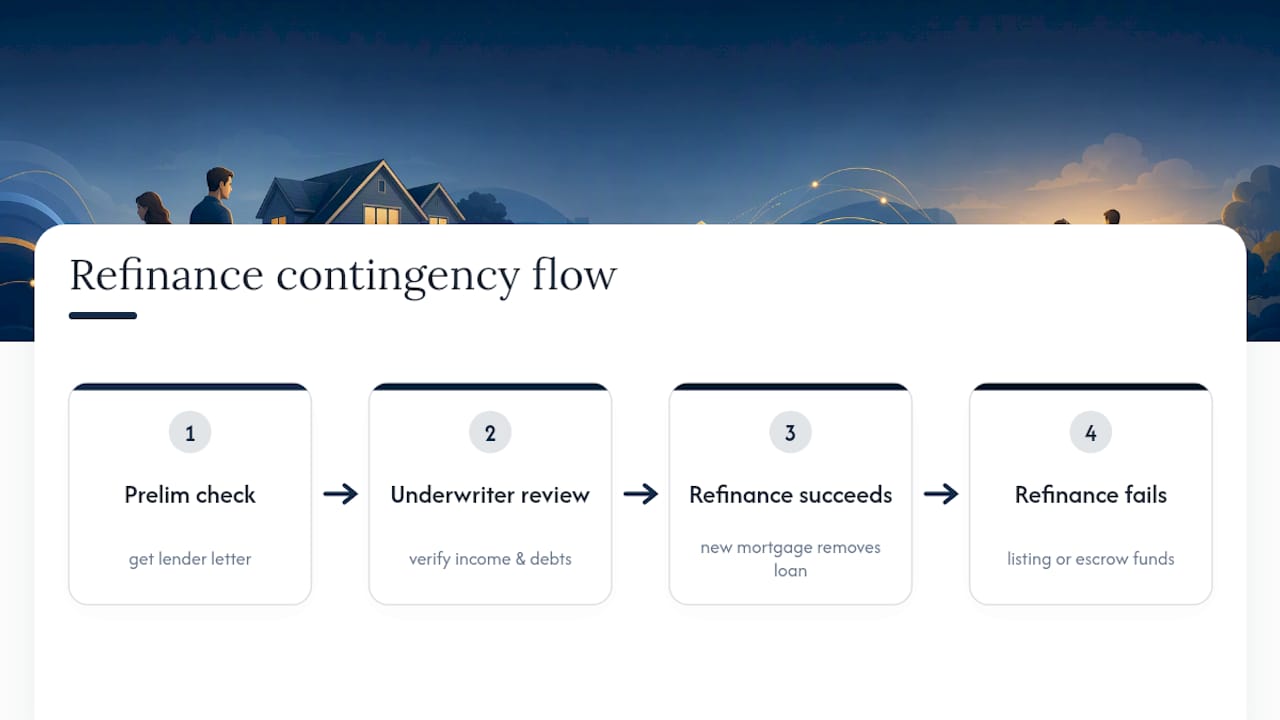
Lenders qualify the remaining spouse on their own income, not the household income you both used to bring in. Support payments like alimony or child support often can’t be counted toward qualification until they’ve been received consistently for six to twelve months, according to First Commerce Financial’s guidance on divorce mortgages. If your decree assumes a quick refinance right after the papers are signed, that assumption may not survive contact with an actual underwriter.
There’s a second trap. Debts assigned to your ex-spouse in the settlement, like a car loan or credit card balance, can still show up on your credit report and affect your debt-to-income ratio until they’re actually paid off or formally removed from the account. A decree saying “he takes the credit card debt” doesn’t erase it from your credit history.
Pro Tip: Before you agree to a refinance deadline in your settlement, get a preliminary qualification letter from a lender. It costs nothing and can save you from a decree that sets you up to fail.
If the refinance falls through, you need a backup plan already written into the agreement. Common fallbacks include a mandatory listing within a set number of days, or escrowed funds that cover the mortgage while the parties renegotiate. The Consumer Financial Protection Bureau offers plain-language resources on how servicers handle these transitions, which is worth reading before you assume anything about how your loan will behave.
How Do You Calculate Equity and a Fair Buyout?
The math behind a divorce house sale isn’t complicated, but it needs to be done in the right order or one spouse ends up shortchanged.
- Find your equity. Appraised value minus the remaining mortgage balance equals your equity. A home appraised at $400,000 with a $250,000 mortgage balance leaves $150,000 in equity.
- Subtract selling costs for net proceeds. Closing costs and commissions typically run 6 to 10 percent of the sale price. On that same home, expect to lose roughly $24,000 to $40,000 before the remaining balance gets split, per typical sale-mechanics breakdowns.
- Calculate the buyout. If one spouse is staying, the formula is usually (equity minus any agreed offsets) divided by two, unless your decree specifies a different split. On $150,000 in equity with no offsets, that’s a $75,000 payout to the departing spouse.
- Adjust for improvements, liens, or debts. A second mortgage, unpaid contractor lien, or one spouse’s documented capital improvements can shift the split before the final number gets set.
These numbers only work if the appraisal is current and both sides agree on the mortgage payoff figure, not the balance from six months ago.
Step-by-Step: Selling the House During Your Divorce
A divorce house sale moves faster and with less conflict when both spouses agree on the mechanics upfront, not after an offer arrives.
- Order a valuation and payoff statement first. Get either a full appraisal or a comparative market analysis, plus a written mortgage payoff quote from your servicer. Both numbers expire, so get them close to your actual listing date.
- Decide who represents the sale. Many divorcing couples use a single neutral listing agent representing both spouses instead of hiring two competing agents, which tends to reduce conflict and confusion over pricing and showings. Others skip the agent route entirely and evaluate a cash-buyer offer against expected net proceeds from a traditional listing.
- Put showing and repair authority in writing. Decide now who approves repairs, who’s present for showings, and who signs off on price reductions if the house sits unsold.
- Agree on who pays what while the house is listed. Mortgage, property taxes, homeowners insurance, and utilities all need an assigned payer in writing, not a verbal understanding.
- Plan the closing split before an offer arrives. Decide whether proceeds get wired to a joint account, split directly at closing, or held in escrow pending a final accounting of expenses.
Skipping any one of these steps is how a routine sale turns into a three-month standoff over who forgot to mow the lawn before a showing.
What Belongs in the Settlement Agreement About the House
Vague settlement language is where most post-divorce house disputes start. Specific deadlines and payment terms prevent a second trip to court.
- Set a hard listing or refinance deadline, with a defined consequence (like a forced sale) if it’s missed.
- Name exactly who pays the mortgage, property taxes, and insurance while the home is on the market.
- Specify who has authority to accept an offer, approve a price reduction, or hire a listing agent.
- Include an escrow or holdback arrangement for sale proceeds if disputes over repairs or credits are likely.
- Define a dispute-resolution method, whether that’s mediation or returning to the original judge, so disagreements don’t require filing a new case.
Attorneys who handle these cases regularly point out that specific, deadline-driven language prevents the kind of ambiguity that sends couples back to court months after the decree is signed.
Expert Cautions Before You Decide to Keep the House
Keeping the family home feels like stability. Financially, it’s often a bet nobody stress-tested.
Financial advisors consistently warn that a house kept without a clear, sustainable budget can quietly turn from a stable asset into a liability once property taxes, insurance premiums, or interest rates shift after the divorce is final.
That’s why practitioners increasingly recommend running a formal Divorce Mortgage Planning Report or CDLP consultation before agreeing to keep the house in a decree. It stress-tests whether the refinance will actually happen on schedule.
Short-term co-ownership deserves the same scrutiny. It frequently extends conflict rather than avoiding it, unless the agreement includes hard exit triggers, like a sale date tied to a child’s graduation, not a vague “when things settle down.”
A Straight Answer from Someone Who Buys Houses for a Living
Divorce doesn’t leave much room for a leisurely home sale, and I’ve watched enough of these deals cross my desk to know when speed genuinely matters versus when it’s just panic talking. If your settlement has a tight deadline, a refinance that’s already fallen through once, or a house neither of you can afford to carry another month, a fast as-is sale isn’t giving up. It’s often the financially sound move.
What I’d push back on is treating “keep the house” as the emotionally safe default. The math has to work on its own, months after the divorce is final, not just on the day you sign. Choose based on what your budget can sustain, not what feels less painful this week. If you’re rebuilding after the split, resources like The Broken Seam’s practical roadmap can help you think through the housing decision as part of the bigger picture, not in isolation.
— Dave
When a Fast Cash Sale Makes More Sense Than Listing
A cash buyer exists for exactly the situation this article just walked through: a settlement deadline that won’t bend, a refinance that fell apart, or a mortgage neither of you can keep covering while a traditional listing sits on the market. Such buyers purchase houses as-is, often based on the After Repaired Value, so there’s no repair list to negotiate between two people who’d rather not negotiate anything else right now.

There’s no agent commission, no showings around your schedule, and no financing contingency that can collapse the deal at the last minute the way a buyer’s mortgage approval can. A market listing still makes sense if you have time and want to maximize price. But if your decree has a hard deadline or the house has become a financial drag on both of you, get a cash offer from Rhodyhomebuyer and see the number before you commit to anything else in the settlement.
Where to Verify the Rules Yourself
Don’t take secondhand summaries as the final word on tax or lending rules that affect your settlement.
- IRS Topic No. 701 covers the home-sale gain exclusion and the ownership/use tests directly from the source.
- CFPB’s mortgage resources explain servicing rules and borrower protections in plain language.
- The American Bar Association publishes divorce and property-division resources written for consumers, not just attorneys.
Sources
- IRS Topic No. 701
- CFPB — Mortgages
- Divorce and mortgage qualification — First Commerce Financial
- Peeples Law — Real estate sales during or after the divorce
FAQ
How Hard Is It to Sell a House During a Divorce?
It’s harder logistically than a normal sale because both spouses must agree on price, repairs, and timing, but a single neutral listing agent or a cash buyer can remove most of the friction.
How Do You Divorce When You Can’t Afford to Live Separately?
Many couples stay under one roof temporarily, sell the house quickly to access equity, or use a court-ordered temporary support arrangement while the house sale proceeds; a fast cash sale can shorten the wait for accessible funds.
What Assets Can’t Be Touched in a Divorce?
Separate property owned before the marriage, inheritances kept apart from marital funds, and certain personal injury settlements are typically protected, though rules vary significantly by state, so confirm specifics with a family law attorney.
Can My Ex-Husband Sell Our House Without My Signature?
If both names are on the title, no, both signatures are generally required to sell; if he tries to force a sale unilaterally and you disagree, the house typically stays off the market until a court resolves the dispute or orders a partition.