
In most cash-for-home sales you still owe prorated taxes, recording and title fees, and any mortgage payoff, but you usually avoid lender fees and agent commissions. Gone are the appraisal fees, loan origination charges, and lender’s title policy that come standard with a financed buyer. Some direct cash buyers structure offers around this stripped-down cost picture rather than the traditional model.
TL;DR:
- Transfer taxes can range from 0.1% to 3% of the sale price, significantly affecting closing costs in some states and cities.
- Seller closing costs typically fall between 1% and 3% of the sale price, not including mortgage payoff or liens, which can total several thousand dollars.
- Asking for a sample settlement statement upfront and confirming mortgage payoff details directly can prevent surprises at closing.
- Negotiating who pays transfer taxes, owner’s title insurance, and selecting the escrow company can lower overall closing expenses.
- Cash buyers usually eliminate lender-related fees but may include costs like title searches, transfer taxes, and escrow fees, which sellers must understand and verify.
Table of Contents
- Cash Sale Closing Costs: The Itemized Checklist
- What the Numbers Actually Look Like
- How to Negotiate Closing Costs With a Cash Buyer
- Reading the Settlement Statement Before You Sign
- How Rhody Home Buyer Handles Closing Costs
- A Publisher’s Take on Where Sellers Get Burned
- Ready to See Your Actual Numbers?
- Sources
Cash Sale Closing Costs: The Itemized Checklist
A cash sale still generates a settlement statement, and that statement still has line items with your name on them. Knowing what to expect before you sign keeps you from being surprised at the closing table.
Here’s what typically shows up on a seller’s side of the ledger:
- Title search and owner’s title insurance. Someone has to confirm you actually own the property free and clear. If you’re covering the owner’s policy, budget roughly $500 to $1,000 depending on home value and state.
- Transfer taxes (documentary stamps). This is the line item most likely to surprise you. Rates run from about 0.1% up to 3% of the sale price depending on your state, and some cities layer on their own local transfer tax on top of the state rate.
- Escrow and settlement fees. The title or escrow company charges for managing funds and paperwork, generally a few hundred dollars.
- Recording fees. The county charges to file the deed and related documents. Usually well under $100.
- Attorney fees. Several states require an attorney at closing. Where that’s the rule, fees typically run from a few hundred to several thousand dollars depending on complexity.
- HOA estoppel fees. If your property sits in an HOA, expect a fee (often $100 to $300) for a letter confirming your dues are current.
- Prorated property taxes. You pay your share of the year’s taxes up to the closing date, no matter who buys the house.
- Mortgage payoff and lien resolution. Any remaining mortgage balance, judgment, or contractor’s lien gets paid off out of proceeds at closing. This isn’t technically a “cost,” but it reduces your check the same way.
None of these items disappear just because the buyer isn’t financing. What disappears is everything tied to a lender: underwriting fees, appraisal fees, loan origination points, and the lender’s title policy. Those charges alone can add up to thousands of dollars, and they simply don’t exist when there’s no mortgage in the deal.
What the Numbers Actually Look Like
Seller closing costs in cash sales commonly land in the 1% to 3% range, not counting a mortgage payoff. That range climbs when your state charges a steep transfer tax or when local custom puts owner’s title insurance on the seller’s shoulders.
Here’s how that plays out in real dollars:
- $150,000 sale price: At 2%, seller costs run around $3,000, covering title work, recording, prorated taxes, and a modest transfer tax.
- $300,000 sale price: At 2%, that’s $6,000. In a state with a higher transfer tax bracket, this could push toward $9,000, or 3%.
- $500,000 sale price: At 2%, you’re looking at $10,000. A jurisdiction near the top of the transfer tax scale could bring seller costs closer to $15,000.
A sample settlement from an actual cash transaction shows the buyer covering a $400 settlement fee, $200 title search, $225 document prep, roughly $566 for owner’s title insurance, and a $28 recording fee, with the seller paying nothing out of pocket on those line items.
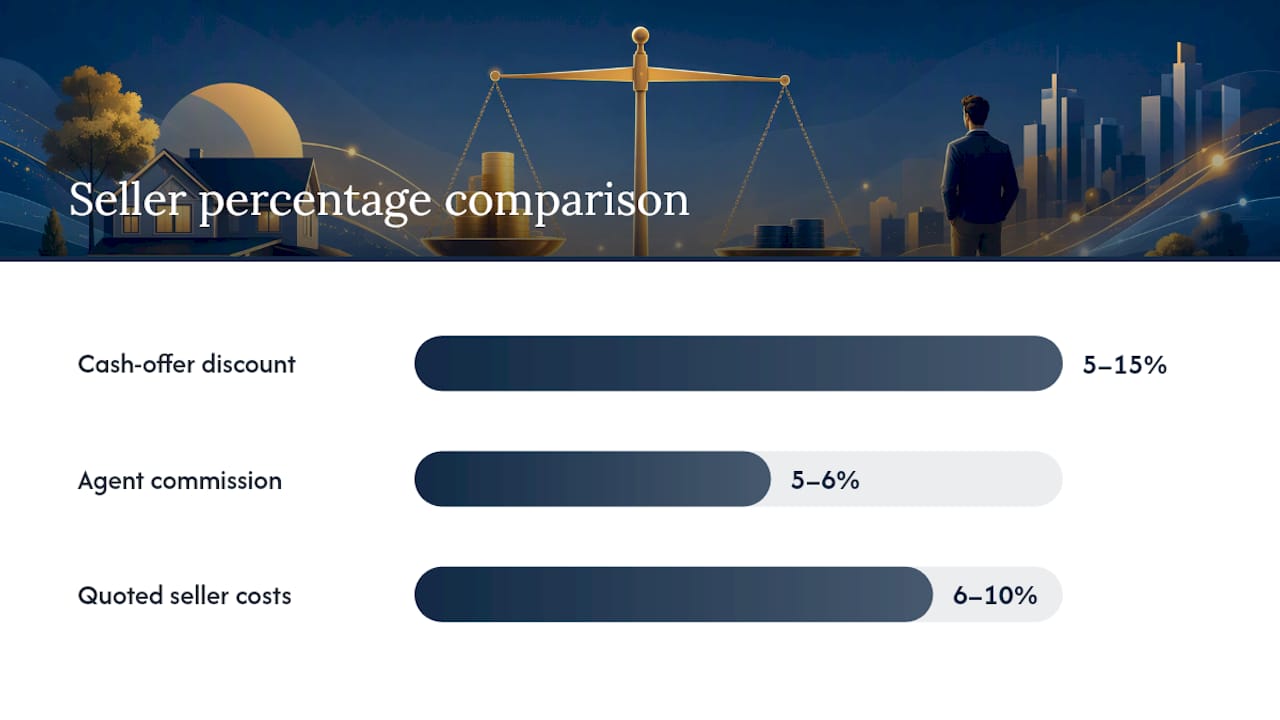
That’s the trade you’re actually weighing: a smaller, cleaner cost sheet against an offer that may run 5% to 15% below market value, depending on your home’s condition and the investor’s resale strategy. Skipping a 5% to 6% agent commission is real money. Most of what people quote as “typical” 6% to 10% seller costs is really commission dressed up as a closing fee, and in a direct cash sale, that line item is off the table entirely.
How to Negotiate Closing Costs With a Cash Buyer
A cash buyer covering “all your closing costs” sounds generous until you realize that cost often gets built back into a lower offer. The number that matters isn’t what the buyer promises to pay. It’s your net proceeds after everything clears.
Before you sign anything, ask directly:
- Who pays the transfer tax, and is that specified in the purchase agreement?
- Who selects the title or escrow company, and can I request a different one?
- Will you cover owner’s title insurance, or is that on me?
- Can I see a sample HUD-1 or settlement statement before closing day?
- What is the exact closing date, and is it firm?
Get any buyer-paid item written into the purchase agreement itself, not just discussed verbally. Verbal promises about who covers what tend to evaporate once the paperwork gets drawn up.
Pro Tip: In many states, you have the right to choose the title company even when a cash buyer suggests their own. Choosing a title company you trust, rather than the buyer’s preferred vendor, can shave money off escrow fees and gives you a second set of eyes on the numbers.
Reading the Settlement Statement Before You Sign
Cash transactions commonly use a HUD-1 settlement statement, while financed deals rely on a Closing Disclosure. Knowing which document you’re reviewing tells you what to check.
On a HUD-1, walk through these lines before signing:
- Your mortgage payoff amount, confirmed directly with your lender, not estimated
- Any lien or judgment payoffs, especially older contractor liens that can surface late
- Prorated tax and HOA figures, calculated to the actual closing date
- Every fee credited to the buyer, matching what your purchase agreement promised
Wire fraud targets real estate closings constantly, so confirm account and routing numbers by phone with the title company directly, using a number you already have on file, not one from a last-minute email. Once the mortgage payoff and liens clear, your net proceeds typically arrive within one to a few business days, depending on your title company’s process.
How Rhody Home Buyer Handles Closing Costs
Some cash buyers build offers around the As-Is condition of your home, using an After Repaired Value calculation rather than the retail listing model. This structure removes agent commissions from the equation entirely and lets them make a fair cash offer without asking you to fix or clean anything first.
Transparency at closing means the offer breakdown you see at the start is the one you see at the signing table. No surprise line items, no last-minute renegotiation over repairs or fees that weren’t part of the original conversation.
The offer terms spell out which costs, if any, certain buyers cover, and sellers can review the title company selection and closing logistics before committing to a date. That process detail matters more than most sellers realize until they’ve been through a deal where it wasn’t disclosed upfront.
A Publisher’s Take on Where Sellers Get Burned
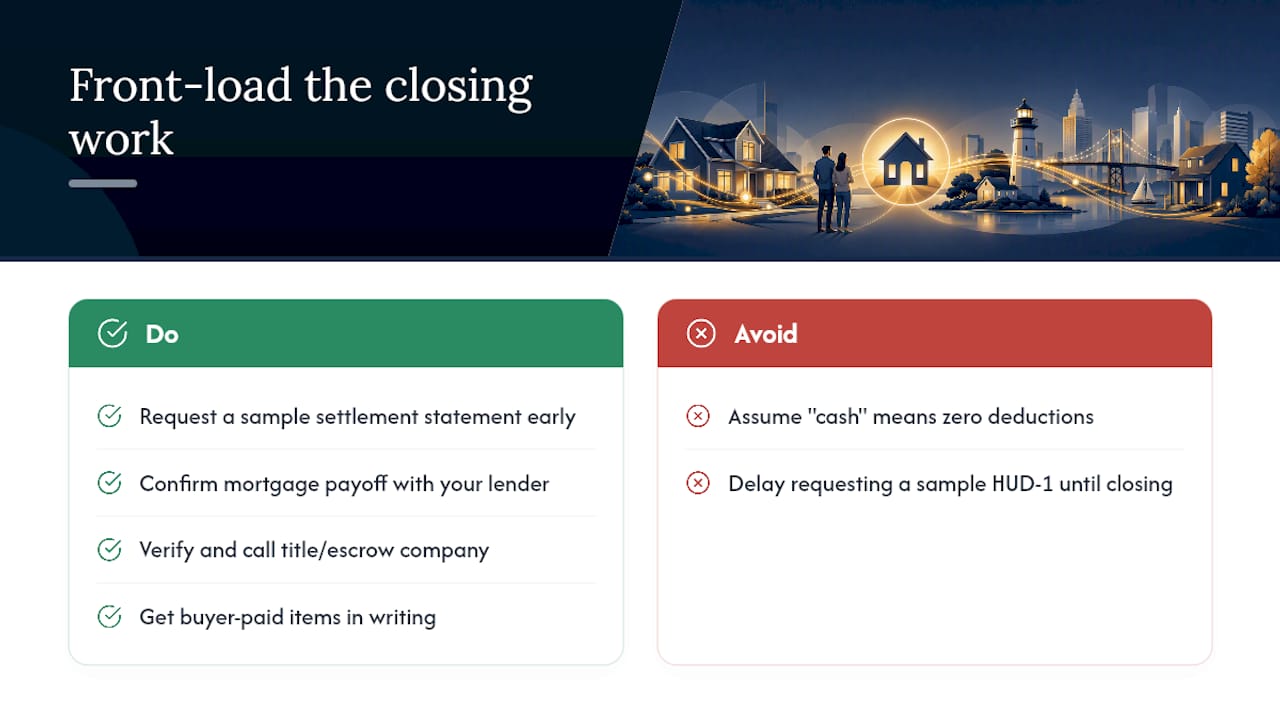
The biggest mistake I see: sellers assume “cash” means “zero deductions,” then get blind sided by a payoff balance or a lien they forgot existed. The second biggest: not asking for a sample HUD-1 until the day of closing, when there’s no time left to negotiate anything.
Fix both by front loading the work. Request a sample settlement statement early. Confirm your mortgage payoff with your lender directly. Verify who’s handling title and escrow, and call them yourself. Get every buyer-paid item in writing before you sign. And ask for a real net-proceeds estimate, not a round number pulled from the initial offer conversation.
— Dave
Ready to See Your Actual Numbers?
Some cash buyers provide an alternative to listing with an agent when you want a straightforward answer on what lands in your pocket, not a percentage buried in fine print. Because there’s no commission and no lender fees to navigate, the offer breakdown you get upfront can be close to what you’ll see at closing.

The process starts with a simple offer request. Some cash buyers review your property, calculate a fair cash offer based on its As-Is condition, and walk you through exactly which costs, if any, come out of your proceeds. From there, you pick a closing date that works for you, sometimes in as little as a week. If you’re ready to see what a transparent, commission-free offer actually looks like for your situation, request your cash offer and get real numbers instead of guesses. You can also read more about how the process works before you commit to anything.
Sources
- Real estate transfer taxes by state — PropertyShark
- Do cash buyers pay closing costs? — HomeLight
- Closing costs for sellers — Zillow