
Yes, you can legally avoid or shrink realtor fees, and there are four main routes: sell FSBO, pay a flat fee to get on the MLS, hire a discount agent, or sell directly to a cash buyer or investor. Each one trades something for that savings, whether it’s your time, your marketing reach, or a chunk of the sale price itself. Buyer-agent compensation is also negotiable now, not automatic, so even sellers who list traditionally have more leverage than they think.
TL;DR:
- Selling FSBO often results in homes selling for less due to pricing mistakes and weaker marketing reach, with an average 5% to 6% commission offset.
- Flat-fee MLS listings cost between $99 and $999, providing broad online exposure without full agent services, suitable for confident sellers handling negotiations.
- Discount agents typically reduce commissions to 1-2%, but may limit services, so interviewing multiple providers ensures you understand what is included.
- Cash buyers and iBuyers may offer quick sales with no listing commission but usually at a 7% to 18% discount on the final sale price.
- Closing costs like title fees and transfer taxes remain regardless of the sale method, and legal review is recommended for all transaction types.
Table of Contents
- What Are the Legitimate No-Fee and Low-Fee Options?
- How Does FSBO Work and What Will You Have to Handle Yourself?
- Should You Use a Flat-Fee MLS Service Instead of Going Fully FSBO?
- How Do You Find and Negotiate With a Discount Agent?
- What Do Cash Buyers and iBuyers Actually Cost You?
- What Legal and Closing Costs Remain Even Without an Agent?
- How Do You Calculate Your Actual Net Proceeds?
- How Do You Choose the Right No-Fee Route for Your Situation?
- When Do No-Fee Routes Actually Make Sense?
- Want to Skip the Fees and the Showings Entirely?
- Where to Verify These Numbers Yourself
- Sources
What Are the Legitimate No-Fee and Low-Fee Options?
Before you commit to any path, it helps to see all five side by side. Agent commissions still average roughly 5% to 6% of the sale price, split between the listing broker and the buyer’s agent, so anything that cuts into that total is worth a serious look.
- For sale by owner (FSBO): You skip the listing commission entirely, but you take on pricing, marketing, showings, and negotiation yourself. Best for sellers with time, a strong local market, and a house that doesn’t need much selling.
- Flat-fee MLS listing: You pay a set price, often between $99 and $999, to get your listing onto the Multiple Listing Service and feeding sites like Zillow and Realtor.com. Best for sellers who want broad exposure without paying a percentage.
- Discount or low-commission agent: You get licensed representation for a reduced percentage, often 1% to 2%, sometimes with fewer included services. Best for sellers who want professional guidance but don’t need the full-service package.
- Cash buyers and iBuyers: You get a fast, no-showings sale with zero listing commission, but the offer usually lands below market value once fees and adjustments are factored in. Best for sellers who value speed and certainty over top dollar.
- Local real estate investors: Similar to iBuyers but often more flexible on condition and timeline, particularly useful for homes that need repairs or sellers facing a deadline. Best for distressed properties or urgent situations where traditional buyers would balk.
None of these is objectively “best.” The right choice depends on whether you’re optimizing for price, speed, or your own free time.
How Does FSBO Work and What Will You Have to Handle Yourself?
Selling FSBO means you become the listing agent, the marketing department, and the negotiator, all at once. The process breaks down into a handful of concrete tasks, and skipping any one of them is usually where FSBO sellers get burned.
Pricing your home correctly comes first. Without an agent pulling comps for you, you’ll need to research recent sales in your area yourself, through county records, Zillow’s sold listings, or a paid appraisal. Overpricing is the single most common FSBO mistake, because sellers tend to anchor to what they want, not what buyers will actually pay.
Getting on the MLS is next, and this is where flat-fee services come in. A full-service agent bundles MLS access into their commission, but FSBO sellers can pay a flat-fee provider, often $99 to $999 depending on the plan, to get the same MLS exposure and syndication to major portals.
Marketing beyond the MLS matters too. That means professional photos, a compelling listing description, yard signs, and social media posts. Skimping here is a fast way to sit on the market longer than a comparable agent-listed home.
Managing showings and offers falls entirely on you. You’ll field calls, schedule walkthroughs, and negotiate directly with buyers or their agents, which can be uncomfortable if you’re emotionally attached to the number in your head.
Closing paperwork is the last, and highest-stakes, stage. Purchase agreements, disclosures, title work, and closing documents all need to be accurate and legally sound.
Here’s the data that should temper your expectations: FSBO homes have historically sold for less than agent-assisted homes, according to research cited by Fidelity. Part of that gap comes from pricing mistakes, part from weaker marketing reach, and part from buyers assuming an unrepresented seller will negotiate harder on price.
Pro Tip: Hire a real estate attorney to review your purchase agreement and disclosures before you sign anything. Many FSBO sellers who skip this step discover contract gaps only after a buyer’s attorney points them out, at which point renegotiating from a weaker position is your only option.
Some states require an attorney at the closing table by law, and even where it’s optional, legal guidance for FSBO sellers consistently recommends it. Budget for a few hundred dollars in attorney fees. It’s cheap insurance against a lawsuit that could cost you far more.
Should You Use a Flat-Fee MLS Service Instead of Going Fully FSBO?
Flat-fee MLS splits the difference between full FSBO and a traditional listing. You get the single biggest advantage an agent provides, which is MLS exposure, without paying for the rest of the service package.
MLS access matters because that’s where the syndication happens. List on the MLS and your home automatically populates on Zillow, Realtor.com, Redfin, and dozens of other sites buyers actually browse. Skip it, and you’re relying on Craigslist, Facebook Marketplace, and yard signs to reach buyers who might never see your listing.
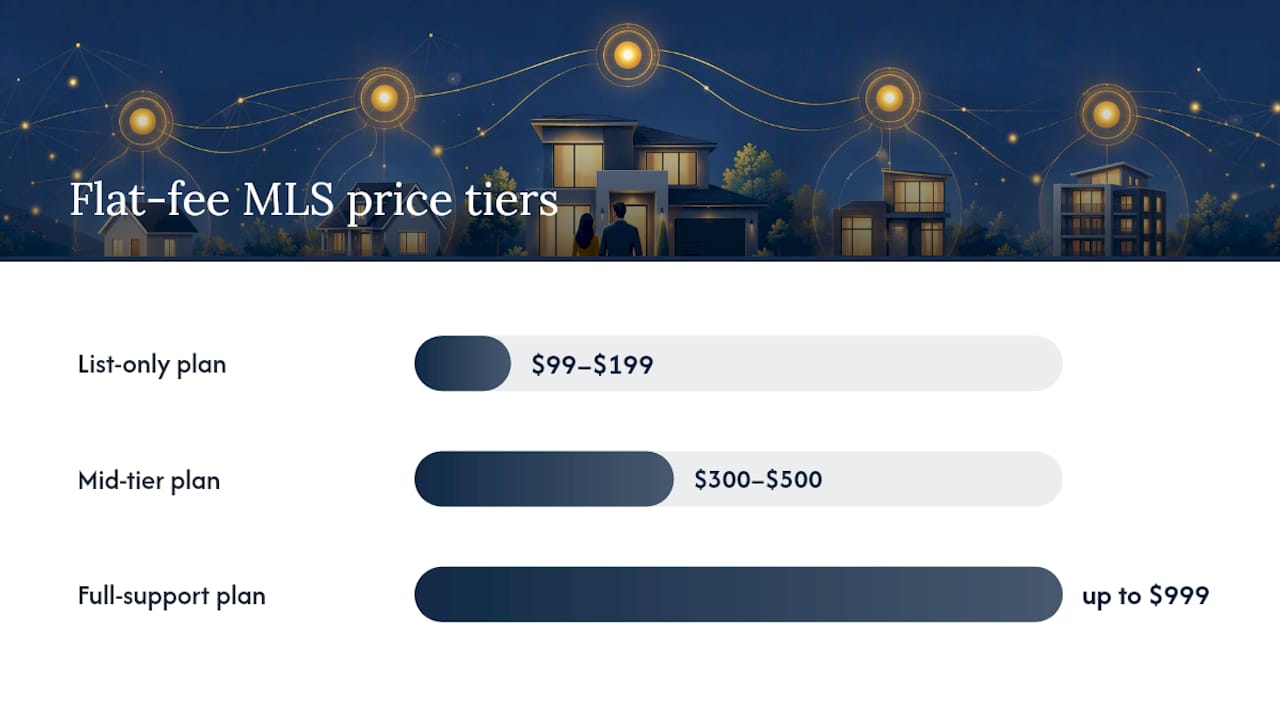
Flat-fee providers typically offer a few service tiers:
- List-only plans (often near the $99 to $199 range): You get MLS placement and photos uploaded, and that’s it. You handle everything else.
- Mid-tier plans (often $300 to $500): Add a lockbox, basic paperwork templates, and sometimes a yard sign or a limited number of photo edits.
- Full-support plans (up to roughly $999): Include contract review assistance, showing coordination, and sometimes a licensed agent on call for questions.
Flat-fee MLS tends to make the most sense for sellers who are comfortable handling negotiations and paperwork but want the marketing reach of a traditional listing. It’s a weaker fit if you’ve never sold a house before and don’t want to learn contract law under time pressure.
Before you sign up with any provider, run through this checklist:
- Confirm exactly which MLS regions or boards the plan covers, since some flat-fee services only reach one county.
- Ask how long the listing stays active and what happens if your home doesn’t sell in that window.
- Check whether photo updates, price changes, or listing edits cost extra after the initial upload.
- Read the fine print on cancellation, because some plans lock you into a contract length even if you switch strategies.
Pro Tip: Call the provider and ask a specific question about your address before you pay anything. A responsive company will answer quickly; a slow or vague reply is a preview of what support looks like after they have your money.
How Do You Find and Negotiate With a Discount Agent?
Discount agents aren’t a single business model. Some charge a flat fee for a full-service listing. Others charge a reduced percentage, commonly 1% to 2% instead of the standard 2.5% to 3% listing side, but cap the marketing budget or limit how many showings they’ll personally handle. A few operate on a “menu” system, where you pay separately for each service you actually want.
The trade-off retains real value when the agent still provides pricing strategy, contract review, and negotiation support, since those are the pieces that most often cost FSBO sellers money on the back end. It stops being a good deal when “discount” really means “reduced effort,” and you end up doing the marketing work yourself anyway while still paying a commission.
- Interview at least three agents and ask each one directly what their reduced fee does and does not include.
- Ask for their marketing plan in writing, including photography, MLS syndication, and any paid advertising, before you compare pricing.
- Negotiate the listing agreement’s duration, since a 30 to 60 day term gives you an exit if the agent underperforms, rather than locking you into six months.
- Ask how showings get scheduled and who handles them, since some discount agents rely heavily on lockbox access and self-guided tours.
- Get a straight answer on buyer-agent compensation, since that’s now a negotiated line item rather than an automatic MLS field following the 2024 NAR settlement changes.
Watch for red flags like vague answers about marketing spend, reluctance to put service inclusions in writing, or pressure to sign immediately. A discount agent worth hiring will welcome the scrutiny.
Pro Tip: Ask every agent the same five questions in the same order. Side-by-side answers make weak commitments obvious in a way that scattered conversations never do.
What Do Cash Buyers and iBuyers Actually Cost You?
Cash buyers and iBuyers eliminate the listing commission completely, but they replace it with something less visible: a lower offer price. Industry summaries put total iBuyer costs, once service fees, repair-cost adjustments, and convenience charges are factored in, somewhere between 7% and 18% of the home’s value in some cases. That’s often more than a traditional agent commission, not less.
The trade-off in one line: you’re not avoiding a fee so much as swapping a transparent commission for a less visible discount baked into the offer itself.
Here’s where that gap actually comes from:
- Service or convenience fees, charged as a percentage of the sale price for the certainty of an instant offer.
- Repair cost deductions, where the buyer estimates repair needs after an inspection and subtracts that estimate from your final payout, sometimes far more than the repairs would actually cost you.
- Inspection holdbacks, where a portion of your proceeds gets withheld until repairs are verified or a contingency clears.
- Reduced initial offers, since most iBuyer models price below market from the start to build in resale margin.
Major iBuyer programs also aren’t available everywhere. Coverage tends to concentrate in larger metro markets, and rural or smaller-market sellers often find these programs simply don’t operate in their area at all. Local investors can fill the gap, particularly for homes needing significant repairs, inherited properties, or sellers facing foreclosure timelines where speed matters more than maximizing price.
Speed and certainty justify the discount when you’re facing a deadline: a job relocation, a probate timeline, mounting repair costs you can’t front, or a house that’s been sitting unsold for months already. If none of those apply to you, the math usually favors a traditional or discount listing instead.
What Legal and Closing Costs Remain Even Without an Agent?
Cutting the commission doesn’t cut every cost. Title fees, transfer taxes, and escrow charges apply whether or not an agent is involved, and some states legally require an attorney at closing regardless of how you sold the home.
Attorney involvement varies significantly by state. In places that mandate it, budget for either an hourly rate or a flat closing fee, which typically runs a few hundred to low thousands of dollars depending on complexity. Even in states where it’s optional, most FSBO guidance recommends it anyway.
Standard closing costs that stick around no matter how you sell:
- Title insurance and title search fees
- State or local transfer taxes
- Escrow or settlement agent fees
- Recording fees for the deed transfer
- Any prorated property taxes or HOA dues owed at closing
Put every agreement about buyer-agent compensation or seller concessions in writing, since verbal understandings tend to fall apart the moment a deal gets tense. Before closing, gather your deed, disclosure forms, any HOA documents, and payoff information for your mortgage, and consider whether a transaction coordinator or attorney should review the closing package before you sign.
How Do You Calculate Your Actual Net Proceeds?
The commission you avoid only matters if it actually increases what lands in your pocket. Run the math before you commit to a strategy, using this basic formula:
Net proceeds = Sale price − mortgage payoff − closing costs − any fees specific to your chosen route
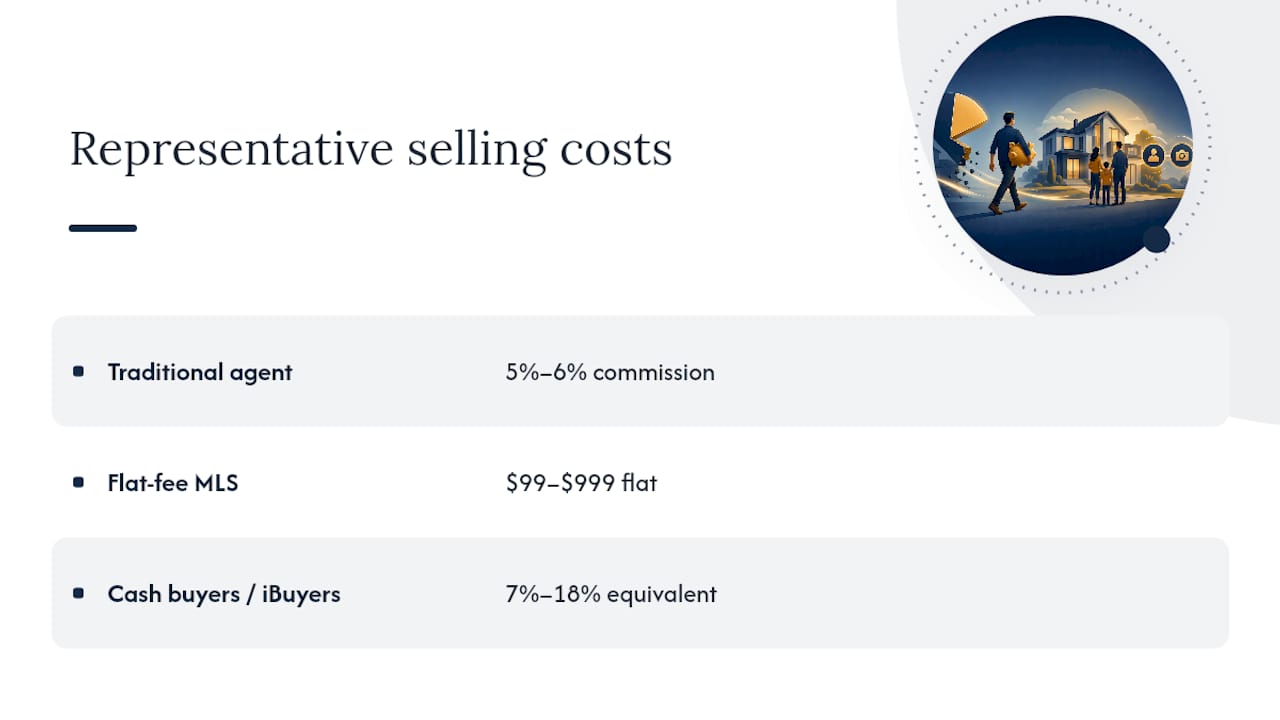
Plug in realistic numbers for each path. A traditional agent listing costs roughly 5% to 6% in combined commission. Flat-fee MLS runs $99 to $999 flat. Cash buyers and iBuyers can cost the equivalent of 7% to 18% once every fee and adjustment is counted. These are representative ranges, not guarantees, and your actual numbers depend on your market and the specific provider.
Two quick scenarios show why the “no fee” option isn’t automatically the winner:
Scenario one: A $400,000 home sold traditionally at 5.5% commission costs $22,000. The same home sold FSBO with a $500 flat-fee MLS plan and no price drag nets $21,500 more than the traditional sale, assuming it sells at the same price. FSBO wins here, but only if the price genuinely holds.
Scenario two: That same $400,000 home sells FSBO for $380,000 because of pricing mistakes and weaker exposure, which is a documented risk given the FSBO price gap. Now the traditional listing, despite the commission, nets more money.
Use conservative assumptions, and check actual local comps before assuming your home will hold its price without professional pricing help. When you’re deciding between a fast cash sale and a longer listing process, understanding how cash transactions work can clarify what you’re really trading for the speed.
How Do You Choose the Right No-Fee Route for Your Situation?
Start by ranking what actually matters to you: price, speed, certainty, or how much work you’re willing to do. Nobody maximizes all four at once, so figure out your real priority before you pick a path.
- Identify your top priority. If it’s maximum price and you have time, lean toward FSBO or a discount agent with strong marketing. If it’s speed and certainty, a cash buyer or investor fits better.
- Interview at least two providers per option you’re considering, whether that’s flat-fee MLS companies, discount agents, or cash buyers, and ask the same questions of each.
- Ask about paperwork support, refund policies, inspection holdbacks, MLS coverage area, and realistic time-to-close for every provider on your shortlist.
- Watch for red flags: vague fee explanations, pressure to sign same-day, no written scope of services, or an unwillingness to let you review a sample contract.
- Take the concrete next step for your chosen path. For FSBO, that means ordering comps and hiring an attorney for contract review. For flat-fee MLS, that means comparing at least two providers’ fine print. For discount agents, sign only after your five interview questions get satisfactory answers. For a cash sale, request the offer breakdown in writing before you agree to anything.
Pro Tip: Get every fee structure in writing before you sign, whether it’s a flat-fee MLS contract, a discount agent agreement, or a cash offer. A verbal “no hidden fees” promise means nothing once you’re at the closing table.
When Do No-Fee Routes Actually Make Sense?
Sellers who benefit most from FSBO tend to have three things going for them: a hot local market, a straightforward property, and genuine free time to manage showings and paperwork. Flat-fee MLS tends to reward sellers who are comfortable negotiating but don’t want to build a marketing plan from scratch. Cash sales make the most sense for people facing a deadline they can’t control, an inherited property they don’t want to manage, or a home that needs more repair work than they can afford to front.
The uncomfortable truth is that skipping an agent rarely eliminates costs. It shifts them. FSBO shifts cost into your time and legal risk. Flat-fee MLS shifts cost into your negotiation skill. Cash sales shift cost into your final offer price. None of that makes any of these routes wrong, it just means “no realtor fees” and “no cost” are two different claims, and conflating them is how sellers end up disappointed with a decision that was actually reasonable for their situation.
If there’s one seller profile I’d steer hardest toward a direct cash sale, it’s someone dealing with a property in rough shape, an inherited home with no equity for repairs, or a timeline that a traditional listing simply can’t accommodate.
— Dave
Want to Skip the Fees and the Showings Entirely?
We buy homes directly, in as-is condition, with a cash offer based on the property’s value after repairs, and no listing commission attached to any part of the transaction.

Every option covered above still asks something of you: FSBO asks for your time, flat-fee MLS asks for your negotiating confidence, discount agents ask you to vet their fine print, and iBuyers often ask for a bigger price discount than most sellers expect. This company offers a different approach for homeowners: no repairs, no cleaning, no showings, and no agent commission eating into your payout. That makes it a fit for sellers dealing with an inherited property, a home that needs more work than they can afford, or a timeline that a traditional listing just can’t hit.
If speed and certainty matter more to you than squeezing out the last few thousand dollars a slow market sale might bring, see how the cash-offer process works and request a no-obligation offer to compare against your other options.
Where to Verify These Numbers Yourself
The commission and fee figures throughout this guide come from a handful of sources worth bookmarking if you want to double-check the math for your own sale. Opendoor’s breakdown of who pays agent commissions lays out how the standard 5% to 6% split works. Fidelity’s guide to selling without a realtor covers the FSBO price gap and iBuyer fee structures in more depth. Biddlee’s flat-fee MLS page shows current pricing tiers for MLS-only listings, and the Spokesman-Review’s FSBO explainer walks through where attorney involvement becomes necessary rather than optional.
Sources
- How to sell your house without a Realtor – FSBO tips | Fidelity
- Sell Your Home Without a Realtor in Rhode Island | Flat-Fee MLS | Biddlee
- How to sell a house without a Realtor – and what to know first