Unsolicited “we buy houses” offers carry real risk, and some are outright predatory. Verify identity, proof of funds, and escrow arrangements before you sign or transfer anything. If someone contacts you first, pause. Ask for proof of funds in writing, insist a licensed title or escrow company handles closing, and never sign a deed or transfer paperwork on the first call or visit.
TL;DR:
- Verify proof of funds through a direct bank call and insist on a licensed title or escrow company before proceeding.
- Watch for signs like upfront fees, rushed deadlines, and vague contract language such as assignors or no expiration date.
- Avoid signing deeds or transfer documents before escrow confirms funds are secured, and always review contracts with legal advice if possible.
- Require clear, fair offers based on home’s After Repaired Value without upfront fees and ensure escrow handles closing.
- Use vetted local cash buyers, licensed agents, or HUD-approved counselors as safer alternatives to dealing with predatory “we buy houses” schemes.
Table of Contents
- How Sell House Fast Scams Typically Work
- Common Red Flags In Sell Fast For Cash Offers
- Contract Traps That Can Legally Bind You
- How To Verify A Cash Buyer Before You Commit
- Safer Ways To Sell Your House Fast
- What A Trustworthy Cash Offer Actually Looks Like
- Real Cases Show How These Scams Play Out
- What Homeowners Consistently Get Wrong
- Get A Verified Cash Offer From Rhody Home Buyer
- Sources
How Sell House Fast Scams Typically Work
The playbook is remarkably consistent once you’ve seen it once. A caller responds to a bandit sign, a mailer, or a public foreclosure notice. They open with a lowball offer, then apply pressure to close in days instead of weeks. Some ask you to sign a “simple intake form” that’s actually a purchase contract with an assignment clause buried in it, letting the buyer flip your house to someone else before ever putting up their own money.
The actors behind these deals vary. Some are legitimate wholesalers working within local market norms. Others are unlicensed operators running volume plays on distressed sellers, and a smaller group are outright fraudsters using fake company names and burner phone numbers. State consumer protection guidance in North Carolina has documented cases where sellers were pushed into leaseback arrangements that left them liable for a mortgage on a home they no longer controlled.
What makes this era different is speed. Mobile e-signature tools let a stranger get a legally binding signature from you in your driveway in under two minutes. Some operators fabricate proof-of-funds letters or spoof a title company’s phone number, so the person “confirming” your closing details on the phone is the scammer, not your escrow agent.
- Bandit-sign callers working a low volume, high pressure script
- Wholesalers assigning your contract to an unknown third-party buyer
- Fake companies using spoofed emails or cloned title company phone numbers
- Predatory investors targeting homes in foreclosure or probate
Common Red Flags In Sell Fast For Cash Offers
Run any unsolicited offer through this list before you respond at all.
- Upfront fees or payment requests. Legitimate cash buyers pay you at closing. They never ask you for money.
- Compressed timelines with no room to think. “Sign by Friday or the offer disappears” is manufactured urgency, not a real deadline.
- Early requests for your signature on deed or title paperwork. No legitimate buyer needs your deed before closing.
- Vague contract language about “assigns” or “and/or assigns.” That phrase means your buyer can hand your contract to a stranger.
- No earnest money, or refusal to use a licensed title/escrow company. Real buyers put money behind their word and use a neutral third party.
Pro Tip: Keep a copy of every text, email, and mailer you receive. If things go sideways later, that paper trail is what an attorney general’s office or your bank will ask for first.
Contract Traps That Can Legally Bind You
Read every clause before you sign, because some of the language in these contracts is designed to trap you, not protect you.
Assignment clauses let your buyer sell the contract itself to a third party, often for a quick markup, with no obligation to close the deal themselves. Evergreen contracts with no expiration date can leave you legally tied to a buyer for months. AARP has flagged the absence of an expiration date as a deliberate tactic used to lock sellers into deals they can’t easily exit.
Some scammers ask for a temporary deed transfer before escrow even closes, which hands over legal control of your home before you’ve been paid. And mobile signatures are more binding than people assume. Local reporting on one case showed a single swipe on a mobile signing app nearly cost a homeowner her house after she believed she was signing a basic intake form.
- Strike assignment clauses or require written buyer consent before any reassignment
- Insist on a firm expiration date, typically 3 to 7 days
- Refuse any deed transfer until escrow confirms funds are secured
- Ask for a pause and a lawyer’s review before signing anything on a phone or tablet
How To Verify A Cash Buyer Before You Commit
Verification takes an afternoon and can save you your home. Start with proof of funds. Ask for a bank letter or verified escrow commitment, then call the issuing bank directly using a number you find independently, not one the buyer gives you.
Confirm the company is registered and search their name alongside “complaint” through the Better Business Bureau and your state attorney general’s office. Insist on a licensed title or escrow company for closing, and verify wiring instructions by phone using a number you already have on file, never one from an email. Business-email-compromise schemes targeting real estate closings have driven real financial losses nationally, and reporting on the trend shows wire fraud is one of the fastest-growing angles scammers use against home sellers.
- Get proof of funds and call the bank yourself to confirm it’s real
- Check BBB complaints and your state attorney general’s consumer protection page
- Require a licensed title or escrow company, never a private “closing agent”
- Get an independent CMA or appraisal so you know your home’s real value
- Never wire money based only on emailed instructions
Safer Ways To Sell Your House Fast
You have real options that don’t require gambling on a stranger’s contract.
Vetted local cash buyers who operate with a physical office, verifiable references, and a track record of closed deals are a reasonable path when you need speed. A licensed real estate agent running an aggressive, well-priced listing can sometimes move a home nearly as fast as an off-market cash deal, especially in a competitive local market, and you get the protection of standard disclosure and escrow rules. For homeowners in financial distress, HUD-approved housing counselors can help coordinate a short sale or negotiate directly with your lender before foreclosure becomes the only option.
- A vetted local cash buyer with verifiable references and a real office
- An agent-led expedited listing priced for speed, not just top dollar
- A HUD housing counselor for short-sale coordination or lender negotiation
- As-is sales without repairs when you want to skip renovation costs entirely
What A Trustworthy Cash Offer Actually Looks Like
Rhody Home Buyer’s process is built around the exact protections this article recommends you demand from anyone else. Offers are based on the home’s After Repaired Value, not a random lowball number, and there’s never an upfront fee asked of the seller.
Reputable buyers close through a licensed title company, put real proof of funds behind their offer, and give you a clear closing date you control, not one dictated to you under pressure. How cash home sales actually work is worth understanding in detail before you compare offers, because the difference between a fair buyer and a predatory one usually shows up in the paperwork, not the pitch.
- Offer based on After Repaired Value, explained in plain terms
- No upfront fees, no payment requests from the seller, ever
- Closing handled through a licensed title/escrow company
- A closing date the seller sets, with no forced timeline
Real Cases Show How These Scams Play Out
The damage from these schemes is rarely abstract. Fraud who lost roughly a third of her home equity after a wholesaler used deceptive contract terms to lock in a lowball price. Her family discovered the terms too late to intervene.
The mobile-signature case out of the Coachella Valley followed a similar arc. A homeowner believed she was completing routine paperwork on a tablet, only to find out later that her swipe had authorized a binding transfer tied to her property. The signature nearly cost her the home she’d spent a lifetime paying off, and it took legal intervention to unwind the damage.
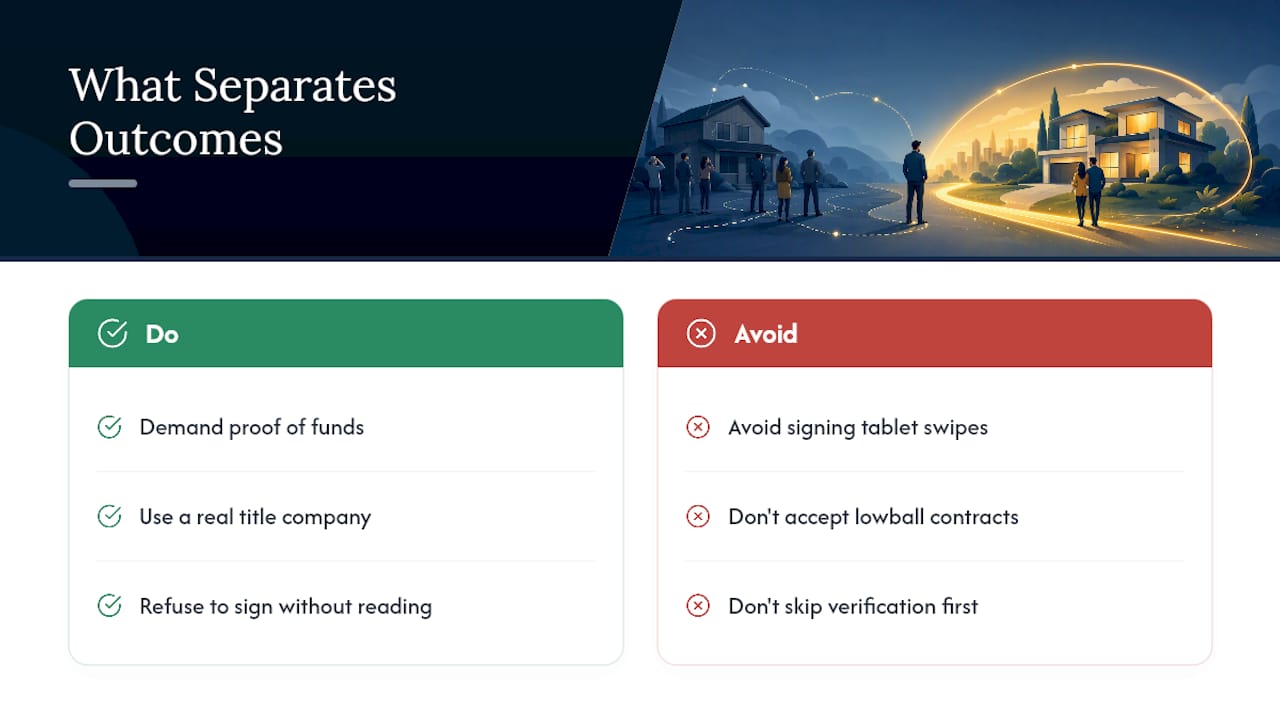
Not every story ends badly, and that’s worth saying plainly. ProPublica’s investigation into national “we buy ugly houses” franchises found aggressive and sometimes deceptive sales tactics at some locations, but it also found sellers who got fair, fast deals from the same broader network when they insisted on verification first. The pattern that separates the two outcomes isn’t luck. It’s whether the seller demanded proof of funds, used a real title company, and refused to sign anything without reading it first.
What Homeowners Consistently Get Wrong
Most advice about avoiding cash-buyer scams focuses on spotting the scammer. That’s backwards. The stronger habit is treating every unsolicited offer the same way, good or bad, and making the buyer prove themselves before you engage at all. A legitimate buyer never balks at a proof-of-funds request or a title company requirement. Only the bad actors get impatient when you ask questions.
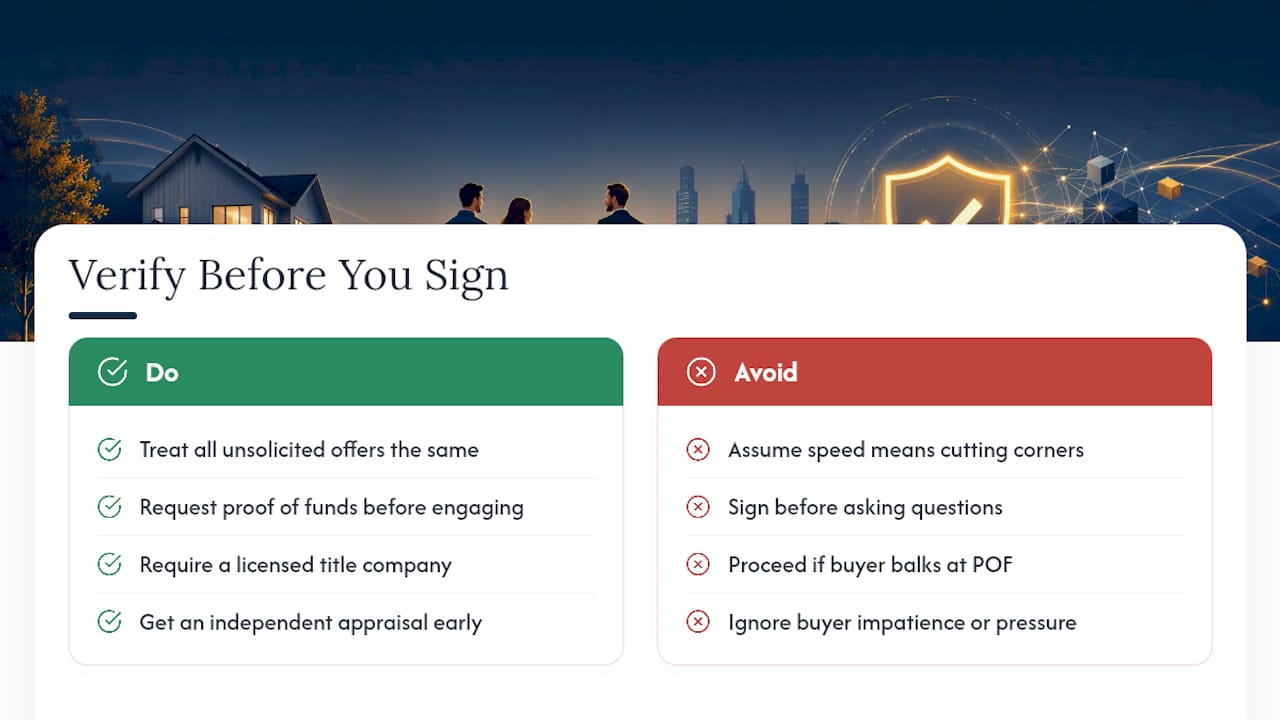
The other mistake I see constantly: sellers assume speed and safety are opposites, so they think a fast sale automatically means cutting corners. It doesn’t. AARP’s advocacy work pushing for licensing, appraisal requirements, and cancellation rights exists precisely because a fast sale and a protected one aren’t mutually exclusive. You can close in a week and still get an independent appraisal, still use a licensed title company, and still walk away with your equity intact.
If I had to boil this down to one priority, it’s this: verify before you sign, not after. Every horror story in this space traces back to a seller who signed first and asked questions later. Flip that order and most of these scams simply can’t work on you.
— Dave
Get A Verified Cash Offer From Rhody Home Buyer
If you’ve read this far, you already know what a safe cash sale should look like: no upfront fees, a fair offer grounded in your home’s After Repaired Value, and a closing date that works on your schedule instead of someone else’s countdown clock. That’s the entire model behind Rhody Home Buyer.

When you reach out, expect a straightforward conversation, not a script designed to rush you. We’ll ask about your property’s condition, walk you through how the offer is calculated, and explain the closing timeline before you commit to anything. There’s no obligation to accept, and no pressure tactics disguised as “limited time” deadlines. If you’re weighing a fast sale against the risks laid out above, request a no-pressure offer from Rhody Home Buyer and see the numbers for yourself before you decide anything.
This article is general information, not a substitute for advice from a qualified financial advisor. Consult a qualified financial professional about your own circumstances before acting on anything here.
Sources
- Fraud
- “We Buy Homes” Scams — NC Department of Justice
- Beware of ‘Let Us Buy Your Home’ Ads — AARP
- The ugly truth behind ‘we buy ugly houses’ — ProPublica
- I-team signature scam: one swipe nearly cost homeowner her house — KESQ